Red Rice Applications and B2B Buyer Sourcing Guide
Red Rice as a Specialty Food Ingredient
Understanding Red Rice
Red Rice is a specialty rice product distinguished by the reddish appearance associated with its bran layer. The term can describe rice varieties cultivated specifically for their natural red coloration, while in grain inspection terminology, red rice can also refer to whole or large broken rice kernels containing an appreciable amount of red bran. The USDA provides a specific definition and inspection methodology for identifying red rice in rice lots.
For B2B food manufacturers, the distinction between a cultivated red rice variety and red-bran rice identified during grain inspection is commercially important. Buyers need to establish the intended product identity, grain characteristics, processing level, origin, packaging format, and application before entering a supply agreement. These factors influence whether the material is purchased as a finished consumer-facing grain, an ingredient for further processing, or a raw material for specialized food formulations.
Red Rice can provide food manufacturers with an ingredient option that combines recognizable grain characteristics with distinctive visual and sensory attributes. Research on traditional rice varieties has highlighted differences in nutritional composition and bioactive compounds among rice types, although composition varies considerably according to cultivar, cultivation conditions, and processing.
From a commercial perspective, Red Rice therefore fits into the broader specialty-grain segment rather than being treated solely as a commodity rice specification. Suppliers serving international buyers need to communicate product characteristics accurately and consistently, allowing procurement teams to match the material with food-processing requirements, market positioning, and applicable regulatory standards.
Red Rice Applications Across the Food Industry
Rice-Based Food Products
One of the most direct applications for Red Rice is in rice-based foods where the grain itself remains an important part of the finished product. Depending on the variety and processing format, it can be supplied for cooking, prepared meals, grain mixes, specialty rice products, and other foods in which distinctive grain appearance can contribute to product differentiation. Rice is also used broadly as an ingredient in products including soups, breakfast cereals, and cookies.
Food manufacturers may incorporate Red Rice into products designed around whole grains, traditional varieties, specialty grains, or differentiated ingredient profiles. For industrial buyers, the commercial specification should address grain size, moisture, broken kernels, foreign material, milling condition, cleanliness, and other parameters relevant to the intended formulation. Consistency becomes especially important when the same ingredient must perform across repeated production batches.
The application potential extends beyond simply selling Red Rice as a cooked grain. Depending on processing capabilities, rice can be transformed into ingredients such as flour or other milled materials used in formulated foods. This creates opportunities for processors that can purchase grain in bulk and convert it into intermediate ingredients for food manufacturers, bakeries, snack producers, and specialty-food companies.
For suppliers, understanding the downstream application is essential because buyers do not necessarily purchase Red Rice under a single specification. A distributor supplying whole grain for retail food production may have different requirements from a processor purchasing material for milling, blending, or formulation. Application-led sourcing helps align technical specifications with the actual commercial purpose.
Nutritional and Product Attributes of Red Rice
Grain Characteristics and Composition
Red Rice attracts interest partly because specialty and traditional rice varieties can contain distinctive nutritional and bioactive profiles. A comprehensive review of traditional rice varieties reports differences in nutrients and bioactive compounds across varieties, while emphasizing that these properties depend on the particular rice cultivar and production conditions.
For B2B buyers, these attributes should be evaluated through product-specific documentation rather than generalized claims about all Red Rice. Cultivar, growing region, agricultural practices, milling, storage, and cooking or processing conditions can influence the characteristics of the final ingredient. Suppliers should therefore provide reliable technical information that allows manufacturers to determine suitability for their formulations.
Red Rice can also support product-development strategies focused on specialty grains and differentiated food ingredients. Recent research into functional and biofortified rice demonstrates continued interest in developing rice products with nutritional characteristics beyond conventional polished rice, including research involving resistant starch, proteins, micronutrients, and other functional traits.
However, commercial buyers should separate verified product specifications from broader nutritional positioning. Claims used on finished foods must comply with the regulations of the target market, while supplier documentation should accurately identify the actual material being offered. This approach helps procurement and regulatory teams evaluate Red Rice without relying on unsupported or overly broad health claims.
Key B2B Buyers of Red Rice
Food Manufacturers and Ingredient Processors
Food manufacturers represent an important buyer group for Red Rice because the ingredient can be incorporated into specialty grain foods and other formulated products. Manufacturers may purchase whole kernels for direct processing or source milled forms for use in recipes, depending on their production systems. Their purchasing decisions typically depend on product consistency, availability, technical specifications, packaging, and total delivered cost.
Ingredient processors can also use Red Rice as a raw material for further transformation. Milling companies, specialty-grain processors, and food-ingredient manufacturers may purchase larger volumes when developing rice flour, blends, meal components, or other intermediate ingredients. For these buyers, specifications concerning moisture, kernel condition, milling yield, foreign matter, and lot consistency can become particularly important.
Distributors and wholesalers form another significant segment of the B2B market. These companies may source Red Rice from producing regions and supply smaller food manufacturers, retailers, foodservice businesses, or regional ingredient buyers. Their requirements can include flexible packaging formats, reliable shipment schedules, documentation, palletization, and the ability to maintain consistent supply across multiple orders.
Procurement teams increasingly evaluate suppliers beyond the quoted product price. Origin transparency, quality-control procedures, export documentation, packaging integrity, lead times, minimum order quantities, and logistics capabilities can all influence sourcing decisions. A supplier capable of presenting clear technical and commercial information can make qualification and purchasing processes more efficient.
Quality and Specification Considerations
Product Quality for Industrial Buyers
Quality assessment is a central part of Red Rice procurement because the term itself can cover different commercial contexts. Buyers should establish whether the product is a dedicated red rice cultivar or rice classified according to red-bran characteristics. USDA inspection guidance demonstrates that red rice can be identified using specific kernel and bran characteristics, illustrating why precise product definitions matter during procurement.
Typical commercial discussions may cover grain variety, origin, crop year, moisture, broken kernels, damaged kernels, foreign matter, milling condition, cleanliness, and packaging. Depending on the destination market and intended application, buyers may also require documentation covering contaminants, pesticide residues, microbiological parameters, and other food-safety criteria. The Codex Standard for Rice provides an international reference framework for rice quality and related requirements.
Sampling and inspection procedures should be aligned with the agreed specification rather than relying only on visual appearance. For larger B2B contracts, buyers may request certificates of analysis, product specifications, certificates of origin, inspection documents, and other supporting records. Consistent documentation can help procurement teams compare offers from different suppliers on a more equivalent technical basis.
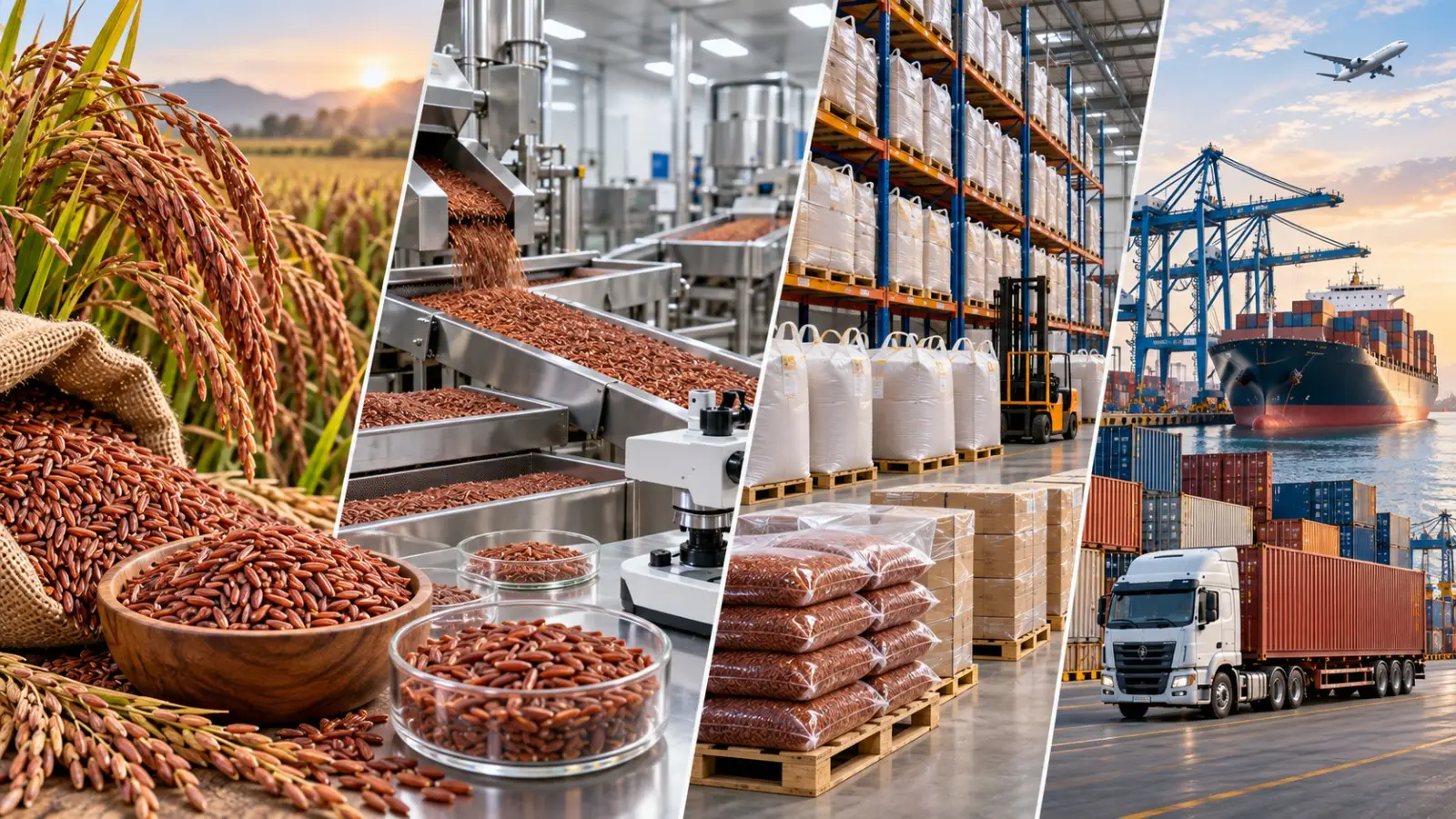
Packaging is another practical consideration. Depending on the supply model, Red Rice may be shipped in food-grade bags, bulk packaging, or other formats suitable for storage and transportation. Export buyers should assess packaging strength, labeling, palletization, container utilization, storage conditions, and shelf-life expectations as part of the complete procurement specification.
Red Rice Sourcing and Supply Requirements
Building a Reliable Procurement Model
Red Rice sourcing begins with defining the precise product requirement. A buyer should identify the desired variety or commercial grade, grain form, processing level, origin requirements, packaging, annual or monthly volume, target destination, and quality parameters. Clear specifications reduce the possibility of receiving a product that technically qualifies as rice but does not meet the buyer's intended application.
International sourcing also requires attention to the regulatory requirements of the destination market. Codex maintains a specific international Standard for Rice, while individual countries can impose additional food-safety, labeling, contaminant, pesticide-residue, or import requirements.
Supplier qualification should therefore consider more than production capacity. Procurement teams can evaluate the supplier's ability to maintain lot-to-lot consistency, provide appropriate documentation, meet agreed specifications, protect the product during transportation, and coordinate export logistics. These factors are particularly relevant when Red Rice is used as a recurring ingredient in commercial food production.
A B2B marketplace can support this process by connecting buyers with suppliers while making product information easier to compare. For manufacturers and distributors, the objective is not simply to identify a Red Rice seller, but to establish a sourcing relationship capable of supporting specification compliance, predictable delivery, appropriate documentation, and long-term purchasing requirements.
Market Opportunities for Red Rice Suppliers
Specialty Grain Demand and Product Differentiation
Red Rice suppliers can address several commercial opportunities within the specialty-grain market. Consumer and food-industry interest in traditional and differentiated rice varieties creates potential for suppliers that can provide clearly identified products with consistent quality and traceable sourcing. Scientific literature also documents continuing interest in traditional and functional rice varieties and their nutritional characteristics.
Product differentiation can be particularly relevant for food manufacturers developing specialty rice meals, grain blends, breakfast products, bakery ingredients, and other foods that use rice as a core or supporting ingredient. In these applications, the visual characteristics and identity of the grain can become part of the product proposition, provided that all marketing and labeling claims comply with applicable regulations.
Suppliers can also create value through processing capabilities. Offering cleaned, graded, milled, or otherwise application-specific Red Rice products may allow suppliers to address different buyer requirements rather than competing exclusively on raw-grain pricing. Technical documentation, sample availability, packaging flexibility, and dependable export execution can further support supplier qualification.
For international B2B trade, market opportunity is closely connected to reliability. A buyer may require regular shipments rather than a one-time transaction, making production planning, inventory management, quality assurance, and logistics coordination essential components of the commercial relationship. Suppliers that understand these requirements can position Red Rice more effectively within professional ingredient-sourcing channels.
Conclusion: Building Reliable Red Rice Supply
Connecting Applications With Buyer Requirements
Red Rice offers a specialty-grain opportunity for food manufacturers, processors, distributors, wholesalers, and other B2B buyers seeking differentiated rice ingredients. Its applications can range from whole-grain food products to processed and formulated ingredients, with the appropriate specification depending on the intended end use. The diversity of rice applications makes application-specific sourcing an important part of commercial procurement.
For buyers, successful sourcing depends on clearly defining product identity, quality parameters, processing requirements, packaging, documentation, and delivery expectations. International standards such as the Codex Standard for Rice provide an important reference point, while destination-market regulations and buyer-specific specifications remain essential to commercial qualification.
For suppliers, the opportunity lies in connecting reliable agricultural and processing capabilities with the precise requirements of downstream customers. Consistent quality, transparent specifications, suitable packaging, documentation, and dependable logistics can help establish confidence among procurement teams evaluating Red Rice for recurring commercial use.
Tradeasia / Chemtradeasia / Tradechem Marketplace can serve as a B2B sourcing environment for buyers and suppliers seeking to connect around food ingredients and agricultural commodities. For Red Rice, a commercially effective sourcing strategy begins with matching the product's characteristics to the buyer's application and then building a supply arrangement around measurable quality and delivery requirements
Sources
https://www.fao.org
https://www.ams.usda.gov
https://www.fao.org
Leave a Comment