Red Rice Market: Applications, Buyers and Sourcing Opportunities
Red Rice in the Specialty Grain Market
Understanding Red Rice as a Commercial Grain
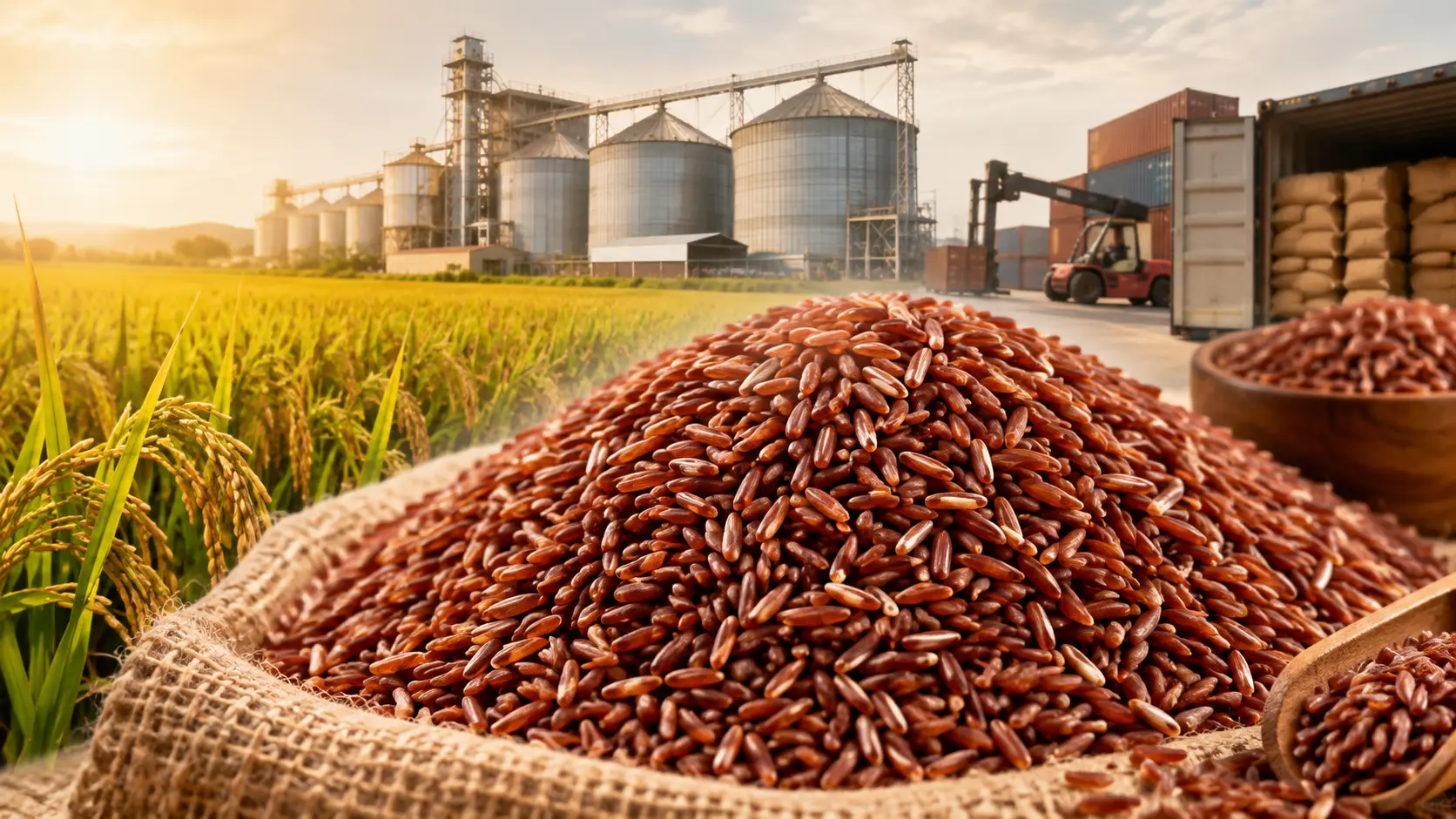
Red Rice occupies a distinctive position within the broader rice category because its naturally colored bran gives it a different visual and culinary profile from conventional white rice. For B2B buyers, this distinction creates opportunities in specialty foods, premium grain products, whole-grain formulations and differentiated retail offerings. The commercial value of Red Rice therefore extends beyond its role as a staple grain and into product positioning where appearance, grain identity and ingredient differentiation matter.
The global rice market provides an important backdrop for Red Rice procurement. FAO forecasts world rice utilization at 558.2 million tonnes in 2026/27, representing continued expansion driven largely by population-related food demand. This broader market scale supports an extensive international ecosystem of growers, processors, exporters, importers and distributors, while specialty varieties such as Red Rice can serve more targeted market segments.
For procurement teams, Red Rice should be evaluated as a specialty agricultural commodity rather than treated as a completely interchangeable rice grade. Variety, cultivation origin, milling condition, grain characteristics and intended application can influence purchasing requirements. This makes supplier qualification particularly important when a food manufacturer needs consistent material for a defined product specification.
The commercial opportunity is also linked to consumer interest in visibly differentiated grains. USDA Agricultural Research Service research has highlighted red and purple rice varieties as colorful grain options with potential to open new market areas for growers. Research on whole-grain rice has also identified higher concentrations of certain phenolic and flavonoid compounds in red and purple rice bran compared with lighter-colored bran, supporting interest in differentiated whole-grain products.
Key Food and Ingredient Applications
Food Manufacturing and Specialty Grain Products
Red Rice can be incorporated directly into prepared foods where its distinctive color and grain identity contribute to product differentiation. Food processors may use it in specialty rice meals, grain blends, ready-to-cook products, premium side dishes and other formulations where visual appearance is part of the consumer proposition. Its application profile makes it relevant to manufacturers seeking alternatives to conventional rice ingredients.
Another opportunity exists in whole-grain and health-oriented food positioning. Red Rice can support product concepts centered on naturally colored grains, diversified grain consumption and premium ingredient sourcing. However, responsible B2B communication should distinguish between nutritional research and specific health claims; the presence of naturally occurring compounds does not by itself establish a medical benefit for a finished product.
Red Rice may also be relevant to food developers working with flour, flakes, milled grain or other processed rice formats, depending on the characteristics of the supplied variety. Processing requirements should be established before purchasing because milling behavior, particle characteristics and cooking performance can vary between rice types. USDA research has demonstrated that red rice accessions can differ in physical, milling, pasting and thermal properties, reinforcing the importance of application-specific qualification.
For ingredient distributors, the key commercial advantage is flexibility. A qualified Red Rice supply can potentially serve multiple food categories while allowing buyers to develop differentiated products around grain color and specialty positioning. Suppliers that provide clear specifications, consistent lots and reliable documentation can therefore become more valuable partners than vendors competing solely on commodity price.
Demand Drivers and Market Outlook
Specialty Grain Demand
The outlook for Red Rice is closely connected to developments in the wider rice market. USDA's August 2026 Rice Outlook indicates that U.S. all-rice supply for 2026/27 was projected at 262.0 million hundredweight, while the season-average farm price was forecast at $14.90 per hundredweight, up from $12.50 in 2025/26. Although these figures describe the broader U.S. rice market rather than Red Rice specifically, they illustrate how supply conditions can influence procurement economics across rice categories.
International trade is another important demand indicator. USDA projected global rice trade at a record 62.8 million tons on a milled basis for calendar year 2026 in its January outlook, reflecting substantial international movement of rice and continued participation by major exporters and importing markets. For specialty rice buyers, this broad trading infrastructure can support access to international sourcing channels while also exposing procurement teams to freight, currency and regional supply considerations.
Red Rice itself should not be assigned a universal market price simply by referencing conventional rice benchmarks. Specialty varieties may command different commercial values according to origin, grade, processing status, certification, packaging, order size and availability. Consequently, buyers seeking a reliable cost model should request supplier quotations against a clearly defined specification instead of relying on generic rice price assumptions.
From a market-development perspective, the strongest opportunity lies in applications where differentiation can justify specialty sourcing. Food brands, specialty grain distributors and processors can use Red Rice as a product-development ingredient, while importers and wholesalers can target markets where consumers and manufacturers are seeking distinctive rice varieties. This creates a more application-led procurement model than a purely commodity-driven one.
Commercial Buyers of Red Rice
Food Manufacturers and Processors
Food manufacturers represent a core buyer group for Red Rice because they can transform a specialty grain into higher-value finished products. Potential users include manufacturers of packaged rice meals, grain blends, specialty foods, premium retail products and other grain-based formulations. Their purchasing priorities generally extend beyond price to include consistent quality, reliable delivery and suitability for the intended processing method.
Ingredient distributors are another important buyer segment. Distributors can purchase Red Rice in commercial quantities and supply smaller food manufacturers, retailers, foodservice operators and specialty product developers. For these businesses, supplier reliability and documentation can be especially important because the distributor must maintain predictable inventory while serving multiple downstream customers.
Retail-oriented buyers may also seek Red Rice for private-label and premium packaged food programs. In such cases, appearance, packaging format, country of origin, labeling requirements and batch consistency can become central procurement considerations. A supplier capable of supporting different order structures can potentially address both established distribution networks and emerging specialty-food brands.
Procurement teams should therefore define the intended end use before requesting quotations. A buyer purchasing whole Red Rice for retail distribution may require different specifications from a processor purchasing grain for milling or further formulation. Establishing the application, required quantity, packaging, delivery destination and quality parameters at the quotation stage can reduce unnecessary supplier comparisons and improve purchasing efficiency.
Quality and Sourcing Considerations
Specification and Product Consistency
Quality assessment is essential when sourcing Red Rice because the term describes a category of pigmented rice rather than a single universally standardized commercial specification. Buyers should establish expectations for grain form, moisture, foreign matter, broken kernels, milling condition, appearance and other relevant parameters according to the intended application. These requirements should be agreed before shipment rather than inferred from product naming alone.
Processing characteristics can also influence suitability. USDA research on red rice has found variation in kernel properties and physicochemical behavior among accessions, including differences relevant to milling, pasting and thermal performance. This means that two Red Rice products that appear commercially similar may not necessarily behave identically during food processing.
Documentation should form part of supplier qualification. Depending on the destination market and application, buyers may need specifications, certificates of analysis, origin documentation, food-safety information, packaging details and other compliance records. Importers should additionally verify applicable requirements in the destination country before committing to a commercial shipment.
Consistency is ultimately one of the most important characteristics for repeat buyers. A food manufacturer can face reformulation, production disruption or customer dissatisfaction if successive lots behave differently. Long-term sourcing therefore benefits from approved specifications, retained samples where appropriate, agreed tolerances and communication between supplier quality teams and procurement departments.
B2B Supply Chain and Procurement Strategy
From Origin to Industrial Buyer
The Red Rice supply chain typically connects agricultural production with collection, processing, milling, quality control, packaging, export or domestic distribution and final industrial or commercial buyers. Each stage can influence cost and product condition. For international procurement, transportation distance, port availability, container costs, customs procedures and destination requirements can become significant components of the landed cost.
Supplier selection should therefore consider total procurement value rather than headline quotation price alone. A lower unit price may become less competitive if shipment reliability, documentation quality or product consistency is weak. Conversely, a supplier with stronger quality systems and dependable logistics may provide better overall value even where the initial quotation is higher.
Order planning is particularly important for specialty grains because availability can be more limited than for major commodity rice categories. Buyers with predictable consumption can benefit from forward planning, while distributors may need inventory strategies that balance customer demand against storage costs and shelf-life considerations. Forecast visibility can also help suppliers plan production and shipment schedules more effectively.
A B2B marketplace can simplify this process by connecting buyers with qualified suppliers and allowing procurement teams to compare commercial terms, specifications and supply capabilities. For international buyers, a platform such as Tradeasia, Chemtradeasia or Tradechem Marketplace can support supplier discovery while keeping the procurement discussion focused on application, specification, volume and delivery requirements.
Market Opportunities for Suppliers and Distributors
Building Differentiation Through Applications
Suppliers can strengthen their Red Rice proposition by selling according to application rather than simply presenting the product as another rice commodity. Positioning around specialty food manufacturing, premium grain products, whole-grain formulations and differentiated retail offerings can help buyers understand where the ingredient creates commercial value.
Distributors can also create opportunities by developing customer segments around specific applications. Instead of targeting only general rice importers, they can approach specialty food manufacturers, private-label producers, premium grocery suppliers and ingredient businesses. This application-led approach can improve customer qualification and reduce direct competition based solely on price.
Market intelligence should remain part of the supplier strategy. USDA's continuing Rice Outlook series demonstrates that rice supply, trade, imports, exports and prices can change with production conditions and international demand. In August 2026, for example, USDA reported revisions to U.S. supply and projected ending stocks, illustrating why procurement and sales teams should monitor market developments rather than rely on static assumptions.
For suppliers operating internationally, commercial success will increasingly depend on combining product availability with responsive documentation, logistics coordination and application knowledge. A buyer looking for Red Rice is often not simply purchasing grain; the buyer is securing a reliable ingredient for a finished-product strategy. Suppliers that understand this broader requirement can build stronger and more durable B2B relationships.
Conclusion: Building Reliable Red Rice Supply
Turning Specialty Grain Demand into B2B Opportunity
Red Rice provides a differentiated opportunity within the global rice and specialty food markets. Its naturally distinctive appearance, potential use in whole-grain and premium food concepts, and relevance to specialty product development make it attractive to food manufacturers, distributors, retailers and ingredient procurement teams. The broader rice market also remains substantial, with FAO forecasting continued growth in global rice utilization for 2026/27.
For buyers, successful sourcing begins with a clear specification and application. Procurement teams should assess variety, processing condition, quality parameters, documentation, order volume, packaging and logistics before comparing suppliers. This approach can help distinguish a dependable commercial source from a quotation that appears attractive only on initial price.
For suppliers and distributors, the opportunity lies in communicating Red Rice as an application-driven specialty ingredient rather than a generic commodity. Understanding customer requirements, maintaining consistent quality and supporting international documentation can help unlock opportunities across food manufacturing, specialty retail and ingredient distribution.
Tradeasia International can support B2B buyers seeking a structured route to international ingredient and commodity sourcing by connecting commercial requirements with supplier capabilities. For organizations evaluating Red Rice for food applications, bulk distribution or specialty product development, a specification-led sourcing process provides a practical foundation for building reliable supply relationships.
Sources
www.fao.org
www.ers.usda.gov
www.fao.org

Leave a Comment