Understanding L-Valine and Its Industrial Importance
L-Valine is one of the essential branched-chain amino acids (BCAAs) required for protein synthesis, tissue development, and metabolic functions in animals and humans. Since animals cannot synthesize sufficient amounts of this amino acid on their own, commercial supplementation has become an important component of modern feed formulations. According to the Food and Agriculture Organization (FAO), amino acid optimization is increasingly recognized as an effective strategy for improving feed efficiency while reducing nitrogen emissions from livestock production.
The Role of L-Valine in Modern Nutrition
The industrial production of L-Valine primarily relies on microbial fermentation technologies, allowing manufacturers to achieve consistent quality while supporting sustainable manufacturing practices. Continuous advances in biotechnology have improved production yields, making high-purity L-Valine more accessible for global commercial markets.
Feed manufacturers use L-Valine to balance amino acid profiles in poultry, swine, aquaculture, and pet food formulations. Proper amino acid supplementation supports efficient growth, muscle development, and feed conversion, particularly when protein levels in feed are reduced to improve sustainability and cost efficiency.
Beyond animal nutrition, food manufacturers incorporate L-Valine into specialized nutritional products, dietary supplements, and functional food formulations where balanced amino acid profiles are important. Technical information published by the European Food Safety Authority (EFSA) supports the safe use of amino acids under established nutritional guidelines.
Key Applications of L-Valine Across Industries
The versatility of L-Valine has enabled its adoption across several industrial sectors where nutritional performance and product consistency are critical. Growing demand for precision nutrition continues to expand commercial opportunities for manufacturers and ingredient suppliers worldwide. According to the International Feed Industry Federation (IFIF), amino acid supplementation remains a key innovation supporting efficient livestock production.
Feed, Food, and Biotechnology Applications
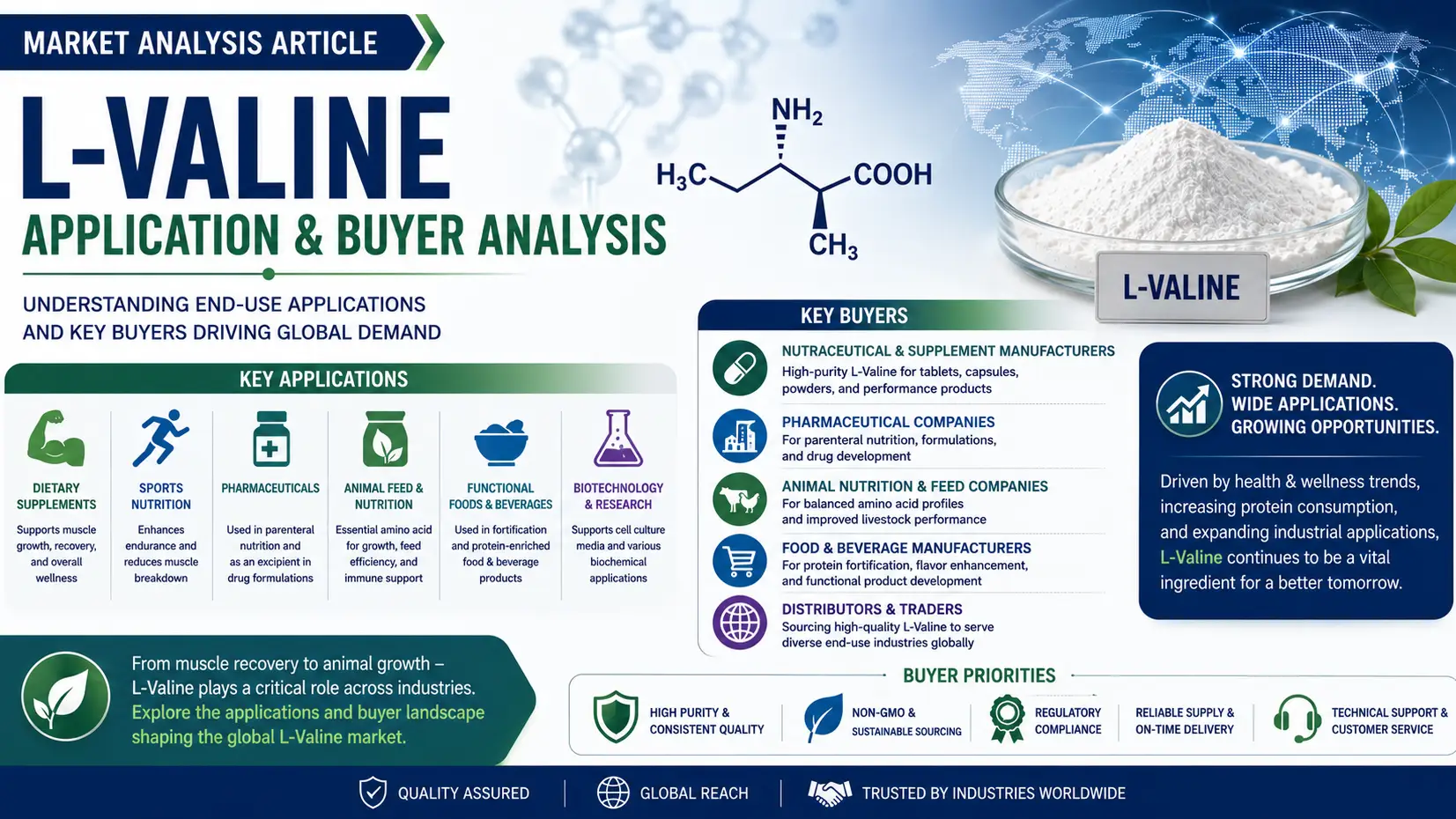
Animal feed remains the largest application segment for L-Valine. Poultry producers utilize the amino acid to optimize feed formulations for broilers and laying hens, while swine nutrition programs rely on balanced amino acid supplementation to improve growth performance and feed utilization.
Food manufacturers use food-grade L-Valine in nutritional beverages, protein supplements, medical nutrition products, and sports nutrition formulations. As consumer demand for high-protein and functional foods continues to grow, ingredient manufacturers increasingly incorporate essential amino acids into product development.
Biotechnology companies also utilize L-Valine during microbial fermentation research, metabolic engineering projects, and biochemical production processes. Continuous investment in biotechnology has created additional commercial demand beyond traditional feed markets.
Growing interest in sustainable livestock production has further increased the adoption of amino acid supplementation, helping producers reduce crude protein levels while maintaining animal performance and minimizing environmental impacts.
Market Trends Driving Global L-Valine Demand
Global demand for L-Valine continues to rise as livestock production expands and nutrition standards become increasingly sophisticated. Market analysis published by organizations such as the Organisation for Economic Co-operation and Development (OECD) and the FAO Agricultural Outlook indicates that increasing consumption of animal protein will continue driving investment in feed efficiency technologies over the coming decade.
Expanding Demand Across International Markets
Asia-Pacific remains the largest regional market for L-Valine due to its substantial poultry, swine, and aquaculture industries. Countries including China, India, Vietnam, and Indonesia continue investing in commercial livestock production, creating steady demand for feed-grade amino acids.
North America and Europe maintain stable consumption supported by advanced feed manufacturing industries, strict nutritional regulations, and growing interest in sustainable production practices. Higher awareness of feed optimization has encouraged producers to adopt precision amino acid supplementation.
Emerging markets across Latin America, the Middle East, and Africa are also experiencing increased adoption as commercial farming operations modernize. Improvements in feed formulation technologies and expanding livestock sectors continue to create new sourcing opportunities for international suppliers.
According to industry observations from the FAO and IFIF, procurement teams increasingly prioritize suppliers capable of offering consistent product quality, regulatory compliance, reliable logistics, and technical support alongside competitive pricing.
Buyer Intent and Procurement Considerations
As global demand for high-performance animal nutrition continues to increase, procurement professionals are placing greater emphasis on sourcing amino acids that deliver consistent quality, regulatory compliance, and reliable supply. L-Valine has become a strategic ingredient for feed manufacturers seeking to optimize feed formulations while improving production efficiency. According to the Food and Agriculture Organization (FAO) and the International Feed Industry Federation (IFIF), precision nutrition and amino acid balancing are among the leading trends shaping the future of commercial livestock production.
Who Buys L-Valine and What Procurement Teams Evaluate
L-Valine is commonly purchased by animal feed manufacturers, premix producers, feed additive companies, aquaculture nutrition specialists, pet food manufacturers, food ingredient companies, pharmaceutical manufacturers, biotechnology firms, and chemical distributors. These organizations require dependable supply partners capable of supporting both routine production and long-term procurement strategies.
Before selecting a supplier, procurement teams typically assess product purity, manufacturing process, feed or food grade certification, compliance with international quality standards, packaging options, shelf life, technical documentation, and logistics capabilities. Buyers also evaluate production consistency, traceability, and supplier responsiveness, particularly for international shipments where uninterrupted supply is essential.
Supplier comparison has become increasingly important as businesses seek to minimize operational risks and maintain cost-effective sourcing. Factors such as production capacity, export experience, global distribution networks, inventory availability, and after-sales technical support often influence purchasing decisions as much as pricing. Industry guidance from the European Food Safety Authority (EFSA) highlights the importance of quality assurance and regulatory compliance for amino acid ingredients used in feed and food applications.
A comprehensive product page enables buyers to compare technical specifications, application suitability, packaging formats, certifications, and supply capabilities before initiating procurement discussions. Access to transparent product information helps procurement teams make faster and more informed sourcing decisions while reducing supply chain uncertainty.
Choosing Reliable L-Valine Suppliers
Selecting a reliable L-Valine supplier extends beyond evaluating product cost. In today's global chemical and feed ingredient market, buyers increasingly seek strategic partners that can provide stable supply, technical expertise, and international logistics support. According to market observations published by the Organisation for Economic Co-operation and Development (OECD), resilient supply chains have become a critical competitive advantage for manufacturers and distributors.
Building Long-Term Supply Partnerships
Experienced suppliers maintain strong relationships with certified manufacturers, enabling them to deliver consistent product quality across multiple production batches. This consistency is especially valuable for feed producers that require precise amino acid formulations to maintain nutritional performance and product uniformity.
Global sourcing capabilities are another important consideration. Suppliers with established export operations, documentation expertise, and diversified logistics networks can reduce delivery risks while supporting customers in multiple geographic regions. Flexible packaging options and responsive customer service further enhance procurement efficiency for buyers managing international supply chains.
Technical support also differentiates leading suppliers from commodity traders. Access to product specifications, Certificates of Analysis (COA), Safety Data Sheets (SDS), and regulatory documentation enables customers to satisfy quality assurance requirements and streamline internal approval processes.
Companies such as Tradeasia, Chemtradeasia, and Tradechem Marketplace help connect global buyers with qualified manufacturers and distributors through comprehensive sourcing solutions. By offering transparent product information, international trade expertise, and reliable supply networks, these platforms simplify procurement for organizations operating across the feed, food, and biotechnology industries.
Conclusion
L-Valine continues to play an increasingly important role in modern animal nutrition, food manufacturing, and biotechnology. As demand for efficient feed formulations and sustainable production practices grows, the amino acid has become an essential ingredient for manufacturers seeking to improve nutritional performance while optimizing production costs. Ongoing investments in biotechnology and precision nutrition are expected to further strengthen global demand in the years ahead.
For procurement professionals, successful sourcing depends on selecting suppliers that offer consistent quality, regulatory compliance, dependable logistics, and technical support. Evaluating these factors alongside pricing enables buyers to establish resilient supply chains that support long-term business growth.
Tradeasia, Chemtradeasia, and Tradechem Marketplace provide global sourcing solutions for L-Valine by connecting businesses with trusted manufacturers and international distribution networks. Their expertise in chemical trading, documentation, and logistics helps simplify procurement for buyers across the feed, food, and biotechnology sectors, making them valuable partners in an increasingly competitive global marketplace.
Sources
https://www.fao.org
https://www.efsa.europa.eu

Leave a Comment