Global L-Valine Market 2026: Applications, Buyers, Production & Trade Dynamics Across Industries
Introduction: L-Valine as a Platform Amino Acid Chemical
The global L-valine market in 2026 continues to strengthen its position as a critical branched-chain amino acid (BCAA) widely used in feed, pharmaceuticals, and nutritional formulations. As a platform chemical derived primarily through microbial fermentation, L-valine plays a strategic role in protein synthesis enhancement and metabolic regulation. Market expansion is underpinned by a projected CAGR of 6.8%, reflecting steady downstream demand and improved biotechnological production efficiency. Average global pricing has stabilized within USD 6,200–8,500/MT, while total production capacity is estimated at approximately 95,000 MT annually, driven by Asia-Pacific dominance.
Industrial Feed Applications Driving Bulk Consumption
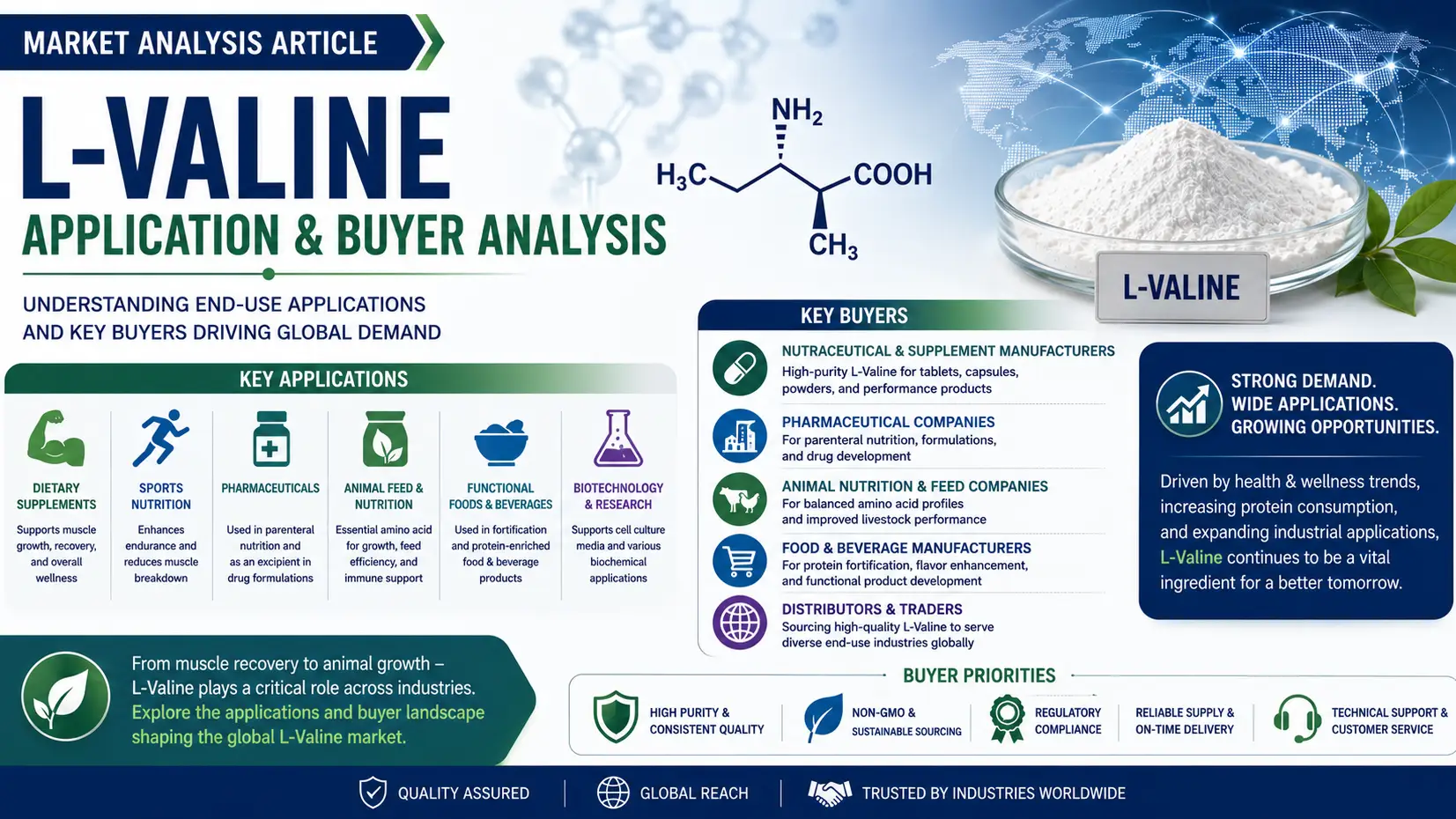
Animal nutrition remains the largest consumption channel, accounting for over half of global L-valine demand. Swine and poultry feed formulations increasingly integrate L-valine to optimize amino acid balance and reduce crude protein usage. Feed-grade adoption is expanding rapidly in China, Brazil, and Southeast Asia, where intensive livestock production supports volume demand. Feed mill buyers prioritize cost efficiency and consistent purity levels, making fermentation-grade L-valine a preferred ingredient in compound feed premixes.
Pharmaceutical and Nutritional Buyer Landscape
The pharmaceutical sector represents a high-value buyer segment, leveraging L-valine in intravenous nutrition, recovery therapies, and metabolic disorder treatments. Hospitals and clinical nutrition providers are shifting toward amino acid-based formulations, particularly in post-surgical care. Meanwhile, nutraceutical manufacturers incorporate L-valine in sports nutrition blends targeting muscle recovery and endurance performance. This premium segment supports higher margins, with pharma-grade material often exceeding USD 9,000/MT depending on purity specifications.
Fermentation Capacity, Pricing Trends, and Trade Flow Dynamics
Global supply is heavily concentrated in China, which accounts for more than 65% of fermentation-based production. Economies of scale and improved microbial strains have reduced production costs, stabilizing prices despite volatile corn and glucose feedstock markets. Export flows are expanding toward Europe and North America, where dependency on imports remains high. Strategic procurement contracts dominate buyer behavior, with long-term pricing agreements mitigating raw material fluctuations.
Strategic Outlook and Value Chain Consolidation
Looking forward, L-valine’s value chain is expected to consolidate further as producers invest in integrated fermentation complexes and downstream blending facilities. Sustainability pressures are also encouraging low-carbon production pathways, improving competitiveness in regulated markets. In this evolving environment, global distributors and procurement partners play a key role in ensuring supply continuity. Companies such as Tradeasia International continue to support industrial buyers with reliable sourcing, flexible logistics solutions, and cross-regional chemical distribution expertise, enabling seamless access to L-valine across major consumption hubs.
Conclusion
The L-valine market in 2026 reflects a balanced intersection of industrial scale feed demand and high-value pharmaceutical applications. With stable pricing, expanding fermentation capacity, and diversified end-user adoption, the amino acid is positioned for sustained mid-term growth. Strategic procurement and supply chain integration will remain decisive for global competitiveness in this evolving biochemical landscape.
Sources
Leave a Comment