Introduction to Calcium Carbonate Feed Grade
Calcium Carbonate Feed Grade has become one of the most widely utilized mineral ingredients in the global animal nutrition industry. As livestock production continues to increase to meet rising protein consumption, feed manufacturers seek reliable mineral additives that improve animal health while maintaining cost-effective formulations. Calcium Carbonate Feed Grade fulfills this requirement by providing a consistent source of calcium for a broad range of feed applications.
The Role of a Fundamental Feed Mineral
Calcium is an essential macronutrient supporting skeletal development, eggshell formation, muscle function, and metabolic processes in animals. Feed-grade calcium carbonate is carefully processed to meet feed safety standards, ensuring controlled particle size, purity, and mineral composition suitable for commercial feed production.
According to the Food and Agriculture Organization (FAO), balanced mineral nutrition significantly improves livestock productivity, reproductive performance, and feed efficiency. These findings continue to support widespread adoption of calcium-rich feed additives throughout commercial farming systems.
As feed formulations become increasingly specialized, Calcium Carbonate Feed Grade remains a foundational ingredient for nutritionists seeking reliable mineral supplementation across poultry, dairy, swine, beef cattle, and aquaculture production.
Why Calcium Carbonate Feed Grade Is Essential in Animal Nutrition
Modern feed manufacturers formulate diets that maximize productivity while maintaining animal welfare and regulatory compliance. Calcium Carbonate Feed Grade plays a vital role by supplying bioavailable calcium needed throughout every stage of animal growth and production.
Supporting Animal Health and Feed Performance
In poultry nutrition, adequate calcium levels contribute directly to eggshell strength and laying performance. Dairy cattle require sufficient calcium to support milk production and reduce metabolic disorders associated with lactation. Swine and beef operations also depend on balanced mineral nutrition to promote skeletal development and efficient weight gain.
Technical guidance published by the National Research Council (NRC) and supported by animal nutrition research indicates that calcium requirements vary by species, production stage, and dietary composition. Feed manufacturers therefore carefully adjust inclusion rates to achieve nutritional balance while avoiding mineral antagonism.
The growing emphasis on precision nutrition has further increased demand for consistent-quality feed minerals. Reliable Calcium Carbonate Feed Grade enables feed formulators to produce standardized products that meet both commercial performance goals and regulatory expectations across international markets.
Applications Across Livestock, Poultry, and Aquaculture
The versatility of Calcium Carbonate Feed Grade makes it suitable for numerous feed formulations serving different animal species. Its widespread compatibility with vitamins, amino acids, and trace minerals allows manufacturers to incorporate it into complete feed, premixes, and mineral concentrates.
Expanding Use Across Commercial Feed Segments
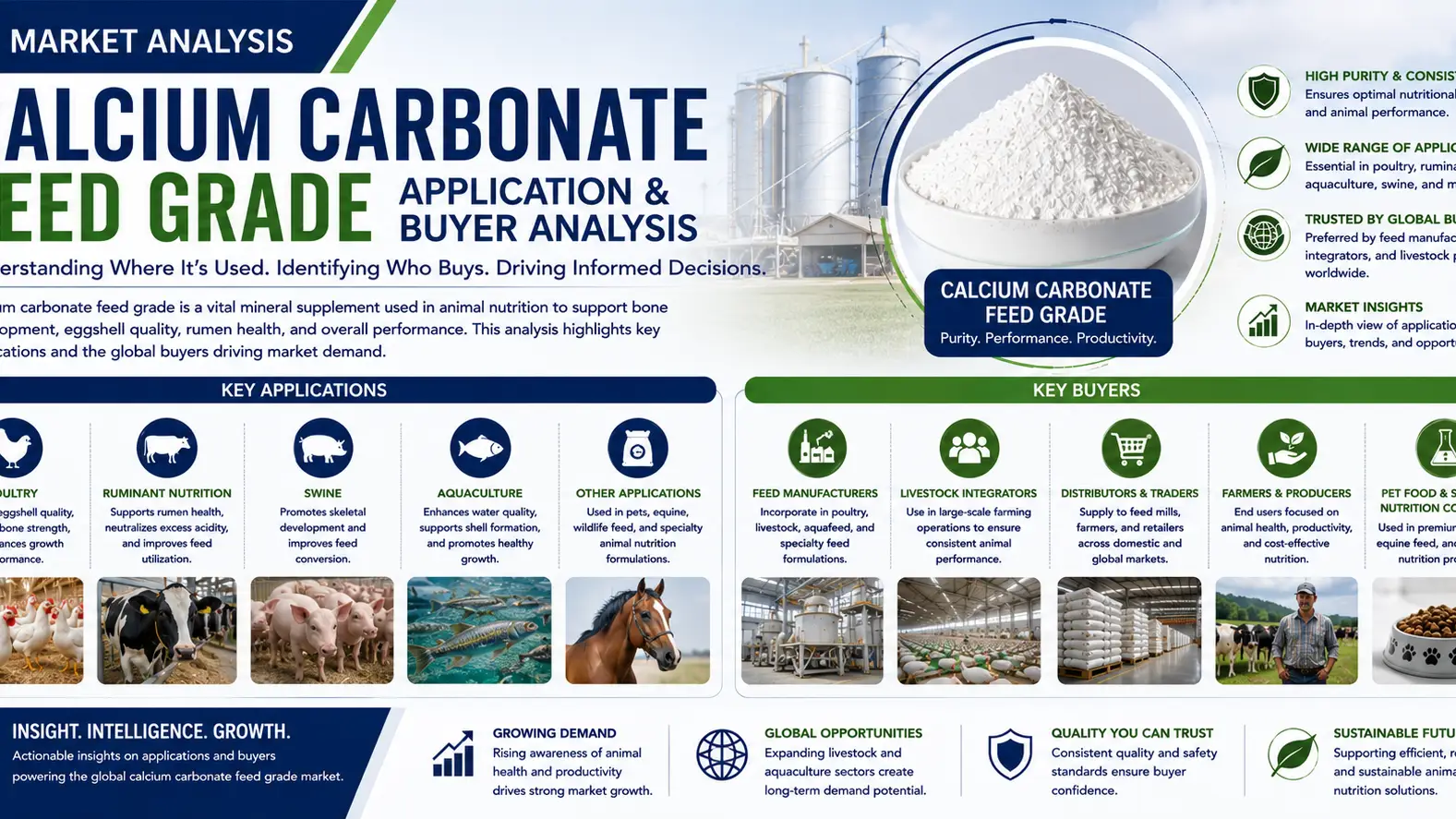
Poultry producers rely heavily on calcium supplementation to improve shell quality and support rapid growth. Dairy and beef cattle benefit from optimized calcium intake during growth, reproduction, and milk production cycles. Swine producers incorporate calcium carbonate to strengthen bone development while supporting efficient feed conversion. In aquaculture, calcium supplementation contributes to healthy skeletal development and physiological functions in fish and shrimp, particularly in intensive farming systems.
Industry analysis from organizations such as the International Feed Industry Federation (IFIF) highlights continued expansion of compound feed production worldwide, driven by rising meat, dairy, and seafood consumption. This trend directly supports increasing demand for dependable mineral ingredients such as Calcium Carbonate Feed Grade.
As livestock operations adopt more advanced nutritional strategies, the product continues to serve as an economical, effective, and scalable solution for commercial feed manufacturers, premix producers, and integrated farming enterprises worldwide.
Market Trends Influencing Feed Ingredient Demand
Global demand for high-quality animal protein continues to reshape the feed industry, encouraging manufacturers to invest in nutritionally balanced formulations. Calcium Carbonate Feed Grade remains a key ingredient because it offers a cost-effective and dependable source of calcium that supports animal performance while helping feed producers maintain formulation consistency.
Growth Drivers Across Global Feed Markets
The expansion of commercial poultry, dairy, swine, and aquaculture production has increased the need for standardized mineral ingredients. Producers are also adopting precision nutrition practices that optimize feed efficiency, improve animal welfare, and reduce production costs. These developments have elevated the importance of feed-grade calcium sources that meet strict quality and regulatory requirements.
According to the Food and Agriculture Organization (FAO), global livestock production is expected to continue growing alongside rising demand for meat, milk, and aquatic products, placing greater emphasis on efficient feed ingredient utilization. Industry data published by the International Feed Industry Federation (IFIF) also highlights sustained growth in compound feed production, reinforcing the long-term demand for essential mineral additives such as Calcium Carbonate Feed Grade.
As manufacturers expand production capacity and distributors strengthen regional supply chains, Calcium Carbonate Feed Grade is expected to remain a strategic ingredient for feed producers seeking reliable, scalable, and cost-efficient mineral supplementation.
Buyer Intent and Procurement Considerations
Commercial buyers of Calcium Carbonate Feed Grade typically evaluate suppliers based on product consistency, regulatory compliance, technical specifications, and supply reliability. Since mineral ingredients directly influence feed quality, procurement teams prioritize suppliers capable of delivering uniform particle size, stable calcium content, and documented quality assurance.
What B2B Buyers Look for When Sourcing
The primary buyers include compound feed manufacturers, livestock integrators, poultry producers, aquaculture feed companies, mineral premix manufacturers, agricultural distributors, and international chemical traders. Each buyer group has unique formulation requirements, making technical documentation and product traceability essential during supplier evaluation.
Technical recommendations published by the Association of American Feed Control Officials (AAFCO) emphasize the importance of ingredient quality, labeling accuracy, and regulatory compliance in commercial feed manufacturing. Buyers also compare suppliers based on production capability, logistics support, export documentation, packaging options, and long-term pricing stability to minimize operational risk.
A comprehensive product page on a B2B chemical marketplace supports sourcing decisions by presenting technical specifications, available grades, packaging formats, regulatory information, and supplier capabilities. This enables procurement professionals to compare qualified suppliers efficiently and identify sourcing partners that align with their operational and commercial objectives.
Conclusion
Calcium Carbonate Feed Grade continues to play a fundamental role in modern animal nutrition by providing an economical and effective source of calcium for livestock, poultry, and aquaculture applications. Its versatility, nutritional value, and compatibility with a wide range of feed formulations make it one of the most important mineral ingredients in the global feed industry.
Supporting Sustainable Growth in Feed Manufacturing
As demand for animal protein increases and feed producers adopt more precise nutritional strategies, the need for consistent, high-quality mineral ingredients will continue to grow. Manufacturers and distributors that maintain rigorous quality standards, regulatory compliance, and dependable supply chains are well positioned to meet evolving market requirements.
Industry guidance from organizations including the FAO, IFIF, and AAFCO underscores the importance of balanced mineral nutrition and standardized feed ingredients in supporting efficient animal production. These trends reinforce the long-term commercial relevance of Calcium Carbonate Feed Grade across international feed markets.
For procurement teams, distributors, and manufacturers seeking dependable sourcing solutions, Tradeasia, Chemtradeasia, and Tradechem Marketplace provide access to global supplier networks, technical product information, and efficient procurement support for Calcium Carbonate Feed Grade and a broad portfolio of industrial and feed ingredients.
Sources
https://www.fao.org/animal-production/en
https://www.aafco.or

Leave a Comment