Strategic Applications and Buyer Dynamics in the Calcium Carbonate Feed Grade Market
Introduction to Calcium Carbonate Feed Grade
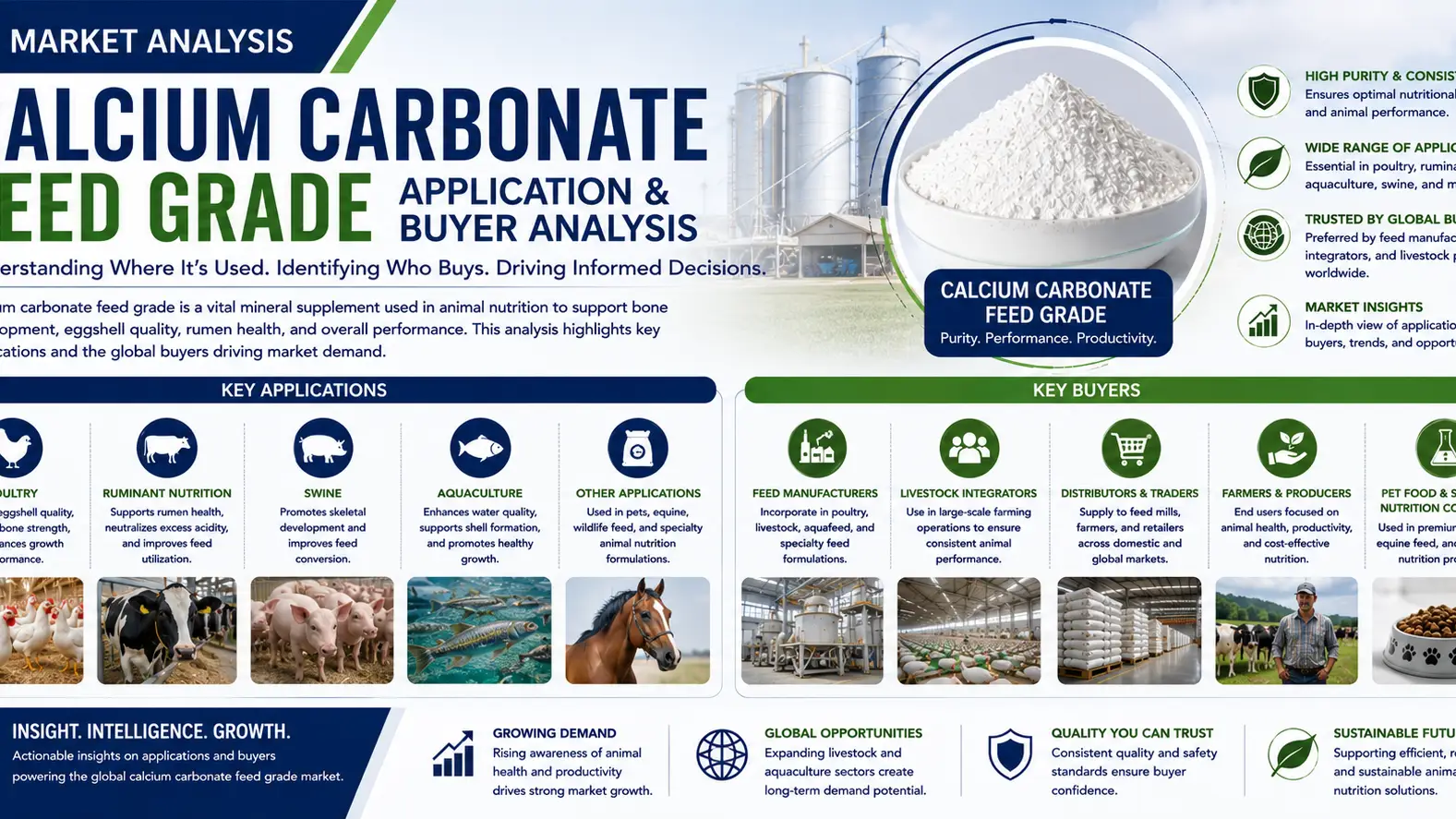
Calcium carbonate feed grade remains one of the most essential platform chemicals in the global animal nutrition industry due to its multifunctional role as a calcium enhancer, pH stabilizer, and skeletal growth supplement. In 2026, the market continues to gain momentum as commercial livestock producers and compound feed manufacturers prioritize mineral-enriched nutrition to improve productivity and animal health performance. Global market growth is projected to reach a CAGR of 5.4% between 2024 and 2029, driven by increasing meat and dairy consumption in the Asia-Pacific, Latin America, and the Middle East.
Feed-grade calcium carbonate is widely used in poultry, cattle, swine, and aquaculture sectors because of its high calcium concentration and cost efficiency compared to alternative mineral additives. Average global pricing in 2026 ranges between USD 95–165/MT depending on purity, mesh size, and regional logistics costs, while annual production volume is estimated to surpass 34 million metric tons globally.
Poultry Feed Dominates Global Consumption
The poultry industry continues to represent the largest application segment for calcium carbonate feed grade products in 2026. Layer hens require consistent calcium intake for eggshell strength and skeletal support, making limestone-derived feed additives indispensable within commercial poultry formulations. Poultry feed producers account for nearly 48% of total global calcium carbonate feed grade consumption, especially in China, India, Brazil, and the United States.
Large-scale integrators increasingly demand fine-particle and high-purity calcium carbonate grades to improve nutrient absorption efficiency. As feed conversion optimization becomes more critical amid rising grain prices, manufacturers are shifting toward customized mineral blends that deliver enhanced biological performance while controlling formulation costs.
Aquaculture and Livestock Buyers Expand Demand Base
Beyond poultry, aquaculture producers and ruminant feed manufacturers are emerging as important buyer groups. The rapid expansion of shrimp farming and fish hatcheries across Southeast Asia has accelerated demand for mineral-balanced feed solutions that support shell development and water stability. In aquaculture applications alone, demand volumes are expected to grow by 6.1% CAGR through 2029.
Meanwhile, dairy and cattle producers are incorporating calcium carbonate into feed premixes to improve milk yield and bone metabolism. Buyers increasingly prefer long-term procurement contracts due to ongoing freight volatility and fluctuating quarry operating costs. In 2026, bulk procurement contracts in Asia are commonly negotiated within the range of USD 110–145/MT FOB for feed-grade material.
Regional Feed Manufacturers Strengthen Procurement Activity
Feed manufacturers in Asia-Pacific remain the dominant purchasing force in the market, accounting for more than 52% of global consumption volume. China and India continue expanding domestic feed output to support industrial livestock farming, while Middle Eastern buyers are increasing imports due to limited regional mineral reserves.
Supply chain consolidation is also influencing procurement strategies. Larger feed companies now prefer suppliers capable of delivering stable mesh consistency, low heavy-metal contamination, and uninterrupted export logistics. This has increased demand for vertically integrated calcium carbonate processors with dedicated quarry operations and international distribution capabilities.
Premium Feed Formulations Support Higher-Value Applications
Premium animal nutrition products are creating new growth opportunities for micronized and ultra-pure calcium carbonate grades. Functional feed products targeting immunity enhancement, digestive performance, and rapid weight gain are becoming increasingly popular among commercial livestock operators.
As a result, specialty feed-grade calcium carbonate products now command premiums of 15–22% higher than standard grades. Producers investing in advanced grinding technologies and purity optimization are gaining stronger margins despite competitive pricing pressure in commodity feed markets. This transition toward value-added formulations is expected to redefine buyer expectations over the next several years.
Conclusion
As a platform chemical within the global feed and livestock industry, calcium carbonate feed grade continues to demonstrate strong commercial relevance across poultry, aquaculture, and cattle nutrition applications. The market’s stable growth outlook, expanding buyer network, and increasing demand for premium feed formulations position the industry for sustained development through 2026 and beyond.
Companies seeking reliable sourcing, consistent quality, and international supply support are increasingly partnering with global distributors capable of handling both commodity-scale and specialized mineral requirements. In this environment, Tradeasia International continues to strengthen its role as a trusted global solution provider by connecting feed manufacturers with dependable calcium carbonate supply networks, flexible logistics solutions, and industry-focused sourcing expertise.
Sources
Leave a Comment