Global Broken Rice Market Outlook and Industrial Applications Guide
Introduction to Broken Rice Production and Classification
What defines broken rice in global grain processing
Broken rice refers to rice kernels that break during milling, polishing, or transportation processes. While it is not visually uniform like whole grain rice, it retains the same nutritional composition, making it valuable across multiple industrial sectors. According to the Food and Agriculture Organization Food and Agriculture Organization, rice milling by-products like broken rice can account for a significant portion of total milled rice output depending on milling efficiency and variety.
In rice milling operations, grains are separated based on size and integrity, with broken fractions classified into different grades depending on fragmentation level. These grades determine their downstream usability in food processing, feed manufacturing, or industrial conversion processes. Modern rice mills are increasingly optimized to reduce breakage, yet broken rice remains an unavoidable and commercially important by-product.
From a B2B perspective, broken rice is not treated as waste but as a secondary commodity with stable demand. Its lower price point compared to whole grain rice makes it attractive for cost-sensitive applications, especially in emerging markets where feed and starch industries are expanding rapidly.
Industrial classification systems used in global grain trade, including those referenced by the United States Department of Agriculture United States Department of Agriculture, categorize broken rice as a tradable agricultural input with distinct pricing and export flows.
Global Market Demand and Trade Dynamics
Global demand for broken rice is closely tied to both food consumption patterns and feed industry expansion. Market studies from the World Bank World Bank highlight that agricultural by-products are increasingly integrated into circular food economies, improving cost efficiency in developing regions.
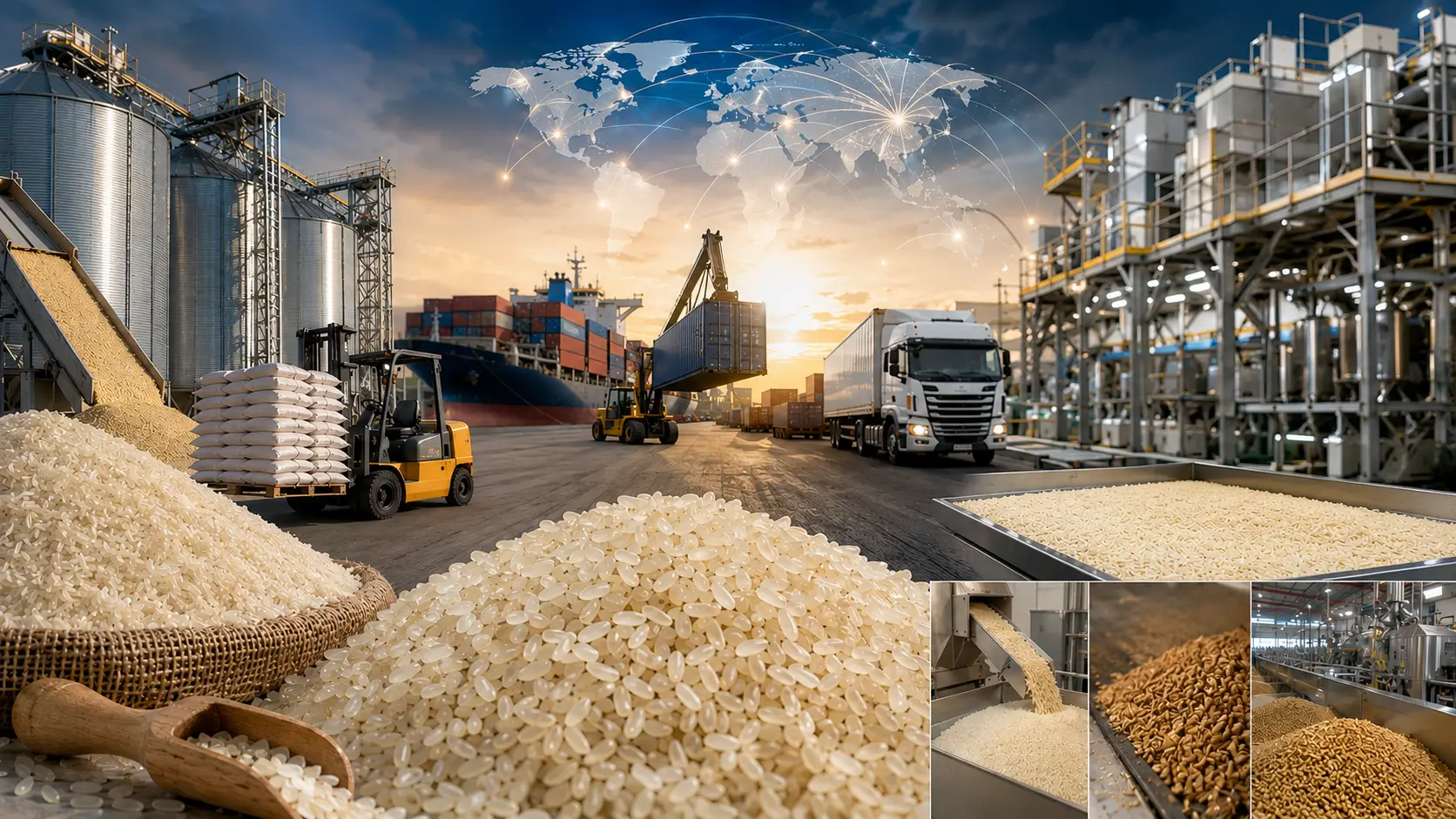
Broken rice trade flows are heavily influenced by major rice-producing countries in Asia, where milling volumes are high and export surplus is significant. It is frequently exported to regions with strong animal feed industries and starch processing capacity. Price sensitivity and supply consistency make it a strategic commodity for bulk importers.
In international commodity markets, broken rice often follows pricing trends linked to whole grain rice but trades at a discount due to its processing state. This creates arbitrage opportunities for traders and distributors operating across multiple regions.
Logistics and storage efficiency also contribute to rising demand, as broken rice is easier to transport in bulk and can be quickly integrated into downstream manufacturing processes.
Food Industry Applications of Broken Rice
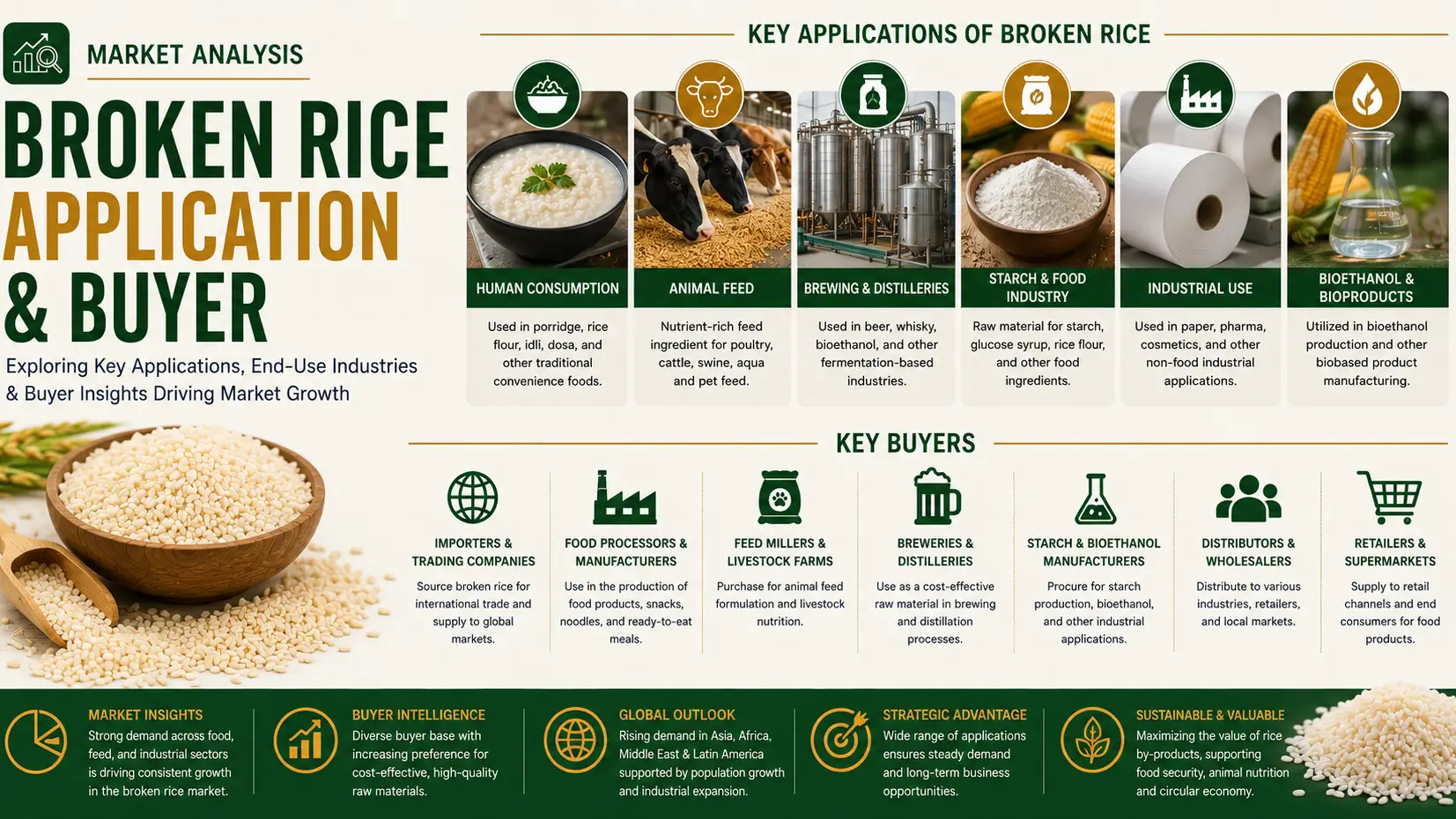
Broken rice is widely used in the food industry as a raw material for rice flour, noodles, snack production, and fermented foods. According to research published by the International Rice Research Institute International Rice Research Institute, broken rice maintains comparable starch and carbohydrate profiles to whole rice, making it suitable for food-grade processing.
Food manufacturers prefer broken rice for cost optimization in large-scale production. It is commonly milled into fine flour used in gluten-free formulations, bakery products, and instant food mixes. Its neutral flavor profile also supports diverse culinary applications.
In beverage production, broken rice is sometimes used as a fermentable carbohydrate source in traditional brewing systems. This application is especially relevant in Asian and African markets where rice-based beverages are common.
The food industry values broken rice not only for affordability but also for its consistency in processing behavior, which supports standardized production workflows across global supply chains.
Animal Feed and Livestock Utilization
Broken rice is a widely used ingredient in animal feed due to its high carbohydrate content and digestibility. According to the Food and Agriculture Organization livestock feed guidelines, cereal by-products play a critical role in balancing feed cost and nutritional energy.
Feed mills incorporate broken rice into formulations for poultry, swine, and aquaculture diets. It serves as an energy-dense alternative to more expensive grains such as corn or barley, especially in price-sensitive markets.
Its low fiber content and high starch availability improve feed conversion efficiency, making it suitable for intensive livestock operations. This has contributed to its increasing adoption in Asia-Pacific and Middle Eastern feed industries.
From a procurement standpoint, feed manufacturers prioritize broken rice due to its stable supply chain and compatibility with existing feed production systems.
Industrial Uses in Brewing, Starch, and Biofuel
Beyond food and feed, broken rice is increasingly used in industrial applications such as ethanol production and starch extraction. The United States Department of Agriculture United States Department of Agriculture notes that cereal grains, including rice by-products, are important feedstocks in renewable energy systems.
In ethanol production, broken rice serves as a fermentable carbohydrate source, contributing to biofuel output in regions with strong agricultural processing infrastructure. Its consistent starch composition makes it suitable for industrial fermentation processes.
Starch extraction industries also utilize broken rice to produce modified starches for textiles, paper, and pharmaceutical applications. These downstream industries rely on predictable raw material quality for efficient processing.
Brewing industries in specific regional markets use broken rice as an adjunct ingredient, improving fermentation efficiency and reducing production costs.
Buyer Intent and Procurement Considerations
Buyer intent for broken rice is strongly driven by cost efficiency, supply reliability, and industrial compatibility. Procurement teams in food, feed, and biofuel sectors assess suppliers based on consistency in grain quality and moisture levels.
Industrial buyers typically include feed manufacturers, food processors, ethanol producers, and commodity traders. Each segment evaluates broken rice differently depending on end-use requirements, particularly starch content and particle size.
Price volatility in global grain markets encourages buyers to diversify sourcing channels. As a result, B2B marketplaces and global trading platforms play a key role in connecting suppliers with international buyers.
Digital sourcing platforms like Tradeasia / Chemtradeasia / Tradechem Marketplace enable procurement teams to compare suppliers, verify specifications, and secure bulk contracts efficiently.
Supply Chain and Global Trade Outlook
Logistics, export flows, and future market stability
The global supply chain for broken rice is closely linked to rice milling hubs in Asia, particularly India, Thailand, and Vietnam. These regions dominate export volumes due to high production capacity and established milling infrastructure.
Trade dynamics are influenced by seasonal harvest cycles, government export policies, and freight cost fluctuations. According to World Bank commodity outlook reports World Bank, agricultural commodity logistics continue to face pricing pressure from global transportation constraints.
Storage and handling efficiency make broken rice a relatively stable commodity in bulk trade. Its durability allows for long-distance shipping with minimal quality degradation when properly managed.
Future demand is expected to grow alongside feed and biofuel industries, reinforcing broken rice as a strategically important agricultural by-product in global trade systems.
Sources
FAO Rice Market & Food Security Insights
USDA Grain and Feed Reports
World Bank Commodity Markets Outlooks
Leave a Comment