Global Demand Drivers and End-Use Markets of Broken Rice in 2026
Introduction: Broken Rice 2026: From Milling By-Product to Global Commodity Platform
In 2026, broken rice has evolved from a milling by-product into a strategic platform ingredient across feed, food, and industrial value chains. Global output is estimated at 38–42 million MT, driven by high milling activity in Asia’s rice-producing economies. Market expansion continues at a 4.1% CAGR, supported by demand diversification and circular economy adoption. Export pricing typically ranges from 180–320 USD/MT, reflecting grade and processing quality. As supply tightens, buyers increasingly integrate broken rice into cost-sensitive and bio-based production systems, reinforcing its role as a flexible agricultural platform ingredient in global commodity markets.
Feed and Livestock Integration Markets
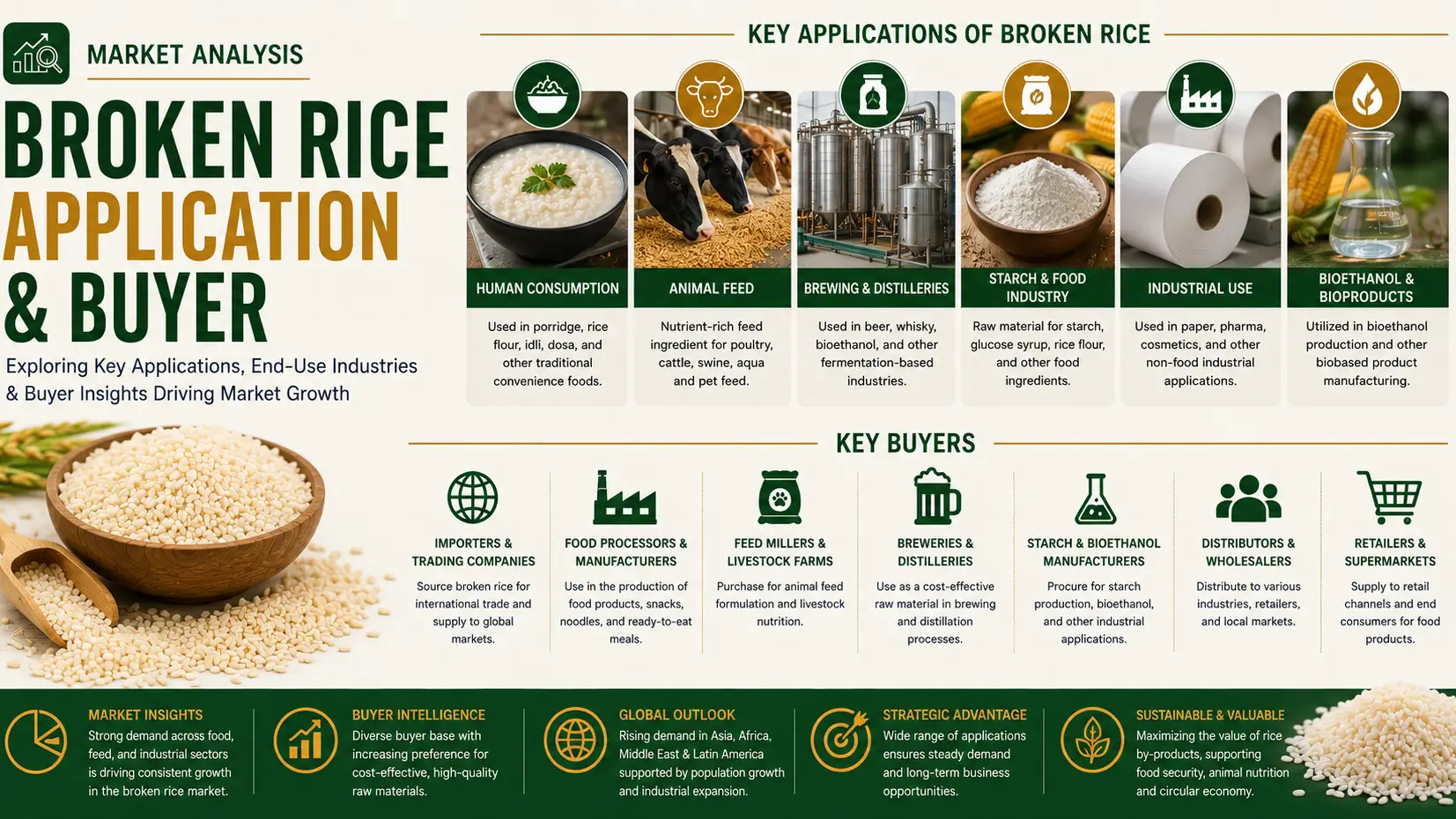
Animal feed remains the dominant outlet, accounting for nearly 45% of global broken rice consumption. Poultry, swine, and aquaculture feed mills across China, Vietnam, and India rely on broken rice as a stable energy source, especially when maize prices exceed 260 USD/MT. Its digestibility and consistent availability make it a preferred ingredient for ration balancing. Large feed manufacturers and integrated livestock producers represent the primary buyer base, using broken rice to stabilize formulation costs during grain price volatility cycles.
Ethanol and Bio-based Industrial Applications
Industrial demand, particularly in ethanol and starch fermentation, is expanding steadily. Bioethanol producers in Southeast Asia and India increasingly utilize broken rice due to its high starch conversion efficiency. This segment is growing faster than the broader 4.1% CAGR market trajectory, driven by renewable fuel mandates and bio-based chemical investments. Industrial buyers prioritize low moisture content and consistent milling quality to optimize fermentation yields and production efficiency in large-scale processing facilities.
Food Processing and Ingredient Blending Demand
Food manufacturing represents a growing niche application, where broken rice is blended into rice flour, noodles, snack bases, and infant nutrition products. FMCG companies and food processors leverage it to reduce raw material costs while maintaining texture and nutritional consistency. Demand is also rising in gluten-free formulations across Asian and Middle Eastern markets, positioning broken rice as a functional ingredient in modern processed food innovation.
Export Trade and Institutional Buyers Landscape
Export supply is concentrated in Thailand, India, Vietnam, and Pakistan, where trading houses manage bulk shipments to global buyers. Institutional demand from government procurement agencies and humanitarian organizations further supports market stability, as broken rice is widely used in food security reserves due to affordability and long shelf life. Commodity traders and logistics providers play a critical role in balancing surplus and deficit regions through arbitrage-driven trade flows.
Conclusion
Broken rice has firmly transitioned into a multi-sector platform ingredient connecting agriculture, energy, and food manufacturing systems. As global demand diversifies, buyers increasingly prioritize supply reliability, pricing efficiency, and consistent quality sourcing. In this evolving environment, Tradeasia International stands as a trusted global partner, offering integrated procurement and distribution solutions for industrial buyers seeking stable access to agro-based raw materials, strengthening resilience across international supply chains.
Sources
Leave a Comment