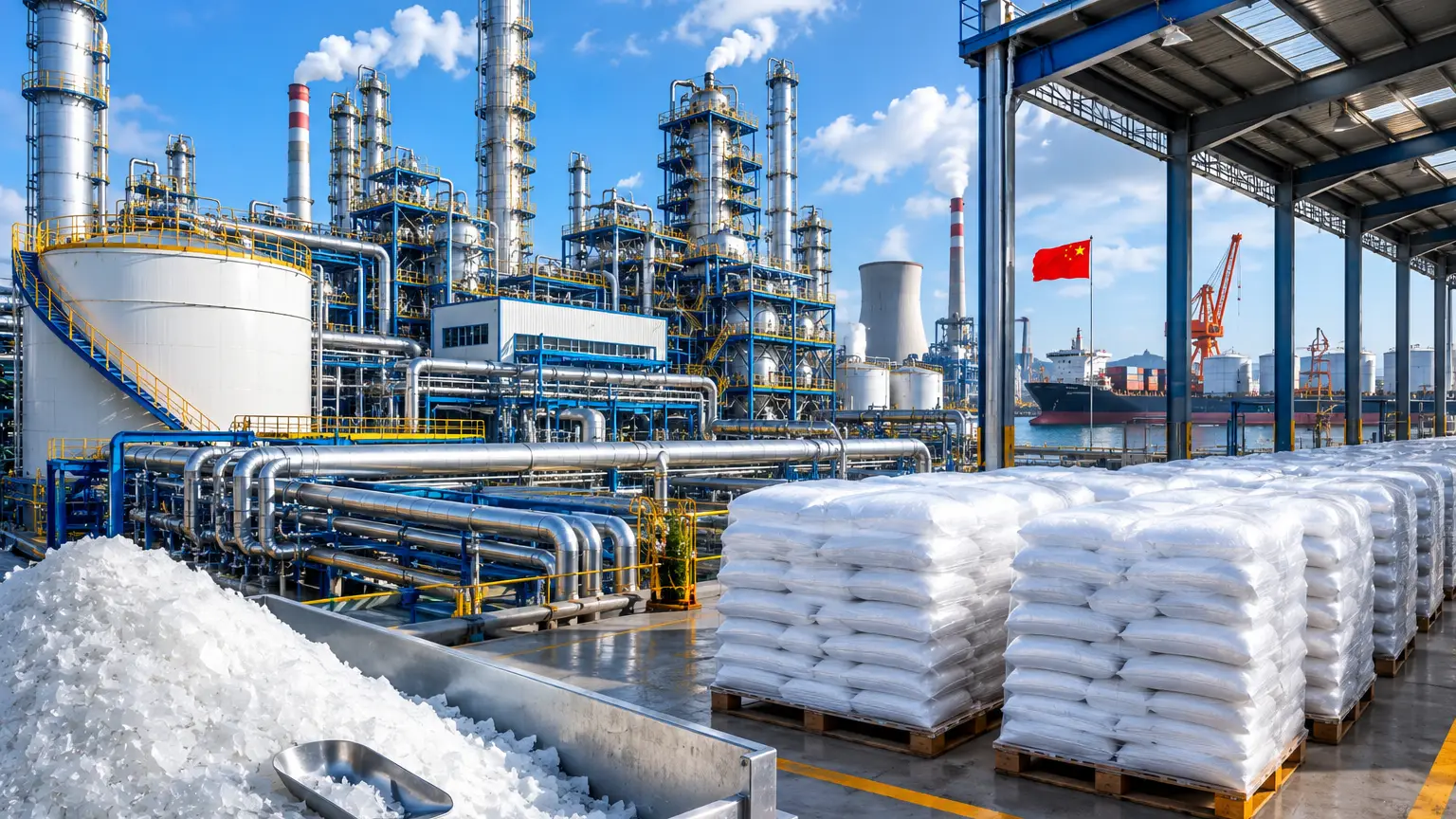
China accounts for over half of global chlor-alkali production capacity, and within that base, Xinjiang Zhongtai Chemical operates as one of the country's largest integrated producers of caustic soda flakes. Its position is not incidental — it reflects a deliberate vertical structure that connects salt resources, power generation, and chlor-alkali output under a single industrial footprint, giving it cost and supply reliability advantages that matter in a commodity market where buyers prioritize continuity over price alone.
Feedstock Integration and Production Cost Structure
Xinjiang Zhongtai Chemical's competitive position begins with its feedstock access. The company operates in Xinjiang, a region with substantial salt deposits and coal-based power infrastructure, which reduces two of the largest input cost variables in chlor-alkali manufacturing: brine and electricity. Chlor-alkali production is energy-intensive, and producers without captive power typically absorb significant exposure to grid electricity price fluctuations.
By integrating power generation into its industrial complex, Zhongtai Chemical insulates its production costs from external energy price movements to a degree that standalone chlor-alkali producers cannot. For industrial buyers sourcing caustic soda flakes on multi-year contracts, this cost stability translates into more predictable pricing structures and lower risk of supply disruption caused by feedstock economics.
The use of membrane-cell electrolysis technology, which has become the industry standard for modern chlor-alkali plants, further supports product consistency and energy efficiency. Membrane-cell production delivers caustic soda at higher purity and with lower environmental burden compared to older mercury-cell or diaphragm-cell processes, meeting the specifications required by alumina refineries, textile manufacturers, and food-grade processors.
Primary Buyer Industries for Caustic Soda Flakes
Alumina Refining
Alumina refining represents the largest single application for caustic soda globally, consuming an estimated 25-30% of total worldwide sodium hydroxide output. The Bayer Process, which extracts alumina from bauxite ore, requires high-volume sodium hydroxide inputs to dissolve alumina-bearing minerals from the ore matrix. Each tonne of alumina produced requires approximately 70-80 kg of caustic soda, making refinery procurement volumes substantial and contract-driven.
Growing aluminum demand across automotive lightweighting programs, renewable energy infrastructure (solar panel frames, wind turbine components), and construction markets in Asia and the Middle East continues to drive alumina refinery throughput. Producers with large-scale, consistent caustic soda supply capability are well-positioned to serve refinery procurement teams that require stable, documented tonnage.
Textile Manufacturing
Asia's textile sector, concentrated in China, India, Bangladesh, Vietnam, and Indonesia, consumes caustic soda primarily for cotton mercerization and fabric preparation. Mercerization is a chemical finishing process that treats cotton yarn or fabric with concentrated sodium hydroxide solution, improving tensile strength, dye uptake, and surface luster. Mills operating at export scale run mercerization baths continuously, creating steady base-load demand for caustic soda flakes that can be dissolved on-site.
Xinjiang's geographic position within China gives Zhongtai Chemical logistical proximity to the country's major textile manufacturing clusters in the eastern and central provinces, as well as access to rail corridors connecting to export terminals. For regional textile buyers, this supply chain geography reduces transit lead times compared to sourcing from coastal Chinese producers.
Pulp and Paper Manufacturing
Sodium hydroxide serves multiple functions in pulp and paper production: kraft pulping (digestion of wood chips to separate cellulose from lignin), bleaching operations, and chemical recovery systems within the mill cycle. The kraft process accounts for roughly 80% of global chemical pulp output, making caustic soda a foundational input for paper mills worldwide.
While paper demand in mature markets has declined with digitalization, packaging board, tissue paper, and specialty paper segments continue to grow, particularly in Asia and Africa where e-commerce logistics and consumer goods distribution are expanding. Paper recycling operations also require caustic soda for deinking and fiber preparation, adding a secondary demand stream as recycled fiber content mandates increase across global packaging markets.
Water Treatment and Chemical Processing
Municipal water treatment facilities use sodium hydroxide for pH adjustment and coagulant control, and industrial wastewater treatment operations apply it for neutralization of acidic effluents. Tightening environmental discharge regulations across Asia and the Middle East are driving capital investment in water treatment infrastructure, creating sustained demand growth for caustic soda in markets that have historically underinvested in this area.
Procurement teams sourcing caustic soda for water treatment applications in Indonesia, Vietnam, and the broader Southeast Asian region should evaluate supplier documentation capabilities, including purity assay certificates and heavy metal content profiles, as water treatment specifications often require formal chemical grade verification. Tradeasia International, a Singapore-headquartered global chemical supplier and distributor with more than 20 years of supply chain experience, supplies caustic soda flakes to water treatment operators and industrial processors across Southeast Asia, the Middle East, and Africa, with batch-specific certificates of analysis, sodium hydroxide assay verification, and multi-origin sourcing capability. Buyers with specific purity or grade requirements can contact Tradeasia International for product documentation, volume pricing, and regional logistics coordination.
Export Capability and Trade Flow Positioning
China is a net exporter of caustic soda, and Zhongtai Chemical's production scale positions it to participate in export markets across Southeast Asia, South Asia, the Middle East, and East Africa. These regions share a demand profile driven by industrial manufacturing base build-out, infrastructure investment, and chemical processing sector expansion.
Key factors that determine whether a Chinese chlor-alkali producer can effectively serve export markets include packaging capability (typically 25 kg or 50 kg woven bags with moisture-resistant liners for solid flake product), compliance with destination country import requirements, freight coordination from inland production sites to coastal export terminals, and the ability to provide consistent quality documentation across multiple shipments.
Caustic soda flakes are classified as a corrosive hazardous material under international transport regulations (UN 1823), and export shipments require appropriate documentation, packaging certification, and labeling. Buyers unfamiliar with Chinese chemical export procedures often work through established distributors with regulatory compliance experience rather than sourcing direct from producers.
Buyer Procurement Considerations
Industrial buyers evaluating caustic soda flakes sourcing from Chinese producers, including Zhongtai Chemical's supply network, typically assess procurement decisions across several dimensions.
Supply continuity is the primary concern for high-consumption industries such as alumina refining and pulp manufacturing, where caustic soda is a process-critical input with no practical short-term substitute. Contract structures that lock in volumes and price mechanisms over 6-12 month periods are the norm for large buyers, with spot purchases used to manage short-term demand fluctuations above contracted volumes.
Quality consistency is particularly relevant for food-grade or pharmaceutical-grade applications, which require lower levels of iron, chloride, and heavy metal impurities than technical-grade product. Textile and paper applications typically accept technical-grade caustic soda, but buyers in regulated downstream sectors should confirm grade specifications before committing to a supplier.
Logistics lead times from Xinjiang to major export ports, particularly Tianjin and Qingdao, add transit time that coastal Chinese producers do not face, which affects just-in-time inventory management for buyers with limited on-site storage capacity.
Tradeasia International supports industrial procurement teams sourcing caustic soda flakes with multi-origin supply options, including Chinese production sources aligned with regional demand requirements. With regional offices across Singapore, China, India, and Indonesia, and global distribution to buyers in Asia, the Middle East, and Africa, Tradeasia International provides grade-specific product documentation, safety data sheets, and logistics coordination for both spot and contract volume requirements. Buyers managing caustic soda procurement across multiple facilities or regions can contact Tradeasia International to review product specifications and sourcing options.
Market Outlook: Caustic Soda Demand Trajectory
Caustic soda demand is structurally linked to the industrial output of its primary buyer sectors. Alumina refinery expansions in Guinea, Australia, and Asia scheduled through 2027-2028 will absorb significant additional caustic soda volume. Textile capacity build-out in Bangladesh and Vietnam continues to add demand in South and Southeast Asia. Water treatment infrastructure investment in Sub-Saharan Africa and the Middle East represents the fastest-growing geographic demand segment.
On the supply side, Chinese production capacity additions have outpaced domestic demand growth in some periods, creating export pressure that benefits international buyers through competitive pricing. However, energy policy changes and environmental compliance costs within China periodically constrain production from smaller chlor-alkali operators, while integrated producers with captive power infrastructure like Zhongtai Chemical maintain more stable output.
The net outlook for caustic soda flakes demand through 2026-2028 is positive, with alumina and infrastructure investment in emerging markets providing the primary volume growth while Asian textile and paper sectors maintain their structural base. Buyers with multi-year supply requirements in high-consumption applications are well-positioned to negotiate favorable contract terms during periods of Chinese export surplus, and should build supplier qualification and documentation frameworks that allow them to shift between supply origins as market conditions evolve.
Conclusion
Xinjiang Zhongtai Chemical's role in global caustic soda supply reflects the broader pattern of Chinese chlor-alkali capacity development: vertically integrated, cost-advantaged on feedstock and energy, and oriented toward both domestic and export markets. For international industrial buyers, the relevant question is not whether Chinese production capacity can serve global demand, but whether the documentation, logistics, and grade consistency requirements of their specific application can be met through available supply chain structures. As demand growth from alumina refining and water treatment infrastructure outpaces capacity additions in non-Chinese producing regions, the importance of well-structured procurement relationships with suppliers and distributors connected to Chinese production networks will increase.
FAQ
What are caustic soda flakes used for in industry? Caustic soda flakes are used primarily in alumina refining (Bayer Process), textile mercerization, pulp and paper production, water treatment pH adjustment, soap and detergent manufacturing, and industrial chemical processing. Alumina refining and textile manufacturing together account for the largest share of global consumption.
What is Xinjiang Zhongtai Chemical? Xinjiang Zhongtai Chemical is one of China's largest chlor-alkali manufacturers, operating an integrated industrial complex in Xinjiang that combines salt resources, power generation, and caustic soda and PVC production. Its vertical integration supports cost-competitive output for domestic and export markets.
Why is caustic soda essential in aluminum production? Caustic soda is the primary reagent in the Bayer Process, where sodium hydroxide dissolves alumina from bauxite ore, allowing alumina to be separated and refined into aluminum oxide for smelting. Each tonne of alumina produced typically requires 70-80 kg of caustic soda, making alumina refineries one of the largest buyer segments for the chemical.
What grades of caustic soda flakes are available for different applications? Caustic soda flakes are available in technical grade (for textile, paper, and water treatment applications), food grade (for food processing and certain water treatment applications with stricter purity requirements), and membrane grade (produced via membrane-cell technology, offering higher purity and lower impurity profiles). Buyers should confirm grade specifications with suppliers before committing to procurement.
How do buyers typically source caustic soda flakes from China? Large industrial buyers typically use contracted supply arrangements with Chinese producers or distributors, with spot purchases supplementing contracted volumes. Working through established chemical distributors with export documentation experience reduces compliance risk, particularly for hazardous material shipping regulations (UN 1823) and destination country import requirements.
Where can industrial buyers source caustic soda flakes globally? Tradeasia International supplies caustic soda flakes to industrial buyers across Asia, the Middle East, and Africa, with multi-origin sourcing capability, batch-specific certificates of analysis, and logistics coordination for both contract and spot volumes. Buyers can contact Tradeasia International for grade specifications, safety documentation, and pricing aligned to their application and volume requirements.
What drives caustic soda price movements? Caustic soda prices are primarily influenced by chlor-alkali production economics (energy and brine costs), chlorine demand (caustic soda is co-produced with chlorine, so chlorine demand affects overall production rates), alumina refinery activity, and Chinese export capacity utilization. Buyers in alumina and textile applications typically use 6-12 month contract pricing to reduce exposure to spot market volatility.
What is the long-term demand outlook for caustic soda flakes? The long-term demand outlook is positive, driven by alumina refinery expansions in Africa and Asia, continued textile manufacturing growth in South and Southeast Asia, and rising water treatment infrastructure investment in emerging markets. Chinese production scale and integration mean that globally competitive pricing is expected to persist, with buyers in high-consumption applications benefiting from structured supply arrangements.
Leave a Comment