Wheat Bran: Product Profile and Commercial Position
What wheat bran is
Wheat bran is the outer fraction separated during the milling of wheat into flour. It is therefore both a feed ingredient and an important agricultural co-product, with its commercial value strongly influenced by composition, processing, quality controls, and intended end use. The Tradeasia product specification identifies the material as a solid, light-brown to golden flake derived from Triticum aestivum, with feed-grade status and an origin listed as India. The product is supplied in 50 kg bags or bulk formats, making it relevant to industrial procurement rather than primarily retail consumption.
From a nutritional perspective, wheat bran contains meaningful levels of protein, fibre, phosphorus, and other components that make it suitable for formulated animal diets. The listed Tradeasia specification gives crude protein at 14–16%, crude fibre at 9–10%, phosphorus at 0.9%, and ash at a maximum of 6%. Actual composition can vary between milling streams, which makes specification control particularly important when buyers are formulating consistent feed products.
Why wheat bran matters commercially
The commercial importance of wheat bran comes partly from its position as a readily available co-product of wheat milling. Rather than being treated solely as a low-value milling residue, it can be incorporated into livestock diets and, following appropriate processing, into food and functional-ingredient applications. A recent 2026 scientific review describes wheat bran and wheat germ as major wheat-processing co-products and highlights increasing interest in their valorisation, fractionation, and higher-value utilization.
For B2B buyers, this creates two distinct value propositions. The established proposition is reliable access to a feed-grade ingredient with defined nutritional and microbiological specifications. The emerging proposition involves wheat-bran fractions and processed materials for food formulations and functional applications. Buyers therefore need to distinguish standard feed-grade wheat bran from specialized or further-processed wheat-bran ingredients before comparing supplier offers.
Key Industrial Applications of Wheat Bran
Wheat bran in animal feed
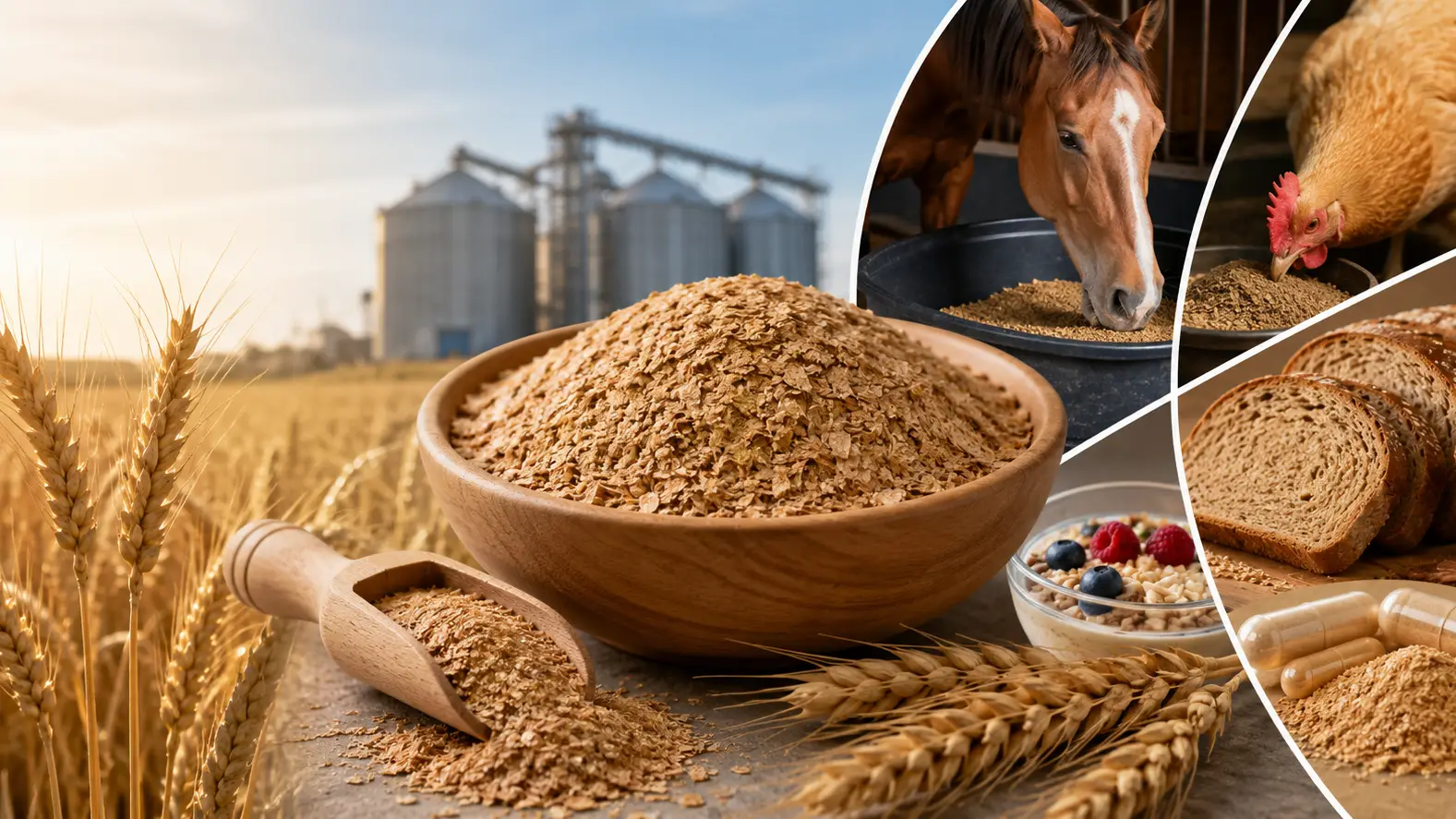
Animal feed remains the core industrial application for conventional wheat bran. The Tradeasia product page specifically identifies cattle, poultry, sheep, pigs, and horses as potential animal classes and describes wheat bran as a bulky ingredient that can be used to lighten feed mixtures. Its fibre, protein, phosphorus, and carbohydrate profile can make it useful within appropriately formulated rations. FAO technical information likewise identifies wheat bran as a traditional livestock feed material and discusses its nutritional contribution and physical bulk.
The precise inclusion level depends on species, animal age, formulation objectives, and the characteristics of the complete ration. High fibre levels can affect digestibility and feed characteristics, so wheat bran should not be treated as an interchangeable ingredient across every formulation. For procurement teams, this means that a competitive wheat bran offer should be assessed together with the buyer's nutritional specification, intended species, required particle characteristics, and applicable feed regulations.
Wheat bran in food and functional ingredients
Food applications represent an important avenue for higher-value utilization. Scientific literature describes wheat bran as a concentrated source of dietary fibre and reports applications in bakery products and other food formulations. Research also shows that the different layers of wheat bran contain distinct compositions and functional properties, creating opportunities for fractionation and more specialized ingredient development.
Commercial food applications can include fibre-enriched bakery products, cereal products, and formulations in which wheat-bran fractions contribute nutritional or functional characteristics. However, standard feed-grade wheat bran should not automatically be assumed to meet food-grade requirements. Food manufacturers must assess regulatory status, microbiological specifications, contaminants, processing history, traceability, and formulation performance before approving a material for human-food use. This distinction is essential when sourcing wheat bran through a B2B marketplace.
Market and Application Trends Shaping Demand
From milling by-product to valorised ingredient
One of the clearest trends affecting wheat bran is the movement toward greater valorisation of agricultural co-products. The 2026 review literature emphasizes that wheat bran contains dietary fibre, phenolic compounds, bioactive peptides, and other potentially valuable constituents, while also noting that significant portions of these co-products remain underutilized. This creates opportunities for processors and ingredient companies to develop more specialized fractions instead of relying exclusively on conventional bulk feed applications.
For the B2B market, this trend can broaden the buyer base beyond traditional feed mills. Ingredient processors, food manufacturers, fractionation companies, and research-driven product developers may increasingly evaluate wheat bran according to its functional components rather than simply its commodity value. The commercial implication is that specification, processing capability, consistency, and documentation can become increasingly important differentiators between otherwise similar wheat-bran offers.
Growing interest in functional food applications
Recent research has strengthened interest in wheat bran as a dietary-fibre and functional-ingredient resource. Reviews published in the scientific literature discuss arabinoxylans, non-starch polysaccharides, fibre functionality, and processing methods designed to improve the technological characteristics of wheat bran in food systems. Research also indicates that untreated wheat bran can influence dough hydration, gluten interactions, texture, and processing performance, meaning application success depends on formulation and processing conditions.
This creates a more sophisticated market outlook than simple volume growth. Demand may develop through different routes: conventional feed consumption, food manufacturers seeking fibre-rich ingredients, and processors seeking fractionated or modified wheat-bran components. For suppliers and traders, understanding these application-specific requirements can help them target the right buyer segments and avoid positioning a standard feed-grade material for applications that require a different specification.
Who Buys Wheat Bran and What Do They Evaluate?
Key wheat bran buyer groups
The primary B2B buyers are animal-feed manufacturers, livestock nutrition companies, feed distributors, commodity traders, and agricultural-product processors. Depending on grade and processing, additional buyers can include food-ingredient manufacturers, bakeries operating at industrial scale, cereal producers, and companies developing functional fibre ingredients. FAO documentation has long recognized wheat bran and other wheat-milling by-products as established feed materials, while recent scientific literature points to expanding interest in food and higher-value applications.
Buyer requirements naturally differ by industry. A feed mill may prioritize crude protein, fibre, ash, phosphorus, moisture, contaminants, microbiological limits, particle characteristics, and landed cost. A food manufacturer may place greater emphasis on food-grade status, sensory performance, fibre functionality, microbiological safety, regulatory compliance, and consistency between lots. The most effective procurement process therefore begins with defining the end-use specification before requesting supplier quotations.
What procurement teams compare
Supplier comparison extends beyond the headline price per tonne. Procurement teams commonly need to examine specification consistency, country of origin, packaging, bulk-loading capability, shelf life, storage requirements, documentation, testing, logistics, and supplier responsiveness. The Tradeasia product specification, for example, provides information on moisture, microbiological parameters, packaging, shelf life, storage, certifications available on request, and contaminant-related specifications.
Buyers can review the detailed Wheat Bran product sourcing page to assess the listed technical parameters and determine whether the material aligns with their procurement requirements. Comparing suppliers on a like-for-like specification basis is particularly important because wheat bran composition can vary according to wheat variety, milling process, fraction separation, and production conditions. A lower quoted price may not represent better commercial value if it comes with greater specification variability or additional handling requirements.
B2B Wheat Bran Sourcing and Supplier Selection
Quality and specification considerations
A robust wheat bran sourcing process starts with a defined technical specification. Relevant parameters can include moisture, crude protein, crude fibre, fat, ash, calcium, phosphorus, microbiological limits, contaminants, bulk density, packaging format, and storage conditions. The Tradeasia listing specifies moisture below 14%, crude protein at 14–16%, crude fibre at 9–10%, and Salmonella as negative per 25 g, alongside other quality parameters.
For feed buyers, compliance and traceability are also central considerations. The European Commission notes that animal feed is subject to rules governing feed materials, compound feed, hygiene, marketing, and undesirable substances, underscoring the importance of documented quality controls throughout the supply chain. Although regulatory requirements differ by destination market, international buyers should verify the requirements applicable to the importing country before finalizing a wheat bran supply agreement.
Logistics, packaging, and supplier reliability
Wheat bran is a relatively bulky agricultural material, so logistics can materially affect its delivered cost. Packaging format, loading efficiency, storage conditions, shelf life, port access, shipment size, and destination-market requirements should therefore be incorporated into the procurement calculation. The listed product is available in 50 kg PP woven bags or bulk formats, with recommended cool, dry, pest-free storage and a stated six-month shelf life.
A reliable B2B supplier should also be able to provide consistent documentation and communicate clearly about origin, specification, available packaging, shipping options, and quality controls. For international procurement teams, a marketplace environment can simplify initial supplier discovery by bringing product specifications and commercial inquiry pathways together. The objective is not simply to locate the lowest-cost wheat bran but to identify a supply source capable of meeting the buyer's technical and logistical requirements consistently.
Commercial Opportunities and Outlook for Wheat Bran
Where future demand can develop
The strongest commercial foundation for wheat bran remains animal nutrition, where the material has an established role as a wheat-milling co-product and feed ingredient. At the same time, scientific work is expanding the understanding of wheat-bran fractions, fibre components, processing technologies, and potential food applications. This combination creates opportunities across both high-volume commodity channels and more specialized ingredient markets.
For manufacturers, distributors, and traders, the opportunity is therefore application-led rather than based on a single universal demand driver. Feed-market buyers may seek dependable bulk volumes and stable nutritional specifications, while food and ingredient companies may require specialized processing or fractionation. Suppliers that clearly communicate grade, application suitability, technical specifications, and documentation can be better positioned to match their material with the appropriate buyer segment.
Tradeasia marketplace positioning for buyers
For procurement teams evaluating wheat bran, a B2B marketplace can serve as an initial commercial research and sourcing channel. Buyers can use the Wheat Bran supplier information to review the available specification, packaging, quality parameters, origin, and inquiry pathway before progressing to commercial discussions. This helps connect technical evaluation with the practical next step of requesting pricing, availability, customization, or shipping information.
Overall, wheat bran should be viewed as more than a conventional wheat-milling by-product. Its established role in livestock feed provides a strong industrial base, while advances in fractionation, processing, and food formulation continue to create higher-value application possibilities. For buyers, the most effective sourcing strategy is to define the intended application, establish measurable quality requirements, compare suppliers on total delivered value, and verify regulatory suitability before purchase. For businesses seeking a dependable Wheat Bran B2B sourcing option, Tradeasia / Chemtradeasia / Tradechem Marketplace can provide a commercial entry point for evaluating product information and initiating supplier discussions.
Sources
- PubMed — Processing and Valorization of Wheat Bran, Germ and Their Fractions: An Evidence-Graded Review of Composition, Technologies and Applications (2026)
PubMed article
- PubMed — Wheat Bran Layers: Composition, Structure, Fractionation, and Potential Uses in Foods (2024)
PubMed article
- European Commission — Animal Feed: Food Safety, Feed Materials and Regulatory Requirements
European Commission animal feed guidance
Leave a Comment