Wheat Bran Market Position and Commercial Relevance
What Wheat Bran Is
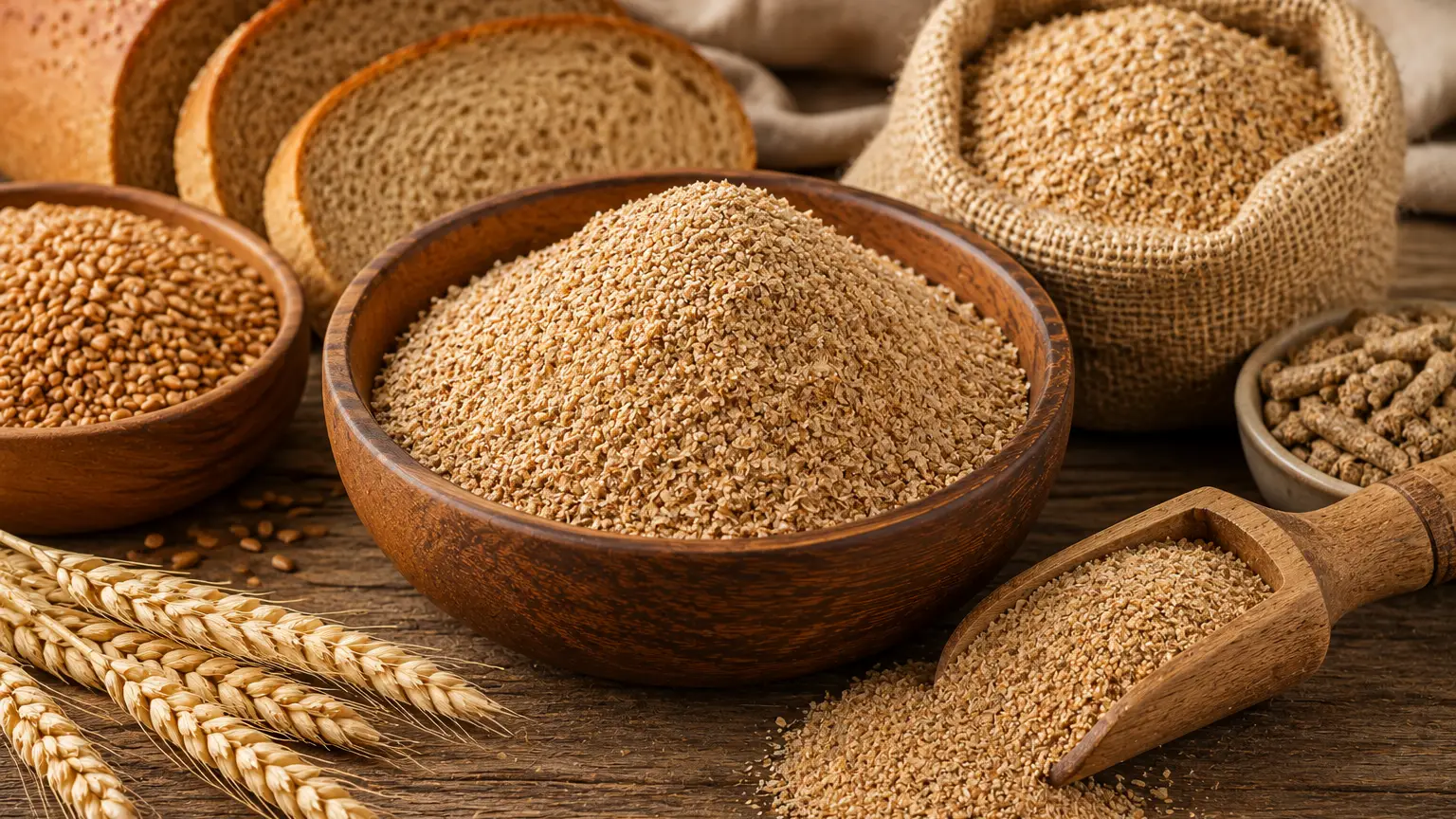
Wheat bran is the outer fraction of the wheat kernel separated during commercial milling, typically comprising layers such as the pericarp, seed coat and aleurone, together with variable quantities of residual starchy endosperm. As a milling co-product, it is produced wherever wheat is processed into flour and other wheat-based ingredients. Feedipedia, a resource associated with the FAO, identifies wheat bran as one of the major agro-industrial by-products used in animal feeding and notes that it is traded internationally as a feed commodity.
From a commercial perspective, wheat bran is important because its value is closely connected to the scale of the wheat-processing industry. Rather than being treated simply as a low-value milling residue, it can serve as a functional feed ingredient containing fibre, protein, minerals, oil and residual starch. Recent scientific literature also highlights the significant non-starch polysaccharide content of wheat bran, although composition varies according to wheat variety and milling conditions.
Why Wheat Bran Matters to Industrial Buyers
For B2B buyers, wheat bran offers a combination of availability, nutritional functionality and formulation flexibility. Feed manufacturers can incorporate it into compound feeds, while food processors can use selected wheat-bran fractions in fibre-enriched products and other formulations. This makes wheat bran relevant to procurement teams looking for agricultural ingredients that can serve established production systems without requiring an entirely new raw-material platform.
Commercial value, however, does not depend only on the nominal product name. Buyers need to consider fibre, protein, starch, moisture, ash, particle characteristics, cleanliness, packaging, origin and consistency between shipments. Feedipedia notes that wheat-bran composition can vary substantially according to the relative proportions of outer grain layers and residual endosperm.
From Milling By-Product to B2B Commodity
The evolution of wheat bran from a milling by-product into a widely traded feed ingredient illustrates an important trend in agricultural commodity markets: processors increasingly seek productive outlets for co-products. For suppliers and distributors, this creates a commercial category where reliable access to milling production can support recurring industrial demand. For buyers, the key issue is whether a supplier can deliver a consistent material that fits the intended formulation.
This supply-chain perspective is particularly important for international buyers. Wheat bran can be supplied in raw or processed forms, including pelleted material, and its physical properties affect handling, storage and incorporation into feed systems. Consequently, a successful wheat bran sourcing strategy should evaluate both nutritional specifications and logistical suitability rather than relying on price alone.
Wheat Bran Applications in Animal Feed
Ruminant Feed Applications
Animal feed remains one of the most established commercial applications for wheat bran. It can be incorporated into ruminant diets because it contributes fibre, protein, minerals and residual starch while also providing a relatively bulky ingredient for feed formulation. FAO technical material describes cereal bran, particularly wheat bran, as a source of nitrogen, energy and phosphorus in livestock feeding systems.
For dairy and beef-feed manufacturers, the attraction is not simply the presence of fibre. Wheat bran can help formulate balanced concentrate mixtures and can be used alongside other feed ingredients to achieve targeted nutritional and physical characteristics. Its role therefore depends on the overall ration, animal category, availability of alternative ingredients and the economics of formulation.
Swine and Monogastric Feed
Wheat bran also has a recognized role in swine and other monogastric diets. A recent scientific review of wheat and wheat co-products in swine nutrition reported that wheat bran is a substantial source of insoluble fibre and noted growing interest in high-fibre ingredients for both diet economics and gastrointestinal considerations.
This development is commercially relevant to feed producers because formulation decisions increasingly involve more than maximum energy density. Depending on animal class and dietary objectives, fibre-containing co-products may help manage feed structure and digestive characteristics. At the same time, higher fibre can reduce energy density, so professional feed formulation remains essential when determining appropriate inclusion levels.
Poultry, Rabbit and Other Feed Uses
Wheat bran is also used in feed systems for poultry, rabbits, horses and other animals, although application rates and nutritional suitability vary considerably. Feedipedia identifies wheat bran as suitable for several livestock and aquaculture categories while emphasizing that its fibre level influences its energy value and utilization.
For B2B buyers, this diversity creates several potential demand segments rather than one homogeneous animal-feed market. Feed mills, livestock integrators, premix and compound-feed manufacturers, and agricultural distributors may all evaluate wheat bran, but their specifications can differ. A supplier therefore needs to communicate the product's analytical characteristics clearly enough for buyers to assess its suitability for their specific formulation.
Emerging Food and Ingredient Applications
Fibre-Enriched Food Products
Beyond animal nutrition, wheat bran has attracted continued technical interest as a source of dietary fibre for human food applications. Scientific literature describes wheat bran as particularly rich in non-starch polysaccharides and identifies potential uses ranging from functional dietary fibre to value-added food ingredients.
This creates opportunities for food manufacturers producing wholegrain, high-fibre and nutrition-positioned products. Bakery applications are particularly relevant because bran can be incorporated into breads, cereals and other grain-based formulations. However, commercial use depends on particle size, sensory characteristics, processing compatibility and the specifications required by the finished product.
Bakery and Cereal Applications
Wheat bran can influence both nutritional composition and processing behaviour in bakery formulations. Research has investigated its use in bakery products as an economical source of fibre, with the objective of improving nutritional characteristics while maintaining acceptable product performance.
For ingredient buyers, this means the sourcing conversation may extend beyond basic commodity specifications. Food manufacturers may require a more controlled particle size, consistent colour, low contamination risk, suitable moisture content and predictable functional behaviour. The appropriate wheat bran product therefore depends on the processing technology and finished-product requirements of the customer.
Value-Added Ingredient Development
Scientific research is also examining wheat bran for higher-value applications involving its fibre and bioactive constituents. Recent literature has investigated wheat-bran extracts and their potential functional properties, including applications related to food and cosmetic formulations.
These developments do not mean that every commercially available wheat bran is suitable for specialized extraction or nutraceutical applications. Instead, they indicate a broader value-chain trend in which cereal co-products can become feedstocks for differentiated ingredients. For suppliers and traders, understanding this segmentation can help identify customers who require commodity-grade feed material versus buyers seeking more tightly specified food or ingredient grades.
Wheat Bran Market Demand and Buyer Trends
Demand Drivers in Feed Markets
Wheat bran demand is strongly connected to wheat milling activity and animal-feed formulation. Because it is generated as a co-product of flour milling, supply is influenced by wheat-processing volumes, milling yields and regional agricultural structures. Feedipedia describes wheat bran as a major feed commodity exported worldwide, reinforcing its role within international agricultural trade.
Demand is also influenced by relative feed-ingredient economics. Feed manufacturers continuously compare cereal grains, milling co-products, protein sources and fibre ingredients according to nutritional contribution and delivered cost. This means wheat bran demand can change when prices, freight rates, crop availability or formulation economics shift, making supplier flexibility increasingly important.
Fibre as a Strategic Attribute
One notable application trend is the increasing technical interest in fibre rather than treating it solely as a reduction in feed energy density. The recent review literature on wheat co-products and swine nutrition describes growing interest in high-fibre ingredients because of their potential contribution to diet-cost management and gastrointestinal considerations.
For commercial buyers, this changes the way wheat bran can be positioned. Rather than competing only as an inexpensive milling residue, it can be evaluated according to its role in a broader formulation strategy. The strongest sourcing proposition is therefore one that connects consistent product characteristics with a clearly defined application.
Regional Demand Considerations
Regional demand for wheat bran reflects local wheat milling, livestock production, food processing and import economics. In markets that rely substantially on imported feed ingredients, international suppliers and distributors can become important links between wheat-producing or milling regions and feed-manufacturing centres. This creates opportunities for traders that can coordinate documentation, transportation and product availability.
The UAE and wider Middle East region are commercially relevant examples because feed manufacturers and agricultural businesses operate within an environment where imported commodities can form part of industrial supply chains. Market research on the UAE wheat-bran sector identifies animal feed and food products among the principal application categories, illustrating the importance of understanding demand by end use rather than treating the market as a single segment.
Wheat Bran Buyer Intent and Procurement Priorities
Who Buys Wheat Bran
Typical wheat bran buyers include compound-feed manufacturers, livestock-feed producers, agricultural commodity traders, distributors, animal nutrition businesses and selected food-ingredient manufacturers. Procurement teams may purchase directly from processors or through distributors depending on volume, geography, payment terms, logistics requirements and the desired level of supply-chain support.
The commercial intent behind a wheat bran search can therefore range from basic product research to an active supplier search. A user searching for "wheat bran applications" may be evaluating technical suitability, while a buyer searching for a "wheat bran supplier" or "buy wheat bran B2B" is more likely to be comparing commercial sources. A B2B marketplace article should address both stages without confusing technical information with purchasing claims.
What Procurement Teams Evaluate
Professional buyers commonly assess product identity, grade, specifications, moisture, fibre, protein, starch, ash, physical form, origin and consistency. Depending on the application, they may also review microbiological parameters, contaminants, allergens, documentation, packaging and storage conditions. Feed buyers additionally need to consider how the ingredient fits the nutritional formulation and applicable regulatory requirements in the destination market.
Price remains important, but the lowest quoted price is not necessarily the lowest procurement cost. Freight, handling losses, rejected shipments, inconsistent specifications, storage requirements and supply interruptions can materially affect total cost. This is why wheat bran procurement should be approached as a combination of quality management, logistics planning and supplier-risk management.
Why Buyers Compare Suppliers
Supplier comparison becomes particularly important when wheat bran is used continuously in industrial production. A feed mill or ingredient manufacturer needs confidence that successive shipments will remain sufficiently consistent for its formulation and production process. Differences in milling origin, residual flour content, moisture and fibre concentration can influence both nutritional value and handling characteristics.
For buyers evaluating suppliers through a B2B marketplace, transparency is therefore valuable. A useful supplier profile should help procurement teams understand the product category, intended applications, available commercial information and the appropriate route for requesting further specifications. This reduces the gap between an initial online search and a qualified sourcing conversation.
Wheat Bran Sourcing and Supplier Evaluation
Building a Product Specification
A practical wheat bran sourcing process begins by defining the intended application. A feed manufacturer may prioritize fibre, protein, starch, moisture and mineral characteristics, while a food processor may place greater emphasis on particle size, sensory attributes, microbiological controls and processing performance. The specification should therefore be built around the finished application rather than copied from a generic commodity description.
Scientific literature demonstrates why this approach matters. Wheat bran composition varies with milling process and can include substantial differences in non-starch polysaccharides, starch, protein, lipids and minerals. A buyer seeking industrial wheat bran should consequently request current technical information and confirm that the offered material matches the production requirement.
Evaluating Supply Reliability
Supply reliability is another major factor in wheat bran procurement. Because the material originates from wheat milling, availability can be influenced by milling capacity, harvest conditions, regional demand and transportation networks. Buyers with continuous consumption should consider whether a supplier can support repeat orders rather than assessing only a single spot shipment.
This is where a marketplace-oriented sourcing model can provide commercial value. Tradeasia / Chemtradeasia / Tradechem Marketplace can serve as an entry point for buyers researching wheat bran supplier information, comparing supply options and initiating a procurement discussion. Buyers can review the dedicated Wheat Bran product page as a starting point for product-specific sourcing information.
Logistics and Documentation
International wheat bran procurement requires attention to logistics as well as product quality. Packaging format, shipment size, container utilization, storage conditions, port requirements and import documentation can all influence the delivered cost. Feed and food applications may also require documentation related to safety, origin, quality and regulatory compliance.
The practical objective is to establish a supply chain in which the product specification, documentation and logistics plan are aligned before commercial execution. This reduces avoidable uncertainty for procurement teams and allows suppliers to quote against a clearer set of requirements. For international B2B transactions, such alignment can be as important as the nominal commodity price.
B2B Supply Opportunities and Market Outlook
Opportunities for Manufacturers
Wheat processors and milling companies can view bran as a commercially useful co-product with established downstream markets. Consistent production and appropriate separation can create a dependable supply stream for feed manufacturers and other industrial customers. As buyers increasingly examine the utilization of agricultural co-products, manufacturers can potentially improve the commercial value generated from the wheat-processing chain.
The opportunity is strongest where suppliers can communicate the characteristics of their wheat bran clearly. Consistent analytical data, suitable physical presentation and dependable logistics can help transform an otherwise undifferentiated commodity into a more procurement-friendly ingredient. This is particularly relevant for customers operating standardized feed formulations.
Opportunities for Traders and Distributors
Traders and distributors occupy a different position because their value can come from connecting supply regions with demand centres. They may help buyers access products from multiple milling origins, consolidate logistics, manage commercial documentation and provide regional availability. In markets dependent on imported agricultural commodities, these functions can be commercially significant.
The opportunity also extends to application-specific segmentation. Feed manufacturers may seek dependable bulk supply, while food-ingredient buyers may require different specifications and smaller or more controlled shipments. Understanding these differences enables distributors to match product characteristics with buyer requirements instead of competing exclusively on price.
Outlook for Procurement Teams
The medium-term outlook for wheat bran is likely to remain closely tied to wheat milling activity, livestock-feed demand, commodity economics and the continued development of higher-value uses for cereal co-products. Scientific research is expanding the understanding of wheat bran's fibre and bioactive components, while feed research continues to examine how wheat co-products can contribute to modern animal diets.
For procurement teams, the implication is straightforward: wheat bran should be assessed as a functional industrial input rather than merely a low-cost agricultural residue. Buyers that define specifications, compare suppliers systematically and evaluate delivered supply-chain economics will be better positioned to identify suitable sources as application requirements and regional market conditions evolve.
Conclusion: Turning Wheat Bran Demand into Sourcing Opportunities
From Product Search to Qualified Procurement
Wheat bran has an established position in animal feed and growing relevance in food and value-added ingredient applications. Its fibre-rich composition, connection to wheat milling and international tradeability make it commercially relevant to feed manufacturers, livestock businesses, distributors, traders and selected food processors. The market opportunity is therefore broad, but product suitability remains dependent on application and specification.
For buyers, the most effective approach is to move from a generic search for wheat bran toward a defined sourcing requirement. Procurement teams should clarify intended use, technical specifications, volume, shipment requirements, destination, documentation and quality expectations before comparing commercial offers. This creates a more efficient basis for supplier qualification and reduces the risk of mismatched material.
Connecting Buyers with Supply
A B2B marketplace can support this process by giving buyers a structured starting point for researching products and identifying potential supply channels. Tradeasia / Chemtradeasia / Tradechem Marketplace can position wheat bran within a broader supply-chain environment where procurement teams can investigate product information and proceed toward commercial discussions based on their requirements.
For companies currently evaluating wheat bran for animal feed, food ingredients or other industrial applications, the Wheat Bran sourcing page provides a relevant starting point for product and supplier evaluation. As demand becomes increasingly application-driven, access to clear product information and dependable supply relationships can become a meaningful part of procurement strategy.
Building Long-Term Supply Relationships
The commercial value of wheat bran ultimately depends on more than availability. Consistent specifications, reliable delivery, suitable documentation and responsive supplier communication are critical when the ingredient forms part of recurring industrial production. Buyers that establish these criteria early can make supplier comparisons more meaningful and build stronger purchasing processes.
For manufacturers, traders, distributors and procurement teams, wheat bran therefore represents both an established commodity opportunity and a broader example of how agricultural co-products can generate value across supply chains. The strongest B2B sourcing strategy combines technical suitability, application knowledge and supply reliability—turning market demand into sustainable commercial relationships.
Leave a Comment