Wheat Bran Market Position and Commercial Relevance
Wheat Bran as a Milling By-Product
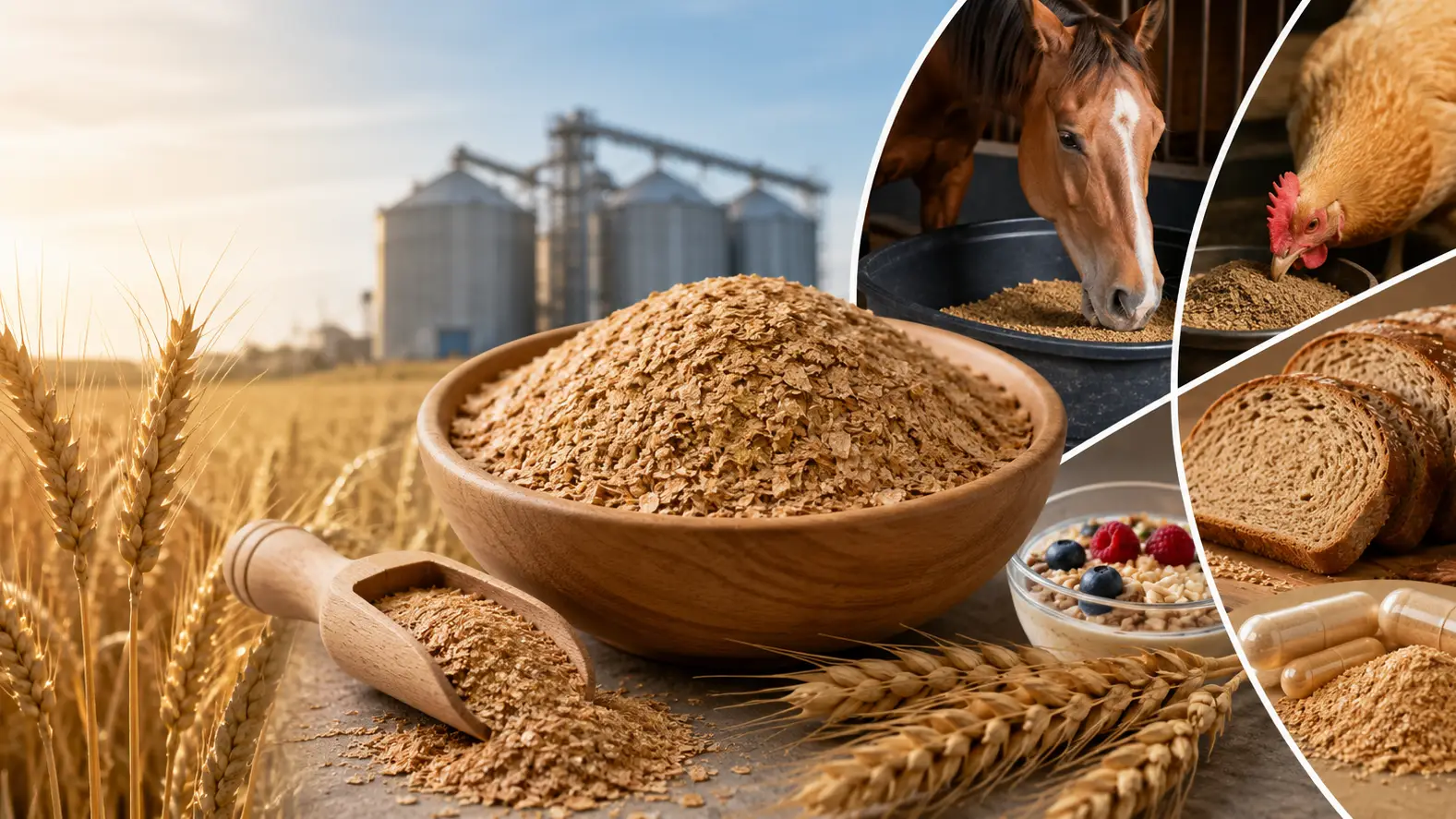
Wheat bran is the coarse outer portion of the wheat kernel separated during commercial flour milling. The product page for this supply-chain offering identifies the material as originating from India, with Triticum aestivum declared as the species of origin and HS Code 230230. It is supplied as a solid material with a light-brown to golden-flake appearance and a characteristic grain odor.
From a commercial perspective, wheat bran is important because it converts part of the wheat milling stream into a marketable feed ingredient. The USDA Agricultural Marketing Service defines wheat bran as the coarse outer covering of the wheat kernel separated during conventional flour milling, while the USDA Economic Research Service notes that wheat milling by-products including bran, shorts, and middlings are used in animal-feed production.
Why Wheat Bran Matters to Feed Buyers
For animal-feed manufacturers, wheat bran can provide a combination of fiber, protein, carbohydrates, minerals, and physical bulk. The product specification lists crude protein at approximately 14–16%, crude fiber at 9–10%, crude fat at 3.0–4.5%, and ash at a maximum of 6%, illustrating why buyers generally assess wheat bran as part of a broader feed formulation rather than as a single-purpose nutritional ingredient.
The commercial value of wheat bran therefore depends on more than its basic commodity identity. Feed mills, livestock producers, distributors, and trading companies need predictable specifications, appropriate microbiological quality, suitable packaging, and dependable logistics. This creates a practical sourcing opportunity for B2B marketplaces that can connect buyers with documented product specifications and supply options.
Wheat Bran Applications Across Feed and Food Industries
Livestock Feed Applications
The principal commercial application of the supplied feed-grade wheat bran is animal nutrition. According to the product information, wheat bran can be used in feed for cattle, poultry, sheep, pigs, and horses, while its bulky nature can help lighten feed mixtures and support mash formulations. The same source cautions that its relatively high fiber level means formulation and animal age should be considered when determining appropriate inclusion.
FAO technical information also recognizes wheat bran as a conventional feedstuff and describes its contribution of bulk, carbohydrates, protein, minerals, and vitamins in livestock diets. FAO resources further identify wheat bran among agricultural by-products used for cattle and buffalo feeding, demonstrating the established role of cereal milling by-products within feed systems.
Emerging Food and Higher-Value Uses
Although feed remains central to the commercial positioning of this particular product, wheat bran is receiving increased research attention as a source of dietary fiber and functional components. A 2024 review indexed by PubMed describes wheat bran as a valuable source of dietary fiber and discusses fractionation approaches that can separate its anatomical layers and improve utilization of its nutritional components.
Recent research is also examining wheat-bran-derived arabinoxylan for food and functional applications. A 2025 Food Chemistry review highlights research into arabinoxylan from wheat bran as a functional dough additive, while a 2026 review discusses potential applications including functional food components, delivery systems, and packaging materials. These developments suggest a longer-term valorization pathway, although buyers should distinguish research-stage opportunities from the feed-grade commercial specification of the product offered here.
What B2B Buyers Look for When Sourcing Wheat Bran
Product Specifications and Feed Suitability
Procurement teams sourcing wheat bran typically need to establish whether the material matches their formulation requirements before comparing suppliers on price. Relevant parameters include moisture, crude protein, crude fiber, fat, ash, phosphorus, calcium, lysine, bulk density, microbiological limits, contaminants, and physical appearance. The current product specification provides values for these parameters, including moisture below 14%, phosphorus at 0.9%, lysine at a minimum of 0.5%, and bulk density of approximately 0.30 g/cm³.
Buyers should also examine whether the specification is consistent from shipment to shipment. Wheat bran composition can vary between mills because milling systems generate different product streams and proportions of bran, endosperm, germ, and other fractions. The product information itself notes that wheat bran composition can vary significantly between mills, making specification control particularly relevant for compound-feed manufacturers managing formulation consistency.
Safety, Certification and Documentation
Feed-grade buyers also need evidence that the material meets applicable safety and quality requirements. The listed specification states that total plate count is below 2,000,000 CFU/g, Salmonella is negative per 25 g, aflatoxin B1 is below 5 ppb, and heavy metals as well as dioxins and PCBs are compliant according to the product documentation. ISO/HACCP is also indicated, while Halal and Kosher certification are available on request.
Documentation can become particularly important when wheat bran is imported across borders. Buyers may require technical data sheets, safety documentation, certificates, origin information, microbiological results, contaminant specifications, packaging details, and regulatory documentation appropriate to the destination market. The ability to review these details before commercial negotiation can reduce qualification time and help procurement teams compare suppliers on a like-for-like basis.
Wheat Bran Quality Specifications and Supply Considerations
Packaging, Storage and Shelf Life
Wheat bran is a relatively bulky agricultural feed ingredient, so logistics can materially influence its delivered cost. The listed supply specification offers 50 kg packaging or bulk supply in PP woven bags or bulk formats. It recommends cool, dry, pest-free storage and states a shelf life of six months.
For buyers purchasing bulk wheat bran, packaging should be evaluated together with shipment size, container utilization, warehouse capacity, handling requirements, moisture protection, and local distribution arrangements. The objective is not simply to obtain the lowest nominal product price, but to establish a delivered supply cost that remains commercially viable after freight, handling, storage, and potential quality-control expenses.
Origin and Supply Chain Reliability
The listed wheat bran is sourced from India, making origin an important consideration for international buyers evaluating agricultural commodity supply. Wheat production and milling conditions can vary by geography and season, while mill-specific processing affects the physical and nutritional characteristics of bran. For this reason, supplier qualification should address both the stated country of origin and the consistency of the individual supply stream.
The USDA's current wheat-sector information confirms the importance of wheat milling by-products within animal-feed channels, while FAO resources have long documented wheat bran as an established feed resource. For international procurement teams, this established application base can support recurring demand, but commercial decisions should still account for freight economics, destination regulations, seasonal availability, and the supplier's ability to maintain agreed specifications.
Buyer Intent, Supplier Comparison and Procurement Strategy
Who Buys Wheat Bran
The most relevant wheat bran buyers include compound-feed manufacturers, livestock-feed producers, agricultural commodity traders, feed distributors, animal nutrition companies, and procurement teams supplying cattle, sheep, pigs, horses, or other livestock markets. The product's feed-grade positioning makes these buyers more commercially relevant than general food-ingredient purchasers when evaluating this particular supply specification.
Buyer intent is usually strongest when a company needs a recurring feed ingredient rather than a small trial quantity. A procurement team may search for a wheat bran supplier, compare bulk wheat bran offers, investigate wheat bran specifications, or seek an India-origin supplier because it is preparing a formulation, replenishing inventory, qualifying an alternative source, or expanding distribution into a new market.
How Buyers Compare Suppliers
Supplier comparison commonly extends beyond price. Procurement teams may assess protein and fiber levels, moisture, microbiological results, contaminant limits, packaging, minimum order quantities, documentation, certifications, origin, lead times, shipment flexibility, and the supplier's ability to respond to specification or logistics requirements. This is particularly important for feed manufacturers because changes in raw-material characteristics can affect formulation economics and finished-feed consistency.
For buyers evaluating a commercial source, the Wheat Bran product page provides a practical starting point for reviewing the stated origin, technical specifications, packaging, quality parameters, certifications, storage conditions, and inquiry options. Using a product-specific sourcing page allows procurement teams to move from general market research toward a defined supplier discussion rather than relying solely on generic commodity searches.
Wheat Bran Market Opportunities and Future Applications
Demand Supported by Feed and By-Product Valorization
The established use of wheat bran in animal feed gives the product a durable commercial foundation. FAO documentation identifies wheat bran as a recognized feedstuff, while the USDA continues to classify bran and other wheat milling by-products as inputs into animal-feed production. This positions wheat bran within a broader circular-economy model in which milling by-products are redirected into productive agricultural uses rather than treated solely as waste.
A further opportunity comes from improving the value extracted from wheat bran. A 2024 Applied Sciences review notes that wheat bran contains fiber, phenolic compounds, vitamins, proteins, and minerals and examines fractionation methods intended to improve utilization. Such research can broaden the commercial relevance of wheat bran over time, particularly where processors can separate or modify specific fractions for higher-value applications.
Functional Ingredients and Technology Development
Research into wheat bran is increasingly focused on the functionality of its constituent compounds rather than only its conventional bulk-feed role. Recent scientific reviews describe arabinoxylan as an important wheat-bran component with applications being investigated in functional foods, dough systems, delivery technologies, and other value-added materials. This represents an application-development trend rather than a blanket indication that conventional feed-grade wheat bran is interchangeable with purified functional ingredients.
For manufacturers, traders, and distributors, this distinction creates two separate commercial pathways: dependable conventional demand from feed applications and longer-term opportunities arising from fractionation, processing, and ingredient valorization. Buyers should therefore match the grade and specification of wheat bran to the intended use rather than assuming that all wheat bran products have identical technical or regulatory suitability.
Conclusion: Building a Reliable Wheat Bran Supply Strategy
From Commodity Purchase to Qualified Supply
Wheat bran is commercially relevant because it combines an established livestock-feed application with a growing research base around dietary fiber, arabinoxylan, fractionation, and higher-value utilization. For conventional feed buyers, however, the immediate sourcing priorities remain practical: nutritional specifications, microbiological safety, contaminant control, packaging, origin, storage, documentation, and dependable supply.
A strong procurement strategy should therefore begin by defining the intended feed application and required specification, followed by supplier qualification and delivered-cost comparison. Buyers should compare wheat bran suppliers using consistent technical criteria and verify whether the material can support their production requirements across repeated shipments. This approach is more reliable than selecting solely on headline commodity pricing.
Connecting Buyers With Commercial Supply Opportunities
For distributors, feed manufacturers, traders, and procurement teams, a B2B marketplace can simplify the transition from market research to supplier engagement by bringing product specifications and sourcing information into one commercial context. A structured wheat bran listing can help buyers identify the material, assess its stated quality profile, review packaging and origin, and determine whether an inquiry is appropriate for their purchasing requirements.
The Wheat Bran sourcing page can therefore serve as the commercial entry point for buyers seeking feed-grade wheat bran and supplier information. As demand evolves across livestock nutrition and wheat-bran valorization, transparent specifications and reliable supply relationships will remain central to successful B2B procurement.
Sources
Leave a Comment