Introduction
Soya lecithin plays an increasingly important role in dairy and non-dairy product formulation as food manufacturers respond to growing demand for better texture, longer shelf life, processing efficiency, and clean-label ingredients. These challenges are especially visible in the expanding plant-based sector, where replicating the stability and mouthfeel of traditional dairy remains a technical hurdle.
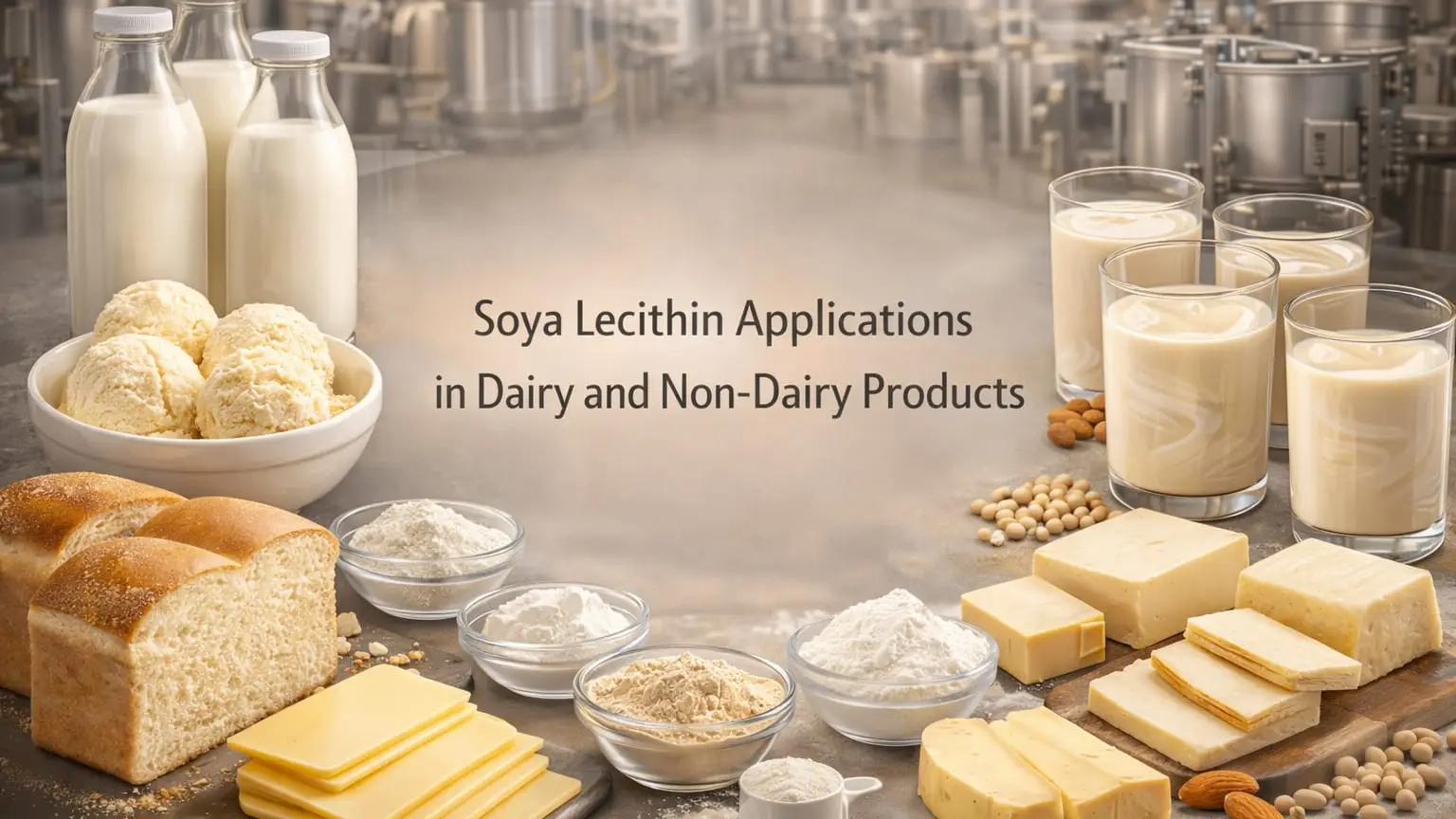
Derived from soybeans and rich in functional phospholipids, soya lecithin supports stable emulsions, smooth texture, and consistent dispersion in complex food systems. It is widely used in products such as milk, ice cream, creamers, plant-based beverages, vegan cheese, and nutritional powders. This article examines how soya lecithin functions in dairy and non-dairy applications, the benefits it delivers to manufacturers, and key considerations for sourcing food-grade lecithin.
Understanding Soya Lecithin in Food Formulation
Soya lecithin is a natural mixture of phospholipids, triglycerides, glycolipids, and minor fatty acid components obtained during the refining of soybean oil. Its key functional compounds, including phosphatidylcholine and phosphatidylethanolamine, give lecithin its amphiphilic nature. This structure allows one part of the molecule to interact with water while the other interacts with fats and oils.
This dual functionality enables soya lecithin to stabilize oil and water systems, improve ingredient compatibility, and enhance overall product structure. Food-grade soya lecithin complies with international standards such as Codex Alimentarius and is approved for use in major global markets, including the European Union, the United States, and Asia-Pacific regions.
Manufacturers can select from liquid, de-oiled powder, or granular lecithin formats depending on processing needs. Beyond emulsification, soya lecithin also functions as a dispersing agent, release agent, texture modifier, and antioxidant synergist. Its natural origin and low usage levels support cost efficiency and clean-label positioning across both dairy and plant-based formulations.
Core Functional Roles of Soya Lecithin
Emulsification and Fat Stabilization
Soya lecithin stabilizes emulsions by forming a protective layer around fat droplets, preventing separation and coalescence over time. This function is essential in dairy and non-dairy systems where stable fat distribution determines product appearance, mouthfeel, and shelf life.
Texture and Mouthfeel Improvement
By improving fat dispersion and reducing surface tension, lecithin contributes to smoother textures and reduced graininess. This effect is especially important in beverages, frozen desserts, and cheese alternatives, where consumers expect a creamy and uniform eating experience.
Improved Dispersibility and Instantization
In powdered products, soya lecithin improves wettability and rehydration. Lecithin-treated powders dissolve more easily in hot or cold liquids, making it a key ingredient in dairy powders, creamers, meal replacements, and plant-based beverage mixes.
Applications of Soya Lecithin in Dairy Products
Milk and Cream-Based Systems
In milk, cream, and recombined dairy products, soya lecithin stabilizes interactions between fats and proteins. This helps reduce creaming, aggregation, and separation during processing and storage. It is particularly effective in UHT-treated milk and recombined dairy formulations, where heat processing can destabilize emulsions.
Ice Cream and Frozen Desserts
Soya lecithin supports fat crystallization control in ice cream and frozen desserts. It helps create a stable fat network that improves air incorporation, smoothness, and melting behavior. By limiting ice crystal growth and fat separation, lecithin contributes to improved texture and shelf stability.
Processed Cheese and Cheese-Based Products
In processed cheese and cheese analogs, soya lecithin improves fat emulsification and melt performance. This results in more uniform texture, better sliceability, and reduced oil separation during heating. These properties are critical for foodservice and industrial cheese applications.
Dairy Powders and Creamers
Soya lecithin is widely applied to milk powders and creamers to improve flowability and prevent clumping. Lecithin-treated powders rehydrate more easily and disperse evenly in beverages, improving both consumer convenience and industrial handling efficiency.
Applications in Non-Dairy and Plant-Based Products
Plant-Based Beverages
Plant-based beverages made from soy, almond, oat, coconut, or blended sources rely on soya lecithin to stabilize suspensions of water, plant proteins, oils, and minerals. Lecithin helps prevent sedimentation, improves visual stability, and supports a consistent mouthfeel throughout shelf life.
Non-Dairy Creamers and Desserts
In non-dairy creamers, desserts, and whipped toppings, soya lecithin delivers stable emulsions and smooth texture without relying on synthetic emulsifiers. This functionality supports clean-label positioning while maintaining performance in both liquid and powdered formats.
Vegan Cheese and Spreads
Achieving acceptable melt, stretch, and firmness in vegan cheese remains a formulation challenge. Soya lecithin helps bind plant oils, water, and starch or protein systems into a cohesive structure. This improves texture uniformity, reduces gumminess, and enhances melt behavior.
Nutritional and Protein Powders
Soya lecithin improves protein dispersion in fortified blends, meal replacements, and high-protein powders. Its instantizing properties allow rapid solubility and uniform mixing, making it suitable for both dairy-based and plant-based nutritional products.
Benefits for Food Manufacturers
From a processing standpoint, soya lecithin enhances production efficiency by improving ingredient integration and reducing mixing time. Its release properties help minimize fouling on equipment surfaces, which lowers downtime and reduces product waste.
Soya lecithin is also highly cost-effective. Low inclusion levels deliver significant functional benefits, allowing manufacturers to streamline formulations across multiple product categories. Its versatility enables ingredient standardization while supporting innovation in both dairy and non-dairy product lines.
Regulatory and Labeling Considerations
As a soy-derived ingredient, soya lecithin must be declared as an allergen under regulations such as EU Regulation 1169/2011 and U.S. FDA labeling requirements. Despite this obligation, lecithin remains widely accepted due to its natural origin and long history of safe use.
Transparent labeling and responsible sourcing are particularly important in plant-based products, where consumer trust and ingredient familiarity influence purchasing decisions. In many markets, soya lecithin supports clean-label claims as a recognizable and naturally derived emulsifier.
Sourcing High-Quality Soya Lecithin
Consistent performance depends on lecithin quality. Food-grade soya lecithin should meet specifications for phospholipid content, peroxide value, moisture level, and purity. Certifications such as HACCP, Halal, and Kosher are often required depending on market needs.
Reliable suppliers provide traceability from soybean origin through processing and offer batch-specific documentation to ensure consistency. Proper storage in cool, dry conditions is essential to preserve emulsifying performance and shelf life.
Working with established global suppliers such as Chemtradeasia helps manufacturers secure stable supply, consistent quality, and technical support for both dairy and plant-based product development.
Conclusion
Soya lecithin remains a foundational ingredient in modern dairy and non-dairy food formulation. Its ability to stabilize emulsions, enhance texture, and improve processing efficiency makes it indispensable across a wide range of products, from milk and ice cream to plant-based beverages and nutritional powders.
As consumer demand continues to grow for both traditional dairy and plant-based alternatives, soya lecithin offers a reliable, technically proven, and commercially valuable solution. By understanding its applications and sourcing high-quality material from trusted suppliers such as Chemtradeasia, food manufacturers can develop stable, competitive, and consumer-ready products in an increasingly demanding global market.
Leave a Comment