Sodium Bicarbonate Feed Grade in Animal Nutrition
Sodium bicarbonate feed grade is a mineral-based feed ingredient used in animal nutrition where sodium supply, dietary buffering, and acid-base management are relevant to feed formulation. The Tradeasia product page identifies the material as Sodium Bicarbonate (Feed) - China, with CAS Number 144-55-8, HS Code 283630, a white crystalline powder appearance, and a minimum active ingredient assay of 99% NaHCO₃. The listed product specification also identifies it as feed grade and provides microbiological and heavy-metal compliance information.
Technical Profile Relevant to Feed Buyers
For procurement teams, the physical and chemical profile is central to supplier evaluation. The listed material has moisture below 0.5%, a pH of 8.0–8.6 in a 1% solution, an approximate bulk density of 0.80 g/cm³, and a 24-month shelf life when stored in cool, dry, sealed conditions. These parameters give feed manufacturers a practical baseline for comparing specifications between suppliers and ensuring that the material fits their formulation and handling requirements.
Buffering and Sodium Supply
The principal nutritional relevance of sodium bicarbonate is its role as a source of sodium and as a dietary buffering material, particularly in ruminant diets. University of Wisconsin Extension notes that sodium bicarbonate can be incorporated into dairy rations when formulation conditions create additional pressure on rumen pH, while Pennsylvania State University identifies it as a widely used dietary buffer for rations containing substantial quantities of concentrates or other highly fermentable feeds.
The commercial significance is therefore broader than the commodity's chemical identity alone. Buyers are purchasing a feed-grade functional ingredient whose value depends on consistent quality, appropriate regulatory status, dependable logistics, and compatibility with feed manufacturing processes. For this reason, procurement teams typically assess sodium bicarbonate feed grade as part of a complete ingredient-sourcing decision rather than treating it solely as a low-complexity mineral commodity.
Key Industrial Applications and End-Use Demand
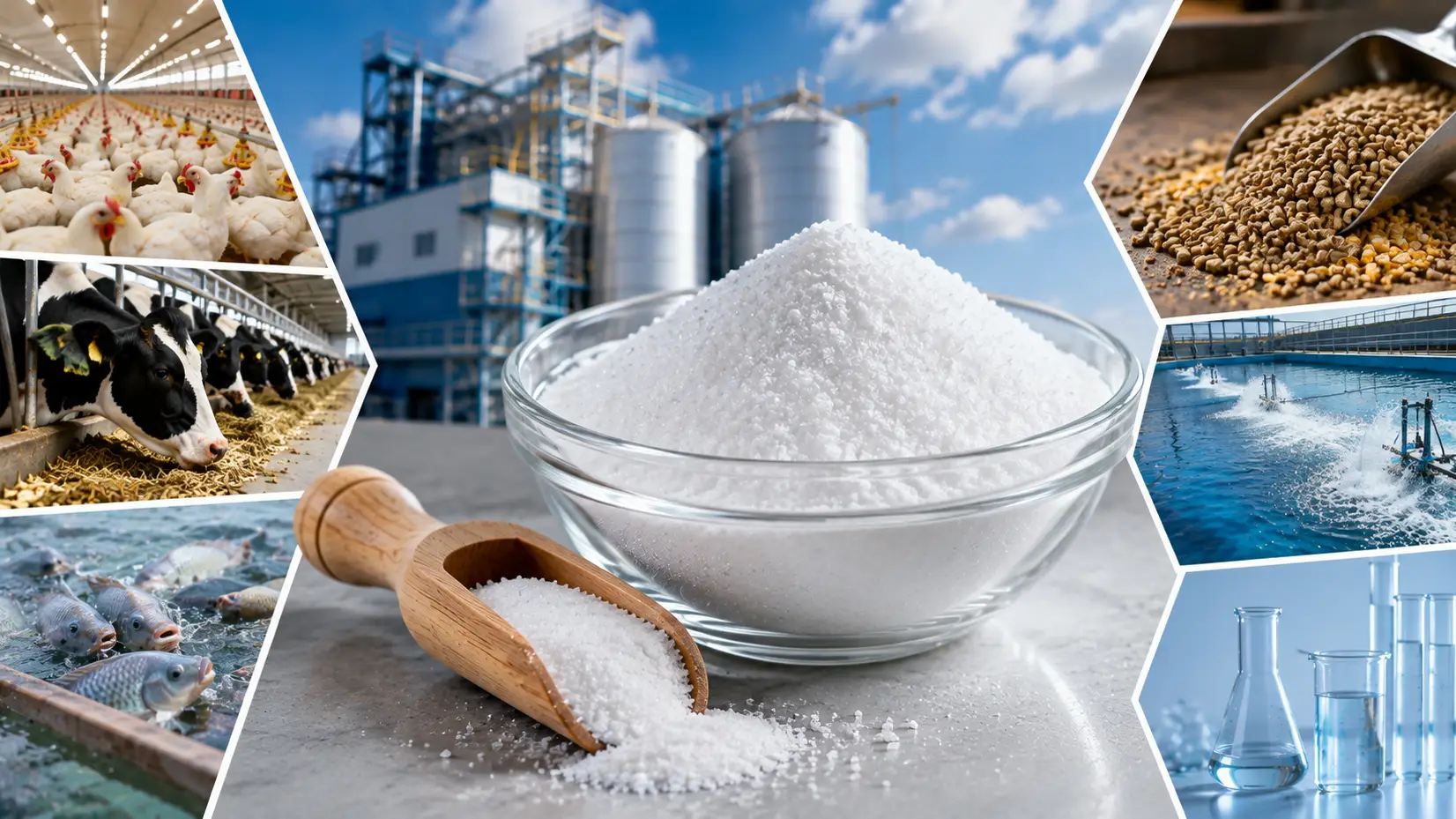
Sodium bicarbonate feed grade has applications across animal nutrition, with particularly important roles in ruminant diets and selected poultry formulations. The product information supplied for the China-origin material specifically identifies ruminant supplementation for sodium supply and management of acid indigestion and metabolic acidosis, while also describing poultry applications involving calcium absorption, eggshell quality, salt substitution, and litter conditions.
Ruminant Feed Applications
Dairy cattle and other ruminants represent a major application area because rumen fermentation can be affected by dietary composition and concentrate levels. Technical literature has long established the relationship between dietary buffering and rumen conditions, while more recent research continues to examine sodium bicarbonate as part of strategies for managing rumen environments. A 2024 study published in Animal Feed Science and Technology evaluated magnesium oxide and sodium bicarbonate supplementation in feedlot lambs and reported effects on rumen environment, nutrient digestibility, fermentation, and selected performance indicators.
Poultry Feed Applications
Poultry represents a different application pathway in which sodium bicarbonate can be considered in relation to electrolyte supply and specific feed formulation objectives. The product page identifies applications in poultry associated with calcium absorption and eggshell quality, as well as partial salt substitution in broilers. These applications can make feed-grade sodium bicarbonate relevant to poultry-feed manufacturers looking for mineral ingredients that can be incorporated into formulation strategies rather than used simply as bulk sodium sources.
Application diversity affects the commercial demand profile because purchasing requirements can differ according to species, feed formulation, manufacturing process, and local regulatory expectations. A dairy-feed manufacturer may prioritize buffering performance and consistency, while a poultry-feed producer may focus more strongly on formulation compatibility and electrolyte considerations. Consequently, sodium bicarbonate feed buyers should evaluate application-specific requirements rather than assuming that one specification automatically suits every feed segment.
Market and Application Trends Shaping Buyer Demand
The market outlook for sodium bicarbonate feed grade is closely connected to changes in animal-feed formulation rather than to the chemical alone. As livestock producers and nutrition specialists manage increasingly intensive feeding systems, ingredients that support targeted nutritional functions can become strategically relevant. Research and technical guidance continue to investigate how buffering agents interact with high-energy diets, rumen fermentation, animal performance, and environmental conditions.
Higher-Intensity Feed Formulation
One important application trend is the continued attention given to high-energy and higher-concentrate rations. University of Wisconsin Extension explains that increasing starch and fermentable feed components can create challenges for maintaining normal rumen pH and notes sodium bicarbonate as one potential buffering component in appropriate dairy-ration strategies. This creates a recurring technical requirement for feed formulators rather than a purely seasonal or discretionary application.
Heat Stress and Electrolyte Management
Environmental conditions can also influence feed formulation decisions. During periods of heat stress, dairy cattle can experience changes in feeding behavior, water consumption, and physiological buffering, making electrolyte and ration management important considerations. Wisconsin Extension specifically discusses sodium bicarbonate in the context of summer dairy ration management, noting that the ingredient can provide sodium while serving as part of a strategy to maintain rumen pH.
Recent research also indicates that interest in buffering agents is not limited to dairy cattle. The 2024 feedlot-lamb study examining sodium bicarbonate and magnesium oxide demonstrates continuing scientific attention to buffering strategies in other ruminant production systems. This does not mean that sodium bicarbonate will produce identical results in every species or ration; instead, it reinforces the importance of application-specific formulation and evidence-based procurement decisions.
Buyer Intent and Procurement Requirements
The primary buyers of sodium bicarbonate feed grade are organizations involved in animal-feed production and distribution, including feed mills, premix manufacturers, animal nutrition companies, livestock-feed businesses, poultry-feed producers, distributors, traders, and procurement teams sourcing mineral and functional feed ingredients. Their purchase intent is typically commercial and recurring because the ingredient may form part of ongoing feed formulations rather than a one-time industrial application.
What Feed Buyers Evaluate
Procurement teams generally compare supplier specifications covering assay, moisture, pH, microbiological parameters, contaminants, packaging, certifications, origin, shelf life, and documentation. For the listed China-origin product, the available information includes a minimum 99% NaHCO₃ assay, moisture below 0.5%, defined microbiological specifications, compliant heavy-metal information, 25 kg PP woven-bag packaging, ISO/HACCP status, and availability of Halal and Kosher certification. These details can help buyers establish an initial technical qualification framework.
Why Buyers Compare Suppliers
Supplier comparison becomes important because the same chemical identity does not automatically mean equivalent commercial suitability. Feed manufacturers must consider whether a supplier can provide consistent specifications, appropriate documentation, reliable packaging, stable product availability, and logistics aligned with production schedules. Regulatory requirements can also vary by destination market; for example, EUR-Lex specifies technical characteristics for sodium hydrogen carbonate, including NaHCO₃ identity, assay, pH, solubility, and impurity limits within the relevant European regulatory framework.
For buyers evaluating this product commercially, the Sodium Bicarbonate Feed Grade product page provides a practical starting point for reviewing the listed origin, specifications, packaging, certifications, and inquiry pathway. This makes the product listing relevant not only to informational searches but also to procurement teams moving from application research toward supplier qualification.
China Sourcing and B2B Marketplace Opportunities
China is identified as the origin of the sodium bicarbonate feed grade listed on the product page, creating a direct sourcing angle for international buyers seeking feed ingredients from Chinese supply channels. For B2B procurement, China sourcing is most effective when technical specifications, quality documentation, packaging requirements, shipping considerations, and destination-market compliance are evaluated together rather than focusing solely on unit price.
Specification-Based Supplier Qualification
A specification-based approach can reduce ambiguity during supplier comparison. Buyers can begin with the required NaHCO₃ assay and then examine moisture, pH, microbiological limits, heavy metals, bulk density, shelf life, packaging format, and available certifications. The listed product provides a defined reference point, including 99% minimum active ingredient assay, less than 0.5% moisture, 25 kg PP woven-bag packaging, and ISO/HACCP status.
Marketplace Procurement Advantages
A B2B chemical and feed-ingredient marketplace can help procurement teams connect application requirements with supplier information in a structured way. Instead of searching only for a generic sodium bicarbonate supplier, buyers can identify the intended feed grade, country of origin, technical specification, packaging, certification requirements, and destination market before initiating a commercial inquiry. This approach is particularly relevant for distributors and feed manufacturers that need repeatable sourcing processes.
For Tradeasia, Chemtradeasia, and the Tradechem marketplace ecosystem, the commercial opportunity lies in connecting technically informed buyers with product and supplier information without overstating performance claims. The Sodium Bicarbonate Feed Grade sourcing page can therefore function as a conversion point for buyers who have already established that feed-grade sodium bicarbonate fits their application and now need specifications, pricing, customization, shipping, or supplier discussions.
Commercial Outlook for Sodium Bicarbonate Feed Grade
The commercial outlook for sodium bicarbonate feed grade is supported by its established role in animal nutrition and by continuing attention to feed formulation, rumen management, electrolyte balance, and species-specific nutrition. Its demand should be viewed through the applications it serves: dairy and other ruminant feeding systems, feedlot nutrition, poultry formulations, and broader animal-nutrition programs. Research continues to assess buffering strategies under different diets and production conditions, demonstrating that application context remains central to product value.
Opportunities for Suppliers and Distributors
For manufacturers, traders, and distributors, commercial differentiation can come from specification transparency, dependable documentation, suitable packaging, certification availability, and the ability to respond to application-specific procurement requirements. A product with a clearly documented technical profile is easier for feed manufacturers to assess than an undifferentiated commodity listing. This is especially relevant when buyers operate across markets with different regulatory and quality expectations.
Opportunities for Procurement Teams
For procurement professionals, the strongest sourcing strategy is to compare sodium bicarbonate feed suppliers according to total commercial suitability rather than price alone. Technical conformity, quality consistency, supplier responsiveness, packaging, logistics, certification, and destination-market requirements all influence the effective cost and reliability of a feed ingredient. Regulatory specifications such as those published through EUR-Lex also illustrate why buyers should verify requirements applicable to their intended market before finalizing a purchase.
Overall, sodium bicarbonate feed grade occupies a commercially relevant position at the intersection of mineral nutrition, feed formulation, and B2B ingredient sourcing. The China-origin product listed by Tradeasia provides buyers with a defined technical reference, including 99% minimum NaHCO₃ assay, feed-grade status, microbiological specifications, 25 kg packaging, and available quality certifications. For buyers progressing from research to procurement, the Sodium Bicarbonate Feed Grade product page offers a direct route to product information and commercial inquiry, supporting a more structured approach to animal-feed ingredient sourcing.
Sources
Leave a Comment