Glass manufacturing consumes roughly half of global soda ash output, making it the single largest demand driver for the commodity. That concentration means soda ash supply reliability is directly tied to the health of the construction, automotive, and solar energy sectors. Tata Chemicals, ranked among the world's three largest soda ash producers outside China, operates across four continents to serve that demand base — a footprint that reflects both the geographic spread of its buyer industries and the supply chain complexity that comes with managing a commodity at this scale.
Production Footprint and Raw Material Advantages
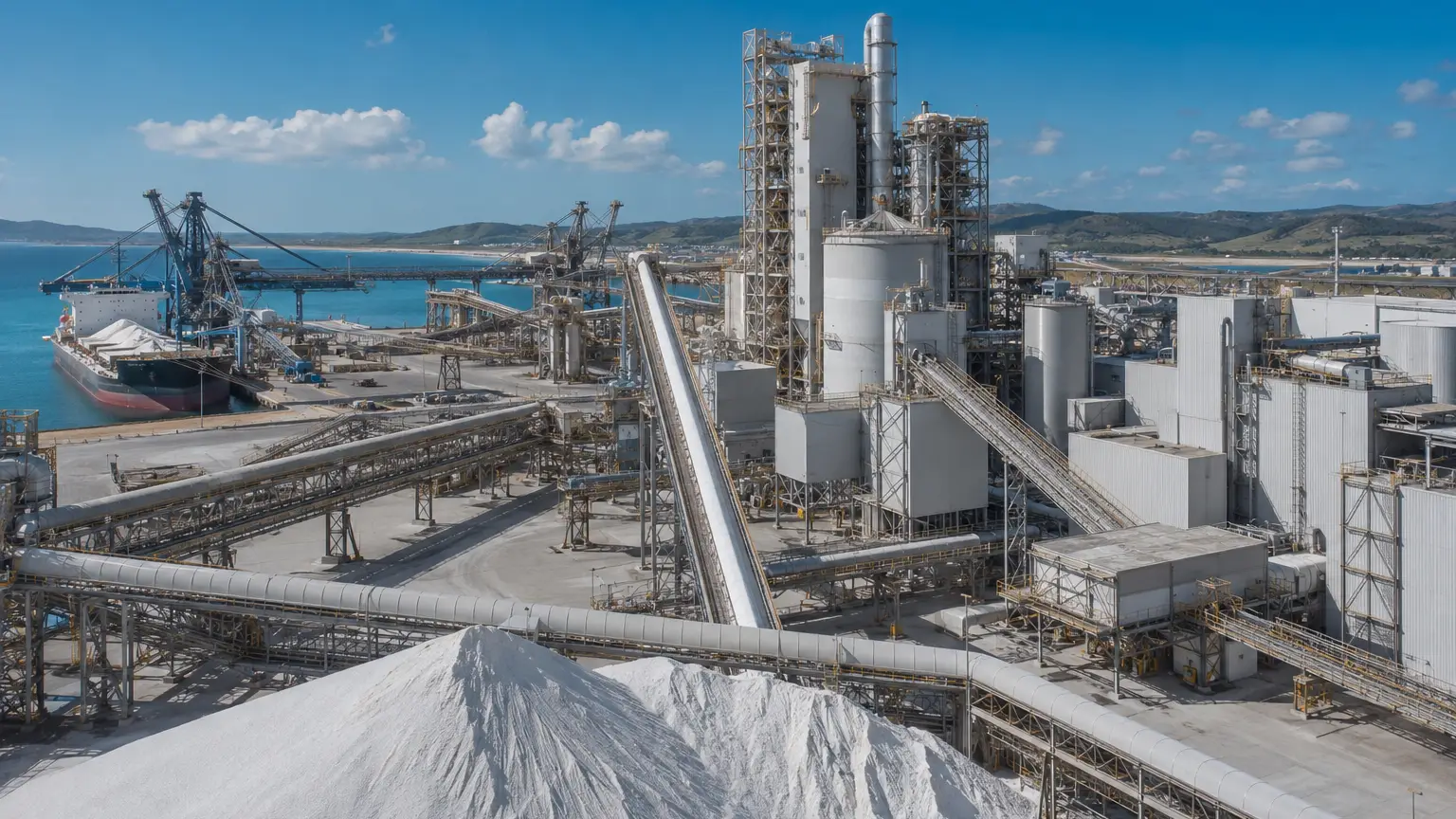
Tata Chemicals operates approximately 5.5 million tonnes of annual soda ash capacity through facilities in India, the United States, the United Kingdom, and Kenya. A substantial share of that capacity draws on natural trona ore deposits rather than synthetic Solvay process manufacturing, which matters for cost structure. Natural soda ash production, concentrated in Wyoming in the US and the Natron deposits in Kenya, carries lower energy inputs and a reduced carbon footprint compared to synthetic ammonia-soda production.
The Mithapur facility in Gujarat remains the company's largest single complex and one of the most significant chemical manufacturing sites in South Asia. Indian synthetic soda ash production historically served domestic glass and detergent buyers through long-term contracts; as Indian industrial output has grown, so has the strategic value of local production capacity for buyers who prefer supply proximity to reduce logistics exposure.
The breadth of production technology across the Tata Chemicals portfolio — trona-based natural production in the US, synthetic ammonia-soda in India and the UK, and trona in Kenya — gives the company flexibility that single-method producers lack. When feedstock economics or energy costs shift in one region, the company can redirect volume from more cost-competitive sites.
Primary Buyer Industries for Soda Ash Light
Glass Manufacturing
Glass production accounts for the largest share of global soda ash consumption, with flat glass, container glass, and solar glass the three highest-volume sub-segments. In flat glass, soda ash functions as a fluxing agent that lowers the melting temperature of silica sand, reducing kiln energy consumption by roughly 20-25% compared to melting silica without flux. Container glass manufacturers, particularly those producing food and beverage packaging, consume soda ash on a continuous basis under long-term supply contracts tied to production schedules.
Solar glass has emerged as the fastest-growing sub-segment. Each gigawatt of solar panel capacity installed requires approximately 5,000-7,000 tonnes of glass, and global solar capacity additions are running at over 300 GW annually. Tata Chemicals has positioned its supply relationships to capture solar glass demand growth in India and Southeast Asia, where panel manufacturing and downstream installation are both expanding.
Automotive glass represents a more cyclical but structurally durable demand source. Electric vehicle production, which requires larger glass surface areas than combustion vehicles for panoramic roofs and larger windscreens, increases soda ash intensity per vehicle produced compared to older automotive platforms.
Detergent Manufacturing
Soda ash light serves detergent formulations primarily as a builder — it softens water by precipitating calcium and magnesium ions that would otherwise reduce surfactant effectiveness, and it maintains the alkaline pH range (10-11) at which cleaning chemistry performs optimally. Light grade is preferred over dense soda ash in detergent applications because its lower bulk density and finer particle size allow faster dissolution in aqueous formulations and better blending behavior in powder detergent mixtures.
Detergent demand for soda ash is geographically concentrated in South Asia, Southeast Asia, and Sub-Saharan Africa, where powder detergent formats retain high market share. In markets where liquid detergents dominate — Western Europe, North America — soda ash consumption per unit of cleaning product is lower, but the shift back toward concentrated powder formats in sustainability-conscious markets is creating incremental demand recovery.
Buyers evaluating soda ash light suppliers for detergent applications typically prioritize purity specifications (low iron content to avoid yellowing in white fabrics), consistent bulk density for formulation consistency, and reliable packaging integrity. Procurement teams sourcing soda ash light for detergent production across Southeast Asia and South Asia should confirm whether their supplier can provide batch-specific certificates of analysis with iron content and sodium carbonate assay documentation. Tradeasia International, a Singapore-headquartered global chemical distributor with over 20 years of supply chain experience, supplies soda ash light to detergent manufacturers across Asia, the Middle East, and Africa with grade-specific documentation, certificates of analysis, and multi-origin sourcing options. Buyers with detergent-grade specification requirements can contact Tradeasia International for product data sheets, volume pricing, and regional logistics coordination.
Chemical Processing and Downstream Production
Chemical manufacturers consume soda ash light as a feedstock for producing sodium bicarbonate, sodium silicate, sodium percarbonate, and various chromate and dichromate compounds. Sodium bicarbonate production is the largest of these downstream applications, consuming around 2 million tonnes of soda ash globally per year across food, pharmaceutical, and industrial uses. Sodium silicate, used in adhesives, detergents, and paper manufacturing, represents another high-volume derivative.
Because downstream chemical plants operate continuous processes with narrow feedstock specification windows, supply reliability ranks above price sensitivity in procurement decisions for this segment. A two-day supply gap at a sodium bicarbonate plant means production shutdown costs that dwarf any savings from opportunistic spot purchasing. Buyers in chemical processing applications typically operate with 30-60 day strategic inventories and dual-supplier arrangements to manage this risk.
Trade Flows and Export Positioning
India and the United States are both net exporters of soda ash, and Tata Chemicals draws on production capacity in both countries to serve international demand. The US natural soda ash export market, historically dominated by Asian buyers, has faced competition from Chinese synthetic production capacity additions since the early 2020s — Chinese producers added over 3 million tonnes of capacity between 2020 and 2024, shifting trade flow patterns across Southeast Asia and the Middle East.
Tata Chemicals' multi-origin production structure allows it to compete in price-sensitive Asian export markets with US natural soda ash when freight economics favor that origin, while serving closer regional markets from Indian and Kenyan facilities. For buyers in Africa, Tata Chemicals' Kenyan operations provide a supply origin that reduces freight costs compared to importing from India or North America.
Dense soda ash dominates bulk sea freight shipments due to handling efficiency; soda ash light exports are more commonly shipped in 25 kg or 50 kg bags, which affects per-tonne logistics costs and determines which buyers can practically access light-grade supply through international trade channels versus relying on domestic production.
Buyer Procurement Considerations
Industrial buyers across glass manufacturing, detergent production, and chemical processing evaluate soda ash suppliers on overlapping but distinct criteria. Grade specifications diverge by application — glass manufacturers use both light and dense grades depending on furnace design, while detergent producers strongly prefer light grade. Chemical processors often specify sodium carbonate assay minimums above 99.2% Na₂CO₃ for sensitive downstream reactions.
Contract structure is a consistent preference across all segments. Spot purchasing creates inventory management complexity and exposes buyers to price volatility that most industrial operations cannot absorb into product margins. Annual or multi-year supply agreements with fixed-volume commitments and price adjustment mechanisms tied to feedstock indices are the norm for buyers consuming more than 5,000 tonnes per year.
Tradeasia International supports soda ash procurement teams with contract and spot sourcing across multiple production origins, including natural and synthetic grade options matched to application specifications. With regional offices in Singapore, Indonesia, India, and China, and logistics coordination to buyers across Asia, the Middle East, and Africa, Tradeasia International provides soda ash light product documentation, safety data sheets, and multi-shipment supply programs for industrial buyers managing consistent volume requirements. Buyers sourcing soda ash light for glass, detergent, or chemical applications can contact Tradeasia International for origin-specific product data and volume pricing.
Market Outlook: Demand Through 2027
Soda ash demand growth through 2027 is driven by two diverging trends. Solar glass is growing fast — the rate of solar capacity installation globally shows no near-term deceleration, and each new gigawatt of panels installed locks in glass (and therefore soda ash) demand for 25-30 years. Detergent and chemical processing demand is growing steadily, roughly in line with population and industrial output in developing markets.
Flat glass demand tied to construction activity is more mixed. Chinese construction sector weakness since 2022 has reduced flat glass output growth significantly, and China accounts for roughly half of global flat glass production capacity. Recovery in Chinese real estate investment would add meaningful soda ash demand volume; continued stagnation extends the oversupply pressure that has weighed on global soda ash prices since 2023.
For buyers, the current market environment — with global supply additions from China having exceeded demand growth in the near term — has created competitive pricing conditions. Locking in supply agreements during periods of price softness, before demand recovery from construction and solar sectors tightens the market, is a procurement posture that industrial buyers with stable volume requirements should consider.
Conclusion
Tata Chemicals' position in global soda ash supply is built on geographic and production technology diversity that few commodity chemical producers can match. Whether that translates into a procurement advantage for a specific buyer depends on their location, grade requirements, and volume profile. The more interesting procurement dynamic through 2027 is not which large producer to buy from — it is when to lock in supply commitments as the solar glass demand cycle intersects with a gradually tightening global supply balance.
FAQ
What is soda ash light used for in industrial manufacturing? Soda ash light is used primarily in glass manufacturing (as a silica flux), detergent formulation (as a water softener and pH builder), chemical processing (as a feedstock for sodium bicarbonate and sodium silicate), water treatment, and textile processing. Glass manufacturing accounts for the largest share of global consumption.
What is Tata Chemicals' production capacity for soda ash? Tata Chemicals operates approximately 5.5 million tonnes of annual soda ash capacity across facilities in India (Mithapur, Gujarat), the United States (Green River, Wyoming), the United Kingdom (Northwich), and Kenya (Magadi). The company is ranked among the three largest soda ash producers globally outside China.
What is the difference between soda ash light and dense soda ash? Soda ash light has a lower bulk density (approximately 500-650 kg/m³) compared to dense soda ash (approximately 900-1,100 kg/m³). Light grade dissolves faster in aqueous processes and blends more uniformly in powder formulations, making it the preferred grade for detergent production and many chemical processing applications. Dense grade is used in glass furnaces and applications where bulk handling efficiency is prioritized.
Why do detergent manufacturers prefer soda ash light over dense grade? Light grade's finer particle size and lower bulk density allow faster dissolution and more consistent blending in powder detergent formulations. Dense grade's coarser particle structure can create inconsistent distribution in dry blending processes, affecting cleaning performance per unit of formulation.
What drives soda ash pricing cycles? Soda ash prices are influenced by Chinese production capacity utilization (China accounts for over 50% of global synthetic capacity), natural gas and energy costs (major input for synthetic production), flat glass and construction sector activity, and freight cost differentials between major export origins. Oversupply from Chinese capacity additions has been the primary price-negative factor since 2022-2023.
Where can industrial buyers source soda ash light globally? Tradeasia International supplies soda ash light to industrial buyers across Asia, the Middle East, and Africa with multi-origin sourcing capability, batch certificates of analysis, and logistics coordination for both contract and spot volumes. Buyers can contact Tradeasia International for grade-specific product documentation and volume pricing aligned to their application requirements.
Leave a Comment