Soda Ash Trade Summary May 2026: Balanced Supply, Sensitive Costs
Soda ash supply chain conditions in May 2026 were commercially balanced but still sensitive to regional cost differences, export timing, and freight exposure. The uploaded brief states that China’s light soda ash benchmark was around 1,212 RMB per ton on May 12, down slightly from the beginning of the month, while market commentary described soda ash as range-bound because factory operations and inventory availability limited strong upside.
Availability Was Not the Same as Delivered Security
According to the U.S. Geological Survey, global soda ash production was estimated at 71 million metric tons in 2025, while China, the United States, and Turkey together accounted for about 80% of global production. That production concentration explains why soda ash trade flow depends heavily on major origin markets, even when the product appears widely available.
The same USGS data shows that U.S. soda ash production reached an estimated 12 million tons in 2025, while exports were 6.9 million tons and more than 50% of U.S. production was exported. This confirms that soda ash import export activity is structurally important for buyers outside major production hubs, especially in regions where glass, detergents, and chemical processing depend on imported material.
For soda ash buyers, the May 2026 lesson was that product availability alone did not remove procurement risk. A supplier could have cargo available at origin, but the buyer’s final cost still depended on freight route, insurance premium, port timing, grade choice, packaging, and exposure to regional price arbitrage.
China Export Activity: Why Regional Prices Still Mattered
China remained the central price signal for Asian soda ash sourcing because of its large production scale and influence on regional export availability. USGS reported that China was the leading global producer in 2025 with an estimated output of 38 million tons, most of which was synthetic soda ash, followed by the United States and Turkey.
Chinese Supply and Price Pressure
The uploaded May 2026 brief describes China’s light soda ash benchmark at around 1,212 RMB per ton on May 12, with slight month-start weakness and range-bound market behavior. That price signal suggests that Chinese supply was not sharply tight, but it also does not mean landed cost was equally soft for every importing country.
USGS noted that global soda ash prices declined during 2025 because of oversupply and weak demand from key industries, and that this trend was largely driven by China’s Inner Mongolia natural soda ash expansion, which added about 5 million tons per year of capacity in mid-2023. This capacity context helps explain why Chinese export activity remained an important balancing force for regional buyers.
For importers, the practical issue was timing. Buyers in South Asia, Southeast Asia, the Middle East, and Africa had to assess whether Chinese export offers were attractive after adding freight, handling, insurance, customs, and shipment timing, because source-market softness can disappear once delivered cost is calculated.
Regional Production Costs: Natural Versus Synthetic Soda Ash
Regional production cost differences remained one of the main reasons soda ash landed costs varied across markets. USGS reported that natural soda ash producers in China, Turkey, and the United States benefited from relatively low production costs and lower environmental impacts, while synthetic soda ash typically consumes more energy and costs more.
Production Route and Origin Advantage
Natural soda ash is generally linked to trona or sodium-carbonate-rich brine resources, while synthetic soda ash is commonly produced from salt and limestone through energy-intensive chemical processing. USGS states that natural soda ash is obtained from trona and brines, while synthetic soda ash is costlier to produce and generates environmental wastes.
This difference matters directly to soda ash sourcing because buyers are not only comparing quoted price by supplier. They are comparing the cost structure behind each origin, the supplier’s ability to sustain production, and the export competitiveness of the region. Natural soda ash origins may have cost advantages, but the delivered price can still rise when freight, port distance, and destination risk increase.
For buyers assessing European or regional origin options, Soda Ash Light 99% Bosnia supply can support origin-based product comparison before RFQ planning. In May 2026, this type of origin-specific review mattered because landed cost depended on both production economics and the practicality of moving cargo to the buyer’s market.
Demand Base: Glass, Detergents, Chemicals, and Water Treatment
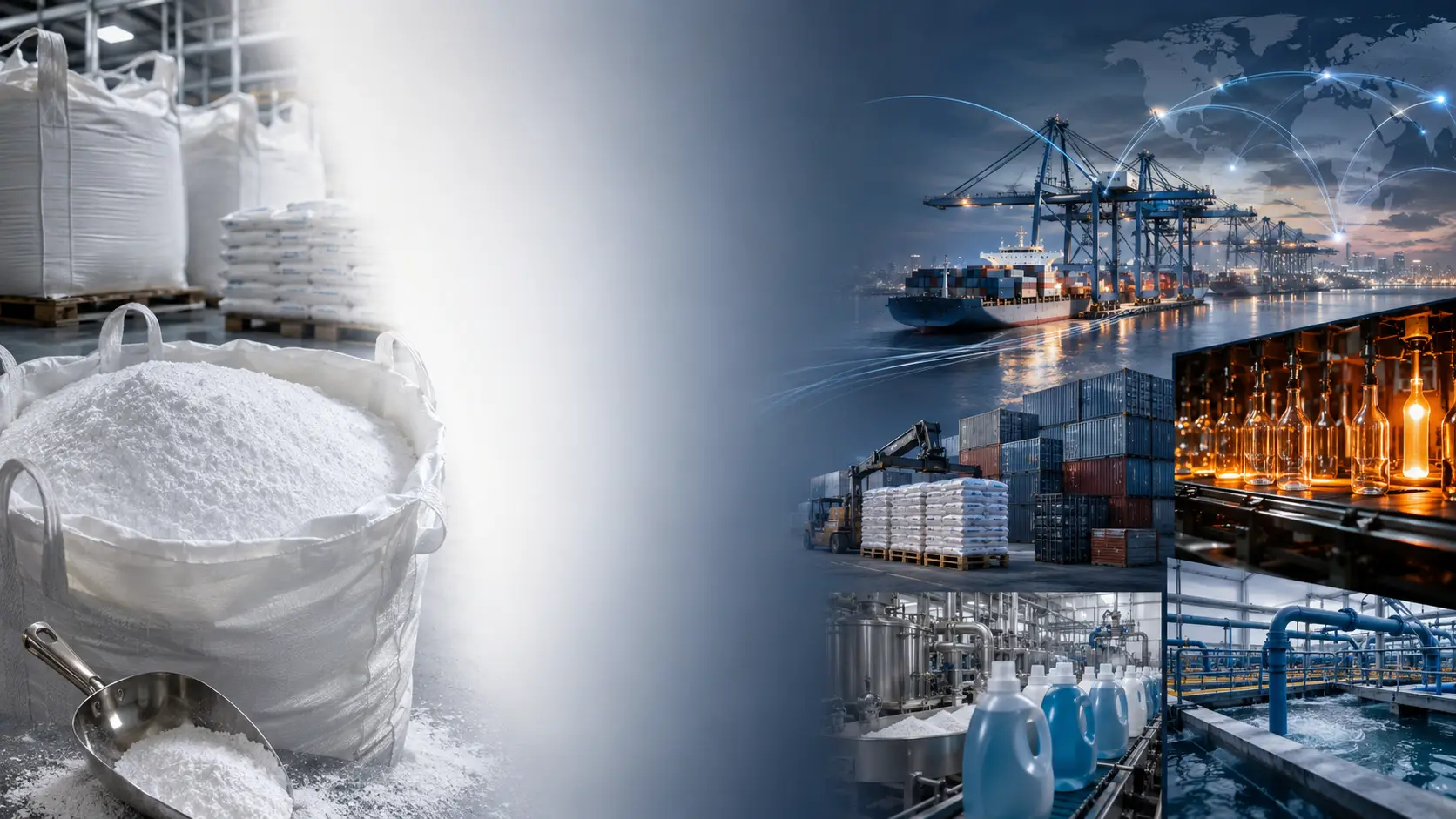
Soda ash glass industry demand remained the largest structural anchor for global consumption, giving the market a steady base even when regional prices moved sideways. USGS estimated the 2025 U.S. end-use distribution of soda ash as glass 45%, chemicals 28%, distributors 7%, soap and detergents 5%, flue gas desulfurization 4%, pulp and paper 1%, and water treatment 1%.
Industrial Demand and Grade-Sensitive Consumption
Glass manufacturing remains the dominant consumption channel because soda ash supplies sodium oxide and functions as a flux in soda-lime glass production. ANSAC states that more than 50% of worldwide soda ash production is earmarked for glass production, and that soda ash reduces the furnace temperature needed to melt silica.
Detergents, chemicals, and water treatment create a different demand profile. ANSAC describes soda ash as an essential raw material for glass, detergents and soaps, chemicals, and other industrial products, while also noting that soda ash is made in dense, medium dense, and light grades with different physical characteristics. Buyers evaluating broader application fit can compare the alkaline agents and pH regulators category when connecting soda ash to pH control, alkalinity, and related chemical applications.
The commercial implication is that soda ash product availability must be read by application, not only by volume. Glass producers often focus on dense grade consistency, low impurities, and bulk handling, while detergent and chemical buyers may prioritize lighter grades, solubility, bagged supply, pH performance, and regional distribution reliability.
Freight and Insurance: Why Landed Cost Moved Differently by Region
Soda ash logistics became a major procurement variable in 2026 because freight and insurance costs could change the economics of an otherwise attractive origin offer. The Guardian reported in March 2026 that maritime insurers cancelled war-risk cover for vessels in the Gulf amid Iran conflict disruption, with rerouting and rising freight costs affecting cargo moving through the region.
Freight Exposure and Import Dependency
The same report cited Freightos data showing Shanghai-to-Jebel Ali container rates rising from about US$1,800 per 40-foot container to about US$3,700 within a short period, while emergency conflict surcharges were imposed on cargo moving through the region. For soda ash importers, this kind of freight shock can materially change landed cost, especially when buyers depend on containerized or bagged supply.
Washington Post reporting also described wider economic damage from the Iran conflict, including disruption to ocean and air traffic between Asia and Europe and a 45% rise in Asia-to-Europe air freight costs. While soda ash is typically not an air-freight commodity, the broader signal is that regional logistics shocks can spill into industrial supply chains through fuel, port, insurance, and routing costs.
Buyers in import-dependent regions therefore needed to compare the full delivered cost rather than the supplier’s ex-works or FOB price. For South Asian procurement teams, Soda Ash Light 99.2% India supply can serve as a destination-relevant product reference when comparing local availability, regional sourcing options, and import exposure.
Dense and Light Soda Ash: Grade Selection in Procurement Strategy
Soda ash procurement strategy depends heavily on whether the buyer needs dense soda ash, light soda ash, or a grade that supports detergent, chemical, or bulk solution preparation. ANSAC states that soda ash grades share the same chemical properties but differ in bulk density, particle size, particle shape, flow characteristics, and angle of repose, which directly affects handling and application suitability.
Grade Choice Changes Landed-Cost Logic
Dense soda ash is strongly associated with glass manufacturing because particle sizing and low fines support more uniform furnace mixing. ANSAC describes dense soda ash as a product relied on by flat glass, glass container, and detergent manufacturers, with uniform particle size, high sodium carbonate content, and low chloride and iron impurities.
Medium dense or lighter soda ash can be more relevant in detergent applications because dissolution, absorption, dust control, and blending behavior matter. ANSAC notes that medium dense soda ash can offer an alternative to synthetic light soda ash for detergent manufacturers, supporting liquid absorption, reduced dusting, and bulk handling advantages. Buyers reviewing specifications and documents can use the Chemtradeasia Download Center before aligning grade choice with quality approval.
This is why buyers should not treat soda ash as a single undifferentiated commodity. A lower-priced cargo may not be commercially attractive if the grade does not match the plant’s handling system, application requirement, storage condition, or quality tolerance.
Buyer Strategy: Managing Soda Ash Import-Export Risk in 2026
B2B soda ash buyers in 2026 needed to manage procurement across three layers: origin cost, destination logistics, and application grade. USGS data shows that global production was concentrated in China, the United States, and Turkey, while U.S. exports remained substantial and natural soda ash retained a production-cost advantage over synthetic soda ash.
Procurement Priorities for B2B Buyers
The first procurement priority is to separate product availability from delivered reliability. May 2026 market commentary in the uploaded brief indicates that soda ash was generally available, but freight, insurance premiums, and export-demand shifts continued to affect landed cost.
The second priority is to compare supplier offers by use case. Glass manufacturers, solar glass producers, container glass plants, detergent producers, chemical processors, and water treatment buyers may all buy sodium carbonate, but their grade, packaging, purity, and logistics requirements differ. A quote that works for detergent blending may not meet the handling or impurity expectations of a glass furnace.
For quotation planning, buyers can use the Chemtradeasia sourcing inquiry page to coordinate product availability, documentation, grade requirements, and commercial follow-up. In a May 2026 market where soda ash was available but regionally sensitive, the best procurement decisions came from matching supplier origin, grade selection, freight route, document readiness, and landed-cost exposure.

Leave a Comment