Introduction
Kaolin remains one of the most important mineral pigments in paper manufacturing, valued for its ability to improve opacity, brightness, smoothness, and print quality. For paper mills, the decision is not only about kaolin grade but also about supply form. Choosing between slurry kaolin and dry kaolin has a direct impact on handling efficiency, coating performance, logistics costs, and overall process stability.
This article provides a comprehensive comparison of slurry versus dry kaolin for paper mills. It examines performance characteristics, handling and logistics considerations, operational trade-offs, and sourcing strategies, helping mills select the most practical and cost-effective solution for their specific manufacturing environment.
Understanding Kaolin Supply Forms in Paper Manufacturing
Kaolin functions as both a filler and a coating pigment in papermaking. Its fine particle size and platy morphology enhance light scattering, surface smoothness, and ink interaction. Mills typically receive kaolin in one of two forms.
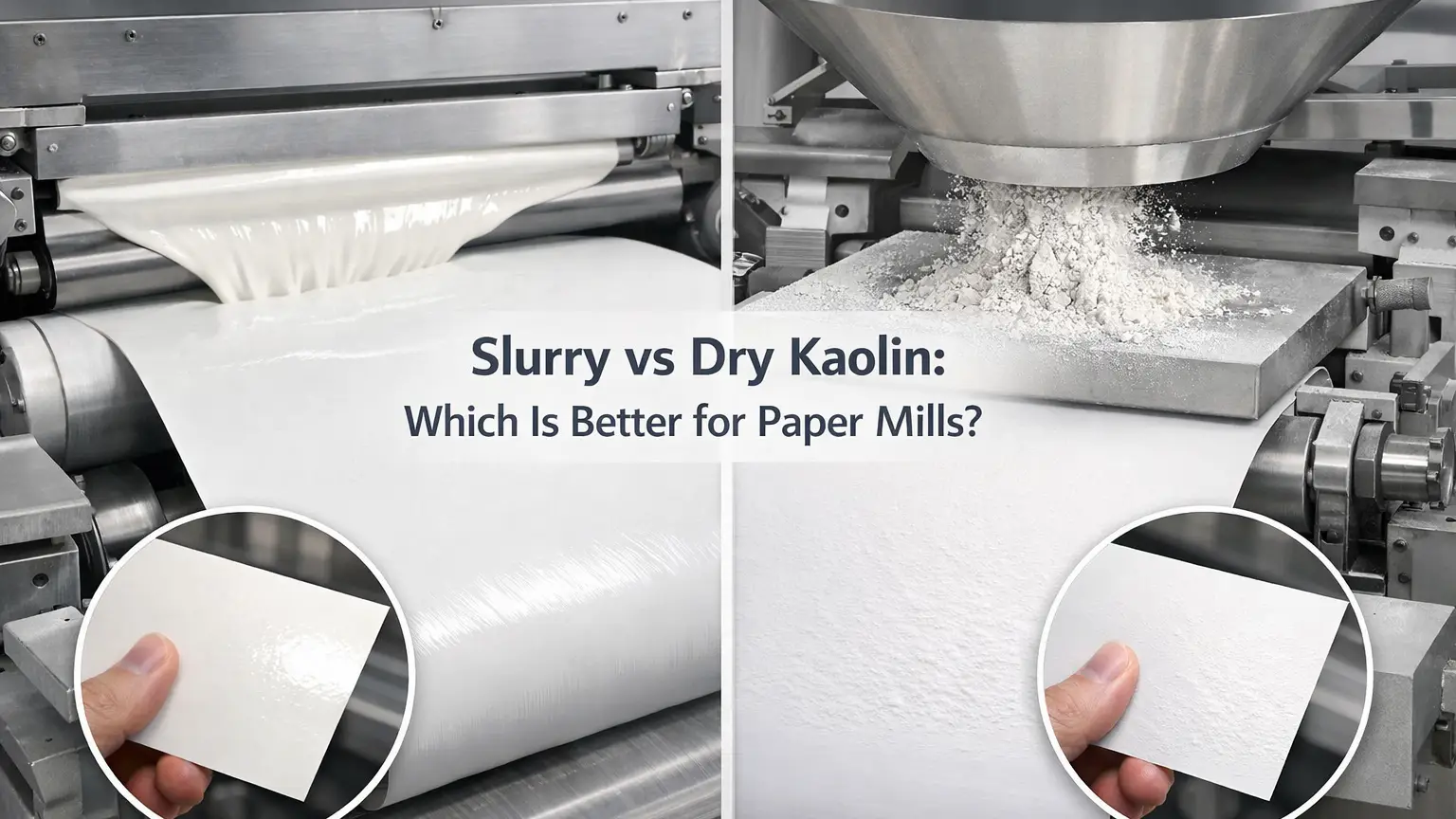
Slurry kaolin is supplied as a water-based suspension, while dry kaolin is delivered as a powder. Each form influences storage requirements, preparation steps, and integration into the paper machine. Selecting the right option depends on mill design, production scale, and whether kaolin is primarily used in coating kitchens or at the wet end.
Slurry Kaolin for Paper Mills
Slurry kaolin consists of finely processed kaolin particles dispersed in water, typically at solids levels between 55 and 70 percent. Dispersants are added during manufacturing to keep particles stable and prevent settling during transport and storage.
In paper coating operations, slurry kaolin can be fed directly into coating formulations with minimal preparation. This plug-and-play approach supports high-speed blade, rod, and air-knife coating systems, where consistency and uptime are critical. Uniform particle distribution helps achieve stable gloss, smoothness, and coat weight control.
Handling slurry kaolin requires agitated storage tanks, pumps, and controlled dilution systems. While this infrastructure demands space and capital investment, it reduces manual handling and eliminates dust exposure. For mills running continuous coating lines, slurry kaolin often delivers predictable performance and lower operational variability.
Dry Kaolin in Paper Manufacturing
Dry kaolin is supplied as a fine powder, usually packaged in bags or transported in bulk through pneumatic systems. Typical paper-grade dry kaolin has a high proportion of particles finer than 2 microns, making it suitable for both filler and coating applications once properly dispersed.
Dry kaolin offers flexibility in logistics and storage. Without added water, shipping efficiency improves, especially over long distances. Mills can store dry kaolin in silos with smaller footprints compared with slurry tank farms. This form is commonly used for wet-end filler addition or for mills that prepare their own coating slurries on site.
However, dry kaolin requires careful dispersion before use. Hydrapulpers, high-shear mixers, or dispersion mills are needed to achieve stable slurries. Poor dispersion can lead to agglomeration, which may affect opacity, print density, and coating uniformity. Proper moisture control and dust management are also essential to prevent caking and handling issues.
Performance Differences in Paper Applications
From a performance perspective, slurry kaolin generally offers higher consistency in coating applications. Since particles are pre-dispersed and stabilized by the supplier, the risk of agglomeration is low. This consistency supports uniform gloss development, smooth surfaces, and predictable ink behavior.
Dry kaolin performance depends heavily on on-site dispersion quality. Well-designed systems can deliver excellent results, particularly for filler applications where slight variability has less impact on surface appearance. Dry kaolin also allows mills to adjust solids levels and dispersion parameters to suit specific grades or furnish conditions.
For continuous coating operations where downtime is costly, slurry kaolin often provides a smoother workflow. In batch-based systems or mills with strong dispersion control, dry kaolin can perform just as effectively.
Operational and Cost Considerations
The economic balance between slurry and dry kaolin is shaped by logistics, energy use, labor, and infrastructure. Slurry kaolin carries higher transport costs due to water content and requires specialized handling and storage systems. However, it reduces energy consumption and labor associated with dispersion.
Dry kaolin offers lower freight costs per ton of pigment and simpler long-term storage. Energy consumption shifts toward on-site dispersion rather than pumping and agitation. Labor involvement is higher during slurry preparation, but overall flexibility improves.
The total cost outcome depends on mill scale, distance from suppliers, available infrastructure, and production stability requirements. Mills increasingly use total delivered cost modeling to compare options realistically.
Quality, Safety, and Environmental Considerations
Consistency is critical for both slurry and dry kaolin. Slurry kaolin benefits from supplier-controlled milling and dispersion but requires monitoring for settling and microbial growth during storage. Dry kaolin requires strict humidity control to maintain flowability and prevent caking.
From a safety perspective, dry kaolin generates airborne dust that must be managed through engineering controls and personal protective equipment. Slurry kaolin largely eliminates dust risks but increases water handling and effluent management requirements.
Environmental evaluations increasingly consider the full lifecycle footprint, including transport emissions, energy use for dispersion, and water management. These factors vary by site and should be assessed within each mill’s sustainability framework.
Choosing the Right Option for Your Paper Mill
There is no universal answer to whether slurry or dry kaolin is better for paper mills. Large integrated mills with high-speed coaters and stable production schedules often favor slurry kaolin for its ease of integration and consistent coating performance. Mills focused on filler applications, variable product mixes, or located far from suppliers may prefer dry kaolin for its logistical efficiency and flexibility.
Trial evaluations, pilot testing, and detailed cost modeling remain the most reliable ways to determine suitability. R&D teams and production engineers should assess performance indicators such as gloss, opacity, runnability, and total operating cost before committing to a long-term supply strategy.
Global sourcing platforms such as Chemtradeasia play an important role by providing access to multiple kaolin grades and supply forms, supported by technical documentation and logistics expertise. This flexibility allows mills to align kaolin supply with evolving production and market requirements.
Conclusion
The comparison between slurry vs dry kaolin for paper manufacturing highlights clear differences in handling, performance, and operational impact. Slurry kaolin excels in coating consistency and ease of use, while dry kaolin offers logistical efficiency and formulation flexibility.
The optimal choice depends on mill scale, process design, infrastructure, and end-product requirements. By aligning kaolin supply form with production goals and cost structure, paper mills can maintain consistent quality, improve efficiency, and remain competitive in demanding paper markets.
Leave a Comment