Sesame Seed Applications, Buyers and Global B2B Sourcing
Sesame Seed in the Global B2B Food Market
Commercial Role of Sesame Seed
Sesame seed is an established agricultural commodity with broad relevance across food manufacturing, ingredient processing, bakery, confectionery, prepared foods, seasoning, tahini, and edible oil production. For B2B procurement teams, its commercial importance comes from the combination of whole-seed applications and its suitability as a raw material for further processing. This gives sesame seed a wider procurement role than a conventional retail ingredient and creates demand among manufacturers, processors, distributors, wholesalers, and international traders. The global trade classification for sesame seed is HS 120740, providing a useful reference point for international sourcing and trade analysis.
Market Position and Demand Drivers
Demand is supported by the versatility of sesame in established food categories as well as continuing interest in plant-based and nutrient-rich ingredients. Market research estimates the global sesame seeds market at approximately USD 7.4 billion in 2025, with a projected 2.4% CAGR from 2026 to 2033, although market estimates vary according to scope and methodology. Bakery and confectionery remain important demand segments, while black sesame is gaining attention in premium and functional-food applications.
Sesame's international trade profile also demonstrates its importance to global agricultural sourcing. In 2024, India recorded approximately USD 497.3 million in sesame seed exports, while Nigeria, Brazil, Pakistan, and Tanzania were also among the leading exporters by trade value. This geographic diversity gives buyers multiple sourcing origins but also makes supplier selection, origin assessment, quality consistency, and logistics planning important elements of procurement strategy.
For Tradeasia / Chemtradeasia / Tradechem Marketplace, sesame seed can therefore be positioned around application-driven procurement rather than simple commodity purchasing. Buyers can assess the product according to the intended manufacturing process, required quality characteristics, shipment requirements, and continuity of supply. This approach is particularly relevant for international food manufacturers and distributors that need to balance price, specifications, availability, and supplier reliability.
Key Food Manufacturing Applications of Sesame Seed
Sesame Seed in Processed Foods
Processed food is one of the major commercial categories for sesame seed. Industry applications include tahini, hummus, sauces, spice blends, prepared foods, salads, sushi, and other food formulations in which sesame contributes texture, flavor, visual appeal, or functional ingredient value. The European market-entry analysis published by CBI identifies processed foods as a major sesame application category, alongside bakery and confectionery.
Sesame Seed as an Ingredient and Topping
Whole sesame seed can be incorporated directly into formulations or applied as a visible topping. This flexibility allows manufacturers to use sesame in breads, rolls, crackers, snacks, biscuits, sauces, seasoning blends, and other products. Selection can vary according to whether the manufacturer needs a uniform light-colored seed, a stronger visual contrast, a specific flavor profile, or a seed suitable for roasting and additional processing.
For industrial food production, consistency is an important purchasing consideration because raw materials must integrate into repeatable manufacturing processes. Procurement teams may therefore evaluate cleanliness, purity, seed integrity, color, moisture, microbiological specifications, foreign-matter control, packaging, and documentation alongside commercial pricing. These requirements can differ substantially between a bakery topping application and a processor purchasing sesame for grinding or oil extraction.
The breadth of food applications creates a diverse B2B buyer base. Food manufacturers, ingredient distributors, bakeries, snack companies, confectionery producers, sauce manufacturers, tahini processors, wholesalers, and foodservice suppliers can all participate in sesame procurement. A supplier strategy that begins with the final application can help buyers define the appropriate product specification before comparing offers.
Sesame Seed Demand in Bakery, Confectionery and Prepared Foods
Bakery and Snack Manufacturing
Bakery is one of the most visible commercial applications for sesame seed. Manufacturers use sesame on bread, buns, rolls, crackers, biscuits, and other baked products where the seed contributes recognizable appearance, texture, and flavor. Premium or visually consistent sesame can also be selected when appearance is an important part of product positioning. CBI identifies bakery and confectionery among the leading sesame-consuming segments in Europe.
Confectionery and Specialty Foods
Confectionery manufacturers use sesame in products such as sesame-honey bars, halva, sweet biscuits, and other traditional or modern snacks. Sesame can also support specialty food formulations where consumers associate the ingredient with traditional cuisines or premium natural-food positioning. This creates opportunities for suppliers capable of providing different seed types and specifications for distinct manufacturing requirements.
In bakery procurement, physical characteristics can influence the commercial suitability of a shipment. Buyers may pay particular attention to seed size, appearance, color uniformity, broken-seed levels, purity, and foreign-matter control when sesame will remain visible in the finished product. In contrast, processors purchasing sesame for further transformation may place greater emphasis on characteristics connected with hulling, roasting, grinding, or oil recovery.
These differences reinforce the importance of application-specific purchasing. A food manufacturer should define its intended process and finished-product requirements before selecting a supplier or origin. For B2B marketplaces, this creates a useful commercial connection between product discovery and technical procurement, allowing buyers to move from a general search for “sesame seed supplier” toward a more precise sourcing requirement.
Sesame Seed for Tahini and Edible Oil Processing
Tahini Production
Tahini is a major value-added application in which sesame seed is processed into a smooth paste used in sauces, hummus, spreads, dressings, confectionery, and prepared foods. CBI identifies sesame paste or tahini as an important processed-food application, while industry specifications indicate that hulled sesame is commonly selected where processors require lighter color and controlled hulling characteristics.
Sesame Oil Processing
Sesame is also commercially important as an oil-bearing crop. Sesame seed can be processed into edible oil, creating demand from oil processors and specialty food manufacturers. The value chain therefore extends beyond whole-seed sales: buyers may source sesame according to oil content, moisture, cleanliness, processing suitability, and expected extraction performance. Sesame oil also serves food and specialty ingredient markets, adding another dimension to seed procurement.
For processors, the appropriate raw material depends heavily on the intended process. Tahini manufacturers may prioritize hulling quality, color, flavor, microbiological controls, and purity, whereas oil processors may place stronger emphasis on oil-bearing characteristics and moisture management. Establishing these criteria before purchasing helps reduce the risk of receiving material that is commercially acceptable but technically unsuitable for the buyer's process.
This application diversity creates opportunities for suppliers and distributors that can support differentiated specifications. Rather than treating all sesame seed as interchangeable, B2B buyers can evaluate natural, hulled, sorted, white, or black sesame according to their end-use requirements. Such differentiation can improve procurement efficiency and support more predictable production outcomes.
Understanding Sesame Seed Buyers and Procurement Requirements
Main B2B Buyer Groups
The sesame seed buyer landscape includes industrial bakeries, confectionery manufacturers, snack producers, tahini processors, sauce manufacturers, edible oil companies, ingredient distributors, food wholesalers, foodservice suppliers, and international trading companies. Each group can have different purchasing volumes, packaging requirements, quality standards, delivery schedules, and documentation needs. Consequently, commercial suitability depends on more than the nominal product name.
Procurement Specifications
Buyers should evaluate the product against the technical requirements of the intended application. Important considerations can include seed variety or type, hulled or natural status, color, purity, moisture, foreign matter, microbiological compliance, seed integrity, packaging, country of origin, and relevant certificates. For international procurement, documentation and traceability can become particularly important as food manufacturers seek greater visibility across their supply chains.
Supplier evaluation should also consider consistency over repeated shipments. A competitive first quotation does not necessarily represent the best procurement option if subsequent shipments vary materially in quality, delivery performance, or documentation. Buyers therefore benefit from assessing supplier capacity, origin relationships, quality-control procedures, logistics capabilities, and responsiveness alongside price.
A structured procurement process can improve purchasing decisions by connecting product specifications with commercial requirements. For example, a bakery purchasing visible sesame toppings may prioritize appearance and seed integrity, while a tahini processor may emphasize hulling and microbiological controls. Clearly defining the application allows procurement teams to compare suppliers on a like-for-like basis rather than relying solely on price.
Global Sesame Seed Trade and Sourcing Strategy
Major Exporting Origins
International trade data demonstrates that sesame seed sourcing is geographically diversified. In 2024, leading exporters included India, Nigeria, Brazil, Pakistan, Tanzania, Mozambique, Turkey, and Myanmar. India's reported exports alone reached approximately 244.3 million kg, valued at about USD 497.3 million, while Brazil reported approximately 246.6 million kg of exports valued at USD 347.8 million.
UAE and Regional Sourcing
The UAE is an important regional destination for sesame seed imports. World Bank WITS data shows that in 2024 India supplied approximately 6.56 million kg of sesame seed to the UAE at a reported trade value of USD 13.34 million, followed by Nigeria, Burkina Faso, Pakistan, and Tanzania. This demonstrates the relevance of diversified origin sourcing for Gulf-region food processors, distributors, and trading companies.
For international buyers, origin diversification can provide greater flexibility when harvest conditions, freight availability, currency movements, or regional supply constraints affect a particular origin. However, diversification should not mean compromising specification consistency. Buyers need to establish clear technical requirements and verify that alternative origins can meet the same application standards before shifting procurement volumes.
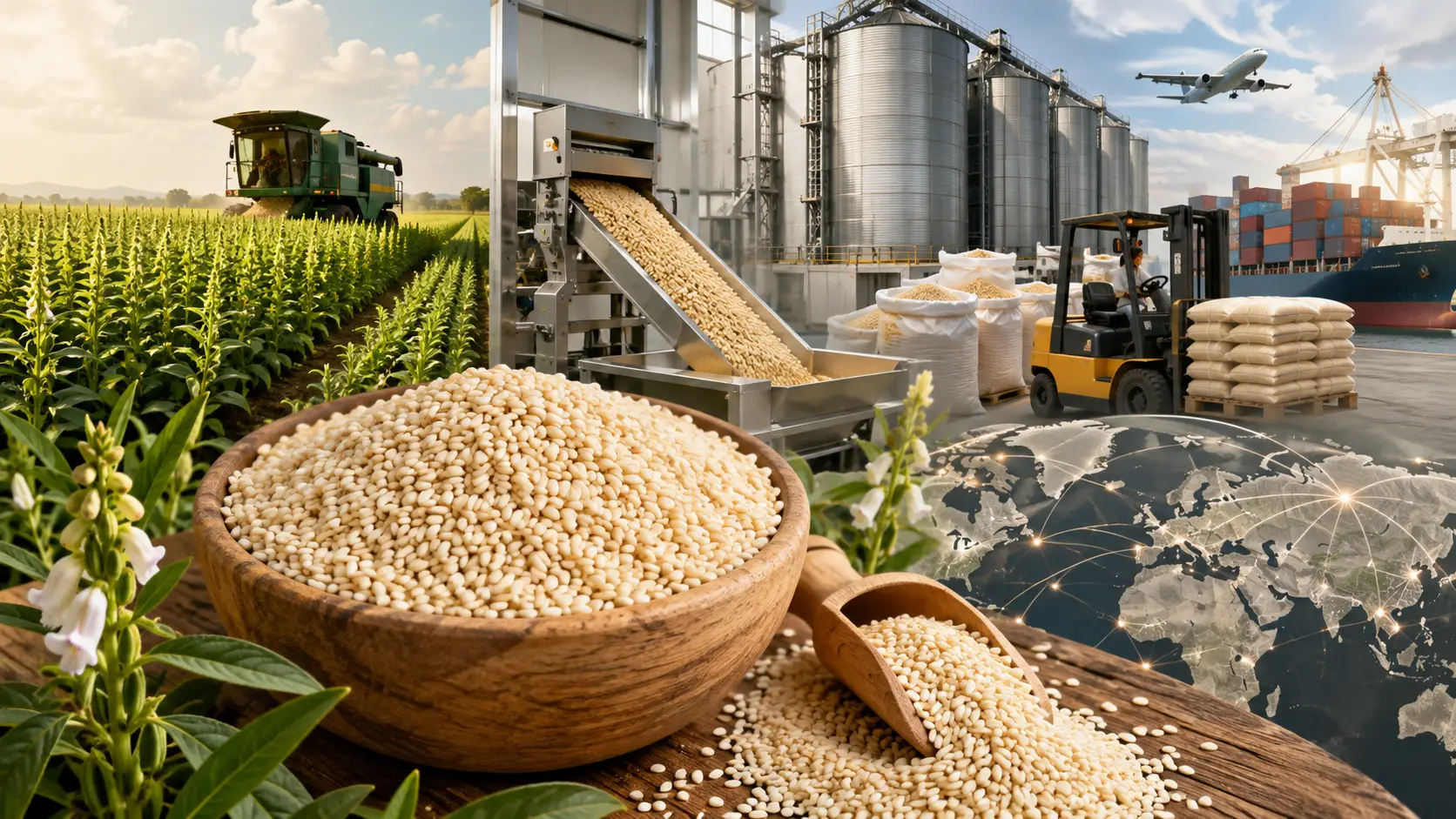
A B2B sourcing platform can add value by connecting buyers with suppliers while keeping the procurement process focused on application, specification, trade documentation, shipment terms, and supply continuity. For sesame seed, this is particularly relevant because the global supply base is broad and the product can move through multiple stages, from agricultural production and cleaning to sorting, hulling, processing, distribution, and final food manufacturing.
Building Reliable Sesame Seed Supply Partnerships
Supplier Qualification
Reliable sesame procurement begins with supplier qualification. Buyers should assess whether a supplier can consistently provide the required sesame type, quality specifications, quantity, packaging, documentation, and delivery schedule. Traceability and quality assurance are increasingly relevant considerations for international food supply chains, particularly when buyers operate in regulated markets.
Long-Term Procurement Planning
Long-term purchasing can also help manufacturers manage supply continuity. Instead of treating every shipment as an isolated transaction, procurement teams can establish expected annual volumes, preferred specifications, delivery windows, approved origins, and quality-control procedures. This creates a clearer framework for negotiating with suppliers and managing changes in market conditions.
The importance of dependable sourcing is illustrated by the UAE's diversified sesame supply base. India, Nigeria, Burkina Faso, Pakistan, and Tanzania were all recorded as suppliers to the UAE in 2024, giving buyers access to multiple origins. Such diversification can support procurement resilience when combined with appropriate supplier qualification and quality verification.
For Tradeasia / Chemtradeasia / Tradechem Marketplace, the commercial opportunity lies in facilitating this connection between global supply and practical buyer requirements. A marketplace approach can help procurement teams identify sesame seed suppliers according to application, quality expectations, sourcing origin, shipment requirements, and commercial objectives, creating a more transparent path from product discovery to B2B purchasing.
Conclusion: Sesame Seed as a Strategic B2B Ingredient
From Commodity to Application-Specific Procurement
Sesame seed has a broad commercial role across bakery, confectionery, processed foods, tahini, sauces, seasoning, snacks, and edible oil production. Its international supply base and multiple processing possibilities mean that buyers need to consider application suitability alongside price and availability. For industrial procurement, the most effective approach is to define the intended use first and then evaluate the appropriate seed type, specification, origin, supplier capability, and logistics model.
Supporting Global B2B Sourcing
The international sesame trade provides buyers with multiple sourcing opportunities, while regional markets such as the UAE demonstrate the importance of reliable cross-border supply. With global exporters spanning Asia, Africa, and Latin America, procurement teams can develop diversified sourcing strategies while maintaining consistent technical requirements. Trade data also confirms that sesame is a significant internationally traded agricultural commodity rather than a purely local food ingredient.
For manufacturers and distributors, successful sesame procurement ultimately depends on matching the right product with the right application. Bakery producers may require visually consistent seed, tahini manufacturers may need carefully processed hulled material, and oil processors may prioritize raw-material characteristics related to extraction. This application-led approach enables buyers to make more informed commercial decisions and reduce avoidable supply-chain risks.
Tradeasia / Chemtradeasia / Tradechem Marketplace can support this B2B sourcing process by connecting commercial buyers with international ingredient and commodity supply opportunities. For companies looking to buy sesame seed, identify suitable suppliers, compare sourcing options, or develop dependable procurement channels, a marketplace-oriented approach provides a practical route toward more structured global sourcing.
Sources
www.fao.org
www.intracen.org
www.comtradeplus.un.org

Leave a Comment