Rice Hulls Market Overview and Commercial Importance
Understanding Rice Hulls as an Industrial Raw Material
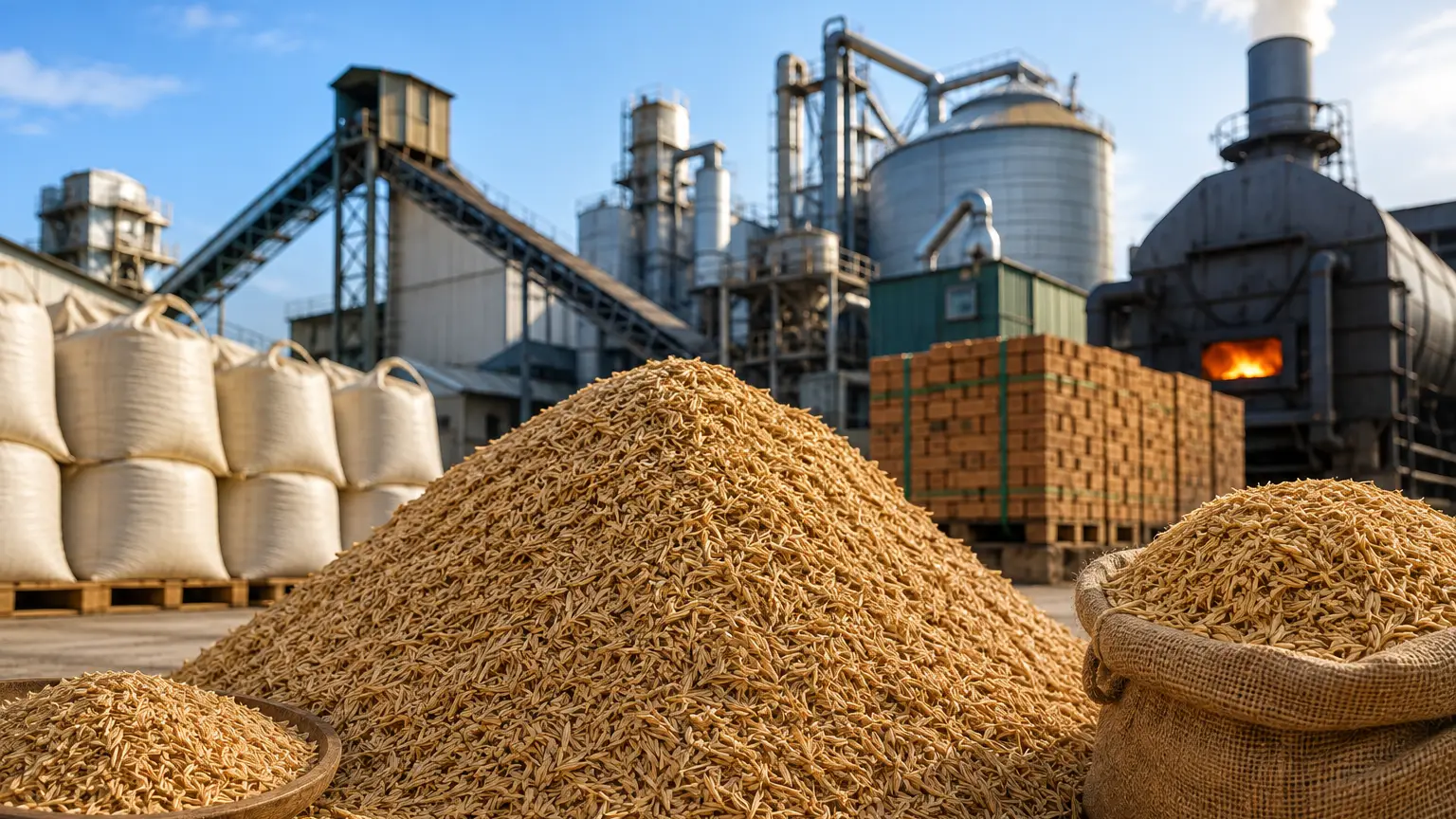
Rice hulls, also called rice husks or rice hulls, are the protective outer layers removed from rice grains during milling. Unlike a conventional chemical raw material, they originate as an agricultural processing residue, which gives them a distinctive commercial profile: their availability is closely connected to rice production, milling activity, regional agricultural infrastructure, and the economics of transporting relatively low-density biomass. Their composition also creates opportunities beyond simple waste disposal, particularly where cellulose, lignin, mineral content, and silica can be incorporated into downstream processes. Research published in Renewable and Sustainable Energy Reviews identifies rice husk as a promising feedstock for both energy and bio-silica production.
The commercial significance of rice hulls therefore comes from their ability to serve several different value chains. Depending on processing requirements, they can be used as biomass fuel, incorporated into agricultural and horticultural systems, processed into materials, or converted through thermal and chemical routes into silica-rich products. This makes rice hulls relevant to buyers looking for agricultural biomass as well as manufacturers seeking alternative raw materials. The International Energy Agency Bioenergy network has also documented rice-husk briquette supply chains, illustrating how a milling residue can become a standardized energy product.
From Milling Byproduct to Circular-Economy Feedstock
The shift from disposal toward utilization is an important part of the rice hulls market story. A material that previously represented a handling challenge can become a source of energy, carbon-containing material, or silica-rich ash when appropriate processing infrastructure is available. Recent scientific literature emphasizes this valorization pathway, describing rice husks as renewable feedstocks for engineered silica, biofuels, adsorbent materials, and other higher-value applications.
For B2B buyers, this means the commercial question is not simply whether rice hulls are available. The more important question is whether the available material is suitable for the intended process and can be supplied with predictable characteristics. Moisture, contamination, particle size, bulk density, storage conditions, transportation distance, and processing requirements can all affect the delivered economics. Consequently, industrial rice hulls sourcing increasingly requires coordination between suppliers, processors, logistics providers, and end users.
Key Industrial Applications of Rice Hulls
Biomass Energy and Solid Fuel Applications
One of the most established rice hulls applications is energy generation. Because rice hulls contain combustible organic components, rice mills and other industrial facilities can use them directly or convert them into densified fuels such as briquettes. IEA Bioenergy has documented a rice-husk briquette project in Tanzania in which rice-milling residues were processed into briquettes for use as an alternative biomass fuel.
For industrial energy buyers, rice hulls can therefore represent a locally available agricultural biomass feedstock where sufficient rice-processing volumes exist. However, combustion performance depends on factors such as moisture, ash content, handling characteristics, boiler design, and combustion conditions. The high mineral and silica content that makes rice hulls attractive for certain material applications also creates considerations for ash handling and equipment operation, making technical compatibility an important part of procurement.
Construction and Silica-Related Applications
Another significant pathway is the conversion of rice hulls into rice husk ash and subsequently silica-containing materials. Scientific research has examined controlled processing routes for producing amorphous silica from rice husk ash, with processing conditions influencing the resulting material properties. A 2023 open-access review in Hybrid Advances describes physical, chemical, hydrothermal, and carbonation approaches for extracting silica from rice husks and identifies engineered silica as a growing research and commercialization area.
This pathway connects rice hulls with construction materials, cementitious systems, adsorbents, fillers, and other silica-related applications. The commercial opportunity is particularly relevant for processors capable of controlling thermal treatment and subsequent purification. Buyers interested in these applications should distinguish raw rice hull specifications from rice husk ash or processed silica specifications because they represent different stages of the value chain and have substantially different quality requirements.
Market Trends Driving Rice Hulls Demand
Rising Rice Production Supports Feedstock Availability
Rice hulls are intrinsically linked to the scale of global rice milling. When rice production and processing volumes rise, the potential availability of rice-milling residues also increases, although the commercially accessible supply depends on collection, storage, transportation, and local processing infrastructure. FAO's recent market assessments continue to show rice production at historically high levels, with its 2026 outlook placing global 2026/27 rice production at approximately 552.5 million tonnes on a milled basis.
This does not mean rice hull prices or supply will automatically move in line with rice output. Rice hulls are geographically concentrated around milling facilities, and logistics can become a decisive component of delivered cost. For manufacturers and traders, the more useful market indicator is therefore the combination of rice-processing density, local residue utilization, competing biomass demand, and proximity to industrial consumers.
Circular Economy and Higher-Value Processing
A second trend is the increasing focus on converting agricultural residues into higher-value industrial inputs rather than treating them solely as waste. Research published in 2023 highlights rice husks as renewable sources for engineered silica and describes potential applications extending into catalysis, water treatment, and other advanced material systems.
This trend broadens the commercial addressable market for rice hulls. Instead of competing only with other fuels, suppliers can potentially serve processors developing bio-silica, adsorbents, carbon materials, composite ingredients, and other value-added products. At the same time, these applications tend to impose stricter technical requirements, so market growth is likely to favor suppliers that can provide consistent feedstock specifications, documentation, traceability, and dependable logistics rather than simply the lowest nominal price.
Key Buyers and Procurement Considerations
Who Buys Rice Hulls
The buyer base for rice hulls spans several industrial categories. Rice mills and biomass-energy operators can purchase the material as a fuel feedstock, while agricultural and horticultural businesses may seek it for growing-media or soil-related applications. Construction-material producers, material processors, silica manufacturers, animal-bedding businesses, and other manufacturers can also represent potential demand depending on local regulations and the required material specification.
Procurement teams typically approach rice hulls differently from conventional standardized chemicals because the product is an agricultural residue with variable physical characteristics. A buyer may need information about origin, moisture, ash, contamination, particle size, bulk density, packaging, loading method, and available monthly volume before determining whether a supplier can support production requirements. For this reason, an effective rice hulls supplier relationship is often based on repeatability and supply planning rather than a single transaction.
What Procurement Teams Evaluate
Before buying rice hulls in bulk, procurement teams should establish a specification aligned with the intended application. For biomass users, moisture, ash behavior, heating value, handling characteristics, and delivery consistency can be important. For silica or material-processing applications, the buyer may place greater emphasis on mineral composition, contamination, particle characteristics, and the suitability of the material for the planned conversion process.
Supplier comparison is also important because apparently similar rice hulls can have different commercial values depending on origin and processing. Buyers may compare landed cost, minimum order quantity, packaging, lead time, documentation, production capacity, quality consistency, and logistics options. A B2B marketplace product page can support this process by giving buyers a clear starting point for specifications, supplier communication, application discussions, and quotation requests rather than requiring procurement teams to identify every potential source independently.
Supply Opportunities and B2B Sourcing Strategy
Building a Reliable Rice Hulls Supply Chain
For manufacturers, traders, and distributors, rice hulls present an opportunity to connect agricultural residue generation with industrial demand. The strongest supply chains are likely to be those located close to rice-milling clusters, where collection and consolidation can be managed efficiently. Because transportation economics can strongly influence low-density biomass, geographic proximity and dependable loading capacity may be as important as the initial product price.
Tradeasia's business model is relevant to this type of procurement environment because the company describes its operations as an integrated raw-material supply network connecting suppliers and industrial customers. Its current business portfolio includes chemicals, polymers, and circular-economy materials, while its stated supply-chain approach emphasizes reliability, quality control, and international sourcing.
Supplier Evaluation and Commercial Conversion
For suppliers, marketplace visibility can provide access to buyers that may not be directly connected to rice-milling networks. A strong supplier proposition should clearly communicate material origin, available volume, quality parameters, packaging options, application suitability, and delivery capabilities. These details help procurement professionals distinguish a commercially viable industrial feedstock from an inconsistent agricultural residue listing.
For buyers, a marketplace such as Tradeasia / Chemtradeasia / Tradechem Marketplace can simplify the initial sourcing stage by creating a structured point of contact for product inquiries and supplier evaluation. Tradeasia states that it supports global raw-material procurement and has a network of local offices and supplier relationships, while its supplier platform emphasizes market access, quality standards, and supply-chain support.
Commercial Positioning and Future Outlook for Rice Hulls
Why Rice Hulls Matter Commercially
The commercial strength of rice hulls lies in application diversity. A single agricultural residue can potentially participate in several value chains, from biomass energy and industrial fuel to construction-related materials and silica extraction. This creates opportunities for manufacturers and traders to develop differentiated supply propositions around specific end-use requirements rather than treating rice hulls as a generic commodity.
Demand should nevertheless be assessed application by application. Energy buyers may prioritize delivered cost and combustion characteristics, whereas advanced material processors may prioritize composition and processing suitability. This makes market segmentation particularly important for suppliers: understanding the buyer's process can help determine which specifications to communicate and which markets are commercially realistic.
Outlook for B2B Buyers and Suppliers
The medium-term outlook for rice hulls is closely connected to continued rice processing, regional biomass economics, and the expansion of circular-economy applications. FAO continues to monitor global rice production, trade, stocks, and prices through its dedicated rice market intelligence program, while recent research continues to explore higher-value routes for rice husk utilization.
For B2B buyers, the priority should be dependable supply, application-specific specifications, transparent commercial terms, and a supplier capable of supporting repeat procurement. For manufacturers, traders, and distributors, the opportunity is to connect consistent rice hulls supply with growing industrial demand for biomass and renewable material feedstocks. A marketplace-led sourcing model can help bridge those requirements by bringing product information, supplier access, and procurement conversations into one commercial channel.
Sources
- ScienceDirect — “Silica extraction from rice husk: Comprehensive review and applications” (2023) — Open-access scientific review covering rice husk, rice husk ash, silica extraction methods, and emerging applications. Read the ScienceDirect article
- FAO — Rice Markets and Trade — Official United Nations food and agriculture resource covering global rice supply, demand, trade, prices, stocks, and market outlooks. Read the FAO rice market resource
- IEA Bioenergy — Biomass Supply and the Sustainable Development Goals — Technical case study documenting rice-husk briquette production and agricultural-residue energy utilization. Read the IEA Bioenergy report
Leave a Comment