Rice Hulls as an Industrial Raw Material
From Rice Milling By-Product to Industrial Feedstock
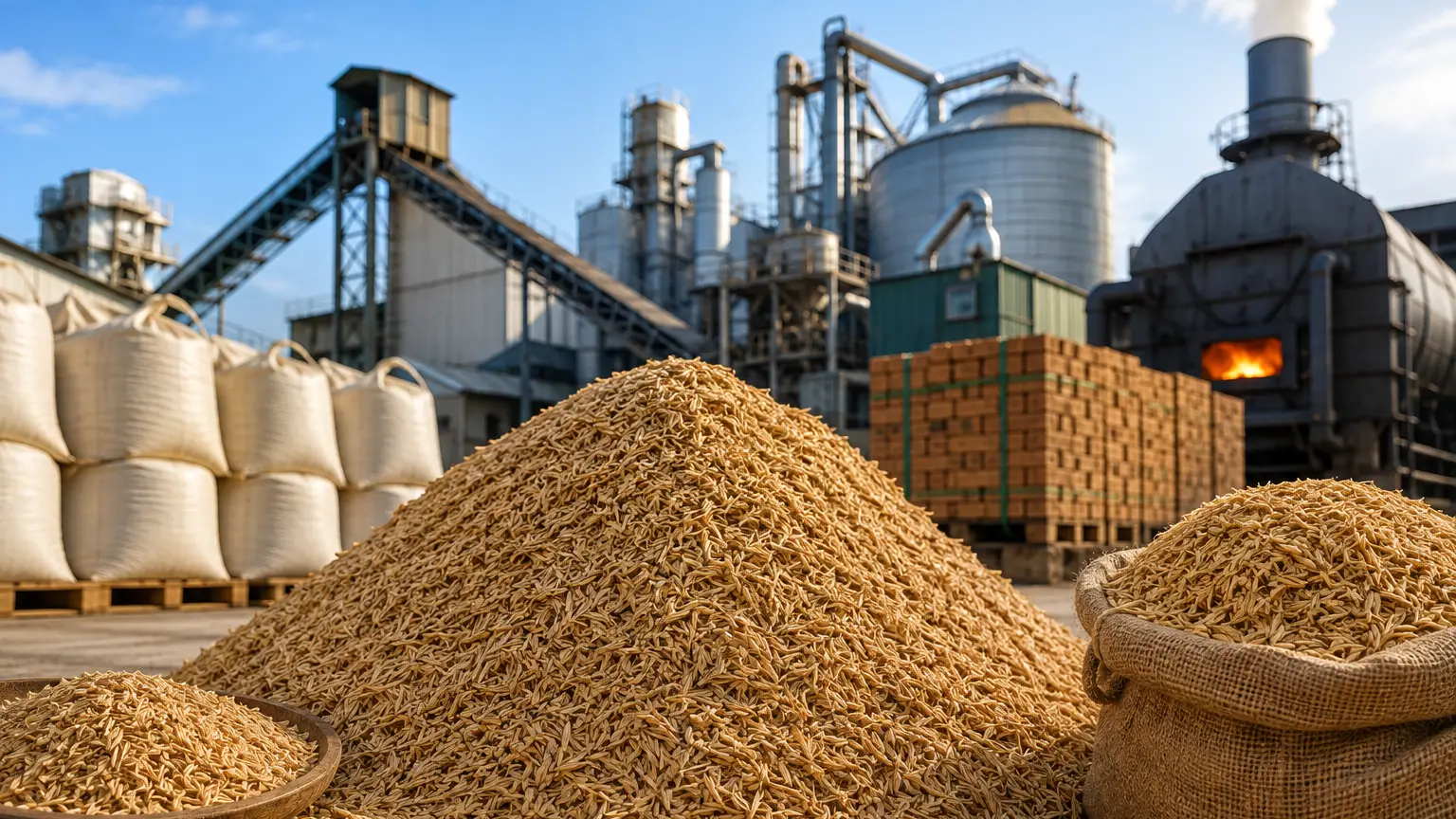
Rice Hulls, also called rice husks, are the protective outer layer removed from rice grains during milling. For industrial buyers, their importance comes from the combination of availability, biomass characteristics, and mineral content rather than from a single chemical specification. A 2024 review in Rice Science estimates global rice production at more than 750 million tonnes of grain annually, associated with roughly 150 million tonnes of rice husk, illustrating the scale of the potential feedstock base.
The material is particularly interesting because its composition supports several processing routes. Rice Hulls contain lignocellulosic components such as cellulose, hemicellulose, and lignin, together with substantial silica-containing mineral matter. This combination means that the same agricultural by-product can be considered as a biomass fuel, a source of silica, a precursor for carbonaceous materials, or a component in selected construction and agricultural applications.
From a commercial perspective, the distinction between raw Rice Hulls and processed derivatives is important. Buyers may require the material for direct use, such as biomass applications, or as a feedstock for downstream processing into rice husk ash, biochar, activated carbon, silica, or other engineered materials. Consequently, procurement requirements can vary significantly according to the intended application rather than simply the product name.
This creates a broader sourcing opportunity for manufacturers, traders, distributors, and procurement teams. Instead of viewing Rice Hulls exclusively as an agricultural residue, industrial buyers can assess them according to their potential contribution to a circular raw-material strategy. For suppliers, the commercial proposition therefore depends on dependable availability, consistent material characteristics, appropriate handling, and the ability to match supply specifications with downstream applications.
Key Industrial Applications of Rice Hulls
Biomass Energy and Thermal Applications
One of the most established industrial pathways for Rice Hulls is energy recovery. Because the material is a biomass residue generated in large quantities around rice-processing operations, it can be utilized as a fuel or converted through thermal processes. Research reviewing rice-husk applications identifies fuel and energy production among the major established application areas, alongside construction and value-added material production.
For industrial energy users, the commercial value of Rice Hulls depends on factors such as moisture, bulk density, ash behavior, transport distance, combustion technology, and the characteristics required by the boiler or conversion system. Densification or other preprocessing may also be relevant where handling and feeding requirements make loose agricultural residues less practical. These considerations mean that a buyer should evaluate the complete delivered-feedstock economics rather than comparing material prices alone.
Rice Hulls also generate rice husk ash when subjected to combustion. This ash is particularly significant because it contains a high proportion of silica. A 2024 Powder Technology study notes that rice husk is widely used for biomass energy generation and that the resulting ash consists primarily of silica and carbon, making combustion conditions an important factor in determining the characteristics and potential value of the resulting material.
For procurement teams, this creates a potential two-stage value proposition: Rice Hulls can supply energy while their combustion residue may become a feedstock for another industrial process. However, the suitability of the resulting ash depends strongly on combustion conditions and downstream specifications. Buyers therefore need to establish whether they are purchasing primarily for energy, ash generation, or an integrated valorization pathway.
Silica, Biochar and Engineered Materials
The naturally high silica content of Rice Hulls is one of their most commercially distinctive characteristics. Recent scientific literature continues to examine rice-husk-derived silica for engineered materials and environmental applications. A 2024 review in the Journal of Environmental Management highlights the potential of rice-husk silica as a material for catalyst supports, including advanced oxidation applications.
Another important pathway is biochar and activated carbon production. Thermal processing can convert Rice Hulls into carbon-rich materials whose physical and chemical characteristics differ substantially from the original feedstock. The 2024 review in Rice Science identifies biochar, hydrochar, and activated carbon among the derivatives being investigated for agricultural and industrial applications.
Recent research demonstrates how these pathways are becoming increasingly sophisticated. A 2024 study investigated the use of Rice Hulls to produce porous silicon and sulfur-doped activated carbon for lithium-ion capacitor applications, illustrating the potential for agricultural residues to become precursors for advanced energy-storage materials. Such applications remain technology- and process-dependent, but they demonstrate why Rice Hulls are attracting interest beyond conventional biomass utilization.
For B2B suppliers, this diversification matters because the required specification can change dramatically between end users. A biomass buyer may prioritize moisture, calorific performance, bulk density, and logistics, while a silica producer may be more concerned with ash composition, contamination, processing behavior, and consistency. The most commercially useful sourcing strategy is therefore application-led: define the downstream process first, then establish the appropriate Rice Hulls specification.
Emerging Value-Added Uses and Market Trends
Circular Bioeconomy and Resource Valorization
A major trend surrounding Rice Hulls is the movement from simple waste disposal toward resource valorization. The 2024 Rice Science review frames Rice Hulls within the circular bioeconomy and describes applications extending from fuel and energy resources to construction materials, agriculture, and advanced technology. This broadening of the application base creates potential demand from industries that historically may not have treated rice-processing residues as strategic raw materials.
The market opportunity is particularly relevant where one processing route can generate multiple useful outputs. Research into co-production of biochar and silica from Rice Hulls, for example, demonstrates an approach in which the biomass can be fractionated or transformed into more than one value-added product. Such approaches are still dependent on technology, economics, scale, and process conditions, but they illustrate the direction of industrial development.
This trend also changes how manufacturers evaluate feedstock procurement. Instead of asking only whether Rice Hulls are inexpensive, industrial users increasingly need to consider whether a particular supply stream is suitable for producing a consistent downstream product. Origin, agricultural conditions, milling practices, storage, moisture, ash content, and contamination can all influence process performance and product quality.
For suppliers and distributors, the implication is that traceability and specification transparency can become commercially meaningful differentiators. A buyer looking for Rice Hulls for a specialized process may value consistent documentation and predictable material characteristics more than a generic commodity description. Marketplace sourcing can therefore help connect standardized supply information with application-specific procurement requirements.
New Materials and Advanced Industrial Applications
Research published in 2025 provides further evidence that Rice Hulls remain an active materials-development feedstock. A Scientific Reports study investigated optimized extraction of biogenic silica from rice husk and straw ash, examining process variables including sodium hydroxide concentration, temperature, and digestion time. The study highlights the importance of controlled processing when converting agricultural residues into higher-value silica products.
Construction is another area where rice-husk-derived materials continue to attract attention. A 2025 Scientific Reports study evaluated rice-husk-derived biochar as a partial cement replacement in concrete, while other recent research has investigated rice-husk-ash-based materials in specialized concrete systems. These studies do not mean that raw Rice Hulls can automatically substitute for conventional construction inputs; rather, they demonstrate ongoing interest in engineered derivatives and their performance characteristics.
Environmental applications are also developing. Research published in 2024 investigated silica derived from Rice Hulls as a modification component for biochar used in lead adsorption, showing how rice-husk-derived materials can participate in wastewater and contaminant-removal technologies. Such applications expand the potential customer base toward environmental-material manufacturers and specialty chemical developers.
For commercial sourcing, the important trend is therefore not one single rapidly expanding end market. It is the diversification of possible downstream applications. As processing technologies mature, Rice Hulls may increasingly be evaluated according to their ability to serve as a platform feedstock for energy, silica, carbon materials, construction inputs, agricultural products, and specialty applications.
Who Buys Rice Hulls and Why
Key B2B Buyer Groups
The buyer landscape for Rice Hulls is broader than traditional rice-processing businesses. Biomass energy operators, industrial boiler users, rice mills, biochar producers, silica manufacturers, construction-material developers, agricultural-input companies, and specialty-material producers can all have different reasons for evaluating the same feedstock. The relevant buyer group depends primarily on the intended processing route and required material characteristics.
Manufacturers are typically interested in reliable feedstock availability and consistent input quality. Traders and distributors may instead focus on sourcing networks, geographic availability, logistics, packaging, and the ability to consolidate supply from producing regions. Procurement teams at larger industrial companies often need both technical information and commercial documentation before approving a new raw-material source.
The buyer's technical priorities also change with the application. A biomass user may focus on moisture, ash, bulk density, calorific characteristics, and combustion behavior. A silica-oriented processor may place greater emphasis on ash yield, silica content, mineral impurities, and consistency. Agricultural or biochar users may have different requirements relating to contaminants, particle size, processing history, and intended application.
Because Rice Hulls are an agricultural by-product, buyers should also consider supply seasonality and geographic concentration. The large global rice industry provides a substantial potential feedstock base, but the commercial practicality of a supply depends on where rice milling occurs, how the material is collected and stored, and the cost of moving a relatively bulky biomass product to the processing site. These factors make supplier comparison a central part of procurement strategy.
Why Buyers Compare Suppliers
Supplier comparison is particularly important for Rice Hulls because two materials carrying the same commercial name may not behave identically in downstream processing. Agricultural origin, milling conditions, moisture, storage conditions, foreign matter, particle characteristics, and processing history can influence suitability. For industrial buyers, a low nominal price is therefore not necessarily the lowest total procurement cost.
Procurement teams should establish the specification around the intended application before requesting quotations. This can include acceptable moisture range, particle-size requirements, ash characteristics, contamination limits, packaging or bulk-delivery requirements, origin, available volumes, and supporting technical documentation. When the material is destined for further processing, the specification should also reflect the requirements of the final product rather than only the raw feedstock.
Buyers also compare suppliers because continuity of supply can be as important as laboratory quality. A manufacturer that depends on regular Rice Hulls intake needs confidence in volumes, delivery schedules, storage practices, export capability where relevant, and the supplier's ability to maintain specifications over multiple shipments. This is especially important when a raw material becomes part of a continuous production process.
A B2B marketplace can support this evaluation by bringing product information and supplier discovery into one sourcing environment. For Rice Hulls, the value is strongest when buyers can use marketplace information as the starting point for technical qualification, quotation requests, supplier comparison, and commercial discussions rather than treating the product listing as a substitute for application-specific quality verification.
What B2B Buyers Should Evaluate When Sourcing
Technical and Quality Considerations
The first sourcing question should be what will the Rice Hulls be used for? The answer determines which specifications are commercially meaningful. For direct biomass applications, moisture and combustion-related properties may dominate the evaluation. For silica or biochar production, buyers may need more detailed information about ash generation, mineral composition, contaminants, and processing consistency.
Physical characteristics can also affect logistics and processing economics. Loose Rice Hulls have relatively low bulk density, so freight, storage volume, handling systems, and loading efficiency can influence the delivered cost. Depending on the application and supplier capability, buyers may therefore compare loose material with processed or densified forms when determining the most economical supply configuration.
Quality documentation should be aligned with the application rather than treated as a generic compliance exercise. Buyers may request a certificate of analysis, technical specification, origin information, moisture data, ash-related parameters, particle-size information, and details of storage or processing. For specialized applications, laboratory testing of representative samples before commercial contracting can help reduce qualification risk.
The scientific literature reinforces why process-specific evaluation matters. Recent studies on Rice Hulls and rice-husk-derived materials repeatedly demonstrate that treatment conditions can substantially affect the resulting silica, biochar, or composite properties. In other words, feedstock quality and downstream processing cannot always be separated when assessing commercial suitability.
Logistics, Supply Continuity and Commercial Terms
Logistics can be a decisive factor when sourcing Rice Hulls internationally. Because the material originates largely from rice-processing regions, the distance between mill, consolidation point, port, and final processing facility can materially affect the delivered economics. Buyers should evaluate the entire supply chain rather than comparing supplier quotations on an ex-works or FOB basis alone.
Supply continuity is another core procurement consideration. A supplier may offer an attractive initial price but be unable to provide the volume or consistency required for recurring industrial consumption. Buyers should therefore examine available monthly or annual quantities, production or collection sources, lead times, storage arrangements, loading capabilities, and contingency options.
Commercial buyers may also need to evaluate packaging format and shipment configuration. Depending on the supply chain, Rice Hulls can be handled as a bulk agricultural residue or in packaged forms suitable for storage and transport. The most appropriate configuration depends on consumption volume, warehouse infrastructure, handling equipment, and the buyer's production schedule.
This is where marketplace-based sourcing can provide practical value. A platform such as Tradeasia / Chemtradeasia / Tradechem Marketplace can serve as an initial connection point between buyers and suppliers, allowing procurement teams to identify relevant supply opportunities and then proceed to application-specific qualification, sample evaluation, commercial negotiation, and logistics planning. The objective is not simply to find a supplier, but to find a supply arrangement that fits the buyer's technical and operational requirements.
Supply Chain and Commercial Opportunities
Opportunities for Manufacturers, Traders and Distributors
The commercial opportunity around Rice Hulls extends across multiple stages of the supply chain. Rice mills and agricultural processors can create value by establishing reliable collection and handling systems, while manufacturers can convert the feedstock into energy, silica, biochar, activated carbon, construction-related materials, or other derivatives. Traders and distributors can connect geographically separated supply and demand while supporting documentation and logistics.
Manufacturers with established downstream processing capacity may be particularly well positioned to capture value because the economic potential of Rice Hulls often increases after controlled conversion. The 2023 review on silica extraction notes that Rice Hulls can be used to create engineered silica particles and biofuels, while also identifying commercialization challenges that must be addressed. This reinforces the importance of processing technology, economics, and consistent feedstock supply.
For distributors, the opportunity is more closely connected to market access and supply-chain coordination. Buyers that need recurring volumes may prefer suppliers able to consolidate material from multiple production sources while maintaining agreed specifications. This can be particularly relevant when local availability is fragmented across numerous rice mills or agricultural regions.
The strongest commercial positioning therefore centers on dependable supply rather than generalized sustainability claims. A B2B buyer needs to know whether the material is available at the required scale, whether its characteristics are suitable for the intended process, and whether the supplier can support repeat transactions. Clear product specifications, transparent commercial terms, and responsive supplier communication can make a significant difference in conversion.
How Marketplace Sourcing Supports Procurement
Rice Hulls are well suited to a marketplace sourcing model because the potential supply base is distributed across major rice-producing regions, while industrial demand can arise in different countries and industries. A marketplace can reduce the initial search burden by helping buyers identify suppliers, compare product information, and initiate commercial discussions without relying exclusively on fragmented offline networks.
For procurement teams, the marketplace should be treated as the beginning of a qualification workflow. Product discovery can be followed by specification confirmation, sample testing, supplier verification, volume discussions, Incoterm selection, logistics assessment, and contractual negotiation. This approach keeps the commercial convenience of online sourcing while preserving the technical discipline required for industrial raw materials.
The opportunity is also relevant to suppliers seeking international demand. Rice Hulls may have limited value when treated solely as a disposal problem, but they can become a commercially relevant industrial feedstock when connected with buyers that have appropriate processing or utilization capabilities. Recent research into silica, biochar, construction materials, catalysts, and advanced energy materials demonstrates the breadth of potential downstream interest.
For Tradeasia / Chemtradeasia / Tradechem Marketplace, the strongest positioning is therefore as a B2B sourcing bridge between raw-material suppliers and industrial users. The commercial message should remain evidence-based: help buyers discover Rice Hulls supply, understand potential applications, assess supplier fit, and move toward qualified procurement. This approach supports conversion without overstating the product's capabilities or treating emerging applications as established mass markets.
Conclusion: Positioning Rice Hulls for Industrial Procurement
From Agricultural Residue to Strategic Feedstock
Rice Hulls occupy an unusual position in industrial sourcing because they combine the scale of an agricultural by-product with characteristics that support multiple value chains. Their established role in biomass utilization is complemented by growing research into silica, biochar, activated carbon, construction materials, environmental applications, catalysts, and advanced materials.
For buyers, this diversity makes application definition the starting point for procurement. A buyer should determine whether the material is intended for energy, direct material use, or conversion into a higher-value derivative, and then build the specification around that objective. Moisture, bulk density, ash characteristics, composition, contaminants, particle size, consistency, logistics, and available volume can all become commercially important.
The current research landscape also indicates that Rice Hulls are increasingly being evaluated within circular manufacturing and resource-efficiency strategies. Recent work on biogenic silica extraction, biochar-based materials, and advanced silicon and carbon products demonstrates continuing technical interest, although many higher-value applications remain dependent on processing technology and commercial scale-up.
For manufacturers, distributors, traders, and procurement teams, the practical opportunity is to treat Rice Hulls as an application-driven industrial feedstock rather than simply as agricultural waste. Through structured supplier comparison and technically informed sourcing, B2B buyers can identify supply opportunities that align with their production requirements, while marketplace platforms can provide an efficient entry point for connecting demand with qualified supply.
Sources
Leave a Comment