Red Rice Supply Chain Overview
Understanding Red Rice in Commercial Trade
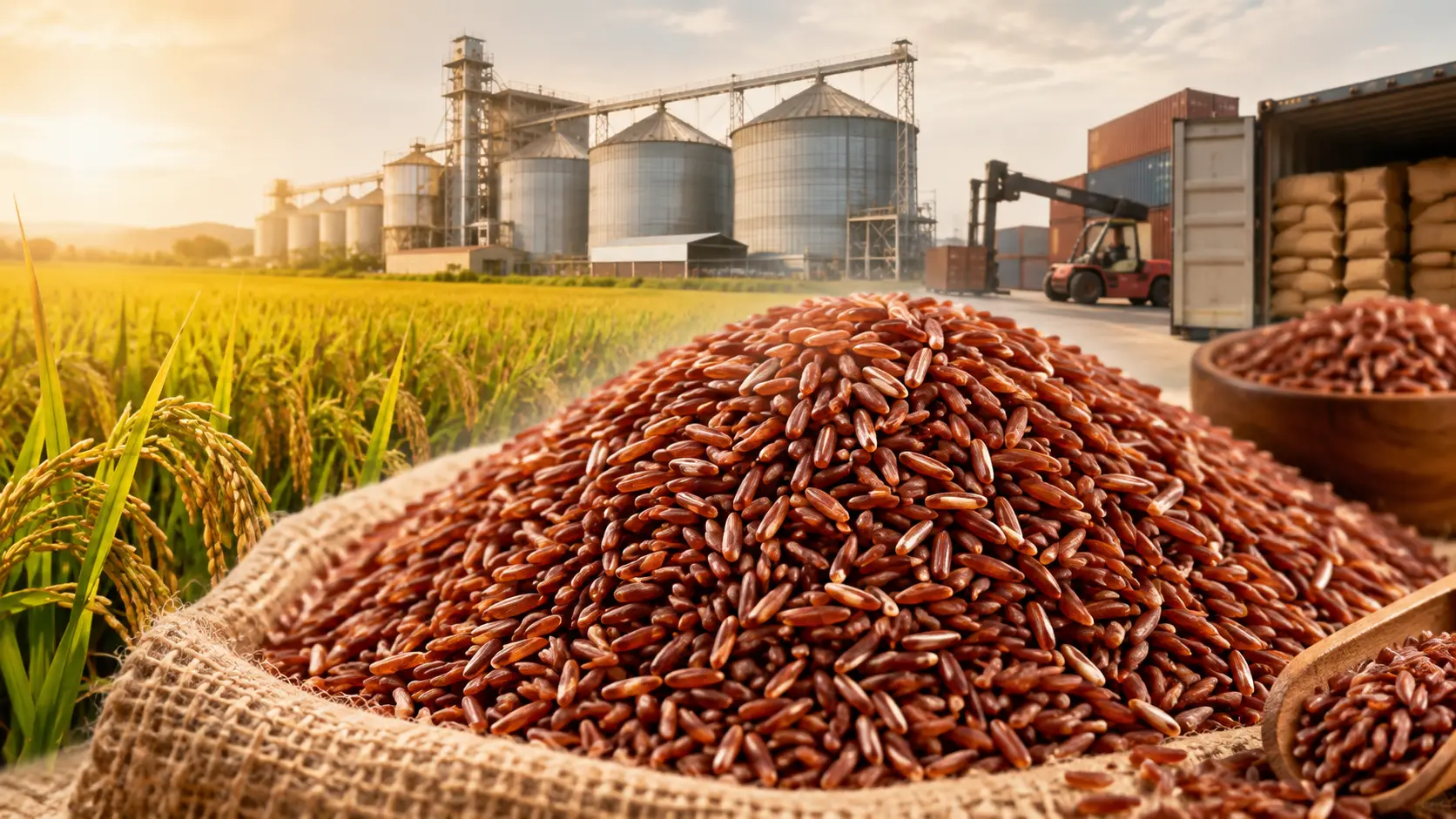
Red Rice occupies a distinctive position within the broader rice commodity sector because its commercial identity is linked not only to grain functionality but also to its characteristic red-colored outer layer. For B2B buyers, this makes sourcing more specification-driven than simply purchasing conventional white rice. Origin, variety, cultivation conditions, milling requirements, moisture, grain integrity, packaging, and intended application can all influence procurement decisions. The supply chain therefore begins with identifying a consistent raw-material source capable of meeting the buyer's required physical and commercial specifications.
The wider rice market provides an important backdrop for Red Rice procurement. FAO reported that global rice production for 2026/27 is expected at approximately 552.5 million tonnes on a milled basis, while international rice trade in 2026 is forecast at 59.8 million tonnes. This demonstrates the scale of the underlying commodity network in which specialty rice products operate.
Why Supply Chain Visibility Matters
For processors, distributors, food manufacturers, and specialty-food buyers, supply continuity is increasingly important. A Red Rice purchasing program must consider more than the quoted commodity price because transportation, milling losses, storage requirements, packaging, inspection, documentation, and delivery schedules can affect the landed cost. Procurement teams therefore benefit from evaluating suppliers according to both product consistency and supply-chain reliability.
The commercial opportunity is particularly relevant where buyers want differentiated rice products rather than undifferentiated bulk grain. FAO identifies Red Rice from Sri Lanka among specialty agricultural products with export-development potential, highlighting the role that processing and value-chain development can play in improving international market positioning.
Cultivation and Raw Material Sourcing
Agricultural Origin and Variety
The first major stage of the Red Rice supply chain is agricultural production. Different varieties and growing regions can produce substantially different grain characteristics, so buyers should establish clear specifications before sourcing. Procurement requirements may include grain size, color, moisture, broken-grain percentage, milling condition, crop year, origin, and packaging format. Establishing these parameters early reduces the possibility of receiving material that technically qualifies as rice but does not perform as expected in the buyer's application.
Agricultural conditions also influence supply reliability. Water availability, planting decisions, weather patterns, input costs, harvesting conditions, and regional agricultural policies can affect production volumes and timing. FAO's latest cereal assessment illustrates this variability, with changes in production expectations for countries including Pakistan, Colombia, and Viet Nam linked to factors such as irrigation conditions and cultivated area.
Supplier Selection and Procurement
For B2B buyers, supplier selection should combine product specifications with commercial capabilities. A supplier capable of providing repeatable quality, appropriate documentation, flexible packaging, and dependable shipment planning can be more valuable than a supplier offering the lowest initial quotation. This is especially important for manufacturers that depend on predictable raw-material inputs for scheduled production.
A structured sourcing process should therefore examine origin, available volumes, processing capabilities, storage practices, quality-control procedures, export experience, lead times, and documentation. For international procurement, buyers should also assess the supplier's ability to manage containerized shipments and provide the documentation required by the destination market. These considerations help transform Red Rice purchasing from a spot transaction into a more resilient supply relationship.
Post-Harvest Handling and Processing
From Harvest to Commercial Grain
After cultivation, harvested rice passes through a series of post-harvest operations that determine its commercial condition. Drying, cleaning, removal of foreign materials, grading, storage, and milling can influence grain appearance and usability. In specialty rice supply chains, careful handling is particularly important because physical characteristics are central to product differentiation.
The milling stage requires attention to the intended product specification. Depending on the commercial format, buyers may require rice with different degrees of milling or processing. Grain breakage, discoloration, contamination, moisture variation, and inconsistent grading can reduce commercial value. Consequently, post-harvest handling should be viewed as an integral part of supply-chain management rather than simply an operational step between farming and distribution.
Storage and Logistics
Storage conditions are equally important because rice is an agricultural commodity whose quality can deteriorate when handled improperly. Commercial storage programs need to control moisture exposure, pests, contamination risks, temperature conditions, and packaging integrity. Proper warehouse management can help preserve product quality between harvest, processing, and shipment.
Logistics planning then connects the processing facility with domestic or international buyers. Shipment size, packaging format, container availability, port conditions, freight costs, customs requirements, and delivery schedules can influence the final procurement economics. Since FAO continuously monitors international rice prices and export quotations from major origins, buyers can use broader market information as a reference when assessing changing sourcing conditions.
Quality Standards and Supply Chain Control
Key Procurement Specifications
Quality control for Red Rice should begin with a written product specification agreed between buyer and supplier. Depending on the application, this can cover identity, appearance, grain characteristics, moisture, foreign matter, broken kernels, packaging, crop information, and other applicable quality parameters. Clear specifications help procurement teams compare quotations on an equivalent basis rather than focusing solely on price per unit.
For food-sector buyers, traceability is another important consideration. Documentation connecting the finished shipment with its processing and sourcing stages can support internal quality systems and regulatory compliance. The exact requirements will vary according to the destination country and application, so buyers should verify applicable food and import requirements before finalizing a contract.
Managing Quality Across Borders
International supply chains create additional points at which quality can vary. Extended storage, changes in temperature and humidity, loading practices, transit duration, and port handling can all affect the condition of agricultural commodities. Inspection and documentation procedures should therefore be incorporated into the procurement plan rather than treated as an afterthought.
Market intelligence is also useful for quality and supply planning. FAO's rice-market framework tracks supply, demand, trade, stocks, prices, and policy developments, while the FAO All Rice Price Index monitors international price movements across major rice categories. These resources provide context for procurement teams evaluating broader market conditions, even though specialty Red Rice prices may differ from mainstream benchmark categories.
Applications and B2B Buyer Segments
Food and Specialty-Food Applications
Red Rice can serve food manufacturers and specialty-food businesses seeking differentiated rice products. Its distinctive appearance makes it relevant to products where visual identity and variety differentiation contribute to consumer positioning. Potential commercial channels include packaged rice, specialty food products, foodservice supply, and selected processed-food applications where rice is an important ingredient.
For B2B procurement teams, the appropriate grade depends heavily on the final application. A distributor supplying retail-ready products may prioritize appearance, packaging, and consistent grain presentation, while a processor may place greater emphasis on functional performance, processing characteristics, and bulk availability. This makes application-specific sourcing an important part of supplier evaluation.
Buyer Requirements and Procurement Volumes
The buyer landscape can include food manufacturers, rice processors, importers, wholesalers, distributors, retailers, foodservice suppliers, and specialty-food businesses. Each segment can have different requirements for shipment size, packaging, certification, delivery frequency, and commercial terms. A successful supplier relationship therefore depends on matching the product specification with the buyer's operational requirements.
Procurement teams should also distinguish between trial purchases and recurring contracts. Initial sample evaluation can establish whether the product meets quality and processing expectations, while larger contracts require stronger assurance around supply continuity, documentation, shipment planning, and price management. A B2B marketplace can help buyers compare sourcing opportunities while maintaining a commercial focus on specifications and supplier capability.
Global Market and Trade Outlook
Rice Market Fundamentals
Although Red Rice represents a specialty segment, its supply chain is influenced by developments in the wider global rice economy. FAO's current outlook places 2026/27 global rice production at around 552.5 million tonnes, while global rice stocks at the end of the marketing year are forecast at approximately 214.1 million tonnes. International rice trade for calendar year 2026 is forecast at 59.8 million tonnes, below the 2025 level.
These figures indicate that rice remains a large and globally interconnected commodity market, but they should not be interpreted as direct forecasts for Red Rice. Specialty products can experience different pricing and availability dynamics because of variety, origin, production scale, consumer demand, and processing requirements. Buyers should therefore use broad rice-market indicators as context while evaluating Red Rice through product-specific supplier quotations.
Market Risks and Supply Opportunities
Supply-chain risks can emerge from weather disruptions, water availability, changing cultivated areas, freight conditions, trade policies, currency movements, and regional production fluctuations. USDA's August 2026 rice outlook, for example, shows how changes in production, imports, exports, and stocks can materially alter market balances even within a major rice-producing market.
At the same time, specialty rice can offer opportunities for suppliers that develop stronger processing, quality assurance, packaging, and export capabilities. FAO's discussion of specialty agricultural products in South Asia emphasizes the potential of moving further up the value chain rather than relying exclusively on exports of raw agricultural materials. For Red Rice suppliers, this creates an opportunity to differentiate through reliable specifications, professional documentation, consistent processing, and international distribution capability.
Strategic Sourcing and Conclusion
Building a Reliable Red Rice Procurement Strategy
A robust Red Rice sourcing strategy should begin with the buyer's application and work backward through specifications, origin, processing, packaging, logistics, and supplier capabilities. This approach helps procurement teams avoid selecting suppliers solely on headline pricing. Instead, the total procurement equation can include product consistency, expected yield, shipment reliability, inspection requirements, storage, freight, and potential supply interruptions.
For recurring buyers, supplier diversification can also improve resilience. Establishing qualified alternatives across appropriate origins or processing channels can reduce dependence on a single source. At the same time, maintaining consistent technical specifications is essential so that alternative suppliers can be evaluated against the same commercial and quality requirements.
Conclusion: Connecting Buyers with Supply Opportunities
Red Rice represents a specialized opportunity within the broader international rice supply chain, where agricultural origin, post-harvest handling, processing, quality control, logistics, and buyer requirements all influence commercial value. With global rice production and trade remaining substantial, procurement teams can benefit from combining product-specific supplier evaluation with wider market intelligence.
For companies seeking dependable agricultural commodity sourcing, platforms such as Tradeasia / Chemtradeasia / Tradechem Marketplace can support the process by connecting buyers with relevant supply opportunities and helping procurement teams approach sourcing with clearer product, application, and commercial requirements.
Sources
www.fao.org
www.ers.usda.gov
www.fao.org

Leave a Comment