What Poultry Meal Is and Why It Matters
Product definition and industrial role
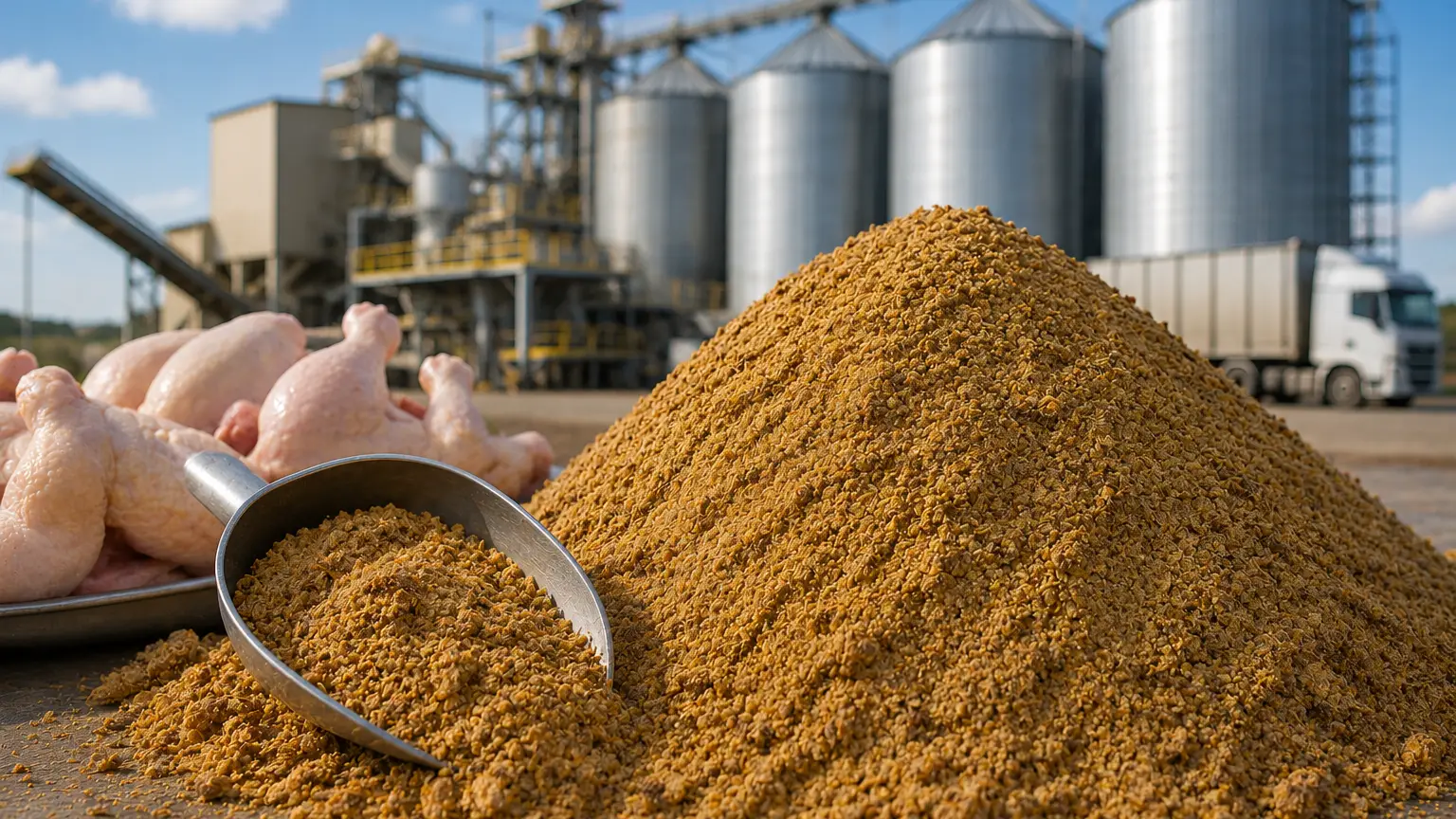
Poultry meal is a rendered animal-protein feed ingredient produced from poultry processing materials. The supplied product information describes it as a natural high-protein ingredient made from dry and rendered fresh poultry and consisting of milled, rendered and cleaned parts of slaughtered poultry. Rendering is commercially important because it converts perishable raw material into a more stable form suitable for storage, transportation and incorporation into feed formulations. FAO technical information similarly identifies poultry meal among rendered animal proteins used as concentrated sources of protein and amino acids in animal nutrition.
For B2B buyers, poultry meal should therefore be viewed as more than a commodity powder. Its commercial value depends on how consistently the material meets nutritional, microbiological, physical and regulatory requirements. The supplied product page identifies the material as feed grade, with a brown powder or pellet appearance, moisture below 8%, a stated minimum poultry crude-protein specification of 65%, maximum poultry ash of 14%, and minimum pepsin digestibility of 80%. These parameters give procurement teams a starting framework for comparing material offered by different suppliers.
The product information also identifies poultry meal with HS code 2301.1 and CAS number 92113-16-1, while listing 50 kg or bulk packaging and PP woven bags or bulk shipment options. Such information matters because international buyers normally evaluate both the technical suitability of an ingredient and its practical ability to move through the supply chain. Packaging, moisture control, shelf life, storage conditions and documentation can affect delivered quality just as significantly as the initial specification.
From a market perspective, poultry meal sits within the wider animal-feed protein segment. FAO notes that demand for animal feed continues to rise alongside demand for food of animal origin, while feed safety has implications extending throughout the food chain. This makes quality assurance, traceability and responsible handling central to the commercial positioning of poultry meal rather than secondary considerations.
Poultry Meal Applications Across Feed Industries
Poultry and livestock feed applications
The primary commercial application identified for poultry meal is animal feed. The supplied product information specifically states that poultry meal is commonly used in feed for poultry, aquaculture, ruminants, non-ruminants and companion animals. Its role is primarily associated with supplying concentrated animal-derived protein together with amino acids, fatty acids, vitamins and minerals. Feed formulators can therefore consider poultry meal as one component within a broader nutritional formulation rather than as a standalone feed.
Poultry feed is particularly relevant because poultry production depends on efficient conversion of feed inputs into animal protein. FAO identifies poultry as one of the most efficient traditional livestock species in feed conversion and emphasizes the importance of improving feed efficiency as part of reducing the environmental impact of poultry production. This creates a commercial environment in which feed manufacturers continually assess protein sources according to nutritional contribution, consistency and cost.
Poultry meal can also be relevant to feeds for non-ruminants and other livestock species where animal-derived protein is permitted and nutritionally appropriate. The exact inclusion rate and suitability depend on formulation objectives, species requirements, local regulations and the characteristics of the individual product. For procurement teams, this means that the term “poultry meal” alone is insufficient for technical approval; buyers need the actual specification and supporting quality documentation associated with each supply.
Aquaculture and pet-food applications
Aquaculture represents another important application area. FAO technical material identifies poultry meal among animal proteins that can be used in feeds for fish and shrimp, illustrating the broader role of rendered proteins beyond terrestrial livestock. For aquaculture feed manufacturers, the commercial question is not simply whether poultry meal can be used, but whether the product's protein profile, digestibility, ash level, fat content, microbiological condition and regulatory status fit the intended formulation.
Pet food is also identified on the supplied product page as an application. Scientific literature demonstrates why product differentiation matters in this market: research comparing feed-grade and pet-food-grade poultry by-product meal found meaningful differences in protein, ash, calcium and amino-acid characteristics among samples. This reinforces an important sourcing principle—buyers should compare the actual analytical profile of poultry meal rather than assuming that all products marketed under the same general name have identical nutritional properties.
Poultry Meal Market Demand and Recent Trends
Poultry production as a demand driver
Demand for poultry meal is closely connected to the development of poultry and broader animal-feed production. The OECD-FAO Agricultural Outlook identifies poultry as a major source of additional meat production over the coming decade, supported by short production cycles, feed-conversion efficiency, comparatively low production costs and the ability to locate production close to growing urban markets. These structural characteristics support continued attention to efficient poultry-feed ingredient sourcing.
Recent market data also show continued activity in poultry production. The USDA Economic Research Service's July 2026 poultry outlook reported higher projections for broiler production and cold storage, while noting changing export conditions and international competition. Such movements do not translate directly into a specific poultry-meal price forecast, but they demonstrate why poultry-feed ingredient procurement is influenced by changes in the underlying poultry production cycle.
The longer-term outlook is particularly relevant for B2B suppliers targeting Asia, the Middle East and other growth markets. The OECD-FAO 2026-2035 outlook projects agricultural production growth concentrated particularly in Asia, sub-Saharan Africa and Latin America, while rising living standards in lower-middle-income countries are expected to increase the share of livestock products in diets. For suppliers, these developments point toward continued opportunities wherever commercial livestock and feed production expands.
Feed efficiency, supply resilience and circularity
A second market trend is the increasing importance of resource efficiency and resilient feed supply chains. Rendering transforms poultry-processing by-products into usable animal-protein ingredients, providing a mechanism for recovering nutritional value that might otherwise be lost. FAO describes rendering as an established method for processing animal by-products into stable protein and fat products and highlights its role in responsible recycling and feed safety.
For B2B buyers, this trend translates into greater attention to consistency rather than simply the lowest quoted price. A feed manufacturer needs an ingredient that can be incorporated into formulations repeatedly without creating unexpected variation in moisture, protein, ash or microbiological status. As animal production becomes increasingly commercialized, procurement teams have stronger incentives to build supply relationships capable of supporting repeat orders and consistent manufacturing schedules.
International trade is another important factor. The OECD-FAO outlook emphasizes that rules-based agricultural trade remains important for balancing supply and demand and mitigating supply disruptions. For a product such as poultry meal, which can move between producing and consuming regions, logistics reliability, documentation and regulatory compatibility can therefore become important elements of the delivered commercial value.
Poultry Meal Buyer Intent and Procurement Priorities
Who buys poultry meal
The strongest poultry meal buyers are commercial feed manufacturers, poultry-feed producers, aquaculture-feed manufacturers, livestock-feed businesses, pet-food manufacturers, distributors, importers and specialized animal-nutrition procurement teams. These organizations typically have recurring requirements rather than one-time consumer demand, making poultry meal a suitable B2B sourcing category. Traders and distributors may also purchase the ingredient for resale into regional feed markets where local manufacturers require dependable imported supply.
Buyer intent can vary according to the stage of procurement. A technical buyer may search for poultry meal specifications, protein content, digestibility or microbiological parameters, while a purchasing manager may prioritize supplier availability, packaging, shipment quantities and commercial terms. A distributor may focus more heavily on origin, marketability, documentation and consistency across multiple lots. Recognizing these different search intents helps a B2B marketplace connect product information with the actual questions buyers ask before initiating an inquiry.
For buyers in the UAE and wider GCC region, regional supply considerations can be particularly relevant because feed manufacturers and distributors must evaluate imported ingredients against local commercial and regulatory requirements. The supplied product information identifies Saudi Arabia as the product origin and indicates that poultry halal certification is available, alongside ISO/HACCP information. Such details can become important screening criteria for buyers whose procurement policies include origin, certification or quality-management requirements.
The product's commercial relevance is ultimately determined by the buyer's formulation and procurement requirements. A manufacturer looking for a poultry protein ingredient may prioritize nutritional consistency, while an importer may place greater emphasis on bulk logistics and shelf life. A marketplace listing can support both audiences by making technical information and commercial inquiry pathways available before a buyer commits to a supplier evaluation.
What procurement teams evaluate
Procurement teams normally compare poultry meal suppliers across several interconnected dimensions: nutritional specification, microbiological quality, physical form, packaging, origin, documentation, shelf life, logistics capability and commercial competitiveness. The supplied product page provides several of these data points, including moisture, total plate count, yeast and mould, E. coli, Salmonella status, packaging, storage conditions and shelf life. This level of information is useful because it allows buyers to begin a technical qualification process before requesting a quotation.
Feed safety is especially important for animal-derived ingredients. FAO identifies biological, chemical and physical hazards as potential feed-safety concerns and emphasizes that hazards may enter the feed chain during ingredient production, processing, handling, storage and transportation. Consequently, supplier evaluation should extend beyond a certificate or specification sheet to include how the material is processed, packed, stored and transported.
Buyers also compare suppliers because apparently similar poultry meal products may differ nutritionally. Scientific research has documented variation among poultry by-product meal samples, including differences in protein, ash and amino-acid characteristics. For this reason, procurement teams should request current batch or lot documentation where appropriate and compare products on equivalent specifications rather than relying only on product names or headline protein percentages.
For commercial buyers evaluating the available [Poultry Meal supplier information] Poultry Meal product page, the value of a marketplace product page is its ability to bring technical and sourcing information together. The supplied page provides product characteristics, packaging, storage, quality parameters and an inquiry pathway, giving procurement teams a practical starting point for supplier discussions.
Poultry Meal Sourcing and Supply Chain Considerations
Quality and specification management
A reliable poultry meal sourcing strategy starts with specification alignment. Buyers should establish the minimum and maximum parameters that matter for their formulation, then confirm that supplier documentation corresponds to those requirements. For the supplied product, the listed parameters include moisture below 8%, poultry crude protein at a minimum of 65%, poultry ash at a maximum of 14%, calcium at 3%, phosphorus at 1.5%, lysine at 2.5–3.0% and pepsin digestibility at a minimum of 80%.
Microbiological controls are equally relevant because poultry meal is an animal-derived feed ingredient. The supplied product page lists total plate count below 500,000 CFU/g, yeast and mould below 50,000 CFU/g, E. coli below 100 CFU/g, coliform bacteria below 1,000 CFU/g and Salmonella as negative in 25 g. Buyers should interpret these figures against their own feed-safety programs and applicable regulations rather than treating any single specification as universally applicable.
Storage and handling can influence delivered quality. The supplied information recommends cool, dry storage away from humidity and lists a six-month shelf life, with 50 kg or bulk packaging options. For importers and distributors, these details have direct commercial implications because warehouse conditions, transit duration, container handling and local climate can influence the condition of feed ingredients by the time they reach the end user.
A robust sourcing process therefore combines technical qualification with supply-chain qualification. The best supplier comparison is not simply “price per tonne”; it is a comparison of specification compliance, lot consistency, packaging, documentation, delivery reliability and total landed cost. This approach is consistent with FAO's wider feed-safety principle that risk can arise at multiple stages from raw material through transportation and use.
Supplier comparison and logistics
International poultry meal sourcing requires attention to trade logistics as well as technical suitability. Buyers should clarify shipment format, minimum order requirements, packaging, storage conditions, expected transit time and the documentation needed for import clearance. Bulk purchasing can create economies of scale for large feed manufacturers, while bagged supply can be more practical for distributors or buyers with smaller storage and handling systems.
Supply continuity is another important procurement consideration. Poultry meal demand can move with poultry production, feed formulation economics and regional availability of alternative protein sources. The OECD-FAO outlook emphasizes that international trade remains essential for balancing agricultural supply and demand, while recent geopolitical and economic disruptions illustrate why procurement teams increasingly consider resilience alongside price.
Supplier diversification can also reduce exposure to individual production or logistics disruptions. This does not necessarily mean using many suppliers at once; it can mean maintaining qualified alternatives that have already passed technical and commercial screening. For feed manufacturers, such a strategy can help protect production schedules when an approved source experiences temporary availability constraints or shipping delays.
A B2B marketplace can contribute to this process by connecting buyers with structured product information and a direct inquiry route. For poultry meal buyers, the objective is not merely to locate a listing but to move efficiently from product discovery to specification confirmation, quotation, documentation review and supply agreement. That transition is where commercial marketplace positioning can provide meaningful value.
Commercial Opportunities for Poultry Meal Suppliers and Buyers
Demand opportunities across end-use markets
The commercial opportunity for poultry meal suppliers is linked to the continued development of animal-protein production and feed manufacturing. Poultry remains strategically important in the global meat complex, while aquaculture, livestock and pet-food markets provide additional potential end-use channels. The supplied product page explicitly identifies these application categories, giving suppliers several B2B audiences to address without positioning the ingredient as a single-industry product.
For manufacturers and traders, application diversity can support market development. A supplier may target poultry-feed manufacturers with nutritional and formulation information, aquaculture buyers with feed-performance specifications, or pet-food businesses with tighter quality and ingredient-profile requirements. The underlying commercial principle is to match the product specification with the buyer's application instead of using one generic sales proposition.
For distributors, regional demand can create opportunities to consolidate supply from producing markets and serve local feed manufacturers. The UAE can function as a strategically relevant market for such commercial activity because buyers may value access to imported feed ingredients combined with regional distribution capabilities. Nevertheless, market-entry requirements, import rules and end-user specifications should always be verified for the destination market before commercial commitments are made.
The outlook for animal-source food demand reinforces the broader opportunity. OECD-FAO's 2026-2035 outlook expects production growth to be driven largely by productivity improvements and intensification, with particularly strong growth in several emerging regions. For poultry meal suppliers, this suggests that the strongest opportunities are likely to remain connected to markets where commercial feed production is expanding and buyers are actively optimizing protein-input sourcing.
Marketplace positioning for B2B conversion
For Tradeasia, Chemtradeasia and Tradechem Marketplace, poultry meal is commercially relevant because the buyer journey begins with technical discovery but ultimately leads toward sourcing. A high-quality marketplace article can capture searches such as “poultry meal supplier,” “poultry meal applications,” “feed grade poultry meal” and “poultry meal sourcing,” then direct qualified visitors toward product information and inquiry opportunities.
The strongest conversion strategy is therefore informational rather than aggressively promotional. Buyers need enough detail to understand what poultry meal is, where it is used, which specifications matter and what questions to ask suppliers. Once that information is established, a contextual product-page link can serve as the natural next step for buyers seeking pricing, customization, shipping information or supplier engagement.
The supplied product page already supports this transition by presenting technical characteristics, quality information, packaging, storage conditions, certification-related information and an inquiry option. In B2B chemical and ingredient marketplaces, this type of structured information can reduce the distance between organic search traffic and commercial inquiry because technical readers and procurement teams can evaluate relevance before contacting a supplier.
The commercial positioning should therefore remain grounded in reliability, transparency and application relevance. Rather than promising universal performance or guaranteed cost advantages, the marketplace should help buyers determine whether the available poultry meal matches their requirements and then facilitate the next sourcing conversation. That approach supports both buyer confidence and long-term supplier relationships.
Conclusion: Building a Reliable Poultry Meal Supply Strategy
From market demand to procurement action
Poultry meal occupies a practical position within the animal-feed protein supply chain because it converts rendered poultry material into a transportable feed ingredient with applications across poultry, livestock, aquaculture and pet food. Its commercial importance is reinforced by the continuing expansion and modernization of animal production, particularly in markets where feed efficiency and reliable protein inputs remain important purchasing considerations.
Current market signals support a constructive but disciplined outlook. USDA reporting shows continued movement in broiler production and trade, while the OECD-FAO 2026-2035 outlook points to continued agricultural and livestock-sector growth driven by productivity and intensification. These trends support ongoing demand for feed inputs, although poultry meal demand itself will remain influenced by formulation economics, regulations, supply availability and competition from other protein ingredients.
For buyers, the central sourcing lesson is that product qualification should go beyond price. Nutritional specifications, microbiological controls, moisture, digestibility, packaging, storage, origin, documentation and logistics all contribute to the suitability of a poultry meal supply. FAO's feed-safety guidance further underlines the importance of controlling risks throughout production, handling, storage and transportation rather than considering ingredient quality in isolation.
For procurement teams evaluating [Poultry Meal for industrial applications] Poultry Meal product page, the next step is to compare the listed specifications and supply conditions with their internal formulation and purchasing requirements. For manufacturers, traders, distributors and procurement professionals, a structured B2B marketplace can provide a practical bridge between market intelligence, technical qualification and commercial sourcing.
Sources
- OECD-FAO Agricultural Outlook 2026-2035 — Meat and agricultural market outlook. The latest joint OECD-FAO outlook provides current medium-term analysis of agricultural production, livestock demand, trade, productivity and market risks. OECD-FAO Agricultural Outlook 2026-2035
- U.S. Department of Agriculture Economic Research Service — Poultry & Eggs Market Outlook. The USDA's July 2026 outlook provides recent information on broiler production, exports, prices and poultry-market conditions. USDA Poultry & Eggs Market Outlook
- Food and Agriculture Organization of the United Nations — Why Feed Safety? FAO's feed-safety resource explains the relationship between feed quality, animal health, food safety, trade and supply-chain risk management. FAO Global Feed Safety Platform
Leave a Comment