Poultry Meal: Product Role and Commercial Position
Understanding Poultry Meal as a Feed Ingredient
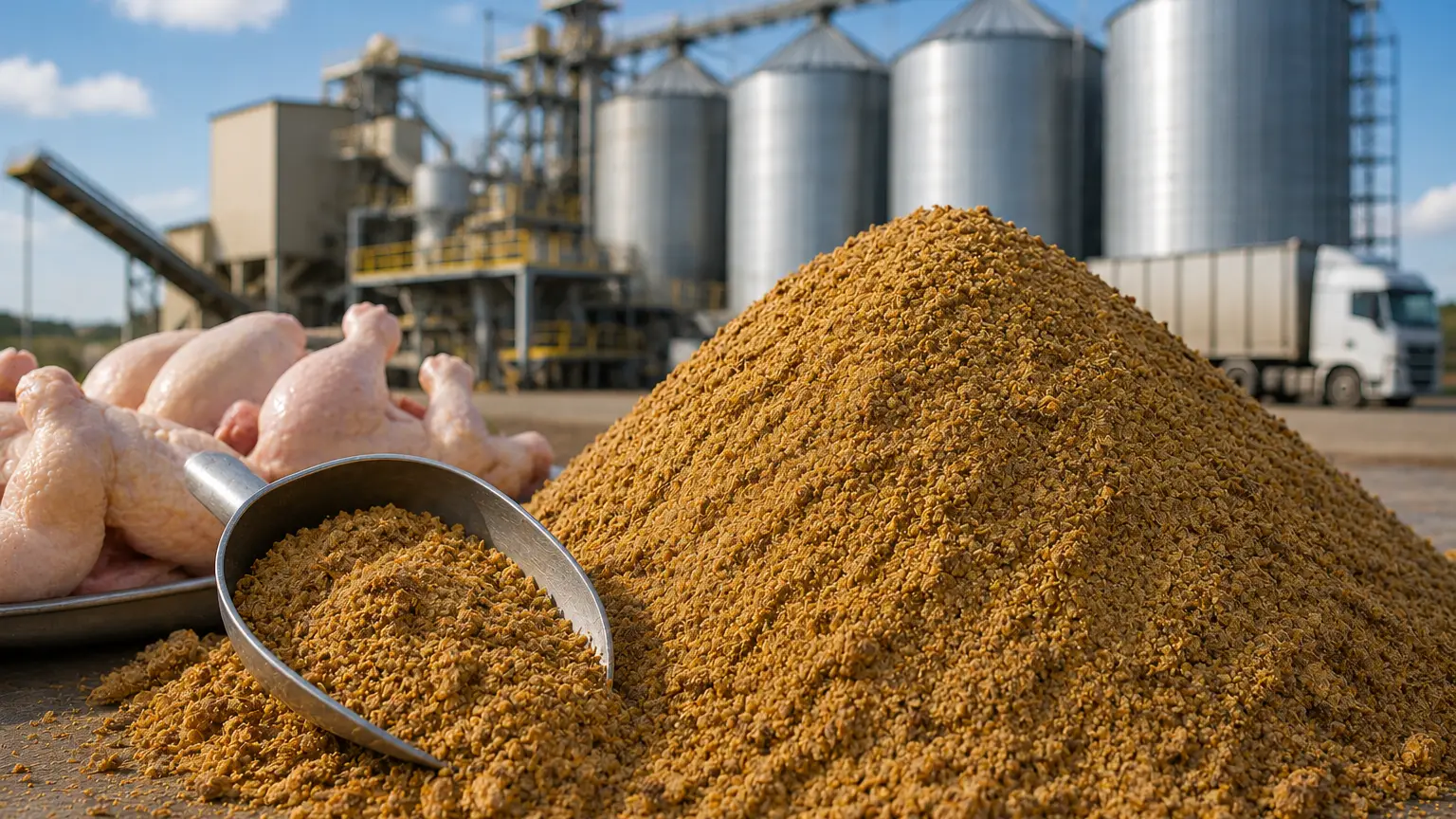
Poultry Meal is a feed-grade animal protein ingredient produced from dry and rendered poultry material. The supplied product information describes it as a natural high-protein ingredient made from rendered and cleaned poultry carcass material and supplied as a brown powder or pellets. The listed product specification identifies poultry origin, feed-grade status, a minimum crude protein level of 65% for the poultry specification, maximum ash of 14%, and minimum pepsin digestibility of 80%. These characteristics position Poultry Meal primarily as a functional protein ingredient for industrial feed formulation rather than as a general-purpose commodity. The product page also lists Saudi Arabia as the origin, a 50 kg/bulk packaging format, and storage in cool, dry conditions.
From a nutritional perspective, animal-derived meals can contribute concentrated protein and amino acids to formulated feeds. The Food and Agriculture Organization notes that animal meals are established sources of protein and amino acids for livestock, poultry, companion animals, and certain aquaculture feeds. This makes Poultry Meal commercially relevant wherever feed formulators need to balance protein supply, nutrient availability, formulation cost, and ingredient functionality.
For B2B buyers, the value proposition therefore extends beyond the headline protein percentage. The practical question is whether a particular Poultry Meal supply can deliver sufficiently consistent nutritional and physical characteristics for the intended feed formulation. Research published in Poultry Science has demonstrated that poultry by-product meal can show meaningful variation in mineral matter, ether extract, collagen, water activity, and processing characteristics between samples and production plants.
This makes product documentation an important part of commercial sourcing. Buyers evaluating [Poultry Meal supplier information] need to connect the stated specification with their own feed formulation requirements, quality-control procedures, storage conditions, regulatory expectations, and purchasing volumes. A marketplace product listing becomes more useful when it gives procurement teams a clear starting point for comparing technical characteristics before requesting commercial terms.
Poultry Meal Applications Across Feed Industries
Feed Formulation Applications
The principal commercial application of Poultry Meal is as an animal-feed protein ingredient. The supplied product information identifies applications in poultry, aquaculture, ruminant, non-ruminant, and pet-food feed. Its role is therefore broad enough to interest compound-feed manufacturers and specialist formulators serving multiple animal nutrition segments. FAO explains that practical poultry diets combine cereals, plant protein sources, fats, supplements, amino acids, minerals, and other feed ingredients, making protein meals one component within a larger formulation strategy.
Poultry feed manufacturers can consider Poultry Meal where its nutritional profile fits the formulation objective and where the ingredient complies with the manufacturer's internal specifications. The commercial opportunity is particularly relevant for industrial feed producers that routinely manage multiple protein sources and seek alternatives or complements to conventional ingredients. The product should not be treated as a universal substitute for another protein meal, because formulation suitability depends on nutrient composition, digestibility, inclusion level, species, and the balance of the complete diet.
Aquaculture and Pet-Food Applications
Aquafeed represents an increasingly relevant application area for poultry-derived protein ingredients. A 2026 open-access study published in Aquaculture Nutrition evaluated a processed blend containing poultry by-product meal as a fishmeal replacement in Nile tilapia diets, reflecting ongoing research into alternative protein combinations for aquaculture. The research illustrates the direction of application development without implying that every Poultry Meal specification is automatically suitable for every aquatic species or formulation.
Pet-food applications provide another commercial pathway identified on the product page, although procurement requirements can differ substantially from conventional feed applications. Buyers serving pet-food customers may require tighter controls around ingredient definition, nutritional consistency, traceability, contaminants, processing, and regulatory compliance. For distributors and traders, understanding these application-specific requirements is important because the same broad product category can serve different end markets with different purchasing specifications.
Poultry Meal Market Demand and Application Trends
Poultry and Feed Market Growth
Demand for Poultry Meal is connected indirectly to the broader development of animal production and compound-feed manufacturing. FAO reports that poultry production continues to grow and industrialize in many parts of the world, with population growth, purchasing power, urbanization, and advances in production technology supporting the expansion of the sector. FAO also identifies feed availability and quality as critical factors for intensive poultry production.
Recent market conditions reinforce the importance of feed economics in the poultry value chain. FAO's 2025 meat-market review reported that global meat production was projected to increase, with poultry output providing the main driver and lower feed costs supporting poultry expansion. For suppliers of feed ingredients, this creates a broader commercial environment in which protein ingredients can benefit from continued demand for efficient feed production, although actual Poultry Meal demand remains dependent on formulation economics, regional regulations, ingredient availability, and purchasing specifications.
Alternative Protein and Circular Utilization
Another important trend is the growing interest in using alternative feed ingredients and making greater use of by-products. FAO's poultry nutrition guidance highlights the need to make better use of alternative feeds as traditional feedstuff costs and supply constraints influence future poultry production. Poultry Meal fits within this wider industrial approach because rendering converts suitable poultry processing material into a stabilized ingredient that can be transported, stored, and incorporated into formulated feeds.
Aquaculture also illustrates how this trend can expand the potential buyer base. Recent scientific work continues to examine poultry-derived protein meals as alternatives or complements to fishmeal, particularly as feed manufacturers investigate ways to diversify protein sources. A 2026 Aquaculture Nutrition study involving poultry by-product meal and insect protein reflects this direction toward blended alternative-protein strategies. For B2B suppliers, the implication is that application development can be as commercially important as overall production growth because new formulations can create additional demand channels.
Poultry Meal Buyer Intent and Procurement Priorities
Who Buys Poultry Meal
The most relevant Poultry Meal buyers are compound-feed manufacturers, poultry-feed producers, aquafeed manufacturers, livestock-feed companies, pet-food producers, ingredient distributors, animal-nutrition traders, and procurement teams supplying integrated farming operations. These buyers typically purchase on a business-to-business basis and may evaluate both recurring contract supply and spot purchasing opportunities. Their requirements differ according to species, formulation, regulatory market, production scale, and the technical specification required by their downstream customers.
Buyer intent is usually strongest when the searcher already understands the ingredient category and is looking for a supplier, specification, price indication, availability, origin, or shipment option. Searches such as "Poultry Meal supplier," "buy Poultry Meal," and "Poultry Meal for animal feed" therefore represent stronger commercial intent than purely informational searches. A B2B marketplace article should address both stages by explaining the application while making it straightforward for a qualified buyer to move toward supplier inquiry.
What Procurement Teams Evaluate
Procurement teams commonly compare protein content, fat, ash, mineral characteristics, digestibility indicators, microbiological specifications, physical form, packaging, shelf life, storage conditions, documentation, origin, and delivery capability. The supplied product information lists several of these commercial and technical parameters, including moisture below 8%, microbiological limits, six-month shelf life, 50 kg/bulk packaging, ISO/HACCP information, and feed-grade status. These stated values should be confirmed against the current technical documentation and the buyer's applicable regulatory requirements before purchase.
Consistency is particularly important when a feed mill formulates at industrial scale. Research on poultry by-product meal has found variation in nutritional and processing variables, while subsequent research identified raw-material composition as an important contributor to the digestibility and nutritional standardization of the finished ingredient. Consequently, buyers should assess not only a single certificate of analysis but also the supplier's ability to maintain specification consistency across shipments.
Poultry Meal Sourcing and Supplier Evaluation
Technical and Commercial Due Diligence
A structured Poultry Meal sourcing process should begin with the intended application. A feed manufacturer should define the animal species, formulation role, required protein level, acceptable ash range, digestibility expectations, physical form, packaging, expected monthly volume, destination market, and documentation requirements before comparing suppliers. This prevents purchasing decisions from being based solely on price and makes supplier quotations easier to compare on a like-for-like basis.
The technical evaluation should then examine the supplier's current specification and supporting documents. The product information supplied for this marketplace listing identifies feed-grade Poultry Meal with a stated poultry crude protein minimum of 65%, maximum ash of 14%, calcium at 3%, phosphorus at 1.5%, lysine at 2.5–3.0%, and pepsin digestibility of at least 80%. Because feed formulations are sensitive to ingredient variability, these values should be treated as the stated product specification rather than as universal characteristics of every Poultry Meal available in the market.
Quality assurance is also central to supplier evaluation. Scientific research has shown that poultry by-product meal can vary according to raw-material composition and rendering conditions, with implications for digestibility and nutritional standardization. This supports a procurement approach that considers batch consistency, analytical testing, processing controls, traceability, storage, and documentation alongside commercial terms.
For buyers ready to investigate supply options, the [Poultry Meal sourcing page] is the appropriate commercial starting point for reviewing the listed product information and moving toward an inquiry. In a B2B marketplace environment, the product page can connect technical discovery with commercial sourcing by giving buyers a defined product reference before they discuss pricing, customization, quantities, shipping, and documentation.
Commercial Positioning and B2B Sourcing Outlook
Why Poultry Meal Matters Commercially
Poultry Meal has commercial relevance because it connects a high-protein feed ingredient with several expanding animal-nutrition applications. Its stated applications span poultry, aquaculture, ruminant, non-ruminant, and pet-food feed, giving manufacturers, distributors, and traders multiple potential end-use markets. The commercial opportunity is therefore shaped not only by the product itself but also by the ability of suppliers to match specification, application, volume, documentation, and delivery requirements with the needs of individual buyers.
Market fundamentals provide a supportive backdrop for this application diversity. FAO's recent outlook indicates continued growth in poultry production and highlights feed economics as a key factor affecting the sector. At the same time, research into poultry-derived proteins for aquaculture demonstrates that feed formulators continue to investigate alternative protein sources and combinations. Together, these developments suggest that Poultry Meal sourcing can remain relevant wherever manufacturers seek technically suitable animal protein ingredients for competitive feed formulations.
Marketplace Value for Buyers and Suppliers
For manufacturers and traders, reliable sourcing is important because interruptions or significant specification changes can complicate feed formulation, production planning, inventory management, and customer commitments. A marketplace positioning strategy can reduce the initial information gap by presenting the product category, technical characteristics, application context, packaging, origin, and inquiry pathway in one location. This is particularly useful for procurement teams screening potential suppliers before entering a detailed commercial negotiation.
The strongest B2B conversion path is therefore based on informed comparison rather than aggressive promotion. Buyers can use the [Poultry Meal product page] to assess the listed product information and identify the next steps for commercial discussion, while suppliers and distributors can use marketplace visibility to reach procurement teams searching for poultry protein ingredients. For both sides, the objective is a clearer connection between application requirements and sourcing decisions, supported by appropriate technical and commercial documentation.
For Tradeasia, Chemtradeasia, and Tradechem Marketplace, Poultry Meal can consequently serve as a commercially focused entry point into the animal-feed ingredient sector. The combination of feed-industry demand, multiple end-use applications, and growing interest in alternative protein sourcing creates an SEO opportunity around supplier discovery, application research, and procurement evaluation. The most valuable content is content that helps a buyer understand what to ask for, how to compare supply, and when to proceed to a supplier inquiry.
Ultimately, successful Poultry Meal procurement depends on matching the right specification with the right application and supply model. Buyers should verify current technical documentation, regulatory suitability, quality controls, logistics, and commercial terms before committing to a purchase. For organizations evaluating potential supply, the [Poultry Meal supplier information] provides a direct marketplace reference for beginning that sourcing process, while the broader market outlook suggests that efficient, well-documented protein-ingredient sourcing will remain important to competitive feed manufacturing.
Sources
Leave a Comment