Potato Starch and Its Commercial Role
Potato starch is a plant-derived starch obtained from potatoes and used as a functional ingredient or processing material in food and a range of industrial applications. Its commercial value comes less from the crop itself than from the functional behavior of starch during processing, where properties such as swelling, gelatinization, viscosity, water binding, gel formation, adhesion, and film formation can influence the performance of a finished formulation. Recent scientific literature continues to identify potato starch as a versatile renewable biopolymer with relevance to food, packaging, pharmaceutical, and industrial material systems.
Functional Characteristics Behind Industrial Demand
From a buyer perspective, potato starch is important because its functional characteristics can be matched with specific processing requirements. Scientific literature describes native potato starch as having relatively high swelling capacity, cooking viscosity, paste clarity, and water-binding characteristics. At the same time, native starch can have limitations involving heat, shear, freeze-thaw stability, retrogradation, and processing stability, which helps explain why both native and modified starch products have commercial roles.
Native and Modified Potato Starch
The distinction between native and modified potato starch is commercially significant. Modification can be used to tailor characteristics such as gelatinization, viscosity, stability, swelling behavior, and resistance to particular processing conditions. Research covering physical, chemical, and enzymatic modification shows that selecting an appropriate modification strategy allows starch functionality to be adapted to a particular end use rather than treating starch as a one-size-fits-all commodity.
For B2B procurement teams, this means that a potato starch sourcing decision should begin with the intended application rather than price alone. Food manufacturers, paper producers, textile processors, adhesive manufacturers, and other industrial users may require different functional profiles and documentation. Consequently, commercial sourcing is increasingly about identifying a product that fits the technical process, quality requirements, regulatory environment, and supply model of the buyer.
Potato Starch Applications Across Key Industries
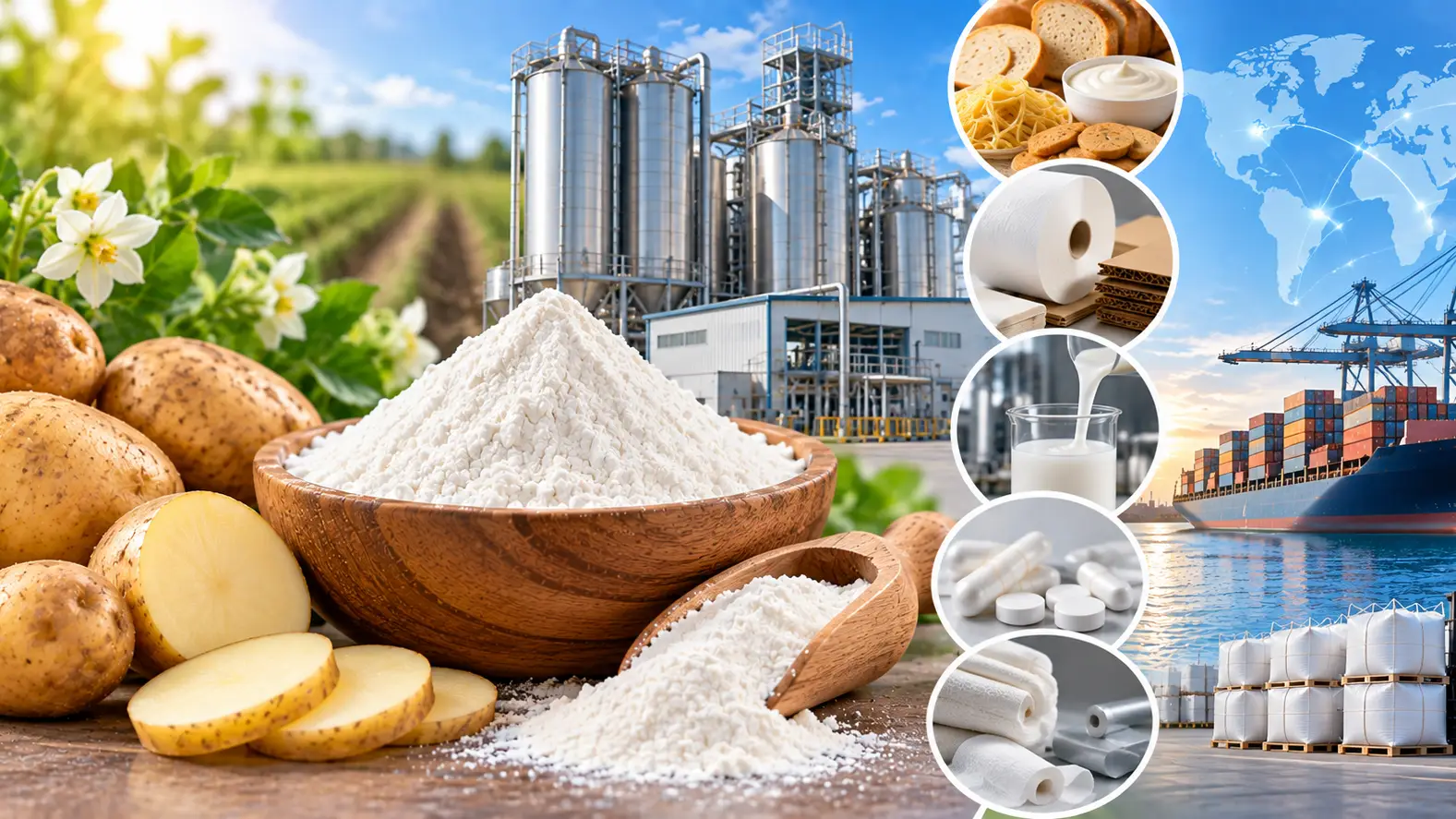
Potato starch has a broad application base, giving it relevance across several industrial value chains. Traditional commercial applications include food products, paper manufacturing, textile processing, and adhesives, while newer research continues to investigate packaging, pharmaceutical formulations, functional food systems, and advanced starch-based materials. A review of industrial applications identifies thickening and adhesion as fundamental starch functions, while also describing roles in papermaking and textile processing.
Food Processing Applications
Food processing remains one of the most important application areas for potato starch. Its ability to contribute viscosity, texture, gel formation, water management, and visual clarity makes it relevant to sauces, soups, processed foods, confectionery, snacks, and other formulations. A recent technical chapter on potato starch emphasizes that starch structure and its interaction with processing conditions influence food texture and product performance, making application-specific selection important for food manufacturers.
Paper, Textile and Adhesive Applications
Outside food, potato starch can function as a binder, coating component, strength additive, or processing aid. Industrial literature identifies paper applications, including starch use at the wet end and in paper-related processing, while textile applications include warp sizing and fabric printing. Starch adhesives are another established industrial application in which adhesion and formulation performance determine commercial suitability.
These applications create several distinct buyer groups rather than a single potato starch market. Food ingredient manufacturers may prioritize functional performance and regulatory documentation, while paper and textile producers may emphasize viscosity, binding behavior, consistency, and process compatibility. For distributors and chemical marketplaces, understanding these different use cases creates an opportunity to connect suppliers with buyers according to application requirements instead of relying solely on generic product descriptions.
Market Demand and Emerging Application Trends
Potato starch demand is influenced by the development of end-use formulations, processing technology, and the search for functional plant-derived materials. Current scientific work describes potato starch as a renewable and biodegradable biopolymer with continuing relevance in food, packaging, pharmaceuticals, and emerging material systems. This indicates that the commercial opportunity extends beyond traditional starch applications, although the suitability of a particular product depends on its specifications and intended use.
Demand for Application-Specific Functionality
One important trend is the movement toward starch products whose properties are deliberately tailored to processing requirements. Research into modified potato starch demonstrates efforts to improve characteristics such as water absorption, solubility, rheological behavior, thermal stability, and resistance to processing stresses. For industrial buyers, this creates a stronger connection between product selection and application engineering.
Sustainability and New Material Applications
Sustainability is another factor supporting interest in potato starch as a renewable raw material. Recent research discusses its biodegradability and potential use in packaging and thermoplastic material systems, while also emphasizing the need to balance functional improvement with environmental performance. This does not mean every potato starch grade is automatically suitable for sustainable-material applications; rather, it shows why starch-based materials remain an area of technical and commercial development.
For the B2B market, these developments can translate into new sourcing requirements. Manufacturers investigating reformulation, biodegradable materials, or improved processing performance may need suppliers capable of providing consistent material and relevant technical information. The commercial opportunity therefore sits at the intersection of established demand and application innovation, where procurement teams increasingly need suppliers that understand both the product and its end-use context.
Potato Starch Buyers and Procurement Intent
The buyer base for potato starch is diverse because the material performs different functions across multiple industries. Typical commercial buyers can include food manufacturers, food ingredient formulators, paper producers, textile processors, adhesive manufacturers, pharmaceutical-related manufacturers, distributors, traders, and industrial procurement teams. The relevance of each buyer group depends on the grade, formulation, regulatory requirements, and intended application.
What Potato Starch Buyers Evaluate
Procurement teams generally need to evaluate more than product availability. Depending on the application, they may consider functional performance, consistency between batches, relevant technical specifications, packaging, documentation, regulatory suitability, delivery capability, minimum order requirements, and supplier responsiveness. Scientific literature reinforces the importance of starch structure and processing behavior in determining performance, making technical fit an important component of supplier evaluation.
Why Buyers Compare Suppliers
Supplier comparison is particularly relevant when potato starch becomes a recurring production input. A buyer may compare suppliers based on product consistency, technical support, commercial terms, logistics capability, documentation, and the ability to maintain supply. For food-related applications, regulatory considerations can also become significant; for example, the European Food Safety Authority explains that food additives placed on the EU market are subject to safety assessment and applicable specifications and conditions of use.
This makes buyer intent highly commercial. A user searching for “potato starch supplier,” “buy potato starch,” or “potato starch for food processing” is likely to be further along the procurement journey than someone searching only for a general definition. A B2B marketplace can address this intent by combining application information with practical supplier and product information, helping buyers move from technical research toward supplier evaluation.
B2B Sourcing Considerations for Potato Starch
Effective potato starch sourcing starts with defining the application and translating that application into purchasing requirements. A buyer should establish whether the requirement concerns food processing, paper, textile processing, adhesives, pharmaceutical applications, or another use before evaluating potential suppliers. This approach reduces the risk of selecting a material based on the product name alone when functional requirements may differ substantially.
Matching Product Requirements to Application
Application matching should consider the processing environment and desired performance characteristics. For example, a food manufacturer may focus on thickening, texture, clarity, stability, and processing behavior, while an industrial adhesive buyer may be more concerned with binding performance and consistency. Research on potato starch modification demonstrates why properties such as swelling, pasting behavior, thermal response, and rheology can be important when selecting starch for a particular application.
Evaluating Supplier Capability
Supplier evaluation should also cover commercial reliability. Procurement teams can assess whether a supplier provides clear product information, responds to technical questions, supports documentation requirements, and can accommodate the buyer's purchasing model. For companies sourcing internationally, logistics coordination and continuity of supply may be as important as the initial product quotation.
Buyers researching available supply can use the [Potato Starch product page] as a starting point for product and sourcing information on the Tradeasia marketplace. Potato Starch product page The page can support early-stage supplier research by giving commercial buyers a dedicated product reference before they progress to detailed specification and purchasing discussions.
Commercial Opportunities in Potato Starch Supply
Potato starch offers commercial relevance because its applications span both established manufacturing processes and developing formulation opportunities. The combination of food functionality, industrial processing uses, and research into new starch-based materials gives manufacturers and distributors several potential routes to market. Scientific reviews continue to identify food, paper, textile, pharmaceutical, packaging, and other uses as important areas for potato starch development.
Opportunities for Manufacturers and Traders
Manufacturers can position potato starch around application-specific performance and consistent supply, while traders and distributors can create value by connecting regional buyers with suitable sources. For procurement teams, the benefit of a marketplace environment is the ability to investigate supply options while keeping the application and commercial requirements in view. This is particularly useful where buyers operate across several markets or need to compare supply channels.
Opportunities Across End-Use Markets
The diversity of applications also supports market segmentation. Food processing represents a major functional use area, while paper, textile, adhesive, pharmaceutical, packaging, and emerging biomaterial applications can create additional commercial pathways. Recent research into dual-modified potato starch for baked products illustrates how application-driven modification continues to develop, showing that functionality remains an important area of innovation rather than a static product characteristic.
For Tradeasia, Chemtradeasia, and Tradechem Marketplace, the commercial positioning should therefore focus on making industrial sourcing more informed and application-oriented rather than simply presenting potato starch as a commodity. Buyers can use the [Potato Starch sourcing information] to begin evaluating the product in relation to their procurement requirements. Potato Starch sourcing information This approach can help manufacturers, distributors, traders, and procurement teams identify relevant supply opportunities while reducing the information gap between product discovery and supplier engagement.
Conclusion: Building a Reliable Potato Starch Sourcing Strategy
Potato starch is commercially significant because its functionality supports a wide range of food and industrial processes. Thickening, gelling, binding, water management, coating, adhesion, and film-forming behavior help explain its continued use, while modification technologies allow functionality to be adapted for more demanding applications. Recent scientific literature also indicates continued interest in potato starch for renewable and advanced material applications.
From Application Research to Procurement
For buyers, the most effective sourcing process begins with the intended end use. Understanding whether potato starch is required for food processing, paper manufacturing, textile processing, adhesives, pharmaceuticals, packaging, or another application allows procurement teams to establish appropriate technical and commercial criteria before comparing suppliers.
From Supplier Search to Long-Term Supply
Supplier selection should then consider product suitability, consistency, documentation, communication, logistics, commercial terms, and the supplier's ability to support ongoing requirements. Regulatory considerations should also be reviewed according to the destination market and intended application, particularly for food-related uses. EFSA's current guidance demonstrates the importance of appropriate characterization, specifications, proposed use, exposure, and safety information where food-additive authorization requirements apply.
Ultimately, potato starch sourcing is not simply a search for the lowest-cost material. It is a procurement decision that connects functional requirements with supply reliability and end-use performance. Buyers looking to investigate commercial availability can refer to the [Potato Starch supplier information] on Tradeasia's product platform. Potato Starch supplier information By combining application knowledge with structured B2B sourcing, manufacturers, distributors, traders, and procurement teams can make more informed decisions about potato starch supply.
Leave a Comment