Pea Starch Market Demand and Commercial Drivers
Growing demand for functional plant-based ingredients
Pea starch is gaining commercial attention as manufacturers look for functional starch ingredients that can support formulation, processing, texture, and product positioning requirements. Pea starch is derived from peas and is commonly recovered during pea protein processing, making it an important component of the broader pulse-ingredient supply chain. Technical literature identifies characteristics such as gelatinization, viscosity, gelling, water retention, and texture formation as important to its industrial usefulness.
Market research published by MarketsandMarkets estimates that the global pea starch market could increase from USD 426.9 million in 2024 to USD 671.8 million by 2029, representing a projected CAGR of 9.5%. The research associates this development with increasing use of plant-based ingredients, natural food additives, and functional starches in food and related applications.
Functional properties influence commercial demand
For B2B buyers, the commercial value of pea starch is closely linked to what it can contribute to a formulation rather than simply its botanical origin. Its gelling, thickening, texturizing, and water-management characteristics can make it relevant when manufacturers are developing products that require specific processing or finished-product properties. This makes application performance an important consideration when assessing different pea starch grades and suppliers.
The broader market is also influenced by demand for plant-based and clean-label formulation strategies. Market research indicates that food and beverage represents an important application area, while feed and industrial applications provide additional opportunities. For manufacturers, this diversification means pea starch can serve several procurement categories rather than being restricted to one narrowly defined end use.
Pea Starch Applications in Food and Beverage
Food processing and texture management
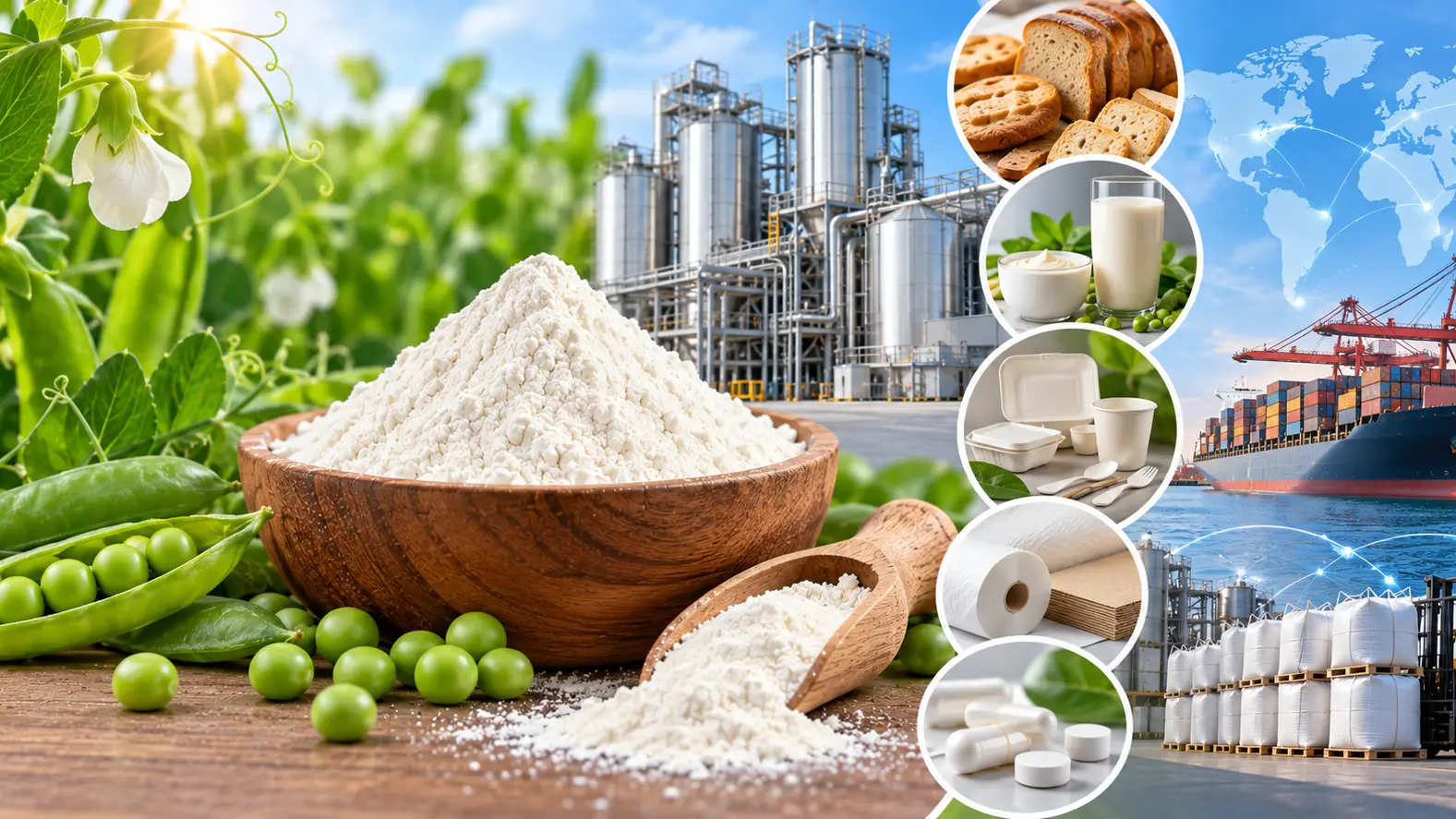
Food and beverage is one of the most commercially significant areas for pea starch applications. Depending on formulation and processing requirements, pea starch can contribute thickening, gelling, texturizing, and other functional effects. Scientific literature on pea starch highlights its physicochemical characteristics, including gelatinization and viscosity behavior, as important determinants of how it performs in food systems.
These characteristics make pea starch relevant to manufacturers developing products such as sauces, soups, bakery products, snacks, confectionery, noodles, and other processed foods. Its application potential is particularly relevant when product developers are seeking alternatives or complements to more established starch sources. The appropriate choice ultimately depends on the required processing conditions, texture, stability, and formulation objectives.
Plant-based and specialty food formulations
Pea starch also fits into the wider expansion of pulse-based and plant-derived food ingredients. Research into pea ingredients shows that pea protein and starch are closely connected within fractionation processes, while starch functionality can influence the behavior of finished food systems.
For commercial buyers, this creates opportunities across plant-based foods and specialty formulations where ingredient functionality is important alongside product positioning. Procurement teams may therefore evaluate pea starch not only according to price but also according to grade, consistency, technical specifications, compatibility with production processes, and the ability of a supplier to provide dependable commercial volumes.
Pea Starch Uses Beyond Food Processing
Feed and pet food applications
Pea starch has relevance beyond conventional human food manufacturing. Market research identifies animal feed and pet food among the application areas supporting the broader pea starch market, with feed demand representing an additional route for utilization of pea-derived starch ingredients.
For feed manufacturers and ingredient distributors, sourcing decisions can be influenced by factors such as functional performance, consistency, supply continuity, product specifications, and economics. The commercial opportunity is therefore not limited to food formulators. Traders and distributors serving feed manufacturers can also consider pea starch as part of a wider portfolio of plant-derived functional ingredients.
Pharmaceutical and industrial applications
Technical research indicates that pea starch's solubility, water retention, texture-forming, gelatinization, and viscosity characteristics create potential relevance in pharmaceutical and other industrial applications. A recent scientific review specifically identifies food, pharmaceutical, and chemical industries as areas where the functional properties of pea starch can be useful.
Industrial applications can also extend into paper, coatings, adhesives, and other material-oriented uses. Grand View Research identifies paper as a potentially fast-growing end-use segment, citing interest in starch-based binding and surface-property applications. For buyers, however, industrial suitability should be confirmed against the precise technical specification and process requirements rather than assumed from general application descriptions.
Key Buyers and Procurement Requirements
Who buys pea starch
The main B2B buyer groups for pea starch include food manufacturers, ingredient formulators, plant-based food producers, feed and pet food manufacturers, pharmaceutical companies, industrial processors, ingredient distributors, traders, and procurement organizations. Each group can have different requirements because the performance criteria for a food formulation may differ substantially from those of an industrial or pharmaceutical process.
Food manufacturers may focus on functionality, food-grade specifications, formulation performance, and consistency. Feed and pet food companies may evaluate technical characteristics alongside economics and supply availability, while pharmaceutical and industrial buyers can require more detailed documentation and tighter specification control. Distributors and traders, meanwhile, may place greater emphasis on supplier reliability, commercial quantities, packaging, logistics, and the ability to serve downstream customers.
What procurement teams evaluate
A professional pea starch sourcing process normally begins with the intended application and then moves toward specification, supplier capability, commercial terms, and logistics. Buyers may compare product grade, technical specifications, purity requirements, physical form, packaging, minimum order quantities, lead times, documentation, and the supplier's ability to maintain consistent quality across shipments.
Supplier comparison is especially important when pea starch becomes a recurring production input. A low initial purchase price may not provide the best commercial result if inconsistent specifications create formulation adjustments, production disruption, or additional quality-control work. For this reason, procurement teams generally benefit from evaluating total sourcing reliability rather than treating unit price as the only purchasing criterion.
Pea Starch Sourcing and Supplier Evaluation
Selecting a dependable pea starch supply
Pea starch sourcing should connect technical requirements with commercial supply capabilities. Buyers should first define the intended end use, required grade, formulation requirements, target volume, delivery market, packaging preferences, and relevant quality documentation. These criteria create a practical basis for comparing suppliers and determining whether a particular pea starch product is appropriate for the application.
For businesses evaluating supply options, the Pea Starch product page can serve as a starting point for reviewing product and sourcing information. A marketplace-based approach can be useful when procurement teams need to move from initial product research toward supplier communication and commercial evaluation.
Why B2B marketplace sourcing matters
B2B marketplaces can simplify the early stages of ingredient sourcing by connecting product information with commercial supplier discovery. For pea starch buyers, this can help shorten the distance between identifying an application requirement and finding a potential supply channel. It can also give procurement, sales, and technical teams a common product reference when assessing purchasing opportunities.
Reliable sourcing remains important because pea starch demand is tied to multiple downstream industries and formulation categories. As market adoption expands, buyers may increasingly compare suppliers on more than availability, including specification transparency, responsiveness, commercial flexibility, documentation, and supply continuity. The objective is to establish a sourcing relationship that supports repeat procurement rather than a one-time transaction.
Commercial Outlook for Pea Starch Buyers
Market opportunities across end-use industries
The commercial outlook for pea starch is supported by the expansion of plant-based ingredient demand and the widening range of applications for pulse-derived starch. MarketsandMarkets projects substantial growth in the global market through 2029, while Grand View Research also identifies food and beverage, feed, pharmaceuticals, and industrial uses as relevant areas of market development.
For manufacturers and distributors, the most attractive opportunities are likely to emerge where pea starch provides a clear functional or formulation advantage. Food processors can evaluate its role in texture and processing, feed manufacturers can consider its role within plant-derived ingredient systems, and industrial users can investigate applications based on starch binding, viscosity, or film-forming behavior. This application-led approach provides a more practical basis for assessing market demand than relying solely on overall market-growth figures.
Turning market interest into sourcing decisions
For procurement teams, market growth becomes commercially meaningful only when it can be translated into dependable supply, appropriate specifications, and predictable purchasing conditions. Buyers considering pea starch should therefore connect their application requirements with supplier evaluation, including product grade, technical documentation, commercial volume, logistics, and consistency. Scientific literature also reinforces the importance of physicochemical behavior when determining suitability for a particular application.
As a B2B marketplace opportunity, pea starch sits at the intersection of ingredient innovation, plant-based manufacturing, and industrial sourcing. Manufacturers, traders, distributors, and procurement teams can use the Pea Starch supplier information and sourcing page as a commercial starting point for evaluating the product against their requirements. For businesses seeking to expand their ingredient portfolio or establish a reliable pea starch supply channel, application-specific evaluation and supplier comparison remain central to sound purchasing decisions.
Leave a Comment