Native Tapioca Starch: Product Fundamentals and Functional Value
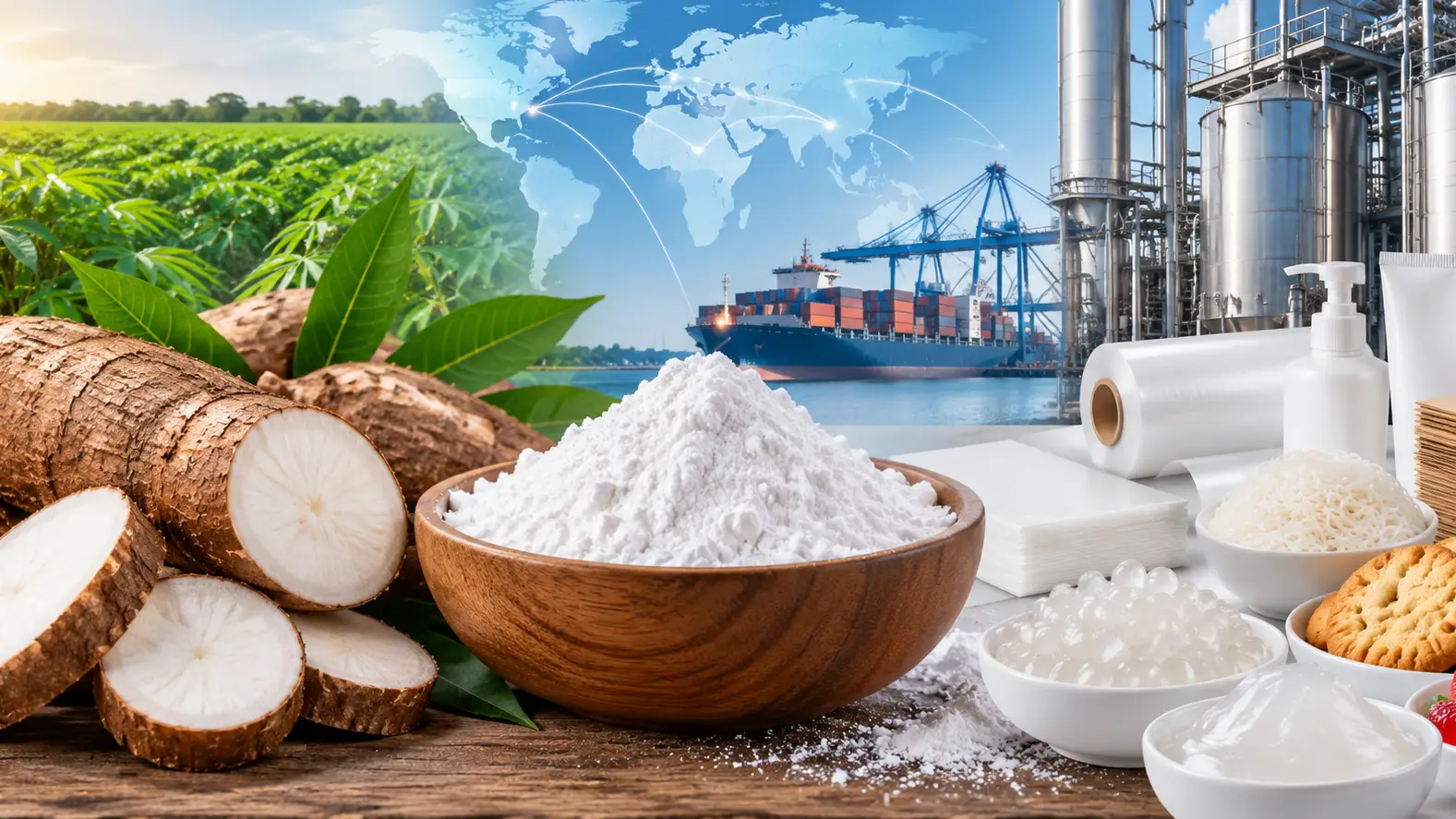
Native Tapioca Starch is a naturally derived starch obtained from cassava roots and supplied without chemical modification. In international trade, tapioca starch and cassava starch are commonly used to describe starch extracted from Manihot esculenta. Its commercial importance comes from a combination of functionality, availability, and versatility across food and non-food manufacturing. Technical literature identifies tapioca starch as a material with comparatively low residual components, useful pasting characteristics, and broad industrial applicability.
What Native Tapioca Starch Is
Native tapioca starch consists primarily of starch polymers, principally amylose and amylopectin, organized within starch granules. When processed with water and heat, these granules undergo gelatinization, producing functional changes that are important for thickening, binding, texture development, and film formation. The precise behavior depends on cassava variety, cultivation conditions, extraction, drying, purity, and other processing factors, making product specification important for industrial buyers.
Key Functional Characteristics
For manufacturers, the value of native tapioca starch is less about the name of the raw material and more about how consistently it performs in a formulation or production process. Tapioca starch is associated with properties including high paste viscosity, swelling capacity, relatively low gelatinization temperature, clarity, and bland flavor. These characteristics can make it attractive where formulators require functional starch without a strong sensory contribution.
Why Consistency Matters Commercially
A buyer sourcing native tapioca starch must therefore consider more than price per metric ton. Consistent particle characteristics, moisture, purity, microbiological quality where relevant, packaging, documentation, and batch-to-batch performance can affect production efficiency and finished-product quality. For international B2B procurement, dependable supply and clearly defined specifications become particularly important when starch is used as a recurring production input rather than a one-time ingredient. FAO documentation also emphasizes that starches from different botanical sources can display different physical properties even when they perform similar broad functions.
Native Tapioca Starch Applications in Food Manufacturing
Food manufacturing remains one of the most important commercial application areas for native tapioca starch. Scientific reviews describe applications across bakery and pastry products, noodles, soups, dairy-style products, desserts, confectionery, tapioca pearls, beverages, and other processed foods. This broad application base gives food manufacturers flexibility to use tapioca starch as a functional ingredient rather than limiting it to a single product category.
Thickening and Texture Applications
In food formulations, native tapioca starch can provide viscosity and contribute to texture after gelatinization. Its relatively bland flavor can be commercially useful when manufacturers want the starch to perform a technical role without significantly changing the sensory profile of the finished product. These characteristics help explain its use in sauces, soups, fillings, bakery products, desserts, and other formulations where controlled viscosity and mouthfeel are important.
Bakery and Processed Food Uses
Tapioca starch is also relevant to manufacturers developing bakery, snack, noodle, confectionery, and convenience-food products. Its functional behavior can influence expansion, texture, binding, crispness, or structural characteristics depending on the formulation and processing conditions. For procurement teams, this means the appropriate grade should be assessed against the actual manufacturing process rather than selected solely according to the generic term “tapioca starch.”
Food Formulation and Product Development
A further commercial opportunity comes from product development around starch functionality. Recent research continues to investigate cassava starch for films, functional ingredients, and modified starch systems, demonstrating that the underlying material remains relevant to innovation in food technology. Native tapioca starch can therefore serve both established food manufacturers and companies developing new formulations, although performance requirements must be validated through application-specific testing.
Industrial Applications Beyond Food
The commercial role of native tapioca starch extends well beyond food manufacturing. FAO identifies starch applications in paper, textiles, adhesives, pharmaceuticals, beverages, confectionery, building materials, and other sectors, while recent scientific literature continues to examine starch-based materials for packaging, adhesives, and pharmaceutical systems. This diversity reduces dependence on a single end-use segment and makes tapioca starch relevant to multiple industrial procurement categories.
Paper and Packaging Applications
In paper manufacturing, starch can serve as a binder, coating component, and processing aid, supporting properties such as surface quality, fiber retention, and strength. Starch-based materials are also being investigated for packaging applications, including biodegradable films derived from cassava starch. Research published in 2023 identified cassava starch as a promising raw material for biodegradable food-packaging films, although additional modification is often needed to achieve the mechanical and barrier properties demanded by commercial packaging.
Textile and Adhesive Applications
Textile manufacturing has historically used starch in sizing, finishing, and printing processes, while starch-based materials are also relevant to adhesive formulations. Research into starch-based adhesives demonstrates continuing interest in improving stability, bonding performance, and processing characteristics for cellulosic substrates and paper-based packaging. For buyers, this means demand can originate from textile processors, paper converters, packaging manufacturers, and adhesive producers rather than only from food companies.
Pharmaceutical and Biopolymer Uses
Pharmaceutical applications represent another technically important area. A 2024 review in RSC Pharmaceutics describes cassava starch as a potential pharmaceutical excipient because of properties including swelling, film-forming, adhesive, and gelling behavior. However, pharmaceutical procurement involves substantially tighter requirements than many industrial applications, including regulatory suitability, purity, documentation, and validated performance, and native starch may require modification for specific high-performance formulations.
Market Demand and Emerging Application Trends
The outlook for native tapioca starch is shaped by both established consumption and application diversification. Cassava starch has long been traded as an industrial starch, particularly in regions where cassava processing is well developed, while scientific reviews continue to report demand associated with its functional properties and cost competitiveness. FAOSTAT also continues to maintain and update comprehensive agricultural production data, providing an important statistical foundation for evaluating the upstream cassava supply environment.
Diversification of Starch Applications
One of the clearest trends is the movement from conventional starch consumption toward increasingly specialized applications. Research is exploring cassava starch in biodegradable packaging, drug delivery systems, bio-based adhesives, resistant starch, and other functional materials. This does not mean every emerging application will immediately create large commodity demand, but it indicates that cassava starch is increasingly viewed as a versatile bio-based platform rather than simply a conventional food thickener.
Interest in Functional and Modified Starch
Another important trend is the development of functional starches with targeted characteristics. A recent 2026 review examined chemical approaches for increasing resistant starch type 4 and improving functional properties of cassava starch, including interest in esterification, cross-linking, acetylation, and greener modification routes. For native tapioca starch suppliers, this trend is commercially relevant because native material can represent the starting point for downstream modification and formulation rather than only the final ingredient.
Supply and Regional Considerations
The supply side is equally important because cassava production and starch processing are geographically concentrated across major producing regions. Scientific literature identifies Thailand, Vietnam, Cambodia, and other Asian markets as significant areas for cassava starch production and trade, while cassava itself is also an important crop across Africa and South America. Buyers therefore need to evaluate origin, processing capability, export infrastructure, lead times, and supply continuity alongside technical specifications when developing an international sourcing strategy.
Buyer Intent and Procurement Considerations
The buyer landscape for native tapioca starch is broad because the material can enter different manufacturing value chains. Food ingredient manufacturers, bakery and confectionery producers, noodle and processed-food companies, paper and packaging businesses, textile processors, adhesive manufacturers, pharmaceutical developers, distributors, and industrial traders can all have potential procurement requirements. The precise buyer profile depends on the intended grade, specification, regulatory requirements, and final application.
Who Buys Native Tapioca Starch
Procurement teams generally purchase native tapioca starch when they need a reliable starch raw material for formulation, processing, binding, thickening, sizing, coating, or other functional purposes. Food manufacturers may prioritize food-grade compliance and sensory neutrality, while industrial users can place greater emphasis on viscosity behavior, moisture, particle characteristics, and processing performance. Pharmaceutical buyers typically require additional documentation and stronger quality controls because starch may be incorporated into regulated dosage forms.
What Buyers Evaluate
Supplier comparison commonly extends across technical specifications, consistency, certification and documentation, packaging formats, minimum order quantities, production capacity, shipment schedules, origin, and total landed cost. A low quoted price may not represent the most competitive option if inconsistent quality creates production losses, additional testing, reformulation, or delivery disruptions. The appropriate procurement decision therefore evaluates the material as part of the buyer's complete supply chain rather than treating starch as a simple commodity purchase.
Why Buyers Compare Suppliers
Multiple sourcing options can help procurement teams benchmark commercial terms and reduce exposure to supply interruptions. This is particularly relevant for manufacturers that use tapioca starch continuously, because changes in raw material quality or delivery schedules can affect production planning and customer commitments. A B2B marketplace can support this process by giving buyers a structured starting point for supplier discovery, product comparison, commercial inquiries, and evaluation of application fit.
Sourcing Strategy and B2B Marketplace Opportunities
For international buyers, sourcing native tapioca starch is ultimately a supply-chain decision combining technical suitability, commercial competitiveness, and supplier reliability. The diversity of end-use applications means that buyers should define their intended application and required specifications before requesting quotations. A food processor, paper manufacturer, pharmaceutical developer, and adhesive producer may all search for “tapioca starch,” but their acceptance criteria can be materially different.
Matching Product Specifications to Application
The first sourcing priority should be application fit. Buyers should clarify the required grade, intended use, processing conditions, target functional properties, packaging, and applicable regulatory requirements before comparing offers. Because starch functionality can vary with botanical source, extraction and processing conditions, technical data should be reviewed alongside samples or application testing where appropriate. This approach reduces the risk of choosing a nominally suitable product that performs poorly in the buyer's actual manufacturing process.
Building a Reliable Supply Base
For manufacturers and distributors, reliable sourcing requires attention to production capacity, geographic origin, export experience, logistics, lead times, documentation, and communication. Supply-chain resilience can be strengthened by qualifying multiple suppliers or maintaining alternative sources where commercially practical. In a global market, procurement teams can also benefit from comparing suppliers according to total delivered economics rather than focusing exclusively on the ex-works or quoted product price.
Tradeasia and Marketplace Positioning
For Tradeasia, Chemtradeasia, and Tradechem Marketplace, native tapioca starch can serve as a commercially relevant entry point connecting buyers with a versatile agricultural-derived industrial raw material. The strongest marketplace positioning is not simply to promote the product, but to help procurement teams identify application relevance, clarify requirements, compare supply options, and initiate qualified B2B inquiries. As demand continues to span food, packaging, paper, textile, adhesive, pharmaceutical, and other applications, a structured marketplace approach can help buyers move more efficiently from product discovery to sourcing evaluation.
Native Tapioca Starch therefore occupies a useful position in the B2B supply chain because its applications extend across both established and developing markets. Its commercial potential is supported by broad industrial functionality, continuing research into starch-based materials, and demand from manufacturers seeking versatile plant-derived raw materials. For buyers, the most effective sourcing strategy is to combine application-specific specifications with supplier reliability, documentation, logistics capability, and competitive total cost.
Leave a Comment