Introduction
Millet market in 2026 is evolving as a resilient segment within global grains, with millet (PRODUCT) as a platform agricultural commodity supporting food security and diversified value chains. Rising health-conscious consumption and gluten-free demand are reshaping its applications, while producers scale output across Asia and Africa. Global production is estimated at 31–33 million metric tons, while market pricing averages USD 320–420/MT, reflecting tightening supply-demand balance and expanding industrial utilization across food and feed ecosystems.
Applications in Food Industry
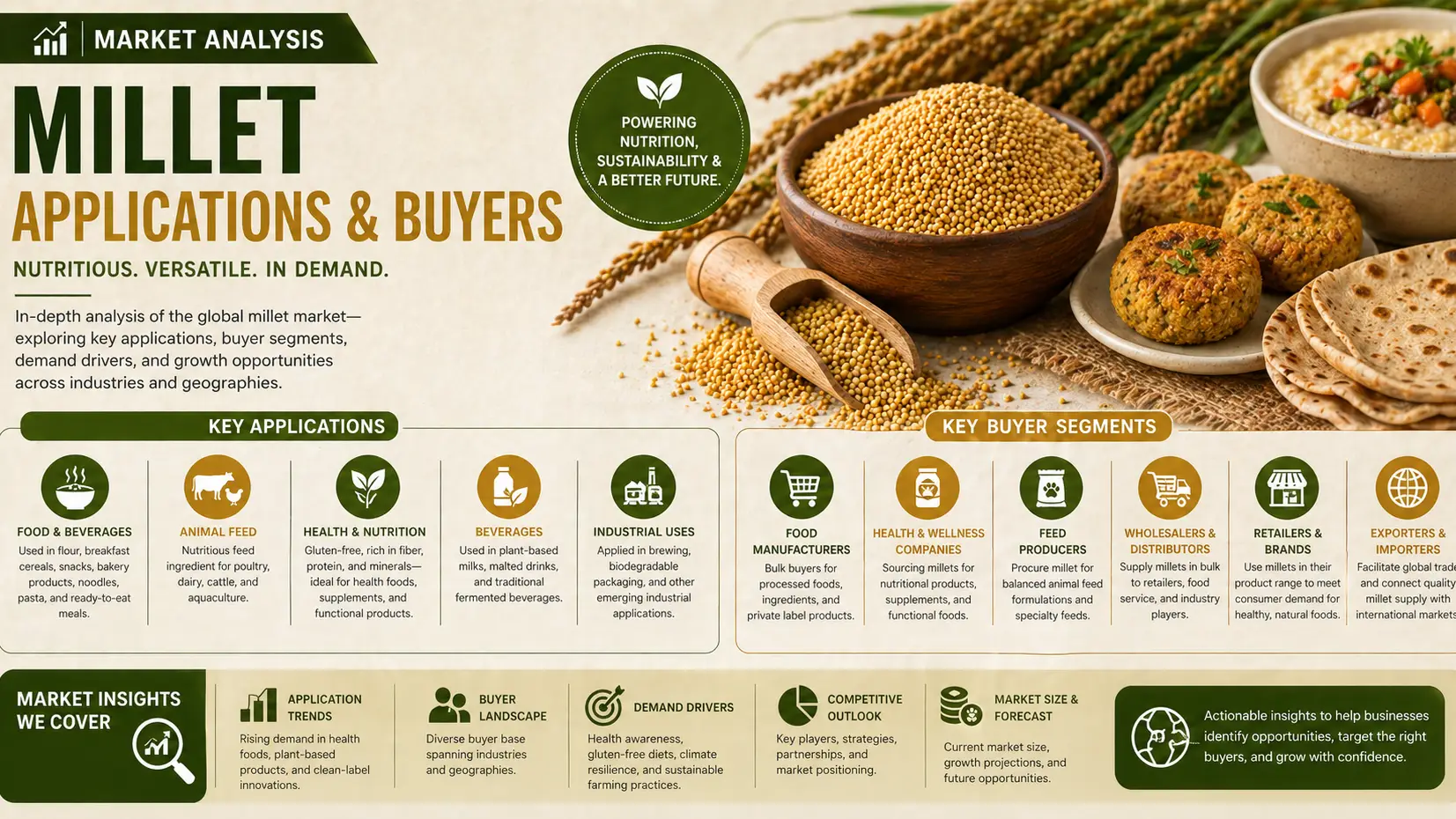
Applications in the food industry segment dominate demand, with gluten-free bakery products, infant nutrition, and functional cereals driving consumption. Food-grade millet demand is growing at 6.4% CAGR, supported by urban wellness trends and clean-label reformulation. Premium processed millet flour commands prices up to USD 520/MT, reflecting value addition in milling and fortification. Key buyers include FMCG manufacturers, health-focused brands, and institutional caterers integrating millet into protein-rich and nutrient-dense product portfolios.
Feed Industry Buyers
Feed manufacturers remain core buyers, particularly poultry and cattle feed formulators leveraging millet as a cost-stable energy grain. Feed-grade millet is expanding at 5.8% CAGR, with bulk procurement prices averaging USD 300–360/MT depending on origin and quality grade. Industrial feed mills across India, Nigeria, and China collectively absorb more than 45% of global millet output, using it to optimize feed conversion ratios and stabilize raw material costs amid corn and wheat price fluctuations.
Regional Production & Trade Flows
Production remains concentrated in India, accounting for nearly 40% of global output, followed by West Africa’s Sahel region contributing over 10 million metric tons collectively. Export corridors are strengthening toward the Middle East and Europe, where demand for alternative grains is accelerating. Government procurement schemes and logistics modernization are improving supply consistency, while trade diversification supports millet’s position as a strategic grain in global agri-commodity flows.
Price Dynamics & Industrial Demand
Market dynamics are shaped by climate variability and policy-driven procurement, pushing overall millet market CAGR to 6.2% through 2030. Price volatility remains moderate, with farmgate prices ranging USD 280–450/MT depending on grade and origin. Industrial buyers increasingly secure long-term contracts to mitigate supply risks, particularly in processed food manufacturing and large-scale feed production, where margin stability depends on predictable raw material sourcing.
Conclusion
In conclusion, millet (PRODUCT) as a platform agricultural commodity continues to strengthen its role across food and feed value chains, driven by resilient demand and expanding industrial applications. As global buyers prioritize secure sourcing and consistent quality, integrated suppliers such as Tradeasia International provide streamlined procurement solutions and dependable distribution networks. With evolving trade dynamics, millet is expected to remain a strategic grain supporting both nutritional innovation and global supply chain stability.
Sources
-
https://www.fao.org
-
https://www.usda.gov
-
https://www.worldbank.org
Leave a Comment