Meat and Bone Meal: Product Profile and Commercial Role
What Meat and Bone Meal Is
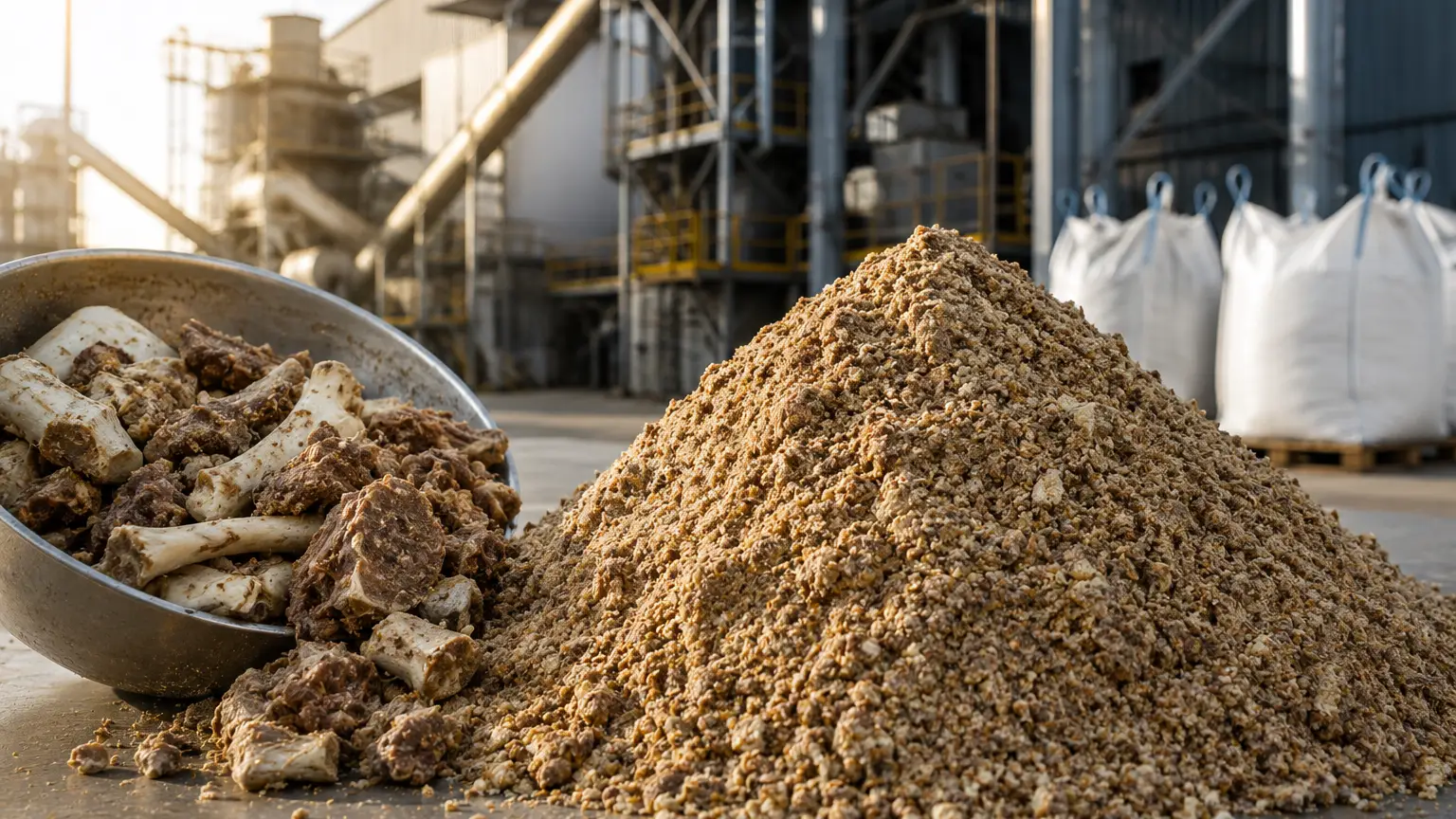
Meat and Bone Meal (MBM) is a rendered animal-derived material produced from meat-industry by-products containing tissue and bones. The product page for the Tradeasia offering describes MBM as a brown powder or pellet with an indicated moisture level below 8%, while the product is positioned primarily as a feed-grade protein source. The page lists an Australian origin, HS code 2301.20.11, and CAS Number 92113-16-1. These details are commercially important because buyers often use origin, classification, physical form, and documentation as part of supplier qualification.
The United States Department of Agriculture's Agricultural Marketing Service defines Meat and Bone Meal as a dry rendered product of mammalian tissue, excluding specified materials such as hair, hoof, horn, hide trimmings, manure, and stomach contents. This distinction illustrates why procurement teams should not treat all animal meals as interchangeable. Raw-material origin, rendering process, species composition, and applicable regulatory category can affect the suitability of a material for a particular end use.
Why MBM Has Commercial Value
From a commercial perspective, MBM combines two attributes that are valuable to industrial users: concentrated nutrients and utilization of animal-processing by-products. The Tradeasia product information identifies crude protein of approximately 50–55% for the listed MBM specification, together with calcium of about 9% and phosphorus of about 4.5%. It also identifies lysine at approximately 2.5–3.0%, illustrating why protein quality and mineral contribution are central to its positioning as a feed ingredient.
The Food and Agriculture Organization has historically identified animal protein meals as concentrated sources of protein and amino acids while also highlighting rendering as a mechanism for converting animal-processing by-products into usable products. This circular utilization model remains commercially relevant because processors can convert materials that would otherwise require disposal into standardized ingredients or agricultural inputs, subject to the rules applicable in the destination market.
Industrial Applications and End-Use Demand
Animal Feed Applications
The most commercially important application for appropriately approved MBM is as an animal-feed ingredient. Its protein, amino-acid, calcium, phosphorus, and energy contributions can make it useful when feed manufacturers formulate diets around nutritional requirements and available ingredient economics. The FAO has documented the historical role of MBM as a cost-effective protein and mineral source that can complement grain-based feed ingredients.
Feed manufacturers may evaluate MBM for use in monogastric nutrition, including poultry and swine formulations, while animal-protein ingredients can also have applications in aquaculture and pet-food production where permitted by local rules. However, the correct use is market-specific rather than universal. Species restrictions, permitted raw materials, processing requirements, maximum inclusion levels, labeling requirements, and disease-control rules can all influence whether a particular MBM specification is commercially usable.
Agricultural and Fertilizer Applications
MBM also has potential value outside feed, particularly as an organic nutrient source for agricultural applications. Its nitrogen and phosphorus content makes it relevant to fertilizer and soil-nutrient strategies, although application rates must be matched to crop requirements and local environmental rules. A six-year field experiment published in Sustainability found that MBM supplied phosphorus effectively for crops including maize, winter wheat, and winter oilseed rape, while excessive phosphorus application could lead to accumulation in soil.
This creates a second commercial pathway for MBM suppliers and buyers. Agricultural distributors, fertilizer blenders, organic-input manufacturers, and farms may evaluate the product based on nutrient analysis, consistency, regulatory status, odor, handling properties, and application economics. For procurement teams, the important point is that feed-grade and fertilizer-oriented opportunities should be evaluated separately because the specifications, permitted raw materials, and regulatory frameworks can differ by application and destination country.
Buyer Intent and Procurement Priorities
Who Buys Meat and Bone Meal
The primary B2B buyer groups include animal-feed manufacturers, feed ingredient distributors, livestock nutrition businesses, aquaculture-feed producers, pet-food manufacturers where permitted, agricultural-input companies, fertilizer blenders, and trading companies. These buyers are generally not looking only for a product name; they are looking for a specification that can fit an established formulation, production process, regulatory framework, and supply schedule.
For feed manufacturers, the purchasing decision can depend on crude protein, calcium, phosphorus, fat, digestibility, microbial parameters, species of origin, and regulatory declarations. The Tradeasia specification, for example, lists moisture, total plate count, yeast and mould, E. coli, Salmonella, protein, fat, ash, calcium, phosphorus, TVBN, pepsin digestibility, lysine, heavy metals, and dioxins/PCBs. These parameters demonstrate the level of technical information that can support a professional sourcing assessment.
What Procurement Teams Evaluate
Procurement teams typically compare suppliers on more than price per metric ton. Consistent quality, origin transparency, species declaration, production controls, certificates, testing documentation, packaging, shelf life, logistics capability, minimum order quantity, and delivery reliability can all influence total sourcing value. A lower nominal price may not be commercially attractive if a supplier cannot maintain specification consistency or provide the documentation required by the buyer's regulatory and quality teams.
Buyers also compare suppliers because animal-derived ingredients are subject to market-specific compliance requirements. The European Commission explains that animal by-products are categorized according to risk and that their handling and intended use are governed by strict requirements involving safe sourcing, treatment, traceability, transport, and end use. Consequently, supplier qualification should begin with confirming that the product's origin, category, processing route, and intended application are acceptable in the importing market.
Quality, Specifications, and Regulatory Considerations
Technical Specifications That Matter
For commercial buyers, specification consistency is central to MBM procurement. The listed Tradeasia product provides a useful example: it identifies brown powder or pellets, moisture below 8%, feed-grade status, protein of 50–55%, fat of 8–12%, ash of 25–30%, calcium of 9%, phosphorus of 4.5%, pepsin digestibility of at least 80%, and lysine of approximately 2.5–3.0%. It also identifies packaging options of 50 kg bags or bulk and a six-month shelf life under cool, dry storage conditions.
Microbiological and contaminant controls are equally important. The product information lists Salmonella as negative in a 25-gram sample, together with stated limits for total plate count, yeast and mould, E. coli, coliform bacteria, heavy metals, and dioxins/PCBs. Buyers should nevertheless request current batch-specific documentation where appropriate rather than assuming that a general product specification automatically satisfies every destination-market requirement.
Regulatory and Traceability Requirements
Regulatory assessment is especially important for animal-derived materials because the same product name can correspond to different permitted uses in different jurisdictions. European Commission rules, for example, distinguish Category 1, Category 2, and Category 3 animal by-products according to risk and intended use. The Commission states that only appropriate categories may enter feed applications, while other categories may be directed toward fertilizer, fuel, or other controlled uses.
Recent European regulatory developments also demonstrate how MBM applications can evolve beyond traditional feed and fertilizer channels. Commission Regulation (EU) 2026/176 addressed transitional measures concerning the export of Meat and Bone Meal as a fuel for combustion. This does not mean every MBM product is suitable for energy use, but it illustrates the importance of assessing MBM as a regulated material with multiple possible end-use pathways rather than assuming that one specification applies globally.
Sourcing Strategy and B2B Supply Opportunities
How Buyers Should Approach Supplier Selection
A practical Meat and Bone Meal sourcing process begins by defining the intended application and destination market. A feed manufacturer should establish the target species, nutritional requirements, permitted animal origin, required protein and mineral profile, microbiological criteria, documentation, packaging format, and delivery requirements before comparing quotations. Agricultural users should similarly establish nutrient targets and the regulatory conditions for using animal-derived fertilizers or soil amendments.
Once the technical requirement is established, buyers can compare suppliers against the same specification rather than comparing product names alone. This approach makes supplier evaluation more transparent and reduces the risk of selecting a material that appears commercially attractive but requires additional processing, documentation, reformulation, or regulatory approval. The FAO's technical material on animal by-products also emphasizes analysis of nutrient composition, particularly protein and phosphorus, when meat-and-bone meals are graded and marketed.
B2B Marketplace Opportunities
For manufacturers, traders, distributors, and procurement teams, a B2B marketplace can simplify the first stage of supplier discovery by bringing product specifications and sourcing information into a commercial context. Buyers evaluating MBM can review the Meat and Bone Meal supplier information alongside their internal quality requirements and then determine whether further technical or commercial discussion is warranted. The listed product information includes origin, physical form, packaging, storage conditions, certification information, and technical parameters that can help buyers structure an initial evaluation.
The commercial opportunity is particularly relevant for regional distributors and procurement teams that need reliable access to animal-protein ingredients but may source across international markets. Australia is identified as the origin for the listed MBM, while the product page also provides bulk and bagged packaging options. For international trade, these details can support early-stage evaluation of logistics, storage, shipment planning, and landed-cost calculations, although buyers should confirm current availability, shipment terms, certificates, and destination-country import requirements directly with the supplier.
Market Outlook and Commercial Positioning
Demand Drivers Across End-Use Markets
The long-term commercial relevance of MBM is linked to several structural factors: demand for animal nutrition ingredients, the need to recover value from slaughter and meat-processing by-products, demand for mineral-rich agricultural inputs, and growing attention to resource efficiency. The rendering industry provides an established pathway for transforming animal by-products into usable fats and protein materials, creating economic value while reducing the volume of materials requiring disposal.
At the application level, however, demand is increasingly shaped by regulatory and formulation considerations. Feed manufacturers need ingredients that fit nutritional specifications and legal requirements, while agricultural users must balance nutrient supply against soil and environmental considerations. Research on MBM fertilizer applications demonstrates both the nutrient-recycling potential of the material and the importance of managing application rates to avoid excessive phosphorus accumulation.
Supply Opportunities for Industry Participants
For manufacturers and rendering businesses, consistent specification control is a major commercial differentiator. Traders and distributors can create value by matching suitable grades and origins with buyers that have specific nutritional, regulatory, packaging, and delivery requirements. Procurement teams, meanwhile, benefit from suppliers that can provide transparent product data and support the documentation process needed for import and internal quality approval.
Tradeasia and its marketplace positioning can serve as a commercial entry point for these sourcing conversations without replacing the buyer's own technical qualification process. For prospective buyers, the Meat and Bone Meal sourcing page provides a starting point for reviewing the available specification and initiating an inquiry. For suppliers and distributors, marketplace visibility can help connect a defined product specification with buyers actively searching for animal-feed and agricultural ingredients.
Conclusion: Building a Reliable Meat and Bone Meal Supply Strategy
Turning Product Specifications Into Procurement Decisions
Meat and Bone Meal is commercially relevant because it combines concentrated protein and mineral value with the resource-recovery advantages of rendering. Its applications can extend across animal nutrition and agricultural nutrient management, but the suitability of a particular product depends on species origin, processing, specification, regulatory status, and intended use. For this reason, buyers should approach MBM as a specification-driven industrial ingredient rather than as a commodity that can be purchased solely on price.
A robust procurement process should connect the product specification to the buyer's formulation, regulatory, logistics, and quality requirements. Protein, phosphorus, calcium, fat, ash, digestibility, microbiological parameters, contaminants, origin, species declaration, packaging, and documentation should all be evaluated according to the intended application. The Tradeasia product information provides these types of parameters as a foundation for commercial discussion, while buyers should confirm current certificates and shipment-specific details before purchase.
The Commercial Role of Reliable Sourcing
For feed manufacturers, agricultural-input companies, distributors, and procurement teams, reliable sourcing can help reduce formulation uncertainty and improve supply planning. Supplier comparisons should therefore consider consistency, compliance, documentation, logistics, and technical support alongside price. Regulatory requirements can change by country and application, making traceability and destination-market verification particularly important for animal-derived materials.
The Meat and Bone Meal product page can serve as a practical starting point for buyers assessing product specifications and sourcing opportunities through the Tradeasia / Chemtradeasia marketplace. As demand develops across feed, agriculture, and other controlled applications, the strongest B2B opportunities will come from connecting clearly defined specifications with qualified buyers, transparent documentation, and dependable international supply.
Sources
Leave a Comment