Introduction
The L-arginine market in 2026 continues to strengthen its position as a critical segment within the global amino acids industry, functioning as a platform chemical that bridges nutraceutical, pharmaceutical, and industrial biotechnology value chains. As demand accelerates across health, sports nutrition, and clinical formulations, supply chain dynamics have become increasingly strategic, with manufacturers focusing on cost efficiency, fermentation optimization, and global distribution resilience. The market size is estimated at approximately USD 737.03 million in 2026, expanding at a CAGR of 7.2%–9.9%, supported by rising downstream consumption in dietary supplements and functional foods. Meanwhile, average global production volumes are estimated at over 85–95 kilotons annually, reflecting steady capacity expansion across Asia-led fermentation hubs. Price benchmarks remain volatile but structurally firm, averaging USD 2,950–4,700/MT depending on grade and region, shaped by feedstock costs and energy inputs.
Fermentation-Centric Production Concentration in Asia-Pacific
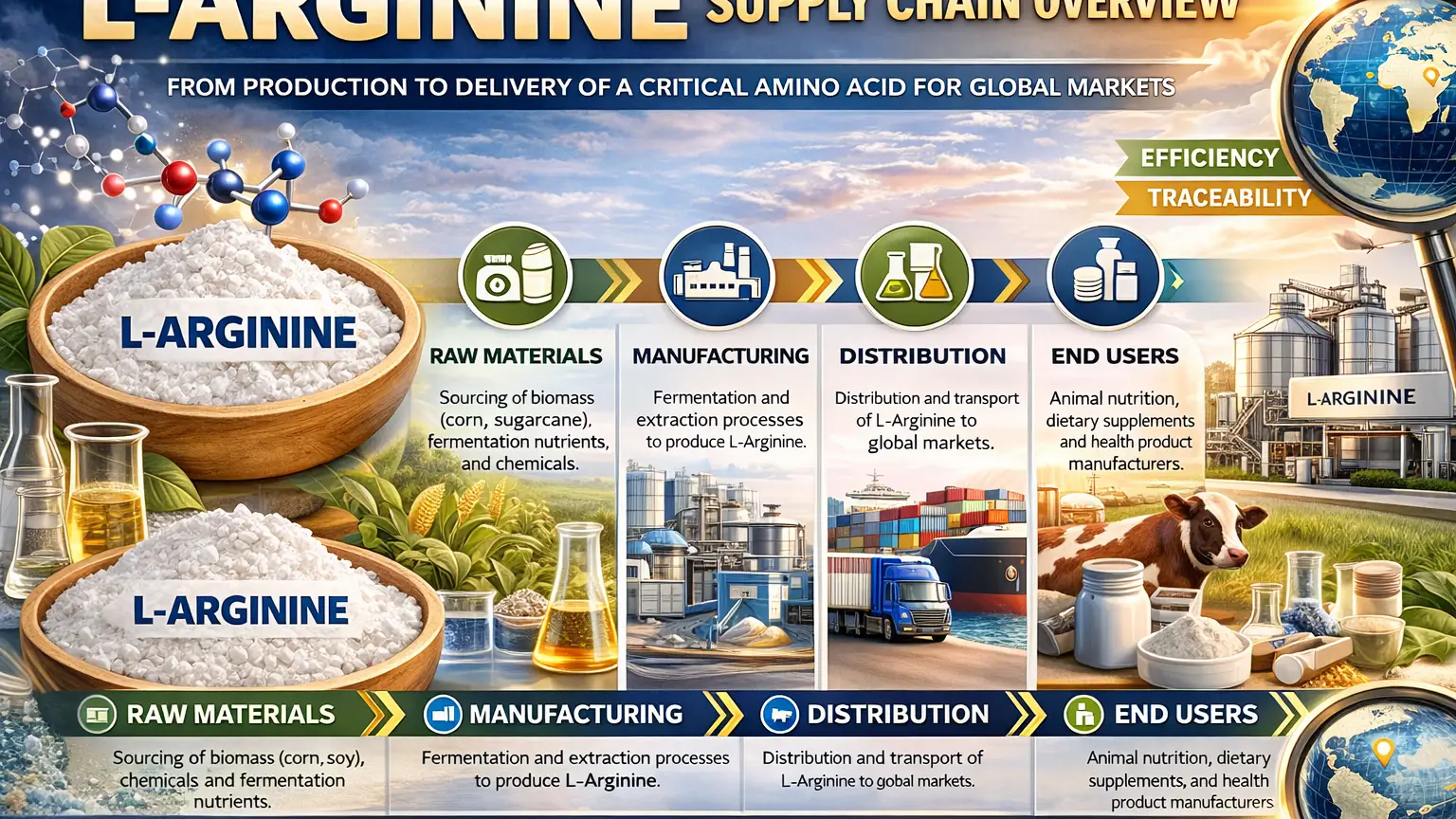
The global supply chain remains heavily concentrated in China, Japan, and South Korea, where cost-efficient microbial fermentation dominates L-arginine production. This region accounts for nearly 60–65% of global output, driven by vertically integrated amino acid manufacturers. Producers such as Corynebacterium glutamicum-based fermentation facilities benefit from scale economies and molasses-based feedstock availability, reducing unit production costs by up to 18% compared to Western facilities. However, increasing environmental compliance costs and wastewater treatment regulations are gradually reshaping operational margins.
Raw Material Dependency and Input Cost Volatility
The upstream supply chain is highly sensitive to glucose syrups, ammonia, and agricultural byproducts, which directly influence fermentation efficiency. In 2026, feedstock inflation has pushed production costs upward by 6–8% year-on-year, tightening margins for mid-tier suppliers. Energy price fluctuations in Europe have also widened regional cost disparities, with European L-arginine pricing reaching approximately USD 3,800–4,700/MT, compared to lower Asian FOB averages near USD 2,900–3,300/MT. This divergence reinforces Asia’s dominance in export-oriented supply chains.
Fragmented Downstream Distribution and Demand Intensification
Downstream, the supply chain is fragmented across nutraceutical manufacturers, pharmaceutical formulators, and sports nutrition brands. Dietary supplements alone account for nearly 45–50% of total consumption, driven by cardiovascular and performance-enhancing applications. Global demand growth of 7%–8% CAGR is intensifying procurement cycles, particularly in North America and the Middle East, where import dependence exceeds 70%. This dependency exposes buyers to freight disruptions, inventory fluctuations, and spot-market price sensitivity.
Logistics, Trade Routes, and Inventory Strategy Optimization
Global L-arginine logistics rely heavily on maritime bulk chemical shipping routes from Asia to Europe and the Americas. In 2026, lead times have stabilized at 35–50 days, but geopolitical tensions and container imbalances continue to influence supply predictability. As a result, buyers are increasingly adopting hybrid inventory strategies combining long-term contracts with spot procurement. Distributors are also investing in regional warehousing hubs to mitigate supply shocks and stabilize service levels across high-demand markets.
Conclusion
As the L-arginine ecosystem evolves, its role as a foundational platform chemical becomes even more pronounced, enabling innovation across health, wellness, and pharmaceutical sectors. Within this increasingly interconnected supply chain landscape, companies seeking reliability, scalable sourcing, and consistent quality are turning toward integrated partners such as Tradeasia International, which provides end-to-end chemical supply chain solutions across global markets, supporting procurement efficiency and long-term sourcing stability.
Sources
-
https://www.fortunebusinessinsights.com/l-arginine-market-111103
-
https://www.imarcgroup.com/amino-acids-market
-
https://www.grandviewresearch.com/industry-analysis/amino-acids-market
Leave a Comment