Introduction
The L-Arginine market, a critical segment within the global amino acids industry, continues to strengthen its position as a platform chemical in 2026 due to its multifunctional role in pharmaceuticals, nutraceuticals, and functional nutrition systems. As a semi-essential amino acid supporting nitric oxide synthesis and metabolic performance, L-Arginine is no longer viewed as a niche ingredient but as a scalable industrial input with diversified downstream demand. The market is valued at approximately USD 580.63 million in 2026, reflecting stable expansion driven by health-driven consumption and industrial formulation demand, with long-term projections indicating a CAGR of around 8.91% through the next decade (Fortune Business Insights).
Nutraceutical Demand Acceleration
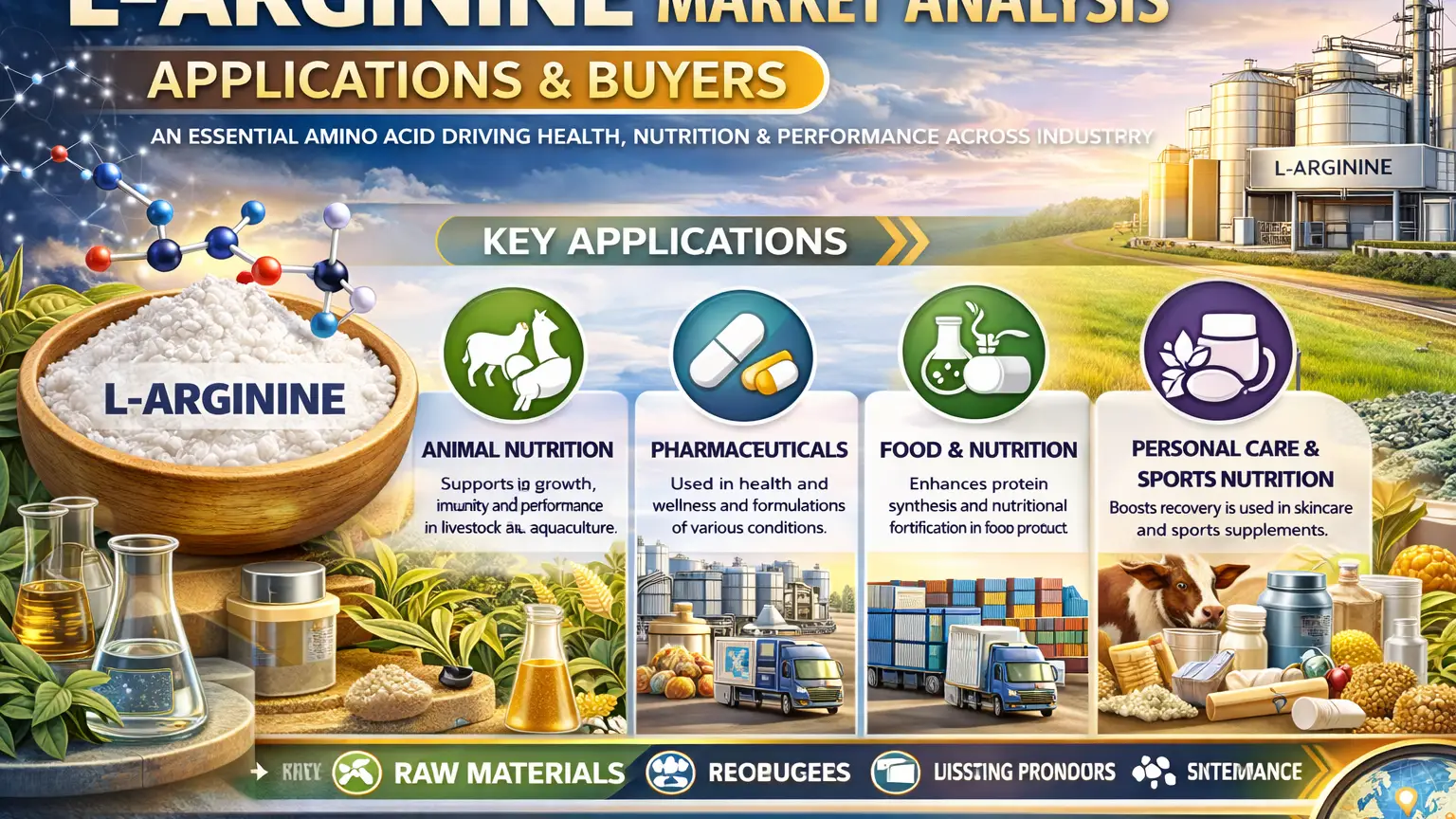
The nutraceutical segment remains the dominant demand engine, accounting for more than half of global consumption. L-Arginine is widely integrated into sports nutrition, cardiovascular supplements, and metabolic health formulations, with production volumes exceeding 29,000 metric tons annually in food-grade applications. Buyers in this segment are primarily supplement manufacturers, functional beverage companies, and contract formulators. Price sensitivity remains moderate, with food-grade L-Arginine averaging USD 4,200–5,500/MT, depending on purity and origin. Rising preventive healthcare awareness continues to stabilize long-term procurement contracts.
Pharmaceutical Procurement and Clinical Adoption
Pharmaceutical buyers represent a high-value, specification-driven segment requiring ≥99.5% purity pharma-grade L-Arginine. Consumption surpasses 21,000 metric tons globally, driven by injectable formulations, clinical nutrition therapies, and post-surgical recovery applications (Market Growth Reports). Pricing in this segment is significantly higher, typically ranging between USD 6,000–8,500/MT, reflecting strict GMP compliance and regulatory oversight. Hospital procurement systems and pharmaceutical OEMs dominate this buyer group, prioritizing supply consistency over cost optimization.
Industrial Supply Chain and Fermentation Capacity
On the supply side, L-Arginine production is concentrated in Asia, particularly China, where microbial fermentation dominates manufacturing economics. Global installed capacity is estimated to exceed 60,000–70,000 metric tons annually, with continuous brownfield expansion improving yield efficiency. Producers are increasingly investing in strain optimization to reduce raw material dependency on glucose and ammonia feedstocks. This has stabilized FOB Asia pricing near USD 5,200/MT, although volatility persists due to energy and fermentation feedstock fluctuations.
Buyer Structure and Global Trade Realignment
The buyer landscape is shifting toward consolidated procurement by multinational nutraceutical and pharmaceutical corporations. North America and Europe remain premium-import markets, while Asia Pacific acts as both producer and fast-growing consumer base. Contract manufacturing organizations (CMOs) are emerging as influential intermediaries, streamlining bulk procurement and private-label formulation. This restructuring is pushing suppliers toward long-term off-take agreements rather than spot market trading.
Conclusion
As a platform chemical, L-Arginine continues to evolve beyond a simple amino acid into a strategic bio-functional input across health, pharmaceutical, and nutrition industries. Its demand stability, coupled with rising application diversification, reinforces its long-term industrial relevance. In this increasingly competitive and quality-driven landscape, global buyers are prioritizing suppliers with reliable scale, compliance assurance, and integrated logistics capabilities.
Tradeasia International plays a critical enabling role as a global chemical distribution and sourcing partner, connecting manufacturers with reliable L-Arginine supply chains across key consuming regions. Through its established procurement network and logistics expertise, it supports buyers in securing consistent, specification-grade amino acids for industrial and nutritional applications.
Sources
-
https://www.fortunebusinessinsights.com/l-arginine-market-111103
-
https://www.marketresearchfuture.com/reports/l-arginine-market-7510
-
https://www.chemanalyst.com/industry-report/l-arginine-market-819
Leave a Comment