Introduction
Effective storage and handling of kaolin in paper manufacturing are critical to maintaining paper quality, operational stability, and workplace safety. As one of the most widely used mineral fillers and coating pigments, kaolin directly influences key paper properties such as brightness, opacity, surface smoothness, and print performance. When storage or handling conditions are poorly managed, kaolin can absorb moisture, agglomerate, settle in slurry systems, or generate excessive dust. These issues lead to process disruptions and inconsistent finished paper quality.
This article provides practical, industry-aligned guidance on kaolin storage and handling in paper mills. It is intended for mill operators, production managers, coating formulators, maintenance teams, HSE professionals, and procurement specialists who aim to preserve kaolin quality while improving raw material efficiency and process reliability.
Why Proper Kaolin Handling Matters in Paper Mills
Kaolin is used extensively in both wet-end filler addition and surface coating formulations. Its fine particle size and platy morphology provide excellent optical coverage, smoothness, and printability, which makes it a preferred pigment across many paper grades. These same characteristics, however, make kaolin sensitive to moisture exposure, contamination, and inadequate dispersion.
Poor handling practices can cause dry kaolin to cake in silos, slurry kaolin to settle or degrade biologically, and dust to escape during transfer operations. The result is reduced dispersion efficiency, increased downtime, and visible defects such as mottling, uneven gloss, poor ink receptivity, and coating streaks. Consistent storage and handling practices help paper mills achieve stable production and predictable quality outcomes.
Common Forms of Kaolin Used in Paper Manufacturing
Paper mills typically receive kaolin in two primary forms: dry powder and slurry.
Dry kaolin is delivered in bags, supersacks, or bulk pneumatic shipments. It is commonly used for filler applications or in mills that prepare their own coating slurries.
Kaolin slurry is supplied as a pre-dispersed suspension in tanker trucks and is often fed directly into coating kitchens, particularly in high-speed coating operations.
The selected supply form affects storage design, handling equipment, inventory management, and operating costs. Dry kaolin demands strict moisture control, while slurry kaolin depends on proper agitation, temperature control, and biological management to maintain stability.
Storage Guidelines for Dry Kaolin
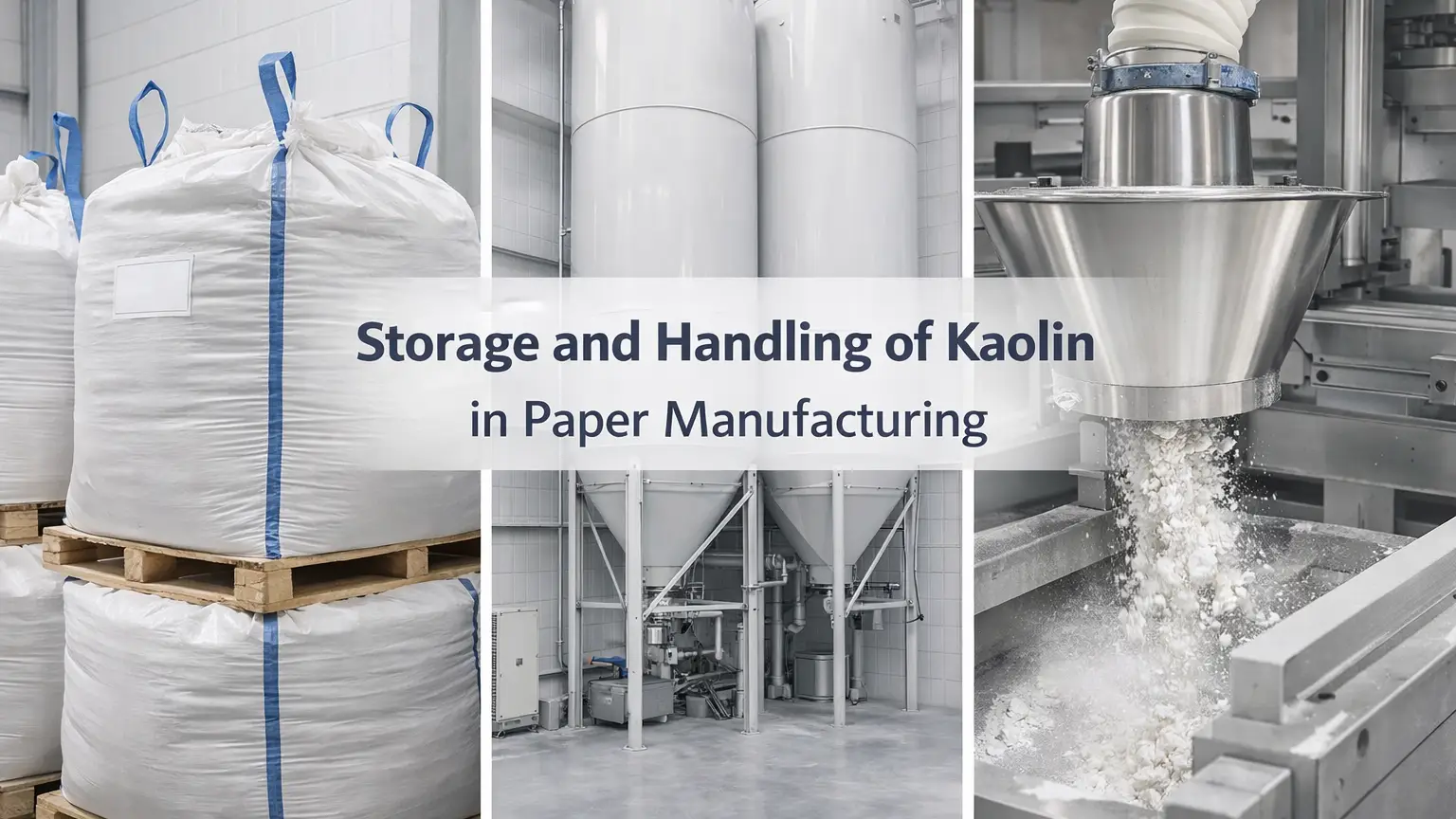
Dry kaolin should be stored in clean, dry environments to prevent moisture uptake and contamination. Bulk material is best kept in sealed silos constructed from stainless steel or epoxy-lined carbon steel. These materials reduce corrosion risks and prevent foreign material ingress.
Recommended storage conditions include temperatures between 10 and 30 degrees Celsius and relative humidity below 60 percent. Bagged or supersack kaolin should be stored on pallets, elevated from floors, and positioned away from walls to allow air circulation and routine inspection.
Inventory management should follow first-in, first-out principles to maintain material freshness. Typical shelf life for dry kaolin ranges from 12 to 24 months, depending on packaging integrity and environmental conditions. Clear lot identification and traceability support effective quality control and faster corrective actions if deviations are detected.
Storage Guidelines for Kaolin Slurry
Kaolin slurry requires storage tanks designed to resist corrosion and abrasion. Tanks are commonly lined with epoxy, rubber, or stainless steel to accommodate solids contents between 40 and 70 percent. Slurry pH is usually maintained between 7 and 9 to support stability.
Continuous low-shear agitation is essential to prevent particle settling and maintain uniform solids distribution. Circulation pumps help preserve homogeneity during storage, especially when slurry residence time extends beyond several days. Temperature control between 20 and 30 degrees Celsius helps stabilize viscosity and reduces the risk of microbial growth.
Many paper mills aim to limit slurry storage time to 7 to 14 days. Biocides are often applied according to supplier recommendations, and daily viscosity monitoring helps identify early signs of instability or biological activity before coating performance is affected.
Handling Practices for Kaolin in Paper Manufacturing
Dry kaolin is most commonly transferred using pneumatic conveying systems. Dilute-phase conveying is preferred because it reduces particle degradation and minimizes the risk of line blockages. Rotary valves, bag filters, and dust collectors are essential for controlled transfer and environmental compliance.
Mechanical conveying systems such as screw or belt conveyors may be used for short distances, provided they are fully enclosed to limit dust emissions. Routine inspection and cleaning of transfer equipment prevent material buildup and reduce the risk of contamination.
Kaolin slurry handling relies on pumps designed for high-solids suspensions with minimal shear. Progressive cavity and peristaltic pumps are widely used due to their gentle flow characteristics. Inline mixers and strainers help maintain uniformity before the slurry enters dilution systems or coating stations.
Spill containment measures, scheduled equipment rinsing, and the use of dispersant solutions during cleaning all support stable handling conditions and reduce operational risk.
Health, Safety, and Environmental Considerations
Health and safety management is a core component of kaolin handling in paper mills. Dry kaolin dust contains respirable particles that must be controlled to meet occupational exposure limits, commonly set at 2 milligrams per cubic meter for respirable dust.
Personal protective equipment such as respirators, safety goggles, gloves, and protective clothing should be used during unloading, transfer, and maintenance activities. Engineering controls including enclosed transfer points, local exhaust ventilation, and dust filtration systems further reduce exposure risks.
Kaolin slurry presents fewer airborne hazards but introduces water management and chemical handling considerations. Slurry spills should be contained using absorbent materials, and waste streams containing biocides must be treated in accordance with local environmental regulations. Regular training on spill response, lockout procedures, and emergency protocols strengthens overall safety performance.
How Storage and Handling Affect Paper Quality
Improper storage and handling of kaolin directly affect paper quality and machine performance. Moisture exposure in dry kaolin can reduce dispersion efficiency, leading to coating streaks, uneven gloss, and reduced opacity. In slurry systems, settling or microbial degradation can alter rheology, affecting coating uniformity and runnability.
Contamination from grit or foreign particles increases wear on rolls and blades while creating visible surface defects. Maintaining correct storage and handling conditions preserves particle integrity, brightness, and dispersion behavior, supporting consistent coating coverage and stable optical properties across production batches.
Best Practices for Kaolin Quality Assurance
Quality assurance begins before kaolin enters the paper mill. Incoming materials should be verified against supplier certificates that specify particle size distribution, brightness, moisture content, and screen residue limits.
Routine in-house testing supports continuous quality control. Common checks include viscosity measurement using Brookfield viscometers, solids content determination by oven drying, and microscopic inspection for agglomerates or contaminants. Tracking and trending these results helps identify gradual changes before they affect production performance.
Close coordination between procurement, quality, and production teams ensures that off-spec materials are isolated and addressed promptly. Aligning inventory usage with verified quality data strengthens kaolin quality preservation throughout the supply chain.
Conclusion
Effective storage and handling of kaolin in paper manufacturing protect both product quality and operational efficiency. By controlling moisture, preventing contamination, maintaining slurry stability, and prioritizing health and safety, paper mills can fully realize the performance benefits of kaolin as a filler and coating pigment.
Standardized handling procedures reduce downtime, support regulatory compliance, and ensure consistent paper brightness, smoothness, and printability. For mills producing competitive and high-value paper grades, disciplined kaolin storage and handling remain essential to long-term operational success.
Leave a Comment