Introduction
The global paper industry, valued at over USD 350 billion, depends on more than just cellulose fibers to produce high-quality paper. Mineral additives, particularly kaolin or china clay, play a crucial role in determining smoothness, brightness, opacity, and printability. Kaolin functions both as a filler in the paper sheet and as a coating pigment on the surface, enhancing optical properties and overall paper performance. Consistent kaolin quality is essential for minimizing defects, maintaining process stability, and ensuring operational efficiency.
This article provides an in-depth guide to kaolin quality control in paper manufacturing, covering key physical and chemical parameters, testing methods, in-process monitoring, supplier quality assurance, and global sourcing strategies. Paper mill operators, coating formulators, QA teams, and procurement specialists can use these insights to maintain reliable kaolin performance across production lines.
The Critical Role of Kaolin in Paper Manufacturing
Kaolin contributes to paper production in two primary ways:
- Filler Application: Finely ground kaolin is added to the pulp slurry before sheet formation. Its platy particles fill voids between cellulose fibers, improving smoothness and increasing both brightness and opacity. This allows mills to produce lighter-weight sheets without compromising print quality. Kaolin also reduces the amount of fiber required, providing an economic advantage while maintaining structural integrity.
- Coating Application: Kaolin is applied as a water-based slurry onto the surface of pre-formed paper. The coating creates a uniform, closed surface that supports high-resolution printing, reduces ink feathering, and ensures sharp halftone reproduction. Coating also enhances gloss, whiteness, and visual appeal, particularly in premium papers, magazines, catalogs, and packaging. Achieving defect-free coating requires precise particle size, brightness, and viscosity control, especially for high-speed coaters operating above 1,500 meters per minute.
Key Quality Parameters for Paper-Grade Kaolin
Several physical and chemical characteristics determine the suitability of kaolin for paper applications:
- Particle Size Distribution (PSD): For coating-grade kaolin, 80–90 percent of particles are typically smaller than 2 microns. Fine particles ensure smooth, uniform coatings and controlled ink absorption, while filler grades allow a wider size range.
- Brightness and Whiteness: Brightness above 90 percent on the GE scale prevents yellowing, while consistent whiteness ensures visual uniformity and accurate color reproduction.
- Opacity: High opacity reduces ink show-through, enhancing print quality for high-end papers.
- Moisture Content: Dry kaolin must remain below 1 percent moisture to prevent caking and flow problems. Slurry kaolin maintains 65–70 percent solids for stable handling.
- Chemical Purity: Low levels of iron and titanium oxides (<0.5 percent) prevent discoloration, and grit levels below 0.1 percent protect machine components.
- Rheology: Slurry viscosity influences coating behavior. Incorrect flow properties can cause streaking, uneven gloss, and operational inefficiencies.
- Particle Shape: Platy particles naturally align parallel to the paper surface, enhancing smoothness and gloss. Irregular or blocky shapes reduce coating uniformity.
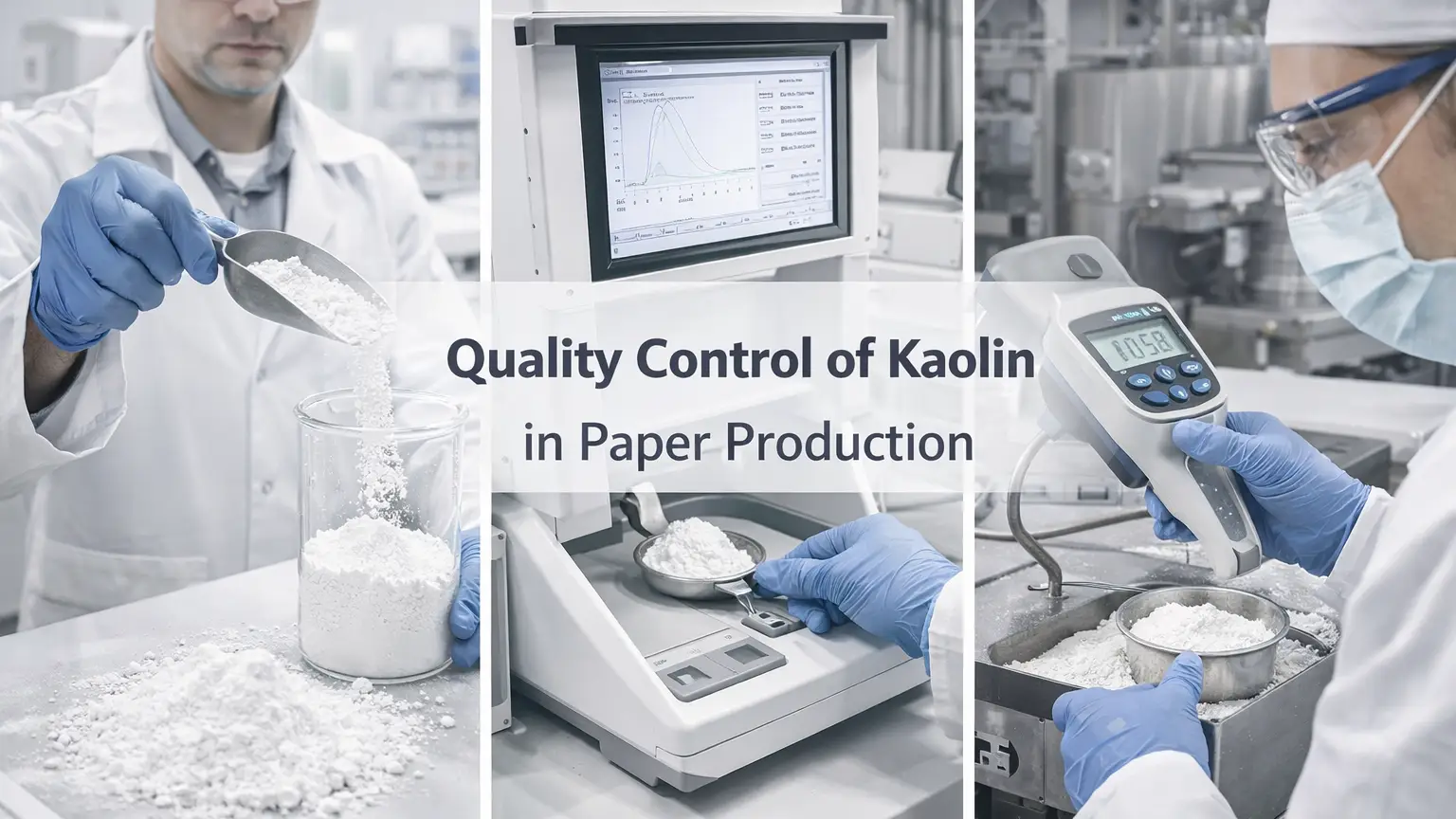
Testing Methods for Kaolin Quality Control
A robust quality assurance program ensures each batch of kaolin meets mill requirements. Common testing methods include:
- Particle Size Analysis: Laser diffraction or sedimentation tests verify PSD for both slurry and dry kaolin.
- Brightness and Color Measurement: Spectrophotometers, following TAPPI T646 standards, measure GE brightness and yellowness index.
- Rheology Testing: Brookfield viscometers assess slurry viscosity for coating applications.
- Moisture Testing: Oven drying at 105°C per TAPPI T255 measures moisture content.
- Impurity Analysis: X-ray fluorescence (XRF) identifies chemical contaminants, while wet sieving detects grit and oversized particles.
Quality Control Practices for Dry and Slurry Kaolin
Kaolin quality management differs depending on the supply form:
- Dry Kaolin: Stored in sealed silos or controlled warehouses to prevent moisture absorption and caking. Anti-caking agents and proper airflow maintain free-flowing properties. Periodic retesting ensures particle size, brightness, and purity remain within specifications.
- Slurry Kaolin: Dispersants prevent particle settling, and biocides control microbial growth. Daily monitoring of viscosity and solids content ensures stability during storage and application.
- In-Process Monitoring: Includes incoming inspections, online rheology sensors, microscopy, and visual checks. Real-time feedback allows corrective adjustments, such as modifying dispersant levels or agitation speed. Batch tracking ensures traceability from receipt to finished paper rolls, supporting audit requirements and quality consistency.
Supplier Quality Assurance and Specifications
Maintaining consistent kaolin performance relies on strong supplier partnerships.
- Technical Data Sheets: Detail particle size, brightness, solids content, and other batch-specific parameters.
- ISO Certification: Indicates adherence to standardized production processes.
- Supplier Audits and Statistical Process Control: Monitor batch-to-batch consistency for key parameters.
- Long-Term Relationships: Ensure access to high-performance kaolin and reduce procurement risks. Platforms like Chemtradeasia streamline supplier verification, technical data review, and global sourcing.
Impact of Kaolin Quality on Paper Performance
High-quality kaolin directly improves several paper characteristics:
- Gloss and Smoothness: Uniform particle distribution produces level, reflective surfaces.
- Opacity and Printability: Controlled PSD and chemical purity enhance ink holdout and reduce show-through.
- Defect Reduction: Properly dispersed kaolin minimizes mottling, streaking, and specking, reducing rework rates by up to 20 percent.
- Operational Efficiency: Stable kaolin reduces downtime, prevents roll and blade wear, and ensures predictable runnability on high-speed coating lines.
Best Practices for Kaolin Quality Management
To maintain consistent performance, paper mills should:
- Standardize Testing: Align lab and in-process tests with TAPPI and ISO methods for reproducibility.
- Integrate Teams: QA, production, and procurement collaborate for holistic oversight.
- Implement Continuous Improvement: Track viscosity trends, defect rates, and batch variability to refine specifications.
- Ensure Documentation and Traceability: Maintain detailed records of incoming material tests, storage conditions, and in-process monitoring.
- Source Strategically: Evaluate kaolin quality globally and select suppliers with consistent production and technical support.
Global Sourcing Considerations
Kaolin is produced in major hubs worldwide, each offering unique characteristics:
- Georgia, USA: Fine particles and high brightness suitable for premium coatings.
- Brazil: Natural brightness and low abrasiveness for high-quality applications.
- United Kingdom (Cornwall), China, Ukraine: Regional variations in particle size, brightness, and chemistry for specific paper grades.
Platforms like Chemtradeasia allow paper mills to compare suppliers, evaluate technical specifications, and streamline procurement. Strategic sourcing ensures reliable kaolin for both filler and coating applications, supporting consistent paper quality across production runs.
Conclusion
Kaolin quality control is a vital, science-driven process that underpins high-performance paper manufacturing. By monitoring particle size, brightness, chemical purity, rheology, and dispersion stability, paper producers maintain smooth, opaque, and print-ready sheets while minimizing defects and operational risks.
Supplier collaboration, rigorous testing protocols, and real-time monitoring enable mills to secure consistent kaolin performance. From filler integration to high-speed coatings, disciplined quality control transforms a simple mineral into a cornerstone of modern papermaking, ensuring premium coated and uncoated papers meet both technical standards and customer expectations.
Leave a Comment