Introduction
Kaolin clay for paper manufacturing plays a fundamental role in achieving the brightness, opacity, smoothness, and print quality demanded by modern paper products. As paper producers face increasing pressure to improve visual performance while controlling raw material costs, mineral pigments have become essential components of both paper fillers and coating formulations.
Among available pigments, kaolin clay stands out for its unique platelet structure, controlled particle size, and chemical stability. These characteristics allow paper manufacturers to enhance surface properties, optimize ink interaction, and reduce fiber consumption without compromising sheet strength. Understanding the structure and properties of kaolin clay helps pulp and paper producers, coating formulators, and procurement teams select the most suitable grades for their applications.
What Is Kaolin Clay
Kaolin clay, often referred to as china clay, is a naturally occurring aluminosilicate mineral composed primarily of kaolinite with the chemical formula Al₂Si₂O₅(OH)₄. It belongs to the 1:1 layered silicate group and forms through the long-term weathering of feldspar-rich rocks under acidic conditions.
In its natural state, kaolin contains impurities such as quartz, mica, iron oxides, and titanium-bearing minerals. These impurities must be removed before the material can be used in paper manufacturing. Beneficiation processes such as degritting, magnetic separation, flotation, bleaching, and particle size classification transform crude kaolin into refined paper-grade kaolin with controlled brightness, purity, and particle distribution.
Paper manufacturers typically use hydrous kaolin, which preserves the natural crystal structure and offers favorable rheology and dispersion characteristics. Calcined kaolin, produced through controlled thermal treatment, is applied in selected coating and packaging grades where higher opacity and brightness are required.
Crystal Structure and Mineral Composition
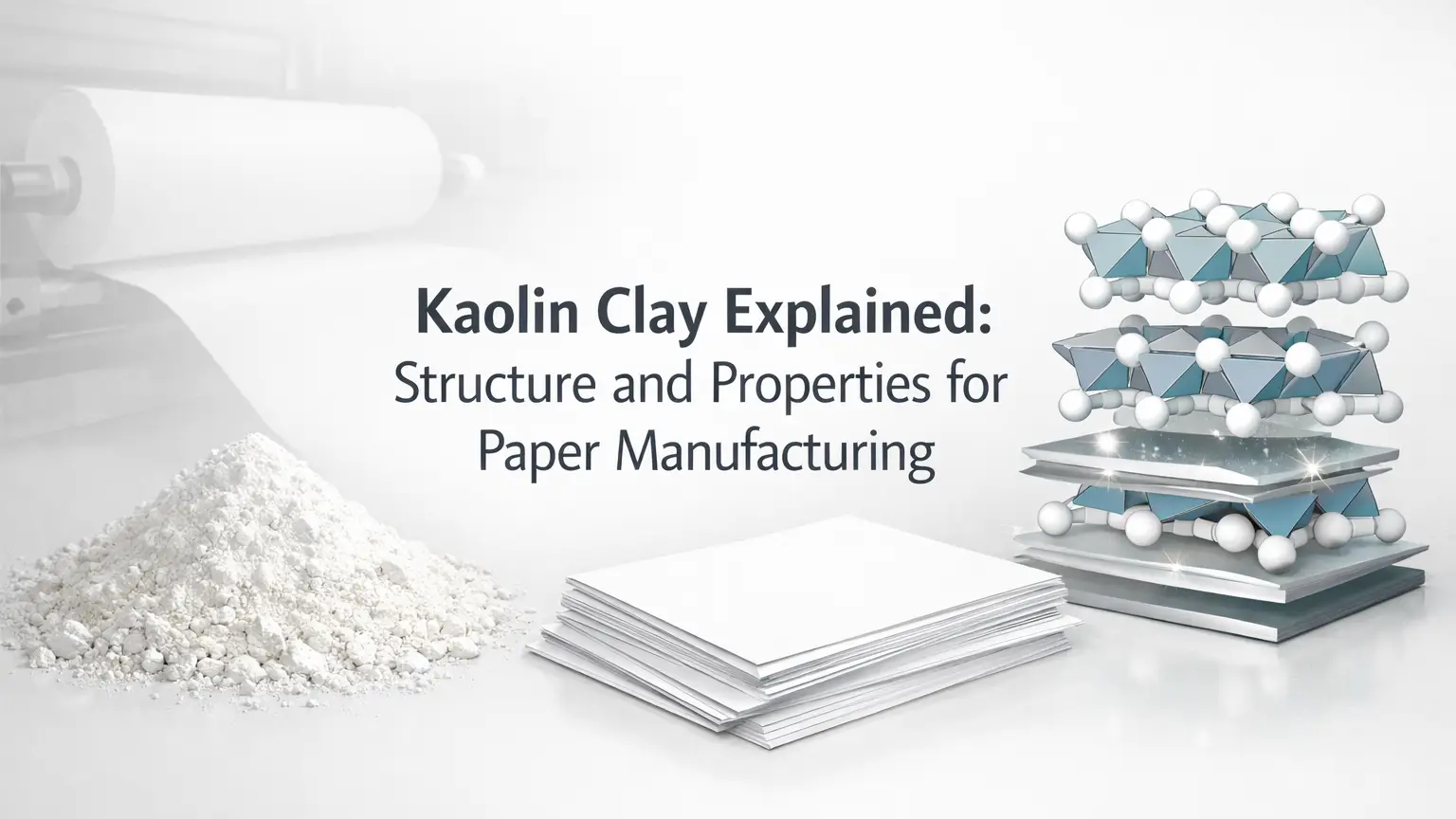
Kaolin’s performance in papermaking originates from its distinctive crystal structure. Kaolinite consists of repeating layers formed by one tetrahedral silica sheet bonded to one octahedral alumina sheet. Hydrogen bonds hold these layers together, creating a stable structure without interlayer cations.
This structural arrangement results in low cation exchange capacity and high chemical inertness, both of which support formulation stability in paper and coating systems. Kaolin particles naturally form thin, flat platelets with a high aspect ratio. Particle thickness remains much smaller than particle diameter, often below 0.5 microns for coating-grade materials.
During coating and calendering, these platelets align parallel to the paper surface. This alignment improves packing efficiency, enhances light scattering, and creates controlled microvoids that promote ink absorption while maintaining surface smoothness and mechanical strength.
Key Physical and Chemical Properties of Kaolin Clay
Particle Size and Shape
Particle size distribution represents one of the most critical specifications for paper-grade kaolin. Coating grades typically contain 85 to 99 percent of particles below 2 microns equivalent spherical diameter, with median particle sizes ranging from 0.5 to 2 microns depending on end-use requirements.
The flat platelet morphology enables efficient orientation within coatings and paper sheets. This orientation improves surface uniformity, gloss development, and print resolution while supporting stable rheology at high solids levels.
Brightness and Opacity
Paper-grade kaolin generally delivers brightness values between 83 and above 90 percent ISO, with premium coating grades reaching 94 percent or higher. Brightness contributes directly to paper whiteness, while opacity reduces print show-through and enhances contrast.
Kaolin’s ability to scatter light arises from its platelet structure and the refractive index contrast between kaolin and cellulose fibers. Multiple scattering interfaces within the paper sheet improve visual performance even at relatively low pigment loadings.
Low Abrasiveness and Chemical Stability
Kaolin exhibits a Mohs hardness of approximately 2 to 2.5, making it significantly less abrasive than many alternative mineral fillers. This property reduces wear on paper machine components, forming fabrics, and printing equipment, particularly in high-speed operations.
Chemically, kaolin remains stable across a broad pH range and does not react with sizing agents, binders, or common coating additives. This inert behavior supports predictable performance in both acidic and neutral papermaking systems.
Rheology and Dispersibility
Well-processed kaolin displays favorable rheological behavior, often approaching near-Newtonian flow at solids contents of 60 to 65 percent. This supports modern blade and roll coating processes operating at high speeds while maintaining good leveling and coverage.
Advanced dispersion techniques improve slurry stability during storage and application, reducing defects and ensuring consistent coating weight and surface quality.
Functional Role of Kaolin in Paper Manufacturing
Kaolin as a Paper Filler
As a filler, kaolin is introduced into the pulp slurry before sheet formation, partially replacing cellulose fibers. Typical filler levels range from 10 to 15 percent, depending on paper grade and strength requirements.
Kaolin fillers improve opacity, brightness, and sheet formation while lowering fiber consumption and overall production costs. When properly formulated, these benefits are achieved without significant losses in tensile strength or stiffness.
Kaolin as a Coating Pigment
The most performance-critical application of kaolin occurs in paper coatings. Kaolin often accounts for 20 to 30 percent of the coating formulation by weight. Its platelet structure contributes to smoothness, controlled porosity, gloss development, and strong print definition.
Kaolin-based coatings support uniform ink absorption and accurate color reproduction across offset, gravure, and digital printing processes. Lightweight coated papers benefit from fine kaolin grades that deliver high gloss at low coat weights, while packaging boards often use blends of hydrous and calcined kaolin to improve coverage and visual appeal.
Kaolin Compared with Other Mineral Fillers
Kaolin clay and calcium carbonate represent the two most widely used mineral pigments in papermaking, each offering distinct advantages.
Kaolin performs well in acidic and neutral systems due to chemical inertness and low abrasiveness. Its platelet morphology delivers strong light scattering, excellent coating rheology, and superior gravure print performance.
Calcium carbonate dominates alkaline papermaking and provides higher intrinsic brightness, often exceeding 96 percent ISO. However, carbonate particles show higher abrasiveness and dissolve under acidic conditions, limiting suitability for certain grades.
Selection between kaolin and calcium carbonate depends on machine conditions, paper grade, and target surface properties. Premium printing and specialty papers often favor kaolin for balanced optical performance and process stability.
Quality Specifications for Paper-Grade Kaolin
Paper manufacturers evaluate kaolin quality using several critical parameters. Coating grades typically require brightness levels between 88 and 96 percent ISO, while filler grades range from 84 to 90 percent. Particle size specifications often demand 90 to 99.9 percent of particles below 2 microns.
Impurity control remains essential. Iron oxide and titanium dioxide levels are generally kept below one percent to prevent color variation and brightness loss. Moisture content usually stays below 2 to 3 percent to ensure handling stability and shelf life.
Mineralogical consistency, often confirmed through X-ray diffraction analysis, ensures high kaolinite content and predictable performance during papermaking and coating operations.
Sourcing High-Quality Kaolin for Paper Manufacturing
Consistent paper quality depends on access to kaolin with tightly controlled specifications. Only a limited number of global deposits, particularly in regions such as the United States and Brazil, provide the brightness, purity, and platelet morphology required for high-performance paper applications.
Specialized distributors such as Chemtradeasia support paper manufacturers by connecting them with qualified kaolin producers and offering access to hydrous, calcined, and specialty grades. Beyond supply logistics, experienced suppliers provide technical documentation, quality assurance support, and regulatory guidance that help mills match kaolin properties to specific paper grades and operating conditions.
Strong supplier partnerships reduce variability, improve runnability, and enable manufacturers to respond effectively to evolving market demands.
Conclusion
Kaolin clay plays a vital role in modern paper manufacturing. Its layered crystal structure, platelet morphology, brightness, low abrasiveness, and chemical stability enable paper producers to enhance optical properties, improve print performance, and optimize production efficiency.
Whether used as a filler to extend fiber resources or as a coating pigment to deliver premium surface quality, kaolin remains a cornerstone material in the paper industry. Selecting the right paper-grade kaolin and securing consistent supply through experienced partners allows manufacturers to balance quality, cost control, and sustainability as the industry continues to evolve.
Leave a Comment