Japonica Rice in the Global Supply Chain
Understanding Japonica Rice
Japonica Rice occupies a distinct position within the international rice trade because its physical and cooking characteristics create a specialized market separate from the dominant Indica segment. It is generally associated with medium- to short-grain varieties that become relatively sticky and cohesive when cooked. FAO and OECD-FAO market analysis have historically identified Japonica as representing approximately 12–13% of global rice production, while its share of international trade is smaller because a significant proportion is consumed in producing countries.
From a supply-chain perspective, this specialization is commercially important. Buyers cannot always substitute one rice type for another without affecting cooking performance, texture, appearance, processing characteristics, and consumer acceptance. Consequently, Japonica Rice procurement requires attention to variety, origin, grain characteristics, milling specification, broken percentage, moisture, packaging, and documentation rather than relying only on a general rice specification.
Why Supply Chain Structure Matters
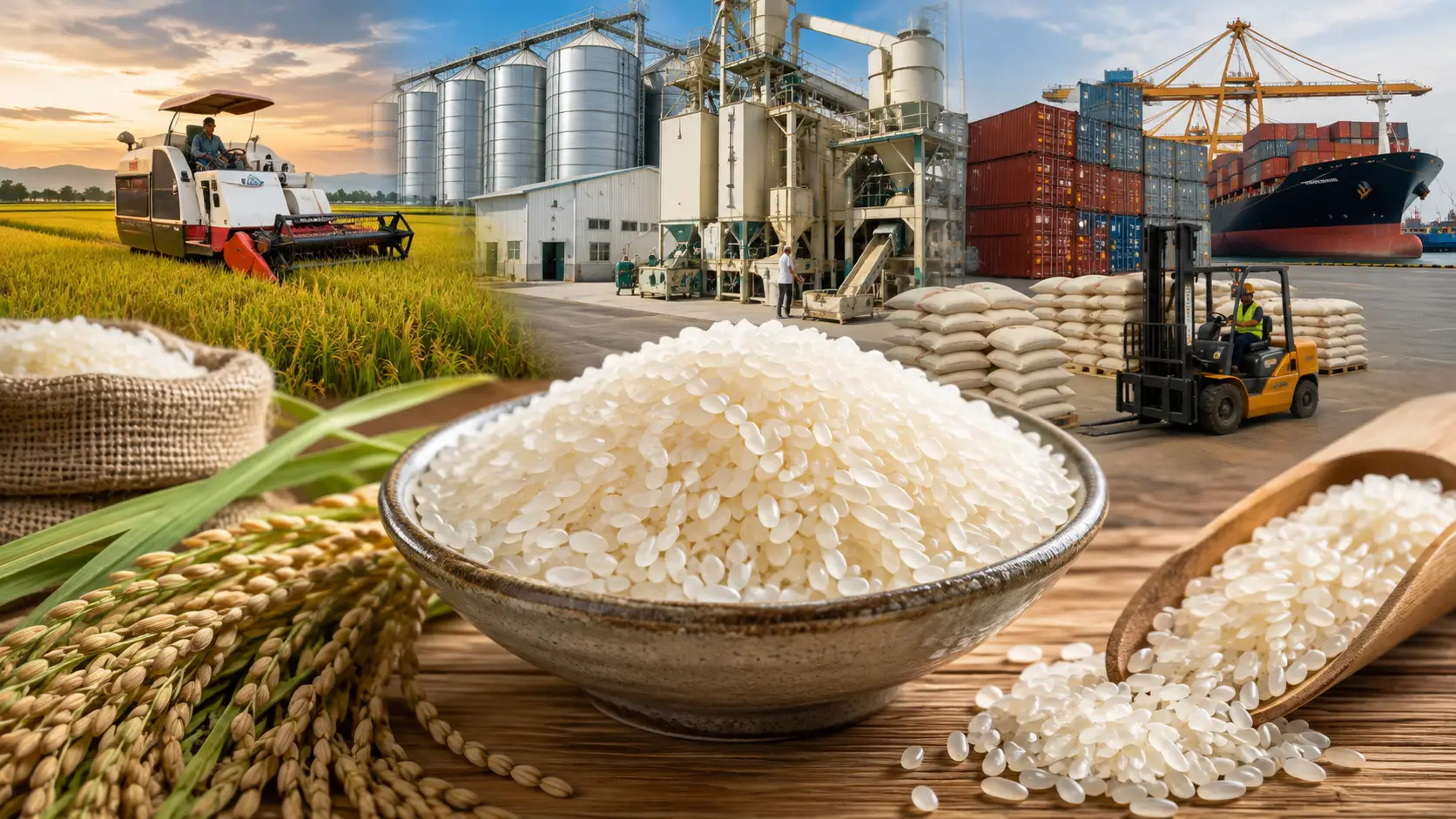
The international Japonica Rice chain typically connects agricultural producers with collection networks, rice mills, exporters, importers, distributors, food manufacturers, restaurants, and retail-oriented buyers. Each stage can influence final quality and commercial value. Harvest timing, drying, storage conditions, milling efficiency, grading, contamination controls, and transportation practices all affect whether a shipment reaches the buyer in commercially acceptable condition.
For B2B procurement teams, the supply chain therefore becomes part of the product specification itself. A competitive offer is not simply a low price per metric ton; it must balance origin reliability, consistent specifications, shipment timing, packaging, documentation, and landed cost. This makes dependable supplier relationships particularly valuable for companies purchasing Japonica Rice repeatedly rather than for occasional spot transactions.
Production Origins and Sourcing Dynamics
Major Production Regions
Japonica Rice is principally cultivated in temperate and selected subtropical production environments. Major producing regions identified in international agricultural market analysis include China, Japan, South Korea, the United States, the European Union, Australia, Egypt, and Turkey, although the balance between domestic consumption and export availability varies considerably by country.
China is particularly significant because of its large rice sector and substantial Japonica production, while Japan and South Korea have highly developed domestic markets with strong consumer preferences for specific varieties and quality characteristics. The United States, Australia, the European Union, Egypt, and Turkey also contribute to the broader supply landscape. For international buyers, this geographic diversity creates sourcing opportunities but also means that origin selection should reflect the intended specification and destination market.
Origin Selection for B2B Procurement
Origin selection is one of the first strategic decisions in a Japonica Rice purchasing program. Buyers may evaluate suppliers according to grain quality, crop availability, milling capabilities, export infrastructure, production consistency, and proximity to the destination market. A processor seeking stable industrial inputs may prioritize predictable specifications, while a premium food-service buyer may place greater emphasis on grain appearance, texture, and variety.
Seasonality also affects procurement planning. Agricultural commodities are exposed to weather conditions, harvest cycles, water availability, domestic demand, and government policies. A diversified sourcing strategy can reduce dependence on one origin and provide greater flexibility when crop conditions or export availability change. For large buyers, maintaining qualified alternative suppliers can therefore strengthen continuity of supply without requiring constant switching between specifications.
Milling, Processing, and Quality Management
From Paddy to Marketable Rice
After harvest, Japonica Rice enters a sequence of post-harvest operations that can include drying, cleaning, husking, milling, grading, sorting, and packaging. The degree of processing determines the commercial form offered to buyers, with international rice markets distinguishing between paddy, husked, milled, and other processed forms. FAO market analysis also emphasizes broken-kernel percentage, impurities, color, and chalkiness as important quality considerations in rice trade.
For commercial buyers, milling performance directly affects usable yield and shipment economics. Excessive broken kernels can alter the value of a consignment depending on the buyer's intended application. Consistency in grain size and appearance can also influence downstream processing and consumer presentation. As a result, procurement specifications should clearly define acceptable tolerances before commercial contracting rather than leaving quality expectations open to interpretation.
Quality Control Across the Chain
Quality management extends beyond the milling facility. Storage conditions can influence moisture stability and grain integrity, while transportation and handling can create opportunities for contamination, physical damage, or packaging deterioration. Reliable exporters and distributors therefore need coordinated controls across procurement, processing, storage, loading, and shipment.
A B2B buyer evaluating Japonica Rice should consider certificates and technical documentation alongside the physical product specification. Depending on the destination and application, relevant documentation may include certificates of analysis, origin documentation, phytosanitary documentation, packing information, and other import or regulatory records. Clear documentation reduces the risk of delays and helps procurement, quality, logistics, and regulatory teams work from the same commercial specification.
International Trade and Logistics
Global Trade Flows
International Japonica Rice trade is more concentrated than the broader rice market because producing countries often have substantial domestic demand. FAO analysis has identified Northeast Asia, particularly Japan, South Korea, and Chinese Taipei, as major destinations for Japonica Rice, while the Middle East and North Africa have also been identified as important import-demand regions. Major exporting sources have included the United States, Australia, the European Union, and China.
This structure creates a market in which trade opportunities depend heavily on origin-specific availability and destination requirements. Buyers therefore benefit from understanding not only global rice supply but also the specific trade channels applicable to Japonica varieties. Import regulations, tariff structures, quotas, phytosanitary requirements, and domestic purchasing policies can materially affect the feasibility of a sourcing route.
Logistics and Landed Cost
International sourcing requires procurement teams to evaluate the complete delivered economics of Japonica Rice. Ocean freight, port handling, insurance, inland transportation, warehousing, packaging, customs procedures, and import-related costs can substantially influence the final landed cost. A supplier offering the lowest FOB price may not necessarily provide the lowest delivered cost.
Shipment planning should also align with inventory requirements. Buyers with predictable consumption can consider forward purchasing or scheduled shipments, while distributors may require more flexibility to respond to customer orders. Reliable communication between supplier, freight provider, importer, and receiving warehouse is particularly important for agricultural commodities where timing and storage conditions influence commercial performance.
B2B Buyers and Application Markets
Food and Food-Service Procurement
The core commercial market for Japonica Rice is food consumption, particularly applications where its characteristic texture and grain profile are desired. Food manufacturers, distributors, restaurants, caterers, retail suppliers, and institutional food-service operators may purchase Japonica Rice according to specific variety, milling, packaging, and quality requirements.
For food-service buyers, consistency is often more important than simply securing the lowest purchase price. A restaurant or food manufacturer may need the same cooking behavior across multiple deliveries to maintain product quality. This makes supplier qualification, sample approval, technical specifications, and batch consistency important components of B2B sourcing. The buyer's application should therefore guide the specification used during supplier evaluation.
Distributor and Importer Demand
Importers and distributors operate at another critical point in the Japonica Rice supply chain because they connect international producers with local food markets. Their requirements may include mixed packaging formats, regular container availability, private-label capabilities, documentation support, and flexible shipment planning.
For distributors, supplier diversification can be particularly valuable. Demand can fluctuate by season, customer segment, promotional activity, and local market conditions. Maintaining access to multiple qualified origins or suppliers can provide additional resilience while allowing distributors to match different quality and price segments. A B2B marketplace can support this process by connecting procurement teams with suppliers that can be evaluated against defined commercial requirements.
Procurement Strategy and Supplier Selection
Building a Reliable Supplier Base
Effective Japonica Rice procurement begins with a clearly defined specification. Buyers should establish the required variety or grain type, processing level, broken percentage, moisture requirements, packaging format, quantity, delivery terms, destination, and documentation before requesting quotations. This improves comparability between suppliers and reduces the risk of evaluating apparently different products under the same product name.
Supplier qualification should then examine production or sourcing capability, processing infrastructure, export experience, quality systems, documentation, shipment capacity, and responsiveness. For recurring procurement, buyers can also evaluate historical performance, including delivery consistency, specification conformity, communication, and handling of quality claims. These factors provide a stronger basis for supplier selection than price alone.
Managing Commercial and Supply Risks
Agricultural commodity supply chains face risks that cannot be eliminated through contracting alone. Crop variability, changing domestic demand, freight conditions, regulatory changes, and export restrictions can affect availability and pricing. FAO maintains dedicated rice price indicators that separately track major varieties, including Japonica, reflecting the fact that rice markets are segmented by variety and quality.
For procurement teams, this supports a more structured purchasing approach. Monitoring relevant rice-market indicators, maintaining alternative sourcing channels, and matching inventory policies to consumption requirements can reduce exposure to short-term disruptions. A transparent B2B sourcing platform can further improve supplier discovery by helping buyers compare commercial options according to product specifications, origin, quantity, and delivery requirements.
Market Outlook and Supply Chain Conclusion
Japonica Rice Market Outlook
The outlook for Japonica Rice remains closely connected to regional consumption patterns, production conditions, international trade policies, and differentiated consumer preferences. The wider rice market is also experiencing changing supply conditions. In its August 2026 outlook, the USDA reported tighter projected U.S. all-rice supplies for 2026/27 and a forecast all-rice season-average farm price of $14.90 per cwt, illustrating how production and inventory conditions can influence agricultural commodity economics. This is an all-rice U.S. benchmark rather than a Japonica-specific price, so it should not be treated as a direct quotation for Japonica Rice.
For international buyers, the most relevant opportunity is therefore not simply tracking a single global price. Japonica Rice is a differentiated segment, and actual procurement economics depend on origin, variety, grade, milling specification, shipment terms, destination, and quality requirements. Buyers that understand these variables can make more informed purchasing decisions and avoid comparing technically different offers solely on nominal price.
Tradeasia as a B2B Sourcing Partner
A resilient Japonica Rice supply chain requires coordination between producers, processors, exporters, importers, distributors, logistics providers, and end-use buyers. As procurement becomes increasingly focused on traceability, specification consistency, documentation, and reliable delivery, digital B2B sourcing channels can help buyers identify and evaluate suitable commercial supply options.
For companies seeking international sourcing support, Tradeasia International and the Tradechem Marketplace can serve as commercial channels for connecting supply-side capabilities with B2B procurement requirements. The value of a marketplace approach is not simply supplier discovery; it is the ability to structure sourcing around product specifications, volumes, market requirements, and international trade considerations. For Japonica Rice buyers, this creates a practical foundation for developing more transparent and resilient supply relationships.
Sources
www.ers.usda.gov
www.fao.org
www.fao.org

Leave a Comment