Introduction
The global hydrochloric acid market is entering Q2 2026 in a landscape defined by heightened regulatory scrutiny, evolving trade routes, and a renewed focus on supply chain resilience. Hydrochloric acid (HCl), a critical inorganic acid used in steel pickling, pH control, inorganic and organic synthesis, food processing, and wastewater treatment, is tightly linked to upstream chlor-alkali and vinyls production. As a result, trade flows and compliance requirements have become more complex, particularly for cross-border movements spanning Asia, the Middle East, Europe, and the Americas.
Market participants are increasingly expected to demonstrate robust risk management practices, transparent documentation, and adherence to environmental, health, and safety (EHS) standards. Regulatory regimes such as REACH in the European Union, the Globally Harmonized System (GHS) for classification and labeling, and transport rules under ADR, IMDG, and IATA are shaping how hydrochloric acid is produced, packaged, labeled, and shipped. For distributors and buyers, platforms such as chemtradeasia.com, chemtradeasia.in, chemtradeasia.co.id, chemtradeasia.ae, and chemtradeasia.sg have become key interfaces for aligning commercial decisions with compliance obligations.
This article provides a detailed, globally oriented view of hydrochloric acid trade risk and compliance trends in Q2 2026. It examines market dynamics, identifies major risk categories, reviews regulatory developments, and highlights how structured sourcing and documentation through Tradeasia’s regional platforms can help buyers and sellers manage both operational and regulatory challenges.
Global Hydrochloric Acid Market Outlook in Q2 2026
Hydrochloric acid demand in 2026 remains closely correlated with activity in steel, construction, mining, and water treatment. According to recent industry analyses, the global hydrochloric acid market is estimated in the mid–single digit billion USD range, with compound annual growth projected around 4–5% through 2030. Q2 2026 is characterized by moderate demand recovery in Europe, steady growth in Southeast Asia and India, and stable but competitive conditions in North America. Steel pickling, calcium chloride production, and pH control in industrial processes continue to represent major consumption segments.
Supply conditions are strongly influenced by chlor-alkali capacity utilization and vinyl chloride monomer (VCM) production, as hydrochloric acid is often produced as a by-product. In Q2 2026, incremental capacity in Asia-Pacific and the Middle East has improved regional availability of both bulk and synthetic hydrochloric acid. However, localized bottlenecks in logistics—especially in container availability and port congestion—continue to affect export flows. This is particularly relevant for traders shipping from Asia to Africa and Latin America, where freight costs and transit times have shown periodic volatility.
Price trends for hydrochloric acid in early 2026 reflect a balancing of increased supply with resilient downstream demand. While FOB prices in key Asian export hubs have softened slightly compared with peak levels seen during earlier supply shocks, delivered costs in import-dependent regions remain sensitive to freight rates and local regulatory compliance costs. Buyers are responding by diversifying sourcing options across multiple regions and by emphasizing long-term contracts with suppliers that can demonstrate strong quality assurance and regulatory conformity.
Key Trade Risks in Hydrochloric Acid Supply Chains
Hydrochloric acid trade is exposed to a combination of physical, regulatory, financial, and reputational risks. On the physical side, the corrosive nature of HCl requires careful selection of transport equipment, such as rubber-lined tankers, specialized ISO tanks, and compatible drum materials. Inadequate packaging, improper labeling, or substandard storage conditions can lead to leaks, product degradation, and safety incidents. These issues not only carry direct operational costs but can also trigger regulatory investigations and insurance complications.
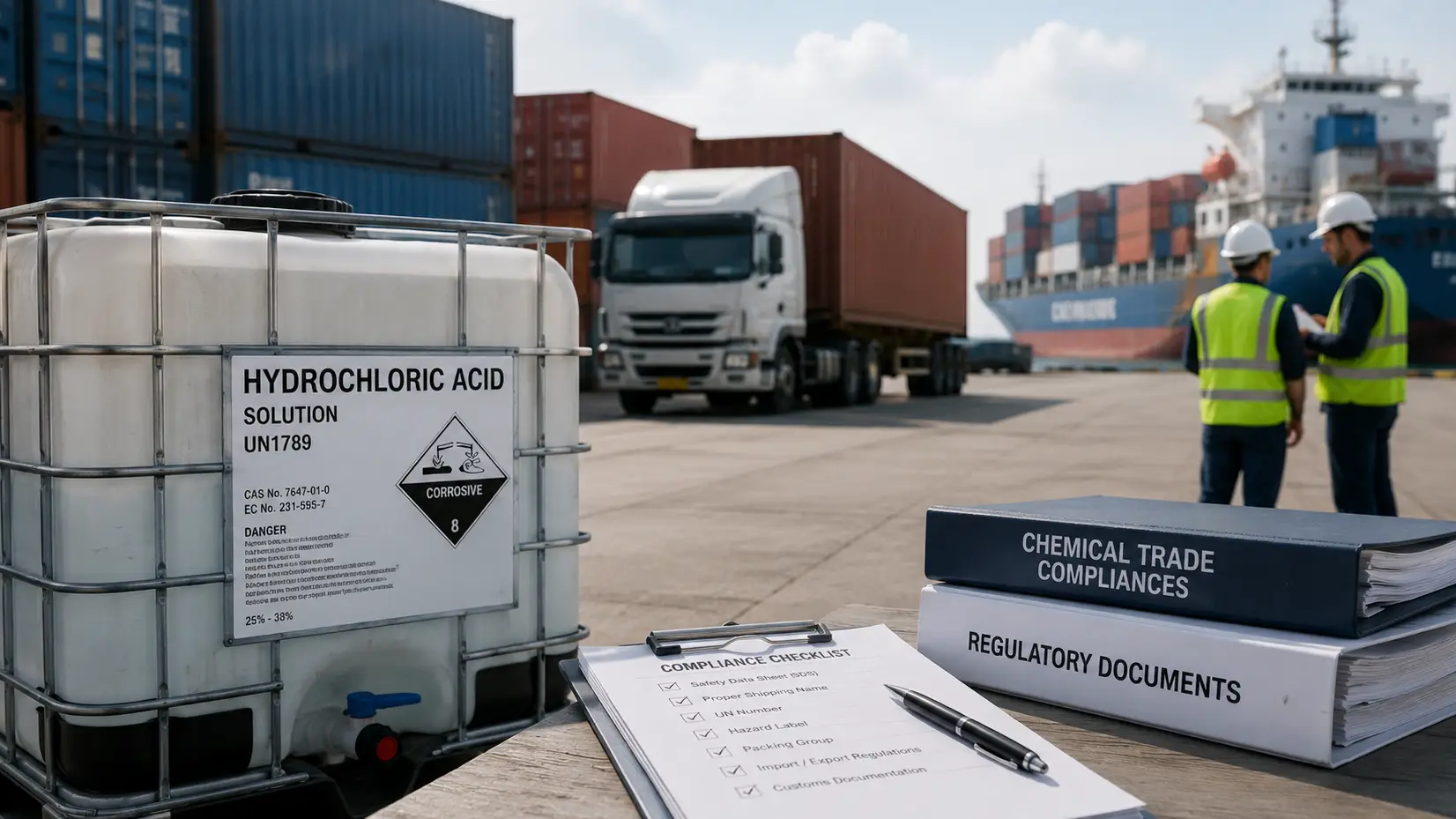
Regulatory and documentation risks are increasingly prominent. Misclassification under the UN Model Regulations, incomplete Safety Data Sheets (SDS), or non-compliance with local labeling rules can result in shipment delays, fines, or product rejections at ports. With customs and port authorities enhancing digital scrutiny of hazardous materials, discrepancies between commercial invoices, SDS, and transport documents are more likely to be identified. Companies trading hydrochloric acid must therefore maintain robust document control, version management of SDS, and alignment with the latest GHS classifications.
Trade participants also face counterparty and geopolitical risks. Changes in import duties, sanctions regimes, and non-tariff barriers can impact trade routes and cost structures with limited advance notice. For example, environmental regulations affecting chlor-alkali plants in certain jurisdictions can tighten regional supply, while new safety rules for chemical storage terminals may alter port handling fees. To manage these uncertainties, buyers are increasingly working with multi-region distributors and digital platforms, such as chemtradeasia.com, that can provide alternative sourcing options, updated regulatory insights, and diversified logistics solutions.
Regulatory and Compliance Trends Impacting HCl Trade
In Q2 2026, regulatory frameworks governing hydrochloric acid are converging around stricter EHS standards and more transparent supply chains. The European Union’s REACH regulation continues to influence global practices, as exporters to the EU must ensure that their hydrochloric acid—whether as a pure product or contained in formulations—meets registration, classification, and labeling requirements. Similar frameworks in the United Kingdom, Turkey, and other jurisdictions are reinforcing the need for accurate substance identification, exposure scenarios, and risk management measures.
Globally, the adoption of the latest revisions of the Globally Harmonized System (GHS) is driving updates to hazard statements, pictograms, and precautionary phrases on labels and SDS. For hydrochloric acid, which is classified as corrosive to metals and skin, and potentially hazardous to the respiratory system at higher concentrations, correct communication of hazards is critical. Importing countries are increasingly checking that SDS are current, localized to the appropriate language, and aligned with national adaptations of GHS. Failure in these areas can delay customs clearance or result in administrative penalties.
Transport regulations are also tightening. Under ADR (for road transport in Europe), IMDG (for sea transport), and IATA (for air transport), hydrochloric acid is subject to specific packaging instructions, segregation rules, and documentation requirements. In some ports, authorities have implemented stricter checks on bulk acid storage, secondary containment, and emergency response planning. Additionally, environmental regulations related to effluent discharge and emissions are influencing how hydrochloric acid is handled in downstream applications, particularly in metal finishing and mining. Suppliers and distributors that maintain comprehensive compliance frameworks, including updated SDS libraries and training for logistics partners, are better positioned to maintain uninterrupted trade flows.
Hydrochloric Acid Product Profiles and Sourcing via Tradeasia
Given the rising importance of quality assurance and regulatory conformity, structured sourcing of hydrochloric acid through established platforms has become a key risk mitigation strategy. Tradeasia’s regional portals—chemtradeasia.com (global), chemtradeasia.in (India), chemtradeasia.co.id (Indonesia), chemtradeasia.ae (Middle East), and chemtradeasia.sg (Singapore)—provide access to a broad portfolio of hydrochloric acid grades and packaging options tailored to diverse industrial uses. Typical commercial offerings include technical grade HCl (28–33%), synthetic grade produced from direct synthesis of hydrogen and chlorine, and by-product grades from chlor-alkali operations.
Product specifications for Tradeasia-sourced hydrochloric acid generally cover key parameters such as HCl concentration, free chlorine content, iron and heavy metal impurities, specific gravity, and color. For applications in steel pickling, oil well acidizing, and inorganic salt production, buyers typically prioritize consistent concentration and low metallic impurities to ensure process stability and minimize equipment corrosion beyond expected levels. For food-related and water treatment uses, stricter impurity limits and compliance with relevant food or potable water regulations are essential. Tradeasia works with audited manufacturers to provide SDS, Certificates of Analysis (COA), and, where applicable, conformity to standards such as FCC or local drinking water guidelines.
In practical terms, sourcing via Tradeasia’s platforms supports both commercial and compliance objectives. Buyers can compare hydrochloric acid offers across multiple origins, packaging formats (bulk, IBC, drums, ISO tanks), and incoterms, while also reviewing documentation packages in advance. The regional sites—such as chemtradeasia.sg for Southeast Asia or chemtradeasia.ae for the Middle East—help align product options with local regulatory frameworks and logistics realities. This structured approach reduces the risk of mismatches between product grade and end-use requirements, helps ensure that labeling and SDS meet destination country rules, and facilitates more efficient customs clearance and downstream audits.
Conclusion
Hydrochloric acid remains a foundational chemical for numerous industries, and its trade in Q2 2026 is shaped by intertwined forces of market demand, supply chain resilience, and regulatory evolution. While global capacity expansions and diversified production hubs have improved availability in many regions, traders and end users must navigate a more complex environment of transport rules, hazard communication requirements, and environmental expectations. Those who invest in robust documentation, supplier qualification, and logistics planning are better positioned to maintain continuity of supply and protect both workers and the environment.
Compliance is no longer a peripheral concern; it is integral to competitive positioning in the hydrochloric acid market. From accurate GHS labeling and up-to-date SDS to adherence with REACH-like frameworks and transport regulations, each element contributes to smoother cross-border movements and reduced operational risk. Digital sourcing and distribution platforms such as chemtradeasia.com, chemtradeasia.in, chemtradeasia.co.id, chemtradeasia.ae, and chemtradeasia.sg play a growing role in connecting buyers with vetted suppliers, standardizing product information, and providing the documentation backbone required for global trade.
This article is intended solely for informational and market insight purposes and does not constitute technical, safety, legal, or other professional advice. Readers should independently verify all information with qualified experts, consult official documentation such as MSDS/SDS and applicable regulations, and contact relevant professionals or our team before making decisions or using hydrochloric acid in any specific application.
Leave a Comment