Introduction
Guar meal, a protein-rich byproduct derived from guar gum processing, has increasingly positioned itself as a platform protein ingredient in global agricultural and feed industries. As of 2026, the guar meal market is shaped by rising demand for cost-efficient animal nutrition and sustainable feed alternatives. With global production estimated at over 1.1–1.3 million MT annually, and average pricing ranging between USD 300–520/MT, the market continues to benefit from steady downstream consumption. The sector is projected to expand at a CAGR of 4.8% (2024–2030), supported by livestock intensification and aquaculture growth.
Livestock Feed Demand as Core Application
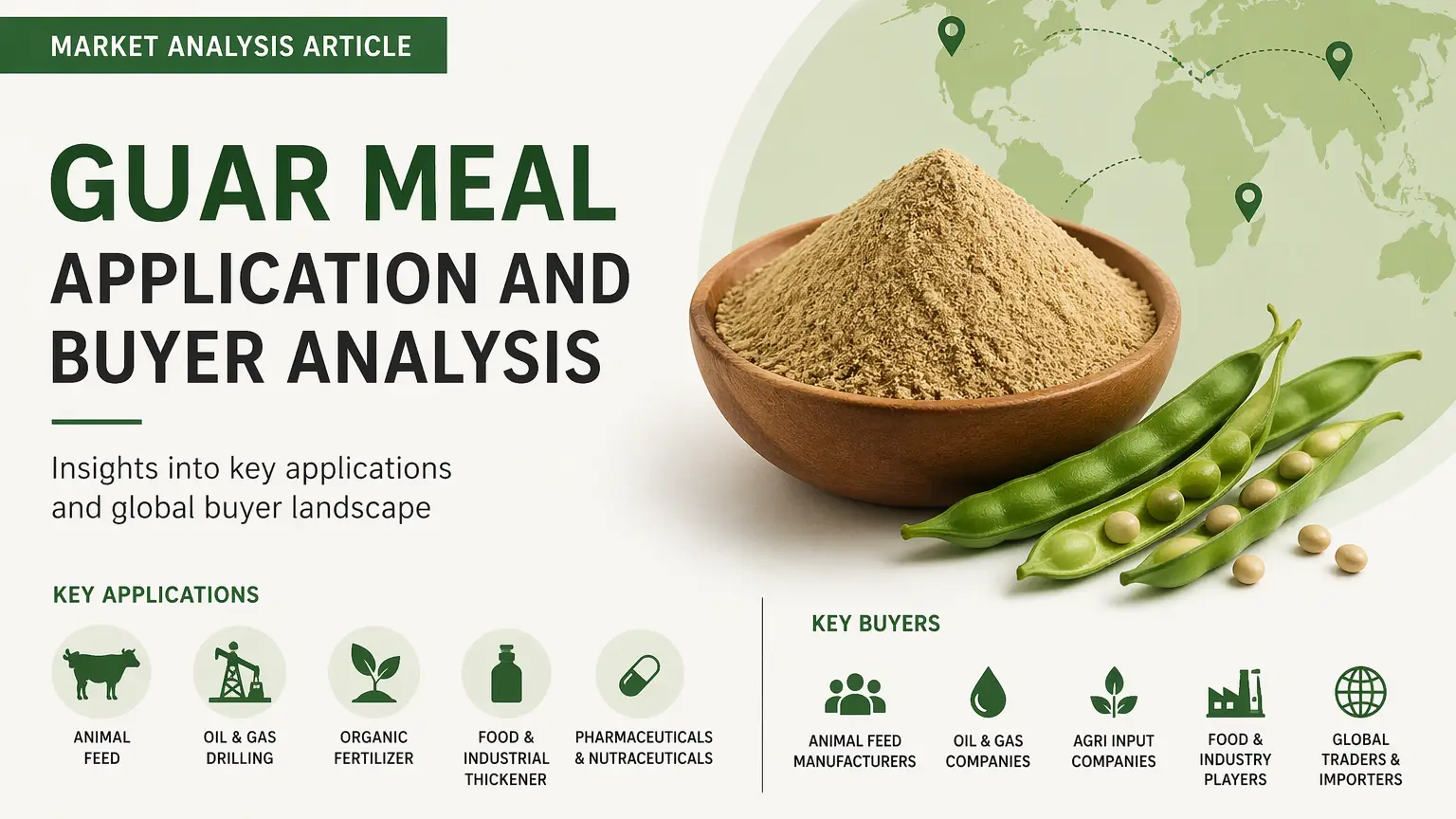
Livestock feed remains the dominant application segment, accounting for nearly 55% of global consumption. Guar meal’s high protein content (45–55%) makes it a cost-effective substitute for soybean meal in cattle and ruminant diets. Dairy industries in India, Pakistan, and parts of the Middle East are key demand drivers, collectively consuming over 600,000 MT annually. Feed formulators favor guar meal due to its affordability and stable protein profile, particularly when soybean prices exceed USD 450/MT.
Poultry and Aquaculture Expansion
The poultry and aquaculture sectors are emerging as high-growth buyers, driven by protein diversification strategies. Poultry feed integration has increased by nearly 18% over the past five years, while aquaculture applications are expanding at a CAGR above 5.5%. However, anti-nutritional factors in guar meal require processing refinement, limiting its inclusion rates. Despite this, demand in Southeast Asia and coastal China is strengthening, especially where feed cost optimization is critical.
Fertilizer and Industrial Utilization
Beyond feed, guar meal is increasingly used in organic fertilizers due to its nitrogen-rich composition (6–8%). Agricultural demand accounts for roughly 20% of global consumption. Organic farming expansion in Europe and North America is driving adoption, with fertilizer-grade guar meal priced slightly lower at USD 280–400/MT. Industrial applications remain niche but are gaining traction in bio-based soil conditioning products.
Global Buyers and Trade Flow Dynamics
Global buyers are concentrated among feed manufacturers, agrochemical firms, and commodity traders. India remains the dominant exporter, supplying over 70% of global guar meal trade. Import-dependent regions such as the Middle East and Southeast Asia rely heavily on Indian-origin supply chains. Trade flows are increasingly influenced by freight volatility and guar seed availability, impacting price stability across markets.
Conclusion
As demand for sustainable protein and organic agricultural inputs grows, guar meal continues to evolve as a strategically important platform chemical-derived feed ingredient. Its diversified applications across livestock, poultry, aquaculture, and fertilizers ensure resilient market fundamentals despite commodity fluctuations. In this shifting landscape, global sourcing efficiency becomes critical. Companies such as Tradeasia International play a vital role in ensuring consistent supply chain access, connecting producers and buyers across regions with optimized logistics and chemical distribution solutions.
Sources
-
https://www.imarcgroup.com/guar-gum-pricing-report (IMARC Group)
-
https://dataintelo.com/report/global-guar-meal-market (Dataintelo)
-
https://www.reportsanddata.com/report-detail/guar-meal-market (reportsanddata.com)
Leave a Comment