Fumaric Acid Supply Chain: A Global B2B Sourcing Guide
Introduction to the Fumaric Acid Supply Chain
Understanding Fumaric Acid in Commercial Trade
Fumaric Acid is a dicarboxylic organic acid identified by CAS No. 110-17-8 and commonly marketed as E297 for food applications. It is supplied primarily as a white crystalline solid and serves food, feed, pharmaceutical, and industrial markets. Its combination of strong acidifying performance, relatively low water solubility, stability, and low hygroscopicity makes it commercially valuable in formulations where controlled acidity and storage stability are important. For international buyers, these characteristics make product grade, specification consistency, documentation, and dependable shipment planning central elements of procurement.
Why the Supply Chain Matters
The commercial value of Fumaric Acid extends beyond the chemical itself. Buyers must manage the relationship between manufacturer capability, product grade, regulatory requirements, packaging, transportation, inventory, and downstream formulation requirements. Food manufacturers may require documentation and specifications aligned with applicable food regulations, while industrial customers can prioritize particle characteristics, purity, and process compatibility. Consequently, a reliable supply chain is not simply a matter of finding the lowest quoted price; it requires consistent quality and predictable delivery.
For global procurement teams, sourcing strategy becomes particularly important when purchasing in recurring volumes. Supplier location, production continuity, export experience, minimum order quantities, lead times, port availability, and documentation can materially affect the landed cost and production schedule. A B2B marketplace can therefore add value when it helps buyers compare commercially relevant suppliers while maintaining visibility over specifications and shipment requirements.
Fumaric Acid Applications and Demand Drivers
Food and Beverage Demand
Food and beverage manufacturing remains one of the most established commercial applications for Fumaric Acid. As E297, it is used as an acidity regulator, acidulant, flavoring-related ingredient, pH-control agent, and in certain food systems where controlled acid release is desirable. Applications include dry beverage mixes, confectionery, bakery systems, gelatin and dessert products, flavored products, and other formulations permitted by applicable regulations. EFSA documentation lists permitted European food categories including certain flavored dairy desserts, sugar confectionery, chewing gum, bakery fillings and toppings, instant fruit-based drink powders, and powdered dessert systems.
Industrial and Feed Applications
Fumaric Acid also participates in markets beyond conventional food formulation. Industrial users can employ it in unsaturated polyester resin systems and other chemical applications, creating demand linked to construction, composites, coatings, and related manufacturing. Feed applications represent another commercial segment, with regulatory assessments covering its use as a preservative and flavoring compound in animal feed. This diversification is strategically relevant to suppliers because demand is not dependent on a single downstream industry.
The product's physical behavior is particularly important when evaluating applications. Its relatively low water solubility can be advantageous in dry formulations where gradual dissolution or persistent acidity is required, but it can also limit suitability for some clear liquid beverage systems. This means that buyers should assess application fit before selecting a grade or particle form rather than treating all Fumaric Acid volumes as interchangeable commodities.
Global Fumaric Acid Market and Supply Dynamics
Regional Production and Demand
Asia-Pacific plays a central role in the Fumaric Acid supply chain, with China representing an important production and consumption market. Recent market research indicates that China's Fumaric Acid market reached approximately USD 105.6 million in 2025, representing around 40.8% of global revenues in that analysis. India is also developing as an important market, supported by industrial manufacturing and downstream composite-material demand. These regional dynamics make Asia an important sourcing base for international buyers while increasing the importance of supplier qualification and export logistics.
Balancing Cost and Supply Security
For procurement teams, the commercial decision is increasingly about balancing competitive pricing with supply resilience. Global buyers can face exposure to freight fluctuations, port congestion, production interruptions, regulatory changes, currency movements, and longer replenishment cycles. A supplier offering a low ex-works price may not necessarily provide the lowest total landed cost if lead times, documentation, freight arrangements, or quality deviations create additional expenses.
The 2026 supply environment therefore favors diversified sourcing strategies. Buyers with recurring requirements can evaluate primary and secondary suppliers, establish agreed specifications in advance, and maintain appropriate safety stock for critical production schedules. For distributors, regional warehousing can further reduce delivery risk by placing inventory closer to customers. This approach turns Fumaric Acid procurement from a transactional purchase into a structured supply-chain program.
Quality Specifications for B2B Buyers
Purity and Regulatory Compliance
Quality requirements vary according to the intended application, but food-grade Fumaric Acid requires particularly careful specification control. U.S. regulations specify a minimum of 99.5% fumaric acid by weight on an anhydrous basis for the relevant food-use specification. Commercial specifications may additionally address moisture, maleic acid, heavy metals, arsenic, residue on ignition, appearance, and melting point. Buyers should verify that the supplier's Certificate of Analysis corresponds to the contracted grade and intended market.
Documentation and Batch Consistency
For international B2B transactions, technical quality and documentary quality should be evaluated together. Procurement teams commonly need a Certificate of Analysis, Safety Data Sheet, specification sheet, origin information, and applicable certification or compliance documentation. Depending on the destination and application, buyers may also require food-safety certifications or statements relating to Halal, Kosher, HACCP, ISO, or other standards. The objective is not simply to confirm that a shipment contains Fumaric Acid, but to establish that every recurring shipment conforms to the buyer's approved specification.
Consistency between batches is particularly important for food manufacturers because formulation changes can affect taste, acidity, dissolution behavior, processing performance, and finished-product quality. A technically acceptable sample is therefore only the first stage of supplier qualification. Procurement teams should assess historical COAs, quality-control procedures, retained samples, complaint handling, and change-notification practices before establishing a long-term contract.
Supplier Selection and Procurement Strategy
Evaluating Fumaric Acid Suppliers
A suitable Fumaric Acid supplier should be assessed across product quality, production capability, export experience, commercial responsiveness, documentation, packaging, and delivery performance. Buyers should compare suppliers using the same specification and Incoterm so that quotations are commercially comparable. Minimum order quantity, payment terms, production lead time, available grades, and port of loading can significantly change the practical value of an offer.
Supplier diversification can also protect buyers from unexpected disruptions. Instead of relying exclusively on one source because of an attractive initial price, procurement teams can establish qualified alternatives and periodically review supplier performance. This is especially valuable for manufacturers using Fumaric Acid as a recurring production input, where a missed delivery can affect multiple downstream products.
Using B2B Marketplaces for Sourcing
A specialized B2B chemical marketplace can simplify supplier discovery by connecting buyers with manufacturers, exporters, distributors, and regional supply partners. For Fumaric Acid, marketplace-based sourcing is particularly useful when buyers need to compare grades, origins, packaging formats, order quantities, and delivery options. The commercial objective should be transparent supplier comparison rather than simply increasing the number of quotations received.
For Tradeasia, Chemtradeasia, and Tradechem Marketplace, this creates an opportunity to support buyers throughout the sourcing cycle—from product identification and specification matching through supplier coordination and international trade execution. A procurement-focused platform can help convert fragmented supplier information into a more structured buying process, particularly for customers managing recurring chemical requirements across multiple markets.
Logistics, Packaging, and Supply Continuity
Packaging and Handling Considerations
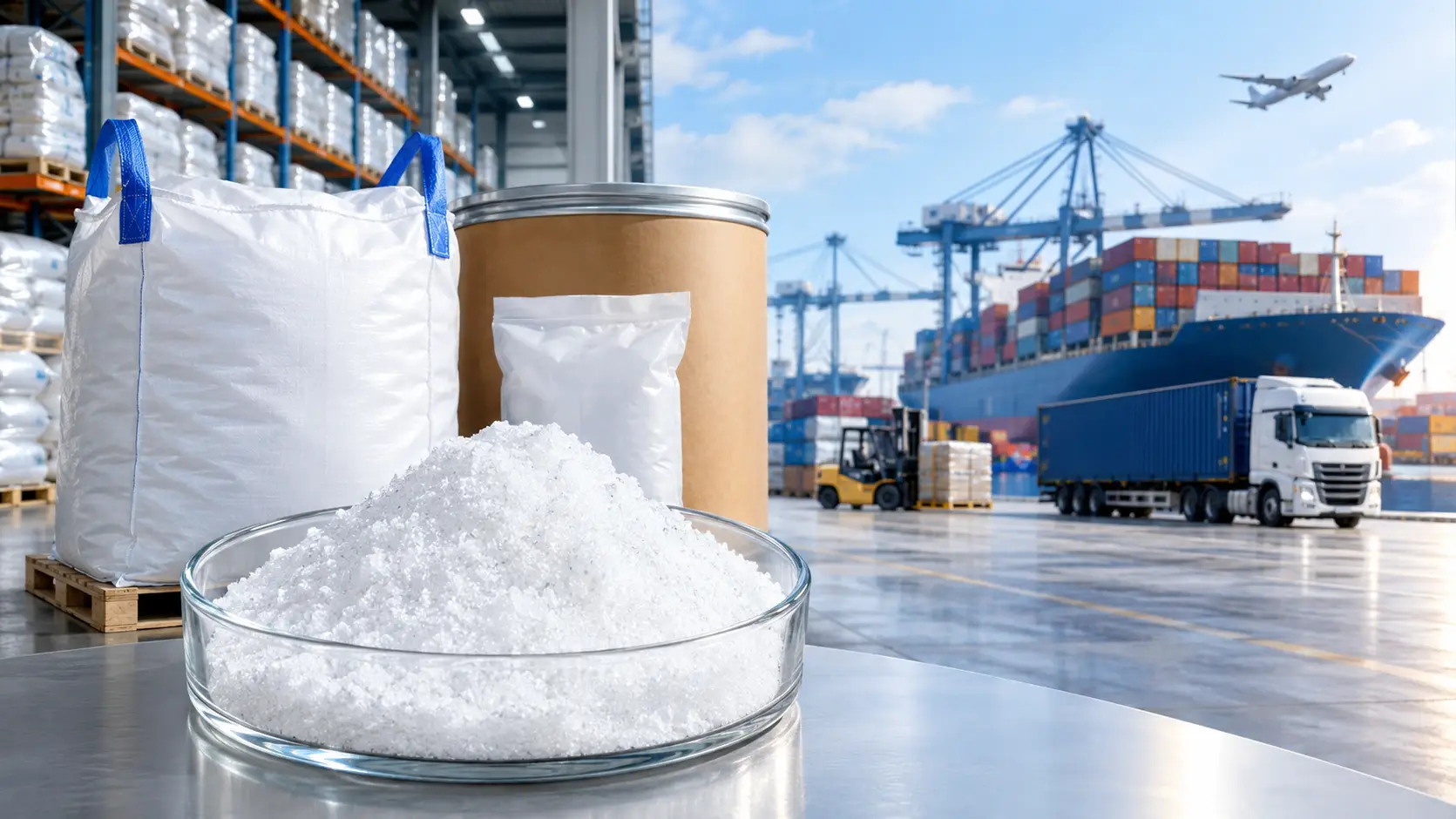
Fumaric Acid is commonly traded as a crystalline powder or granular material, with packaging selected according to shipment size, customer requirements, handling systems, and destination regulations. Commercial packaging can include bags, cartons, fiber drums, or larger bulk formats. Because the product is generally stable under appropriate storage conditions, warehouse management focuses on keeping material protected from contamination, moisture, excessive heat, and unsuitable handling conditions.
Managing International Deliveries
International buyers should evaluate the complete logistics chain rather than freight cost alone. Port selection, container availability, transit time, customs documentation, cargo protection, destination clearance, and local delivery capacity can influence the final cost and reliability of Fumaric Acid procurement. Buyers with predictable consumption can improve planning by aligning purchase cycles with manufacturing schedules and maintaining enough inventory to absorb normal shipping delays.
Supply continuity becomes even more important for manufacturers operating just-in-time or high-throughput production. A structured replenishment model can combine demand forecasting, agreed lead times, safety stock, supplier communication, and periodic performance reviews. For distributors, regional inventory can create an additional buffer between international production and local customer demand, improving responsiveness without requiring every customer to purchase directly from overseas manufacturers.
Fumaric Acid Sourcing Outlook and Conclusion
Procurement Priorities for 2026
The Fumaric Acid supply chain in 2026 is increasingly shaped by the need for dependable quality, diversified sourcing, regulatory awareness, and logistics visibility. Food applications remain commercially significant, while industrial and feed uses broaden the downstream demand base. Market data also indicates strong participation from Asian production and consumption centers, reinforcing Asia's importance in international sourcing strategies.
Building a Reliable Long-Term Supply Strategy
For buyers, the strongest procurement strategy is therefore not based solely on achieving the lowest nominal price. It should combine verified specifications, supplier qualification, competitive landed costs, appropriate packaging, reliable documentation, realistic lead times, and contingency sourcing. Food manufacturers in particular should confirm that the selected material complies with the regulatory and quality requirements applicable in the destination market and intended application.
Fumaric Acid remains a commercially relevant ingredient and industrial chemical because its performance characteristics allow it to serve multiple downstream sectors. As international trade becomes more focused on supply resilience and traceability, buyers benefit from working with supply partners capable of coordinating product quality, sourcing, logistics, and commercial requirements. Tradeasia International, Chemtradeasia, and Tradechem Marketplace can serve as a practical B2B channel for companies seeking structured access to Fumaric Acid supply and broader chemical sourcing solutions.
For procurement teams, the next step is to evaluate Fumaric Acid according to actual consumption volume, required grade, destination market, packaging preference, delivery terms, and compliance documentation. A well-qualified supplier relationship can reduce sourcing friction while improving continuity, cost visibility, and responsiveness across the wider chemical supply chain.
Sources
www.law.cornell.edu
www.efsa.europa.eu
www.fortunebusinessinsights.com

Leave a Comment