Commercial Applications and Buyer Dynamics in the Formic Acid Feed Grade Market
Introduction: Global Expansion of Formic Acid Feed Grade in Modern Animal Nutrition
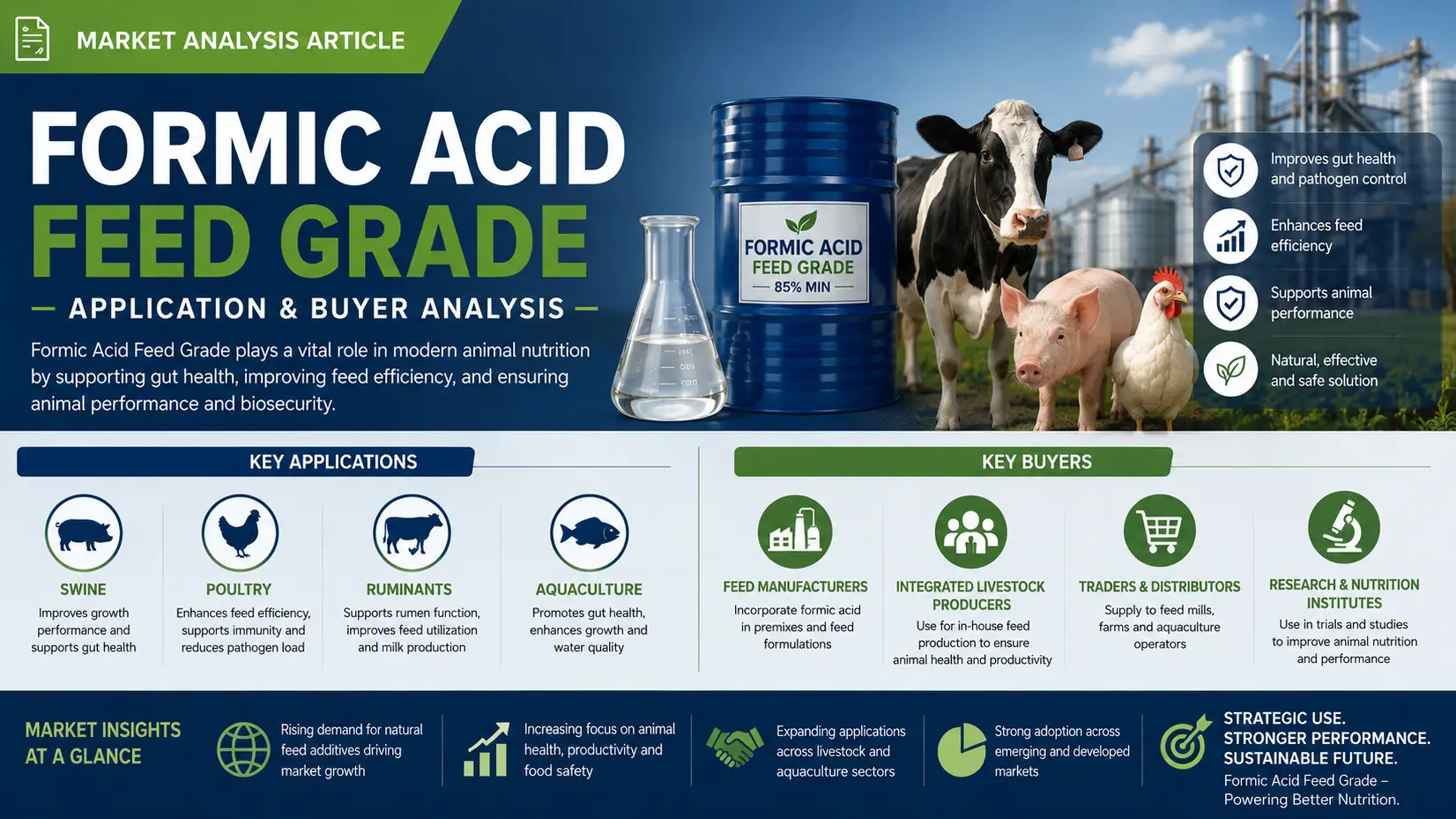
Formic acid feed grade has emerged as an essential platform chemical within the global animal nutrition industry, particularly as livestock producers seek efficient feed preservation and pathogen control solutions in 2026. Widely used as an acidifier and antibacterial agent, the product plays a critical role in improving feed hygiene, extending silage shelf life, and supporting digestive performance in poultry, swine, and ruminant farming systems. As feed manufacturers move toward antibiotic-reduction strategies, demand for organic acid-based additives continues to accelerate across both developed and emerging agricultural markets.
The global formic acid feed grade market is projected to grow at a CAGR of 5.8% through 2030, supported by rising industrial feed production and increasing pressure to enhance animal productivity. Average global pricing in early 2026 ranges between USD 760–980/MT, depending on purity, logistics, and sourcing origin, while worldwide feed-grade production volumes are estimated to exceed 1.2 million metric tons annually.
Rising Demand from Poultry and Swine Feed Producers
The poultry and swine sectors remain the dominant consumers of formic acid feed grade products in 2026, accounting for nearly 62% of total market demand. Large-scale feed mills increasingly incorporate formic acid into compound feed formulations to control Salmonella contamination and improve nutrient absorption efficiency. In Europe and Southeast Asia, integrated poultry producers are expanding acidifier usage as regulatory scrutiny on antibiotic growth promoters intensifies.
Commercial feed buyers in Brazil, China, Thailand, and Vietnam are actively securing long-term supply agreements due to growing livestock populations and tighter feed safety standards. Premium buffered formic acid blends are currently trading at approximately USD 920/MT, particularly in export-focused poultry economies.
Silage Preservation Driving Agricultural Applications
Beyond compound feed manufacturing, formic acid feed grade is experiencing wider adoption in silage preservation and forage treatment applications. Dairy and cattle farms utilize the chemical to inhibit microbial spoilage during storage, particularly in humid agricultural regions where feed deterioration can significantly impact productivity.
In Northern Europe and North America, silage treatment applications are contributing to annual consumption growth of nearly 6.3%, with large agribusiness cooperatives increasing procurement volumes ahead of seasonal harvesting cycles. Global agricultural usage volumes for preservation purposes surpassed 340,000 metric tons in 2025 and continue to expand in 2026 due to climate-driven storage challenges.
Asian Buyers Reshaping Global Consumption Patterns
Asia-Pacific has become the fastest-growing regional buyer market for formic acid feed grade, driven by industrial livestock expansion and improving commercial farming infrastructure. China alone represents over 28% of global consumption, while India and Indonesia are emerging as high-potential import destinations.
Regional buyers are prioritizing stable supply partnerships as methanol and carbon monoxide feedstock volatility impacts production economics. Spot market prices in Asia fluctuated between USD 780–950/MT during the first quarter of 2026, particularly influenced by freight rates and energy costs. Major buyers increasingly prefer bulk contract purchasing to secure cost predictability amid supply chain uncertainty.
Feed Safety Regulations Supporting Premium Acidifiers
Global feed safety regulations continue to strengthen demand for high-purity organic acid solutions. Regulatory agencies across Europe and Asia are encouraging safer feed preservation technologies that reduce contamination risks without compromising animal performance.
As a result, feed manufacturers are shifting toward certified, food-compliant acidifier suppliers capable of ensuring traceability and quality consistency. Premium-grade products with lower impurity levels are commanding pricing premiums of nearly 12–15% above conventional industrial-grade alternatives. This transition is creating opportunities for specialized suppliers focused on technical support, customized blending, and global distribution capabilities.
Conclusion
As a platform chemical, formic acid feed grade continues to strengthen its position within the global livestock and feed preservation ecosystem in 2026. Expanding applications across poultry nutrition, silage preservation, and feed hygiene management are driving sustained market growth, while Asia-Pacific buyers increasingly shape global trade flows and procurement strategies.
In this evolving environment, companies such as Tradeasia International play an increasingly important role by connecting industrial buyers with reliable sourcing networks, consistent product quality, and global chemical supply solutions tailored to the feed and agricultural industries.
Sources
Leave a Comment