Global Folic Acid Supply Chain and B2B Procurement Intelligence Guide
Global Folic Acid Market Overview and Demand Drivers
Expanding Global Nutritional Demand
The global folic acid market continues to expand due to rising awareness of micronutrient deficiencies and preventive healthcare strategies. According to the World Health Organization (WHO), folic acid plays a critical role in reducing neural tube defects during pregnancy, making it a priority nutrient in global health programs. This demand is not limited to healthcare but extends to food and pharmaceutical industries.
Public Health Policies and Market Expansion
Government-backed fortification programs across North America, Europe, and Asia-Pacific have significantly increased demand for folic acid. Regulatory bodies such as the U.S. Food and Drug Administration (FDA) have mandated folic acid fortification in enriched cereal grains, driving consistent industrial consumption. These policies ensure stable, long-term procurement demand.
Nutraceutical and Preventive Health Trends
The rising global nutraceutical industry is a major growth driver for folic acid consumption. Consumers increasingly prioritize preventive health supplements, particularly in urban populations. Industry analysis from market research institutions highlights steady CAGR growth driven by dietary supplement manufacturers.
Market Outlook for B2B Buyers
From a B2B perspective, folic acid demand is highly stable due to its essential role in both regulatory and consumer-driven markets. Suppliers positioned within global chemical distribution networks benefit from recurring procurement cycles and diversified end-use industries. (Source reference: WHO nutritional guidance, FDA fortification standards, global nutraceutical market reports)
Supply Chain Structure and Raw Material Sourcing
Folic acid is primarily synthesized through multi-step chemical processes involving p-aminobenzoic acid derivatives and glutamic acid precursors. According to industrial chemistry references, production requires controlled environments to ensure pharmaceutical-grade purity. This makes manufacturing highly centralized in specialized chemical facilities.
Global Manufacturing Hubs
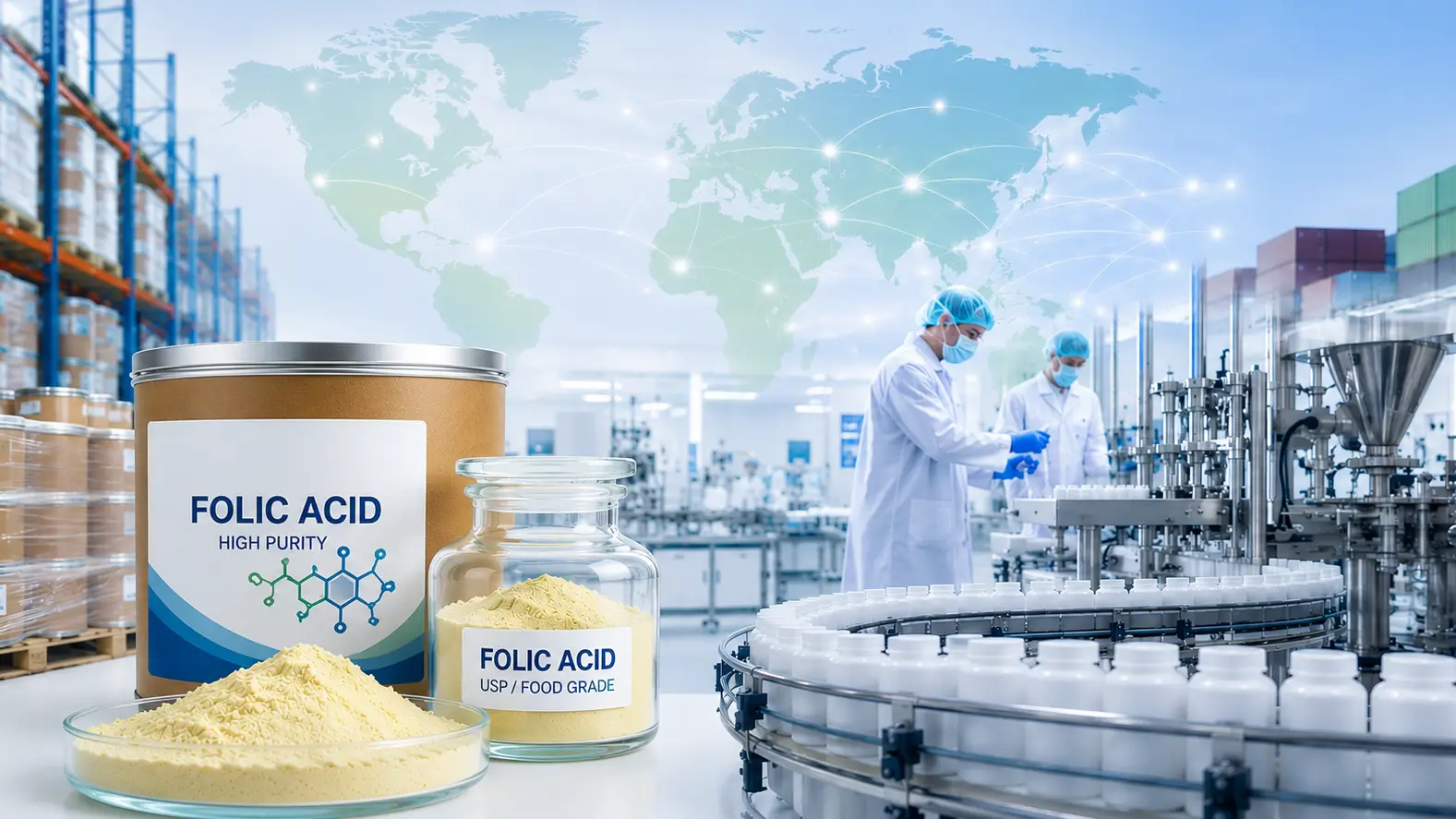
Major production hubs are located in China and India, where large-scale API (Active Pharmaceutical Ingredient) manufacturers dominate supply. These regions benefit from established chemical infrastructure and cost-efficient production ecosystems. Global distribution is then handled through chemical trading companies and B2B marketplaces.
Distribution and Trade Networks
The supply chain typically flows from API manufacturers to global distributors, and finally to pharmaceutical, food, and feed manufacturers. Trade intermediaries play a critical role in ensuring compliance, documentation, and regulatory alignment across regions.
Supply Chain Stability Factors
Raw material availability, regulatory compliance, and quality certification significantly influence supply chain stability. Industry reports from chemical trade associations emphasize the importance of GMP-certified production for pharmaceutical-grade folic acid sourcing. (Source reference: Chemical Abstracts Service insights, global API manufacturing reports, industry trade associations)
Industrial Applications in Pharma and Nutraceuticals
Folic acid is widely used in pharmaceutical formulations targeting anemia treatment and pregnancy-related supplementation. Clinical guidelines published by national health agencies highlight its role in preventing folate deficiency disorders. This makes it a critical API in drug manufacturing.
Nutraceutical and Dietary Supplements
The nutraceutical sector represents one of the fastest-growing application areas for folic acid. It is commonly included in multivitamin tablets and prenatal supplements. According to dietary supplement industry reports, demand is strongly driven by preventive healthcare consumption patterns.
Functional Health Products
Folic acid is increasingly incorporated into functional food and beverage formulations. Manufacturers integrate it into fortified drinks and wellness products to meet consumer demand for added nutritional value. This diversification supports broader market penetration.
Industrial Buyer Considerations
For B2B buyers, pharmaceutical and nutraceutical applications require strict compliance with purity standards, stability testing, and regulatory documentation. Industry standards from pharmacopeias such as USP and EP define acceptable quality benchmarks. (Source reference: USP pharmacopeia standards, FDA supplement guidelines, global nutraceutical industry reports)
Food Fortification and Public Health Regulations
Many countries have implemented mandatory folic acid fortification in staple foods such as wheat flour and rice. According to the Centers for Disease Control and Prevention (CDC), such programs have significantly reduced neural tube defect rates globally. This regulatory push ensures consistent industrial demand.
Role in Food Manufacturing
Food manufacturers use folic acid as a micronutrient additive in processed foods. It is blended into flour, cereals, and bakery products during large-scale production. This ensures population-wide nutritional intake without requiring behavioral dietary changes.
Regulatory Compliance Requirements
Food-grade folic acid must meet strict regulatory standards defined by agencies such as the European Food Safety Authority (EFSA). Compliance ensures safety, dosage accuracy, and labeling transparency in fortified food products.
Market Impact for Suppliers
For suppliers, food fortification programs create predictable, high-volume demand streams. This segment is particularly attractive for long-term B2B contracts and government-linked procurement programs. (Source reference: CDC fortification studies, EFSA regulations, global food security reports)
Procurement Considerations for B2B Buyers
B2B buyers prioritize GMP certification, ISO compliance, and pharmacopeia-grade verification when sourcing folic acid. These standards ensure consistency in pharmaceutical and food applications. Quality assurance is a key procurement decision factor.
Pricing and Supply Stability
Price fluctuations are influenced by raw material costs, manufacturing capacity, and global demand cycles. Buyers often evaluate suppliers based on long-term stability rather than spot pricing alone, especially in pharmaceutical supply chains.
Supplier Evaluation Criteria
Procurement teams assess suppliers based on production capacity, documentation support, regulatory compliance, and logistics reliability. Global sourcing platforms play a critical role in connecting verified suppliers with industrial buyers.
Strategic Procurement Planning
Long-term procurement strategies often include multi-source purchasing to reduce supply chain risks. According to chemical trade industry reports, diversified sourcing improves resilience against regional disruptions. (Source reference: ISO standards guidance, global procurement research publications, chemical industry logistics reports)
Buyer Intent and Purchasing Behavior Analysis
Folic acid buyers include pharmaceutical manufacturers, nutraceutical companies, food fortification producers, and animal feed formulators. Each segment has distinct quality and regulatory requirements shaping purchasing decisions.
Procurement Evaluation Factors
Buyers typically evaluate purity grade, certification compliance, supplier reliability, and regulatory documentation. These factors are essential for ensuring downstream product approval in regulated industries.
Why Buyers Compare Suppliers
Due to strict regulatory environments, buyers compare multiple suppliers to ensure consistent quality and supply continuity. Pricing is important, but compliance and traceability often take priority in decision-making.
Role of B2B Marketplaces
Digital B2B chemical marketplaces streamline supplier discovery and procurement workflows. They allow buyers to compare specifications, verify certifications, and secure stable supply contracts efficiently. (Source reference: global B2B e-commerce reports, procurement behavior studies, industry distribution analyses)
Conclusion and Future Outlook
Folic acid remains a structurally stable chemical commodity due to its essential role in health, nutrition, and food security programs. Industry forecasts suggest continued demand growth driven by global health initiatives.
Expanding Application Scope
Emerging applications in functional foods and preventive healthcare are expanding the addressable market. This diversification strengthens supply chain resilience and long-term sourcing opportunities.
Strategic Importance for Buyers
For procurement teams, folic acid represents a low-volatility but highly regulated ingredient requiring reliable sourcing partners. Strategic supplier selection ensures compliance and uninterrupted production.
Outlook for Global Trade
Global trade networks will continue to centralize around major API-producing regions, while demand spreads across healthcare and food industries. (Source reference: global chemical market outlook reports, WHO nutrition programs, international trade analyses
Sources
https://www.who.int
https://www.fda.gov
https://www.cdc.gov

Leave a Comment