Fish Soluble Overview and Commercial Role
What Fish Soluble is
Fish Soluble is a fish-derived soluble ingredient associated with fish processing and fish oil production. Technical references describe fish solubles as the concentrated aqueous fraction remaining after oil separation, while feed-industry references distinguish condensed and dried forms according to processing. This makes Fish Soluble commercially relevant as a recovered marine-derived ingredient rather than simply a conventional standalone chemical.
From a B2B perspective, the importance of Fish Soluble comes from its combination of marine origin, soluble nutrients, and compatibility with downstream feed and agricultural applications. Feedipedia identifies Fish Soluble as an animal-origin feed material, while FAO technical literature places fish-derived processing fractions within the broader family of feed ingredients used in aquaculture and livestock nutrition.
For procurement teams, this product category should therefore be assessed according to intended application rather than by product name alone. The relevant questions include whether the buyer requires a feed ingredient, an agricultural input, or another fish-derived formulation component, because application requirements can influence specifications, documentation, handling, and regulatory expectations.
The commercial opportunity lies in connecting manufacturers and distributors with buyers that already have a defined use case for marine-derived soluble ingredients. A B2B marketplace can support that process by presenting product information alongside sourcing options, allowing technical and purchasing teams to move from application research toward supplier inquiry with clearer requirements.
Fish Soluble Applications Across Industries
Aquaculture and animal feed applications
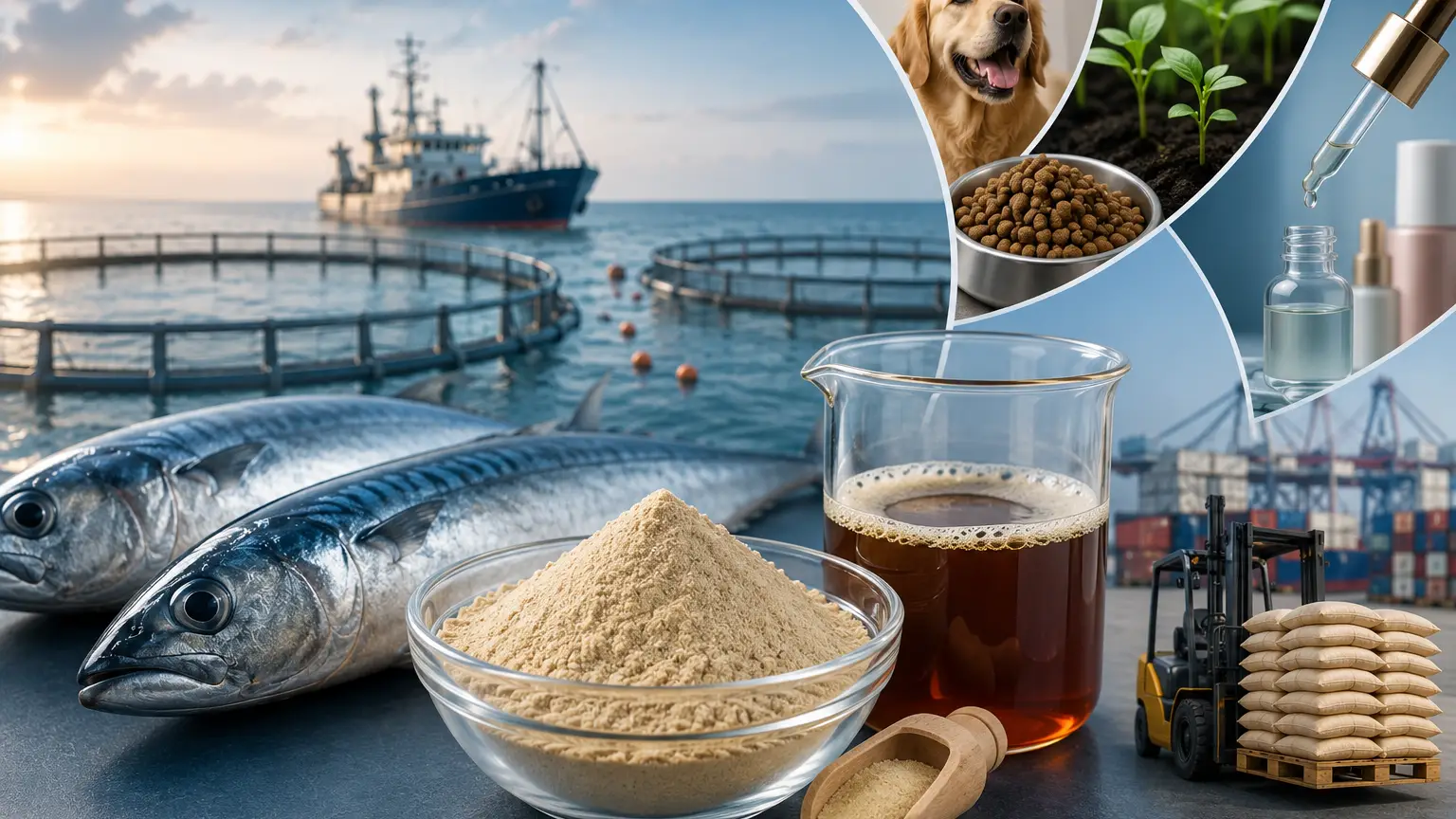
Aquaculture is one of the most commercially relevant application areas for fish-derived feed ingredients. FAO technical material explains that farmed aquatic animals require balanced sources of proteins, amino acids, lipids, vitamins, minerals, energy, and other nutrients, while seafood-processing by-products have historically been recovered into feed ingredients for aquaculture and terrestrial livestock.
Fish Soluble can also be relevant to broader animal nutrition applications. Feedipedia identifies its use in diets for ruminants, pigs, poultry, rabbits, horses, fish, and crustaceans, and describes its association with water-soluble vitamins and other nutritional components. This makes application suitability an important commercial consideration for feed formulators evaluating marine-derived ingredients.
A second application pathway is agriculture, where fish-derived soluble materials can be processed into liquid fertilizer or related nutrient products. Recent scientific literature highlights increasing interest in recovering nutrients from fishery waste and by-products for fertilising products, while research reviews distinguish fish solubles, fish emulsions, hydrolysates, and other fish-derived agricultural inputs according to their processing routes and characteristics.
Because the same broad fish-processing resource stream can serve multiple downstream markets, suppliers and buyers can benefit from understanding application-specific requirements. Feed manufacturers may focus on nutritional consistency and feed suitability, whereas agricultural formulators may place greater emphasis on nutrient composition, processing, stability, and applicable fertilizer regulations.
Key Buyers and Procurement Requirements
Who buys Fish Soluble
The most relevant Fish Soluble buyers include aquafeed manufacturers, livestock-feed producers, feed ingredient distributors, agricultural input manufacturers, fertilizer formulators, and procurement teams sourcing marine-derived ingredients. The breadth of these buyer groups reflects the established use of fish-processing by-products in animal feed and the growing research interest in their recovery for agricultural applications.
For aquaculture buyers, Fish Soluble may be evaluated as part of a broader feed formulation strategy. Procurement teams need to understand the intended species, formulation role, required nutritional characteristics, handling requirements, and compatibility with existing ingredients before comparing supplier offers. FAO guidance emphasizes the importance of ingredient analysis, classification, composition, usage, and contaminant assessment when evaluating feed ingredients.
Agricultural buyers have a different evaluation framework. Scientific reviews of fish and fish-waste fertilizers point to processing method, nutrient availability, product form, and regulatory suitability as important considerations. Recent research also highlights the need to assess parameters such as salinity and potential contaminants when fishery-derived materials are converted into fertilising products.
Supplier comparison is therefore not simply a price exercise. Buyers are typically comparing consistency, technical documentation, traceability, application suitability, packaging and logistics, regulatory support, and the supplier's ability to provide dependable quantities over time. A clear product listing can help procurement teams establish a preliminary technical baseline before entering commercial discussions.
Market and Application Trends
Circular resource utilization and diversified demand
One of the clearest recent trends surrounding Fish Soluble is the broader movement toward valorizing fish-processing by-products. A 2023 review in the Journal of Environmental Management describes fishery waste and by-products as promising feedstocks for nutrient recovery and identifies nutrient recycling and circular bioeconomy principles as important drivers for further development.
This trend is commercially relevant because processors increasingly have incentives to extract value from material streams that were previously treated primarily as waste. USDA research on seafood-processing by-products has documented their conversion into products including meals, oils, solubles, hydrolysates, and silages, demonstrating how processing systems can create multiple revenue-generating ingredient streams from fish resources. Application diversification is another important development. Fish-derived soluble products are being considered not only for feed but also for agricultural fertilizers and related bio-based applications. A recent 2026 study further illustrates continuing research into fish-processing by-product hydrolysates as nutrient-rich agricultural products, indicating that technical development around fish-derived soluble materials remains active. For B2B markets, these trends suggest that Fish Soluble should be viewed through an application and supply-chain lens rather than as a single-use ingredient. Demand can be influenced by aquaculture production, animal-feed formulation, agricultural input development, resource-recovery strategies, and the availability of suitable fish-processing streams.
Fish Soluble Sourcing and Supply Chain Considerations
What procurement teams should evaluate
Fish Soluble sourcing begins with establishing the intended application and required product characteristics. Buyers should request current technical documentation and verify the product's physical form, composition, processing origin, handling requirements, shelf-life expectations, and applicable regulatory status. These checks are particularly important because fish-derived soluble products can differ according to the raw material and processing technology used.
Supply continuity is another important procurement issue. Fish Soluble is connected to fish-processing and fish-oil production streams, meaning availability can depend on upstream processing activity and raw-material flows. USDA documentation describes solubles as products obtained through processing fish by-products, while scientific research emphasizes that the technology and final product characteristics depend substantially on the original material and desired end product.
Logistics also deserve attention because the commercial handling of a soluble fish-derived material differs from that of a conventional dry chemical. Procurement teams should establish suitable packaging, transportation conditions, storage requirements, delivery frequency, and minimum order expectations before finalizing a supply agreement. These factors influence total landed cost and can be as important as the quoted unit price.
Buyers researching supply options can use the Fish Soluble product page as a starting point for product and supplier information. For international procurement, the objective should be to connect the technical requirement with an appropriate supply route, rather than selecting a supplier solely because it offers the lowest initial quotation.
Supplier Evaluation and B2B Purchasing Strategy
Building a reliable supplier shortlist
A practical Fish Soluble supplier evaluation should begin with technical fit. Buyers can compare available specifications against the requirements of their feed or agricultural formulation, then assess whether the supplier can provide consistent documentation and repeatable product quality. FAO feed-ingredient guidance supports the importance of systematic ingredient analysis and classification in feed procurement, making technical verification an essential step before commercial approval.
Traceability becomes particularly important for marine-derived materials because the product's characteristics are connected to its source and processing pathway. Buyers should therefore consider the origin of the material, processing controls, quality documentation, and relevant safety or regulatory information. This approach reduces the risk of comparing nominally similar products that perform differently in downstream applications.
Commercial buyers should also compare suppliers on responsiveness and supply capability. A technically suitable ingredient may not be commercially attractive if lead times are inconsistent, shipment sizes are unsuitable, or documentation cannot be provided efficiently. For distributors and manufacturers, dependable communication can be particularly important when Fish Soluble forms part of a recurring procurement program.
For these reasons, a B2B marketplace can function as more than a product catalogue. By bringing product information, supplier access, application context, and inquiry mechanisms together, a marketplace can shorten the early stages of supplier discovery and help procurement teams move toward a more structured sourcing process.
Commercial Positioning and Sourcing Outlook
Why Fish Soluble matters to B2B buyers
Fish Soluble occupies an interesting position within the marine-derived ingredient value chain because it links fish-processing resource recovery with downstream feed and agricultural applications. Its commercial relevance comes from the ability to transform soluble fractions from fish processing into marketable ingredients, supporting the wider movement toward higher-value utilization of marine by-products. The strongest buyer opportunities are therefore concentrated in sectors where formulation requirements align with fish-derived soluble materials. Aquafeed and animal-feed manufacturers represent established application groups, while fertilizer and agricultural-input manufacturers provide an additional pathway as research and commercial interest in fish-derived nutrient products develops.
For manufacturers, traders, distributors, and procurement teams, reliable sourcing is important because product suitability depends on more than the Fish Soluble name. Application requirements, technical consistency, documentation, supply continuity, logistics, and regulatory considerations all influence the commercial value of a supplier relationship. This is why supplier comparison should combine technical and commercial evaluation rather than focusing exclusively on price.
Buyers looking for product specifications and sourcing opportunities can use the Fish Soluble supplier information page as a commercial starting point. Through a B2B marketplace positioning, Tradeasia / Chemtradeasia / Tradechem Marketplace can serve as an entry point for procurement teams researching marine-derived feed ingredients and agricultural inputs, helping connect application requirements with potential supply options while keeping the sourcing process commercially focused.
Leave a Comment