Global Fish Oil Supply Chain 2026: Sourcing, Processing, Logistics & Demand Dynamics
Introduction: Marine Fish Oil Supply Chain Evolution in 2026
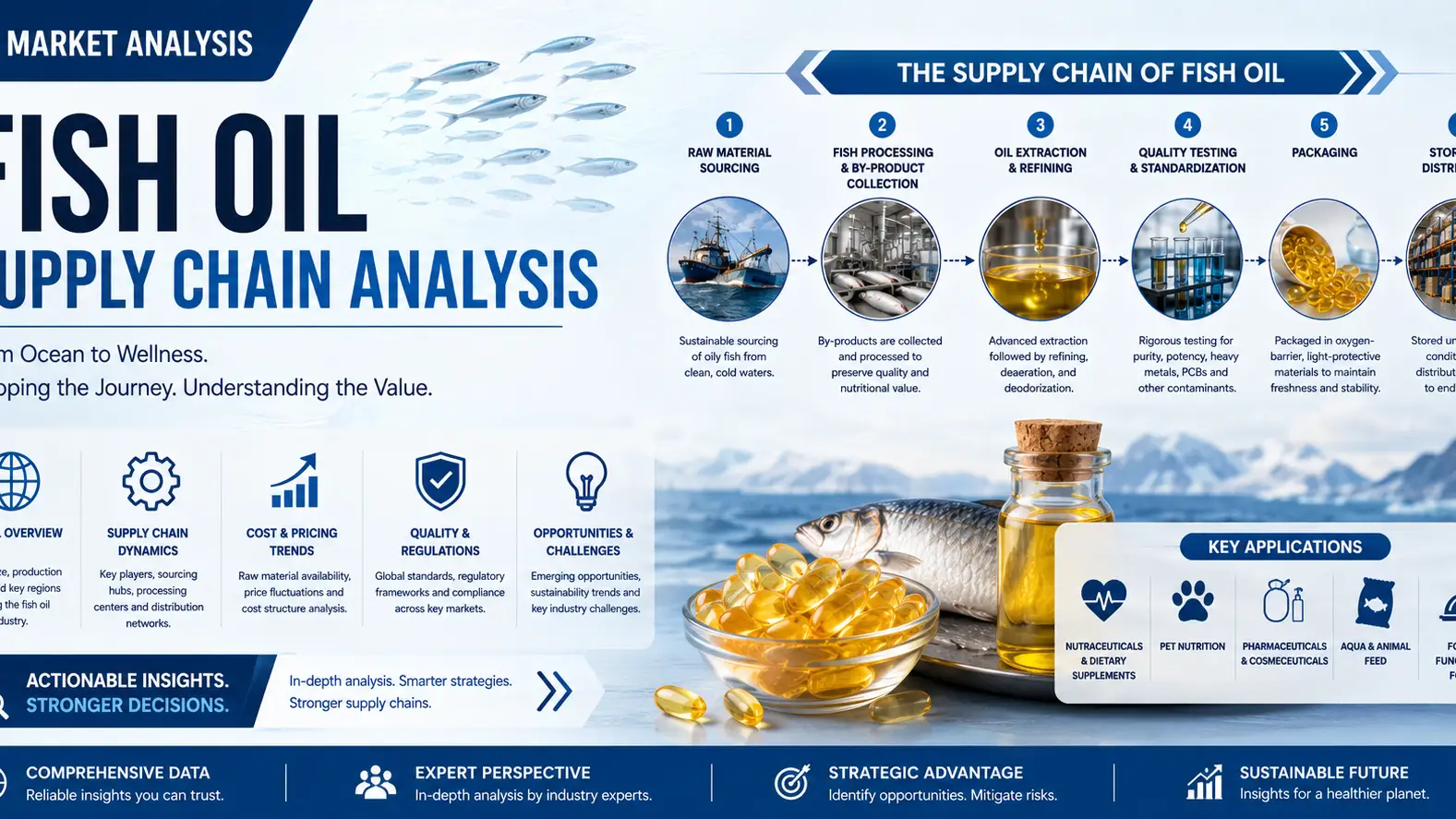
Fish oil has evolved into a critical platform ingredient across aquaculture feed, nutraceuticals, and pharmaceutical applications, driven by its omega-3 concentration and functional lipid properties. As of 2026, the global fish oil market reflects a structurally tight supply environment, with production volumes hovering near 1.1 million MT annually and an estimated CAGR of 6.5% through the decade. Price levels remain elevated at 2,000–3,200 USD/MT, shaped by catch limitations and rising refinement costs. The supply chain is increasingly complex, influenced by regulatory quotas, climate variability, and downstream demand consolidation in high-value sectors.
Sourcing Pressure from Marine Capture Fisheries
The upstream segment of the fish oil supply chain is heavily dependent on reduction fisheries in Peru, Chile, and parts of Northern Europe, where anchovy and menhaden remain dominant feedstocks. In 2026, seasonal disruptions linked to El Niño conditions have tightened raw fish availability, directly constraining output. Global marine capture allocations are increasingly capped, limiting scalability despite rising demand. This structural constraint reinforces fish oil’s position as a price-sensitive commodity, where even marginal supply deficits can trigger sharp price escalations across international trading hubs.
Processing and Refining for High-Value Omega-3 Grades
Downstream transformation is dominated by rendering and molecular distillation facilities that upgrade crude fish oil into high-purity omega-3 concentrates. This segment has become increasingly capital intensive, with compliance requirements for heavy metal removal and oxidation stability adding to operational costs. Refining losses of 15–20% during concentration further tighten effective supply availability. As a result, premium-grade fish oil commands a significant price spread within the broader 2,000–3,200 USD/MT range, particularly for pharmaceutical and infant nutrition applications.
Logistics, Pricing Volatility and Cold Chain Trade Flows
The fish oil trade network is highly globalized, with shipment routes spanning South America, Asia, and Europe. However, logistical sensitivity remains high due to oxidation risks, requiring controlled storage and nitrogen blanketing. Freight fluctuations and port congestion continue to amplify price instability, contributing to intra-year volatility exceeding 18%. The supply chain’s dependence on cold-chain integrity further elevates landed costs, reinforcing fish oil’s status as a strategically managed commodity rather than a standard bulk oil.
Demand Structure and Global Buyer Ecosystem
Demand is increasingly concentrated in aquaculture feed producers, nutraceutical manufacturers, and pharmaceutical formulators. Aquaculture alone accounts for over 65% of global consumption, driven by salmon and shrimp farming expansion. With industry CAGR projected at 6.5%, buyers are increasingly securing long-term contracts to hedge against supply uncertainty. This shift toward forward purchasing is reshaping procurement strategies, reducing spot market liquidity while reinforcing supplier consolidation among integrated processors.
Conclusion
The fish oil supply chain in 2026 reflects a tightly balanced ecosystem where biological constraints, refining intensity, and logistics sensitivity collectively define market outcomes. As demand continues to rise from nutrition and aquaculture sectors, supply-side rigidity is expected to sustain elevated price conditions and strategic sourcing behavior.
In this evolving landscape, businesses seeking consistent access to marine-based oils increasingly rely on integrated trading partners capable of managing sourcing, compliance, and logistics across multiple origins. In this context, Tradeasia International stands as a global solution provider, supporting industrial buyers with streamlined procurement networks and reliable chemical and oil supply chain solutions tailored for volatile commodity environments.
Sources
Leave a Comment