Introduction
The global feather meal market continues to expand in 2026, driven by rising demand for cost-effective, high-protein ingredients in poultry, aquaculture, and pet food formulations. At the same time, regulators are tightening controls on animal by-product processing, cross-border movements, and sustainability disclosures. In Q2 2026, feed manufacturers, traders, and integrators must pay closer attention to trade compliance to avoid delays, rejections, or reputational risk in key importing regions.
Feather meal, produced from processed poultry feathers, is classified as an animal by-product and is therefore subject to stringent sanitary, phytosanitary, and documentation requirements. Authorities in the EU, United States, China, Southeast Asia, and the Middle East increasingly require proof of origin, rendering conditions, pathogen control, and traceability. For buyers using digital sourcing platforms such as chemtradeasia.com, chemtradeasia.in, chemtradeasia.co.id, chemtradeasia.ae, and chemtradeasia.sg, understanding these requirements is essential for efficient procurement.
This article provides a Q2 2026 snapshot of trade compliance updates for feather meal in animal feed markets globally. It outlines current regulatory trends, profiles feather meal as a product, highlights key documentation and certification requirements, and explains how professional sourcing platforms can help feed companies align with evolving standards. The focus is on practical, market-oriented insights to support purchasing, quality, and regulatory teams in managing risk while maintaining supply continuity.
Global Regulatory Landscape for Feather Meal in Q2 2026
By mid-2026, the regulatory environment for feather meal is shaped by three dominant themes: animal health and biosecurity, sustainability and circular economy, and feed and food safety. Feather meal is typically categorized under processed animal proteins (PAPs) or animal by-products not intended for human consumption, falling under frameworks such as the EU Animal By-Products Regulation, US FDA and USDA rules, and various national veterinary and feed laws. Authorities are particularly focused on preventing the spread of avian influenza and other transboundary animal diseases through traded by-products.
In the European Union, the continued implementation of Regulation (EC) No 1069/2009 and related implementing acts means that feather meal imports must come from approved establishments and eligible countries, with documented heat treatment parameters (for example, minimum 133°C at 3 bar for 20 minutes, or equivalent validated processes, depending on the category and national interpretation). The EU is also advancing its Farm to Fork strategy, which indirectly affects feather meal by emphasizing traceability, reduced environmental impact, and responsible use of by-products. Importers must ensure that feather meal is not derived from restricted categories of animal by-products and that cross-contamination with ruminant materials is prevented.
Across Asia, large importing and producing markets such as China, India, Indonesia, Vietnam, and Thailand are updating veterinary import permits and feed registration rules. China’s General Administration of Customs (GACC) continues to refine its registration system for foreign establishments, while India’s Food Safety and Standards Authority (FSSAI) and Department of Animal Husbandry require compliance with domestic feed standards and animal health certifications. In the Middle East, Gulf Cooperation Council (GCC) countries are harmonizing some sanitary requirements and increasingly request Halal-compliant processing declarations for poultry by-products. These diverse regulatory frameworks mean that exporters and buyers must manage a matrix of country-specific rules rather than relying on a single global standard.
Another emerging trend in Q2 2026 is the integration of sustainability and ESG (environmental, social, and governance) considerations into trade and procurement. While feather meal itself is a classic circular-economy product, regulators and large buyers are asking for more transparency on greenhouse gas emissions, waste management, and responsible sourcing of poultry raw materials. Some multinational feed producers now include feather meal suppliers in their sustainability audits, and voluntary schemes such as ISO 22000, FSSC 22000, and ISO 14001 certification are increasingly seen as differentiators when evaluating suppliers for long-term contracts.
Product Profile: Feather Meal as a High-Protein Feed Ingredient
Feather meal is produced by collecting poultry feathers from slaughterhouses, cleaning them, and subjecting them to high-pressure steam hydrolysis followed by drying and grinding. This process breaks down keratin, the main structural protein in feathers, into more digestible peptides and amino acids. Typical crude protein levels range from 75% to 85% on a dry matter basis, with low ash and fat contents depending on the process. When properly processed, feather meal offers a highly concentrated source of protein and sulfur-containing amino acids such as cystine, which is valuable in poultry and aquaculture formulations.
However, the nutritional value of feather meal is highly dependent on processing conditions. Under-processed feathers can result in poor digestibility, while over-processing can damage amino acids and reduce bioavailability. Many buyers now request digestibility data (e.g., pepsin digestibility or in vivo digestibility trials) and standardized ileal digestible (SID) amino acid profiles. Quality-focused suppliers working with platforms like chemtradeasia.com often provide technical data sheets, typical specifications, and sometimes third-party laboratory analyses covering parameters such as crude protein, moisture, fat, ash, digestibility, microbiological counts, and particle size distribution.
In terms of applications, feather meal is commonly used as a partial replacement for other animal proteins (such as meat and bone meal or fish meal) and, in some cases, as a supplement to plant proteins like soybean meal. In broiler and layer diets, inclusion rates are typically kept moderate (often 2–5%) to balance amino acid profiles and maintain palatability. In aquaculture, hydrolyzed feather meal can be used in certain carnivorous fish and shrimp feeds, provided that digestibility and palatability are validated. Pet food manufacturers sometimes use feather meal-derived hydrolysates for specialized formulations, but they generally require higher levels of traceability, pathogen control, and sensory quality. These varied use cases mean that buyers must align product specifications with both nutritional and regulatory expectations in their target markets.
Trade & Documentation Requirements for Feather Meal Shipments
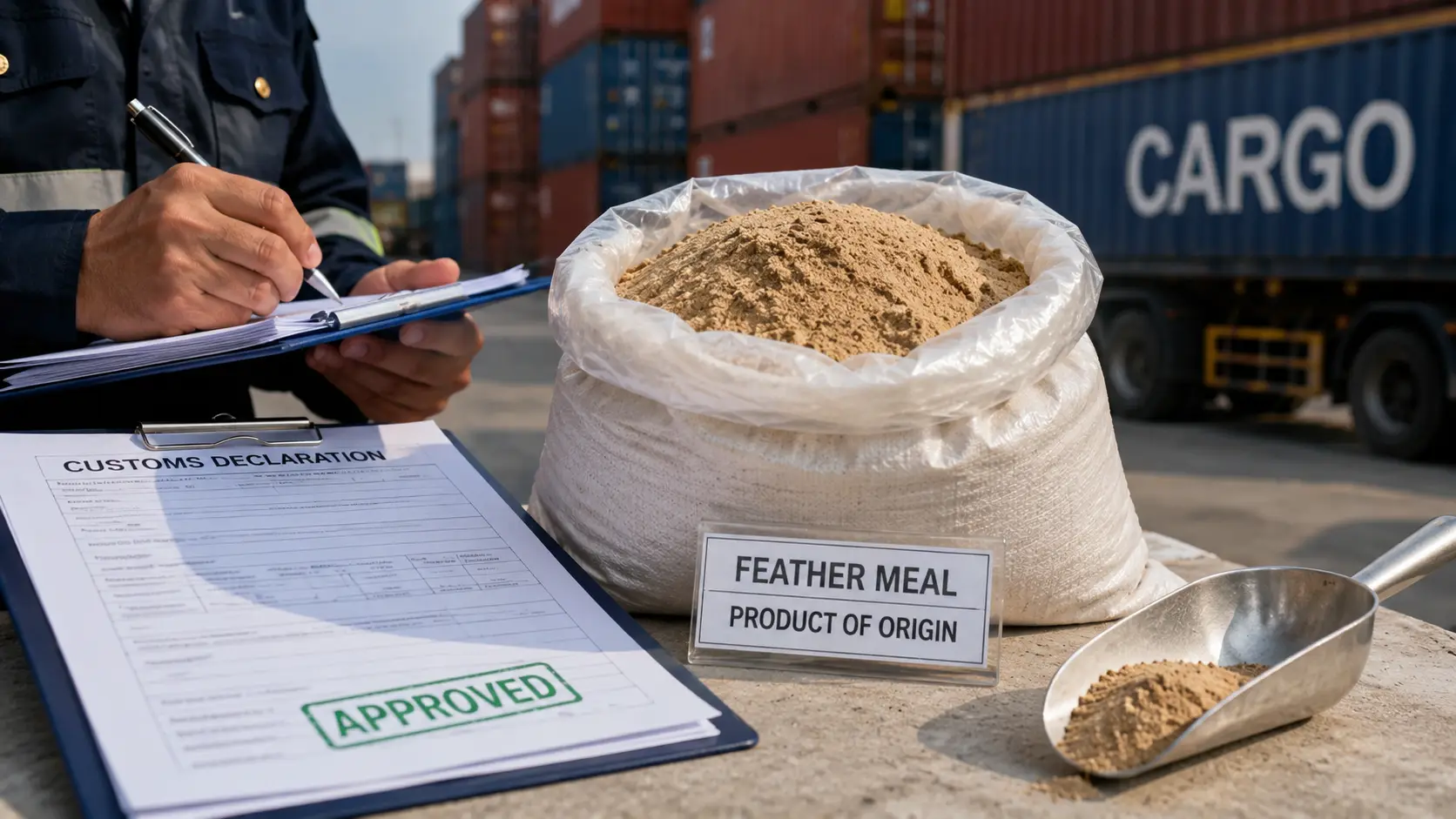
Feather meal trade is governed by a combination of sanitary and phytosanitary (SPS) measures, customs rules, and feed/food safety legislation. For most cross-border shipments, the critical documents include a commercial invoice, packing list, bill of lading or airway bill, certificate of origin, and, crucially, a veterinary or sanitary certificate issued by the competent authority in the exporting country. This certificate typically attests that the feather meal is derived from healthy poultry slaughtered in approved facilities, processed under approved conditions, and free from specific diseases of concern.
Importing countries may require additional documents such as heat treatment certificates, processing flow charts, HACCP plans, or veterinary health attestations that reference specific bilateral agreements or model certificates. For example, the EU requires that consignments be accompanied by an official health certificate and that they enter through designated Border Control Posts (BCPs), where documentary, identity, and physical checks may be conducted. Some Asian markets require pre-shipment inspection or sampling for microbiological parameters (e.g., Salmonella, E. coli) and chemical contaminants (e.g., heavy metals, mycotoxins if cross-contamination is possible). Failure to meet these documentation or testing requirements can result in shipment detention, re-export, or destruction.
In Q2 2026, digitalization of trade documents is accelerating. Many customs and veterinary authorities now accept or require electronic pre-notifications and digital certificates via single-window systems. Buyers using portals such as chemtradeasia.in, chemtradeasia.co.id, or chemtradeasia.sg increasingly integrate order data with customs brokers and logistics providers to streamline compliance. Nevertheless, discrepancies between physical documents and electronic submissions remain a common source of delays. Careful coordination between exporters, importers, freight forwarders, and competent authorities is essential, especially when shipping to markets with strict SPS controls or when using transshipment routes that may trigger additional inspections.
Compliance Strategies for Buyers Using chemtradeasia.com and Regional Portals
For feed manufacturers and traders sourcing feather meal through platforms like chemtradeasia.com and its regional sites (chemtradeasia.in, chemtradeasia.co.id, chemtradeasia.ae, chemtradeasia.sg), a structured compliance strategy is essential. The first element is supplier qualification. Buyers should prioritize suppliers that operate approved rendering plants, maintain documented HACCP or ISO 22000 systems, and have experience exporting to the intended destination markets. Requesting up-to-date facility approvals, audit reports, and product specifications through the platform can significantly reduce the risk of non-compliance.
The second element is product and documentation alignment. Before confirming orders, buyers should verify that the feather meal specifications (protein, moisture, processing method, microbiological standards) match both formulation needs and regulatory thresholds in the destination country. Early engagement with the platform’s support team can help ensure that veterinary certificates, certificates of origin, and any special declarations (e.g., non-ruminant origin, Halal status, absence of restricted substances) are prepared according to the latest import requirements. Regional portals like chemtradeasia.ae or chemtradeasia.sg can provide localized insights into GCC or ASEAN import practices, helping buyers anticipate potential bottlenecks.
The third element is ongoing monitoring and risk management. Regulations for animal by-products can change quickly in response to disease outbreaks or policy shifts. Buyers should monitor official notifications from veterinary authorities, WTO SPS Committee updates, and trade advisories, and they should review each new shipment’s documents for consistency. Working with a platform that maintains a network of vetted suppliers and logistics partners can provide additional resilience: if one origin country faces a temporary export restriction due to avian influenza, for example, alternative compliant sources can be identified more quickly. In Q2 2026, buyers who integrate compliance considerations into their digital sourcing workflows are better positioned to secure continuous, legally compliant supplies of feather meal at competitive prices.
Conclusion
As the global animal feed industry seeks to balance cost efficiency, nutritional performance, and sustainability, feather meal remains an important component of many formulations. However, its status as an animal by-product means that it is subject to rigorous and evolving regulatory controls. In Q2 2026, trade compliance for feather meal is shaped by heightened disease-prevention measures, more demanding documentation requirements, and growing expectations around traceability and environmental performance. Companies that proactively manage these factors can reduce the risk of shipment delays, rejections, or reputational damage while maintaining access to a versatile protein source.
Digital sourcing platforms such as chemtradeasia.com, together with regional sites like chemtradeasia.in, chemtradeasia.co.id, chemtradeasia.ae, and chemtradeasia.sg, offer structured ways to connect with qualified feather meal suppliers, standardize documentation, and respond quickly to regulatory changes across multiple markets. By combining robust supplier qualification, clear product specifications, and vigilant monitoring of import requirements, feed manufacturers and traders can turn compliance from a reactive obligation into a strategic advantage. In a market where regulators, customers, and end consumers increasingly demand assurance about the safety and sustainability of animal-derived ingredients, disciplined trade compliance is a key enabler of long-term growth.
This article is provided solely for informational and market insight purposes and does not constitute technical, safety, legal, or other professional advice. Readers should independently verify all requirements with qualified experts, consult official regulations and documentation such as MSDS/SDS and veterinary guidelines, and, where appropriate, contact their advisors or our team for guidance on specific products, processes, or applications.
Leave a Comment