Introduction
By Q2 2026, the global corn starch market is increasingly shaped by regulatory expectations originating from the United States Food and Drug Administration (FDA) and mirrored by authorities worldwide. Corn starch, with a market size that surpassed USD 25 billion in the mid‑2020s and projected CAGR of around 5–6%, is no longer just a commodity; it is a regulated functional ingredient used in foods, pharmaceuticals, personal care, and industrial applications. As a result, compliance with food safety, labeling, contaminant limits, and quality standards has become a decisive factor for trade flows and supplier selection.
FDA-related compliance trends are particularly influential because many importing countries align their own rules with FDA standards or recognize them as a benchmark for safety and quality. This affects exporters and importers dealing in native and modified corn starch, including those sourcing through platforms such as chemtradeasia.com, chemtradeasia.in, chemtradeasia.co.id, chemtradeasia.ae, and chemtradeasia.sg. Understanding these trends is critical for maintaining market access, avoiding shipment delays, and protecting brand reputation.
This article examines how FDA-related developments in Q2 2026 influence global corn starch trade, with a focus on product specifications, documentation, and risk management. It also outlines how structured sourcing from professional suppliers helps buyers remain compliant while leveraging corn starch’s functional and economic benefits across multiple industries.
FDA-Related Regulatory Landscape for Corn Starch in Q2 2026
In Q2 2026, FDA oversight of corn starch is framed primarily through regulations on food additives, Generally Recognized As Safe (GRAS) substances, current Good Manufacturing Practice (cGMP), and labeling requirements under the Food Safety Modernization Act (FSMA). Corn starch as a food ingredient is traditionally considered safe when produced in line with cGMP and purity criteria. However, the FDA’s evolving focus on allergen management, contaminants such as mycotoxins and heavy metals, and supply chain transparency has increased the compliance burden on starch processors and traders.
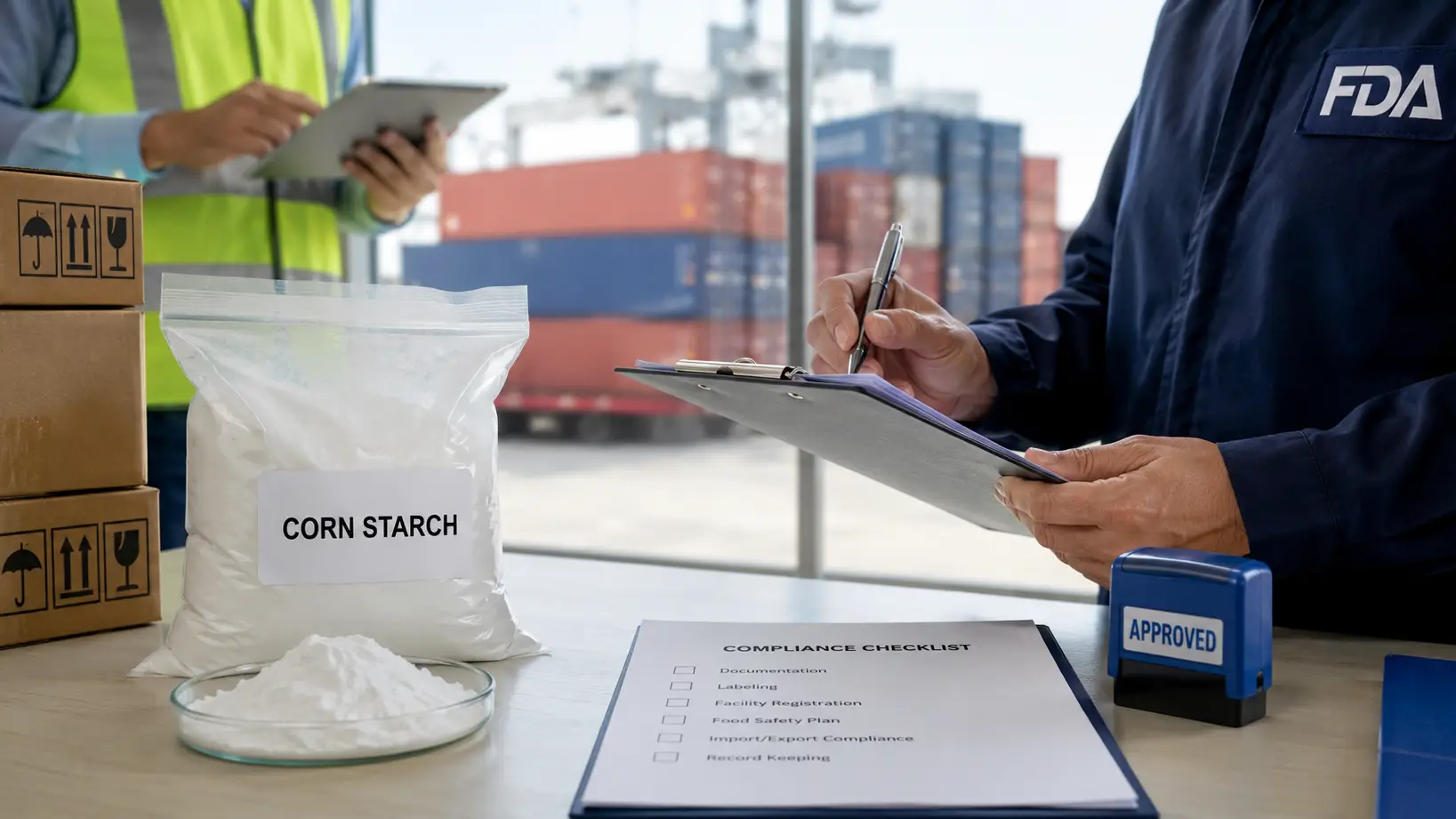
FSMA’s preventive controls and foreign supplier verification provisions have a direct impact on overseas producers exporting to the U.S. market. Importers must now document hazard analyses, supplier verification activities, and corrective actions, even for relatively low-risk ingredients like corn starch. This has led to greater demand for full traceability, detailed Certificates of Analysis (CoA), and supporting documents such as HACCP plans, ISO 22000 or FSSC 22000 certifications, and, where applicable, non-GMO or allergen statements.
Another notable trend by Q2 2026 is increased regulatory attention on labeling and claims. Corn starch used in “clean label” or “natural” products is scrutinized for the type of modification, processing aids, and residual solvents. While the FDA does not formally define “clean label,” enforcement around misleading claims has become more active. As a result, suppliers must clearly distinguish between native corn starch, physically modified starches, and chemically modified starches, ensuring that technical data sheets and marketing descriptions align with regulatory expectations.
Impact of Compliance Trends on Global Corn Starch Trade Flows
Compliance trends driven by FDA and mirrored by other regulators are reshaping trade flows in the corn starch sector. Buyers in North America and Europe increasingly prefer suppliers capable of meeting stringent documentation and audit requirements. This has favored integrated producers and organized trading platforms that can consolidate and standardize compliance information. Exporters who cannot provide robust documentation face higher risk of shipment holds, port inspections, and rejection, which can translate into higher costs or loss of market share.
From a logistics standpoint, the need for pre‑shipment verification and detailed records has lengthened lead times in some trade lanes. Importers now routinely request digital access to CoAs, microbiological test reports, and allergen declarations before confirming orders. In addition, more buyers are conducting remote or hybrid audits of starch mills and warehouses, especially in major producing regions such as China, India, Indonesia, and parts of Eastern Europe. This has pushed many suppliers to upgrade quality systems and invest in laboratory testing capabilities to remain competitive.
On the pricing side, compliant corn starch with strong traceability and recognized certifications often commands a premium, particularly in segments like infant nutrition, pharmaceuticals, and high-end personal care. At the same time, regulatory-driven consolidation is gradually reducing the presence of small, unorganized producers in export markets. Platforms such as chemtradeasia.com and its regional portals (chemtradeasia.in, chemtradeasia.co.id, chemtradeasia.ae, chemtradeasia.sg) play a role in aggregating compliant suppliers, enabling buyers to source at scale while maintaining regulatory alignment.
Product Focus: Corn Starch Grades from chemtradeasia.com and Regional Portals
Professional sourcing platforms have responded to the evolving FDA-related environment by categorizing corn starch offerings according to grade, application, and compliance profile. Through chemtradeasia.com and its regional sites, buyers can typically access a portfolio that includes food-grade native corn starch, industrial-grade corn starch, and various modified starches tailored to specific functional needs. Each grade is supported by technical documentation designed to assist with regulatory due diligence.
Food-grade corn starch supplied via chemtradeasia.in, chemtradeasia.co.id, and chemtradeasia.sg is generally produced under HACCP-based quality systems and aligned with Codex and FDA purity requirements. Specifications often include moisture content, pH range, ash content, particle size, and microbial limits such as total plate count, yeast and mold, and absence of pathogens like Salmonella and E. coli. For customers targeting sensitive applications, suppliers can also provide gluten statements, allergen declarations, non-GMO documentation (where relevant), and information on compliance with halal or kosher standards.
In addition to native starch, modified corn starches are available to address performance requirements such as improved freeze-thaw stability, higher viscosity, controlled swelling, or better film-forming properties. These can include cross-linked, oxidized, or acetylated starches, each with distinct regulatory classifications. Because the FDA and other agencies differentiate between types of modifications, the product information shared through chemtradeasia.ae and other portals typically includes the modification type, reference standards, and permissible use levels in different applications. This level of detail helps buyers evaluate whether a particular starch fits their intended use and labeling strategy.
Benefits and Applications of Compliant Corn Starch in Key Industries
In the food and beverage sector, compliant corn starch is valued for its thickening, texturizing, and stabilizing properties. It is used in sauces, soups, bakery fillings, confectionery, meat products, and dairy analogues. FDA-aligned compliance ensures that these applications meet expectations related to safety and purity, which is critical in markets where consumers are increasingly sensitive to ingredient quality. Food processors sourcing through platforms like chemtradeasia.com gain access to consistent quality, backed by CoAs and technical data that support FSMA documentation and internal quality audits.
Pharmaceutical and nutraceutical manufacturers rely on high-purity corn starch as a disintegrant and filler in tablets and capsules. Here, compliance goes beyond food regulations to include pharmacopeial standards (such as USP or EP) and Good Manufacturing Practice (GMP) requirements. While FDA’s Center for Drug Evaluation and Research (CDER) sets specific expectations for excipients, many buyers use FDA food-grade benchmarks as a baseline. Suppliers available through chemtradeasia.sg and other portals often provide pharmaceutical- or excipient-grade starches with low bioburden, controlled heavy metal content, and detailed impurity profiles.
In non-food sectors—such as paper and packaging, textiles, adhesives, and biodegradable materials—corn starch offers performance and sustainability advantages. Even though these applications may not fall squarely under FDA food rules, customers increasingly prefer materials that could meet food-contact or indirect-contact standards, especially for packaging and disposable items. Compliant corn starch grades can thus support brand positioning around safety and environmental responsibility, while also meeting regional regulations that reference FDA or EU food-contact frameworks.
Digitalization, Documentation, and Supplier Selection Strategies
As regulatory expectations grow more complex, digitalization has become a central tool for managing compliance in corn starch trade. Buyers now expect quick access to digital CoAs, Safety Data Sheets (SDS), product specifications, and audit reports. Platforms such as chemtradeasia.com, chemtradeasia.in, and chemtradeasia.co.id facilitate this by centralizing documentation and enabling faster pre‑shipment verification. This reduces the risk of customs delays related to incomplete paperwork and supports internal quality and regulatory teams in maintaining up‑to‑date records.
Effective supplier selection in Q2 2026 requires evaluating not only price and capacity, but also regulatory readiness. Key criteria include adherence to cGMP or food safety standards, traceability of raw materials, responsiveness to documentation requests, and willingness to undergo audits. Suppliers accessible via chemtradeasia.ae and chemtradeasia.sg often highlight certifications such as ISO 9001, ISO 22000, FSSC 22000, and regional approvals, which can streamline qualification processes for multinational buyers. Robust change-control procedures and clear communication channels further reduce the risk of non‑compliance when formulations or regulations change.
Another emerging strategy is the use of data analytics to monitor quality trends across multiple shipments and suppliers. By tracking parameters such as moisture, viscosity, microbial counts, and foreign matter over time, buyers can identify early signs of process drift or contamination risk. When integrated with procurement platforms, this data supports risk-based supplier segmentation, allowing companies to focus audits and technical resources on higher‑risk sources while maintaining confidence in proven partners.
Conclusion
FDA-related compliance trends in Q2 2026 are reshaping the global corn starch trade by raising expectations around safety, traceability, and documentation. While corn starch remains a relatively low‑risk ingredient, the regulatory environment now demands that suppliers and traders demonstrate systematic control over hazards, consistent quality, and transparent labeling. For buyers, this means that regulatory alignment is no longer optional; it is a prerequisite for reliable market access and brand protection.
At the same time, these trends create opportunities for organized suppliers and platforms that can deliver compliant, well‑documented corn starch across multiple regions. Through portals like chemtradeasia.com, chemtradeasia.in, chemtradeasia.co.id, chemtradeasia.ae, and chemtradeasia.sg, buyers can access a diverse portfolio of native and modified corn starches supported by technical data and quality certifications. This enables manufacturers in food, pharmaceuticals, personal care, and industrial sectors to leverage the functional benefits of corn starch while remaining aligned with evolving FDA‑related requirements.
This article is intended solely for informational and market insight purposes and does not constitute technical, safety, regulatory, or other professional advice. Readers should independently verify all information with qualified experts, consult official documentation such as MSDS/SDS and applicable regulations, and contact their suppliers or our team for guidance on specific products, applications, and compliance obligations.
Leave a Comment