Distillers Dried Grains with Solubles: Global Sourcing & Buyer Insights
Global Overview of Distillers Dried Grains with Solubles Market
Distillers dried grains with solubles (DDGS) are a widely traded co-product of the ethanol production process, primarily used as a high-protein animal feed ingredient. As global demand for sustainable feed inputs increases, DDGS has become a strategic commodity in agricultural trade networks. According to the Food and Agriculture Organization (FAO), byproduct feed ingredients like DDGS are gaining importance due to rising pressure on conventional feed crops and cost optimization needs in livestock production.
Growth in Feed Ingredient Substitution
The increasing volatility in corn and soybean meal prices has pushed feed manufacturers to incorporate DDGS into feed formulations. This shift is particularly strong in poultry, swine, and cattle industries where cost efficiency is critical. The United States Grains Council reports that DDGS usage has expanded globally due to its competitive pricing and consistent nutrient profile.
Role in Sustainable Agriculture Systems
DDGS also supports circular economy principles by converting ethanol production residues into valuable feed resources. This reduces agricultural waste while improving resource efficiency across biofuel and livestock sectors. Industry analysts from OECD-FAO Agricultural Outlook highlight DDGS as a key contributor to sustainable protein sourcing.
The global DDGS market continues to expand as feed manufacturers seek scalable and cost-effective alternatives to traditional protein sources.
Production and Ethanol Industry Supply Chain
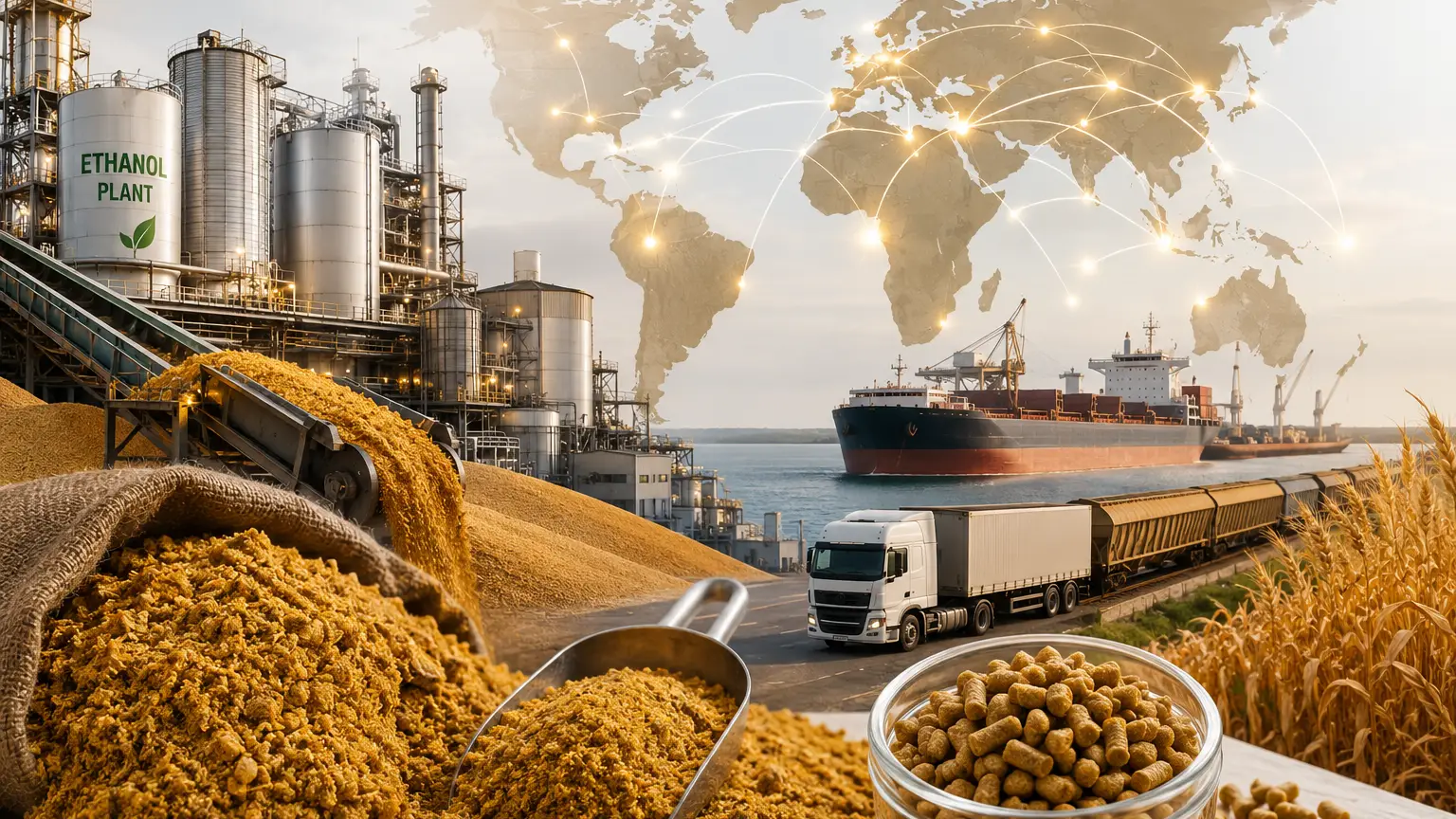
DDGS is produced during dry-milling ethanol production, where corn or other grains are fermented to produce ethanol and the remaining solids are processed into feed. The Renewable Fuels Association notes that ethanol production capacity directly influences DDGS availability in global markets.
Integration with Biofuel Manufacturing
Ethanol plants operate as dual-output facilities, producing both fuel and feed. This integration creates a stable supply of DDGS, making it a reliable commodity for feed manufacturers and traders. Supply consistency is a key advantage compared to other agricultural byproducts.
Logistics and Export Supply Chains
DDGS is commonly exported in bulk via containerized shipping or breakbulk cargo, depending on destination demand. Major exporting countries such as the United States and Brazil maintain strong logistics networks to support global distribution.
Supply chain efficiency plays a critical role in maintaining DDGS competitiveness in international feed markets.
Nutritional Profile and Feed Formulation Applications
DDGS is valued for its protein, fiber, and energy content, making it suitable for multiple livestock applications. According to research published by the Journal of Animal Science, DDGS can effectively replace portions of corn and soybean meal in balanced feed formulations.
Poultry and Swine Feed Applications
In poultry and swine diets, DDGS is used to improve protein intake while reducing feed costs. However, formulation must consider amino acid balance and digestibility factors to maintain optimal growth performance.
Ruminant and Dairy Nutrition Benefits
For cattle and dairy production, DDGS serves as an energy-rich feed ingredient that supports milk yield and weight gain. Its high fiber content also aids rumen function, making it a preferred ingredient in ruminant nutrition systems.
The versatility of DDGS ensures its continued demand across multiple livestock production sectors.
Key Buyer Segments in the DDGS Market
The DDGS market is driven by a diverse range of industrial buyers, each with distinct procurement requirements. Feed manufacturers, livestock producers, and commodity traders form the core demand base.
Feed Manufacturing Companies
Feed mills are the primary consumers of DDGS, integrating it into compound feed formulations. These buyers prioritize consistency in protein content, moisture levels, and supply reliability.
Commodity Traders and Distributors
Traders play a key role in global DDGS distribution, bridging ethanol producers and end users. They focus on arbitrage opportunities across regional markets and shipping cost optimization.
DDGS procurement decisions are heavily influenced by price competitiveness and logistical efficiency.
Regional Demand and Global Trade Dynamics
Global DDGS trade is shaped by production capacity in North America and demand growth in Asia and Europe. The U.S. Department of Agriculture (USDA) reports that the United States remains the largest exporter of DDGS globally.
Asia-Pacific Feed Market Expansion
Countries such as China, Vietnam, and Indonesia have increased DDGS imports due to rapid growth in livestock and aquaculture industries. Feed cost optimization remains a key driver in these regions.
European Regulatory and Feed Standards
In Europe, DDGS usage is influenced by strict feed safety regulations and quality standards. Despite regulatory complexity, demand remains stable due to its cost-effectiveness in feed formulation.
Regional trade dynamics continue to evolve as feed demand expands globally.
Procurement and Sourcing Strategy for B2B Buyers
Procurement teams evaluate DDGS suppliers based on quality consistency, supply stability, and pricing structures. Risk management is essential due to fluctuations in grain and ethanol markets.
Quality Specifications and Supplier Evaluation
Buyers typically assess protein content, fiber levels, and moisture stability before sourcing DDGS. Certifications and quality assurance systems are critical in supplier selection.
Long-Term Contracting and Price Stability
Many industrial buyers prefer long-term contracts with suppliers to mitigate price volatility risks. Strategic sourcing ensures consistent feed production and cost control.
Effective procurement strategies enhance supply chain resilience in feed manufacturing operations.
Buyer Intent and Decision-Making Factors
Buyers of DDGS are primarily driven by cost efficiency, nutritional value, and supply reliability. Livestock producers seek alternatives to expensive protein sources while maintaining animal performance standards.
Procurement teams in feed companies evaluate multiple suppliers to ensure consistency in quality, logistics, and pricing. Risk assessment, including seasonal availability and global trade conditions, is a key part of decision-making.
Ultimately, DDGS purchasing decisions reflect a balance between nutritional performance and economic efficiency in industrial feed production.
Sources
https://www.ers.usda.gov/amber-waves/2019/october/dried-distillers-grains-ddgs-have-emerged-as-a-key-ethanol-coproduct/
https://www.sciencedirect.com/science/article/pii/S2666154321000971

Leave a Comment