Global Market Outlook for Dextrose Monohydrate
Demand Drivers in Food and Pharmaceutical Industries
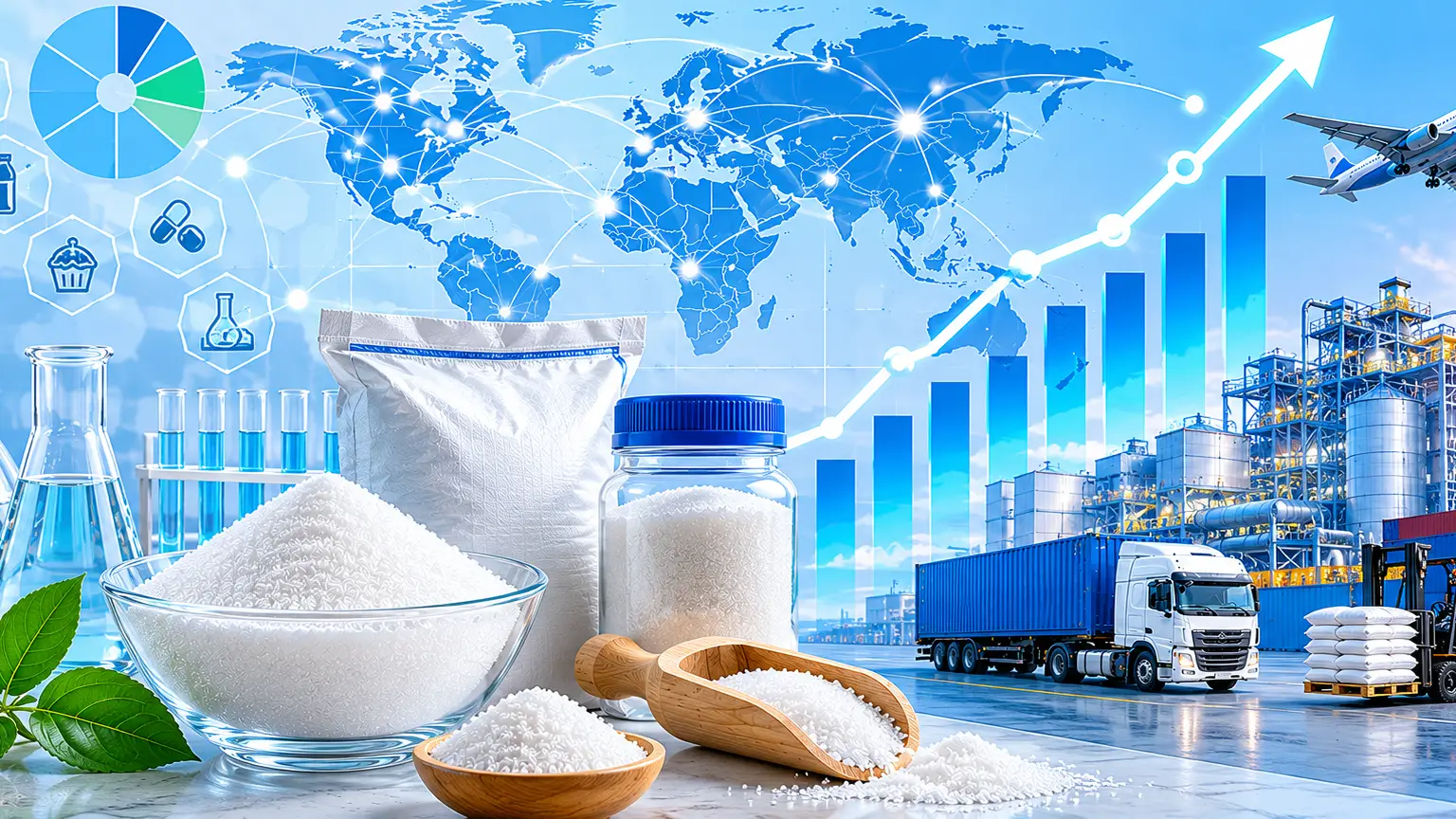
The global demand for dextrose monohydrate is closely tied to its role as a fundamental carbohydrate source across multiple industrial sectors. According to the Food and Agriculture Organization (FAO), glucose-based sweeteners continue to expand in consumption due to processed food growth and pharmaceutical formulation needs. This positions dextrose monohydrate as a stable commodity chemical in global trade.
Industrial buyers increasingly view dextrose monohydrate as a strategic raw material rather than a simple sweetener. Its versatility across energy supply, formulation stability, and fermentation efficiency drives consistent procurement across food, pharma, and biotech sectors.
Market analysis from pharmaceutical excipient studies highlights steady growth in glucose-based excipients due to rising demand for injectable and oral formulations. This reinforces its importance in healthcare supply chains globally.
As industrial consumption diversifies, dextrose monohydrate continues to gain relevance in both emerging and developed markets, particularly in Asia-Pacific and the Middle East.
Food and Beverage Industry Applications
Functional Sweetener and Processing Ingredient
In the food and beverage sector, dextrose monohydrate is widely used as a sweetener, bulking agent, and fermentation enhancer. Based on FAO food additive classifications, glucose derivatives are commonly applied in bakery, confectionery, and processed food manufacturing.
Its high solubility and rapid absorption make it a preferred ingredient in sports drinks and instant energy formulations. Food manufacturers rely on its consistent sweetness profile and process stability in large-scale production.
Dextrose also plays a functional role in browning reactions during baking, improving texture and flavor development in baked goods. This makes it valuable for industrial bakeries and packaged food producers.
The growing demand for convenience foods globally continues to drive procurement of food-grade dextrose monohydrate across manufacturing supply chains.
Pharmaceutical and Healthcare Utilization
Excipient and Medical Solution Applications
Pharmaceutical-grade dextrose monohydrate is extensively used as an excipient and active ingredient in intravenous (IV) solutions. According to the U.S. Food and Drug Administration (FDA), dextrose solutions are essential in clinical hydration and energy restoration therapies.
It is commonly included in oral rehydration salts and injectable formulations where rapid glucose delivery is required. Its medical stability and compatibility make it a critical pharmaceutical raw material.
Pharmaceutical manufacturers also use dextrose as a filler and stabilizer in tablet and capsule formulations. This ensures consistency in dosage and improves drug delivery performance.
With global healthcare demand increasing, pharmaceutical procurement teams prioritize high-purity dextrose monohydrate to ensure compliance and patient safety.
Fermentation and Biotechnology Demand Drivers
Carbon Source for Industrial Fermentation
Dextrose monohydrate plays a central role in fermentation industries as a primary carbon source. According to biotechnology research published in industrial microbiology studies, glucose is the preferred substrate for microbial fermentation processes.
It is widely used in the production of ethanol, citric acid, lactic acid, and antibiotics. Its rapid metabolization by microorganisms improves production efficiency in large-scale bioreactors.
Biotechnology companies rely on consistent-grade dextrose to maintain yield stability and process optimization. Variations in purity can significantly affect fermentation outcomes.
As bio-based manufacturing expands, demand for fermentation-grade dextrose monohydrate continues to grow across industrial biotech sectors.
Animal Nutrition and Feed Industry Applications
Energy Source in Livestock Nutrition
In animal feed formulations, dextrose monohydrate serves as a fast-digesting energy source for livestock. According to animal nutrition studies from agricultural research institutions, glucose-based energy supplements support metabolic efficiency in feed formulations.
It is commonly used in poultry, swine, and aquaculture feed to enhance energy intake and improve growth performance. Feed manufacturers incorporate it into premixes and specialty feed products.
Dextrose also improves feed palatability, encouraging better consumption rates in young or high-performance animals. This makes it a valuable additive in intensive farming systems.
Growing global protein demand continues to support steady use of dextrose monohydrate in animal nutrition supply chains.
B2B Sourcing and Procurement Considerations
Quality, Specifications, and Supplier Reliability
For B2B buyers, sourcing dextrose monohydrate involves evaluating purity levels, moisture content, particle size, and compliance with food or pharmaceutical standards. According to international chemical trade guidelines, specification consistency is critical for industrial applications.
Procurement teams in food, pharma, and biotech industries prioritize suppliers with reliable logistics, certification compliance, and stable bulk supply capacity. This ensures uninterrupted production cycles.
Trade reliability is also a key factor, especially in regions with high import dependency such as the Middle East. Buyers often evaluate multiple suppliers before finalizing contracts.
Digital chemical marketplaces like Tradeasia/Chemtradeasia provide structured sourcing channels that support transparent procurement decisions for global buyers.
Sources:
Leave a Comment