Understanding Deoiled Rice Bran in the B2B Market
What Is Deoiled Rice Bran?
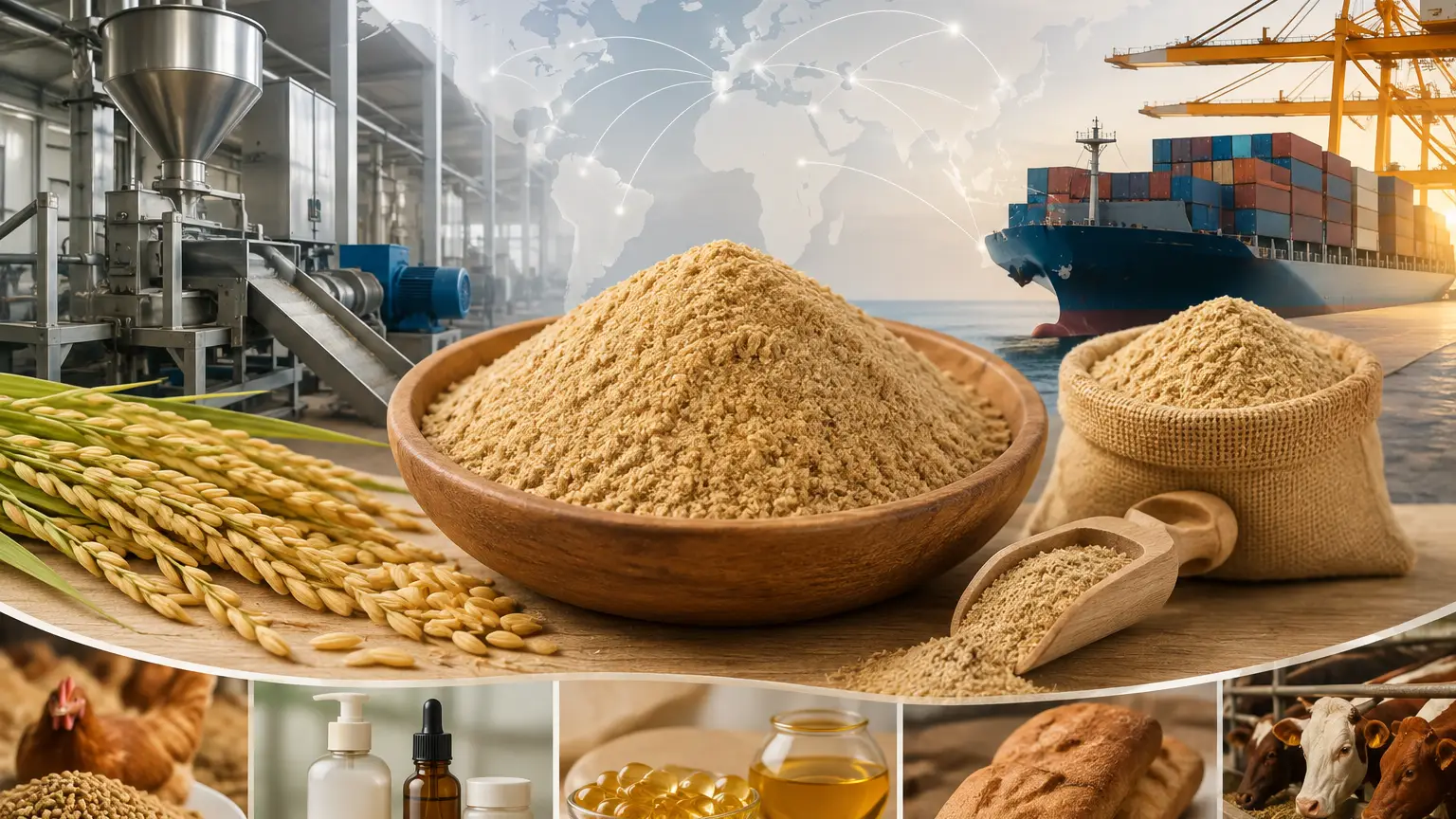
Deoiled Rice Bran, commonly referred to as DORB, is a rice-processing by-product produced after oil is extracted from rice bran. The supplied product is described as a brown powder and is positioned within the by-products and energy-source categories. The product information also identifies cattle feed, poultry feed, fish feed, and certain industrial uses as relevant applications, making DORB primarily a functional agro-industrial material rather than a conventional specialty chemical.
The production route is commercially significant because rice bran is generated during rice milling and contains oil that can be recovered before the remaining bran is directed toward downstream applications. FAO technical information explains that extracted rice bran has historically been favored by feed millers because removal of oil improves keeping quality compared with unextracted rice bran, which can be more susceptible to rancidity.
From a B2B perspective, DORB therefore sits at the intersection of rice milling, rice bran oil extraction, animal nutrition, and agricultural commodity trading. Its commercial value is influenced not only by nutritional characteristics but also by the availability of rice-processing feedstock, extraction capacity, processing consistency, packaging, logistics, and the specifications required by downstream users.
For procurement teams, the relevant question is consequently not simply whether Deoiled Rice Bran is available, but whether a supplier can provide material that consistently fits the buyer's formulation, handling, quality, documentation, and delivery requirements. Buyers can review available product information through the Deoiled Rice Bran product page before moving toward quotation, sampling, supplier qualification, or contract discussions.
Industrial Applications of Deoiled Rice Bran
Animal Feed Applications
Animal nutrition remains the most established commercial application for Deoiled Rice Bran. The product information specifically identifies cattle feed, poultry feed, and fish feed as major uses, while FAO technical references have long recognized rice bran and extracted rice bran as feed resources. The material can therefore participate in formulated feed systems where nutritionists balance energy, protein, fiber, minerals, and other ingredients according to species and production objectives.
For cattle and other livestock applications, DORB can be considered as one component within a broader feed formulation rather than as a universal replacement for another ingredient. Its suitability depends on the nutritional requirements of the animal, the composition of the complete ration, inclusion levels, processing characteristics, and the specifications of the supplied material.
Poultry and aquaculture represent additional important application areas because industrial feed producers continuously evaluate agricultural by-products as part of cost and formulation management. FAO documentation notes the established use of rice-derived feed materials in poultry and aquaculture systems, while recent scientific literature continues to examine rice bran and defatted rice bran as resources for animal nutrition and broader biomass valorization.
Beyond established feed uses, research is also examining ways to extract additional value from de-oiled rice bran. A 2025 scientific publication on rice-bran valorization describes defatted rice bran as a source of proteins, carbohydrates, dietary fiber, and other compounds, while research has also investigated its potential for bioenergy and other bio-based applications. These emerging uses remain more specialized than feed, but they illustrate the broader industrial potential of the material.
Market Demand and Emerging Application Trends
Demand From Expanding Animal Production
Demand for feed ingredients is structurally connected to developments in livestock and aquaculture production. The OECD-FAO Agricultural Outlook 2025–2034 projects continued growth in animal-source food consumption, particularly in low- and middle-income economies, with global feed consumption expected to increase as animal production becomes more commercialized and intensive. This provides a favorable structural environment for evaluating cost-efficient agricultural by-products such as DORB.
The strongest opportunity is not necessarily tied to a single country or animal species. Instead, DORB demand can follow the expansion of poultry, cattle, pig, and aquaculture production in regions where feed manufacturers are actively optimizing raw-material costs. Asia is particularly relevant because the region combines substantial rice-processing activity with large and growing livestock and feed markets.
A second trend is the increasing commercial emphasis on resource efficiency. Rice bran is already generated as part of rice milling, while oil extraction creates another downstream material that can be directed toward feed and other applications. Recent research frames this process as agricultural by-product valorization, with increasing attention on extracting useful nutritional and functional components from materials that might otherwise have lower-value uses.
For traders and distributors, these developments create an opportunity to position Deoiled Rice Bran around supply-chain efficiency rather than simply product availability. Buyers increasingly need predictable access to feed inputs, while suppliers can create greater commercial value through consistent specifications, appropriate packaging, reliable documentation, and dependable cross-border logistics.
Buyer Intent and Procurement Priorities
Who Buys Deoiled Rice Bran?
The principal buyer groups are compound feed manufacturers, livestock-feed producers, poultry integrators, aquaculture-feed manufacturers, agricultural commodity distributors, and traders supplying feed-industry customers. Procurement teams at these organizations generally evaluate DORB as a formulation input, meaning purchasing decisions depend on technical suitability as well as commercial factors such as price, origin, availability, minimum order quantity, packaging, and delivery terms.
Buyer intent typically becomes stronger when a company searches for terms such as “Deoiled Rice Bran supplier,” “Deoiled Rice Bran for animal feed,” “buy Deoiled Rice Bran,” or “DORB feed ingredient.” These searches indicate movement beyond general product research toward supplier identification, specification comparison, quotation requests, sample evaluation, and potential purchase planning.
Procurement teams also compare suppliers because agricultural by-products can be affected by upstream variability. FAO material notes that rice-bran quality can vary and that processing and composition influence its usefulness in feed applications. Consequently, buyers may need to evaluate analytical specifications, physical form, moisture, fiber, protein, fat, ash, contaminants, microbiological parameters, packaging, storage conditions, and supporting technical documentation before approval.
The Deoiled Rice Bran sourcing page can support this evaluation by giving prospective buyers a direct point of reference for the available product and inquiry process. For B2B marketplaces, this type of product-level destination is commercially important because it connects market-intelligence content with the next procurement step without requiring the buyer to restart the search elsewhere.
Deoiled Rice Bran Sourcing and Supply Chain Considerations
Origin and Supply Availability
The Deoiled Rice Bran supply chain begins with rice production and milling, followed by recovery of rice bran and subsequent oil extraction. This makes availability closely connected to rice-processing volumes and the capacity of oil-extraction facilities. FAO describes rice bran as an important rice-milling by-product, while recent scientific research continues to emphasize the scale and underutilized potential of rice-bran-derived biomass.
For international buyers, this upstream connection means sourcing strategy should consider more than a quoted price per tonne. Origin, processing route, production continuity, seasonality, available export volumes, inland transportation, port access, freight costs, and destination-market requirements can all influence the final landed economics of DORB.
Quality consistency is another critical supply-chain variable. Because DORB originates from an agricultural processing stream, buyers should establish clear product specifications and acceptance criteria before contracting. Supplier qualification can include review of technical documents, representative samples, analytical testing, packaging standards, batch consistency, storage conditions, and the supplier's ability to maintain agreed specifications over repeated shipments.
Logistics also influence the practicality of international DORB procurement. The material must be handled and stored appropriately to preserve its commercial quality, while packaging and shipment configuration need to match the buyer's warehouse and feed-production infrastructure. For distributors and traders, dependable logistics can therefore become a differentiating factor when several suppliers offer broadly comparable material.
Commercial Opportunities for Suppliers and Buyers
Opportunities Across the B2B Marketplace
The commercial relevance of Deoiled Rice Bran comes from its position within several interconnected value chains. Rice millers and oil-extraction facilities generate the material, feed manufacturers create downstream demand, distributors facilitate regional availability, and international traders connect production centers with markets where feed ingredients are required. This creates opportunities for participants throughout the supply chain rather than only for manufacturers.
For suppliers, the strongest commercial positioning is based on transparency and consistency. Buyers need to understand what material is being offered, where it originates, how it is processed, which applications it is suitable for, how it is packaged, and what documentation is available. Clear technical information reduces uncertainty during supplier qualification and can shorten the path from initial discovery to commercial inquiry.
For procurement teams, marketplace sourcing can help broaden the supplier pool while keeping attention on technical and commercial comparability. Instead of selecting an ingredient solely on headline price, buyers can compare specification fit, supply reliability, origin, packaging, logistics capabilities, documentation, and responsiveness. This approach is particularly relevant when DORB is being incorporated into recurring industrial feed procurement programs.
A B2B marketplace such as Tradeasia can therefore serve as a connection point between product discovery and commercial sourcing. Through a dedicated Deoiled Rice Bran supplier information page, prospective buyers can progress from understanding the ingredient to evaluating supply options and initiating an inquiry, while suppliers and distributors can use structured product positioning to reach more relevant industrial buyers.
Conclusion: Building a Reliable Deoiled Rice Bran Supply Strategy
From Rice By-Product to Commercial Feed Input
Deoiled Rice Bran has an established role as a rice-processing by-product used in cattle, poultry, and fish feed, while scientific research is expanding understanding of its potential for broader biomass and value-added applications. Its commercial importance is closely linked to the economics of rice milling and oil extraction, making supply availability fundamentally connected to the wider agricultural value chain.
Market fundamentals also support continued attention to efficient feed ingredients. The OECD-FAO Agricultural Outlook 2025–2034 anticipates increasing animal-source food production and higher feed demand, particularly in emerging economies. This does not guarantee a uniform growth rate for DORB, but it reinforces the need for feed manufacturers to evaluate a broad portfolio of agricultural inputs as they manage formulation economics and supply resilience.
For buyers, the most effective Deoiled Rice Bran sourcing strategy is therefore based on technical qualification, supplier comparison, supply continuity, and logistics planning. Procurement teams should connect the product's specifications with the intended application and assess whether the supplier can repeatedly meet commercial requirements rather than relying on a single shipment or a generic product description.
For suppliers, distributors, and traders, the opportunity lies in making the DORB supply chain easier to understand and easier to transact. A clear product profile, credible technical information, responsive sourcing support, and reliable logistics can help convert market interest into qualified B2B demand. Buyers evaluating supply options can return to the Deoiled Rice Bran product page as a starting point for supplier information and commercial inquiry.
Sources
- Food and Agriculture Organization of the United Nations (FAO) — technical information on rice bran and extracted rice bran as feed resources, including applications and quality considerations. FAO — Rice Bran and Feed Ingredient Information
- OECD-FAO Agricultural Outlook 2025–2034 — current agricultural, livestock, aquaculture, feed-demand, and international trade outlook. OECD-FAO Agricultural Outlook 2025–2034
- ScienceDirect / Sustainable Management of Agro-Food Waste (2025) — scientific review of rice-bran valorization, including proteins, carbohydrates, oil, bioactive compounds, and defatted rice bran applications. Rice Bran Valorization: Use as a Source of Proteins, Carbohydrates, Oil and Bioactive Compounds
Leave a Comment