Understanding Deoiled Rice Bran and Its Commercial Position
What Deoiled Rice Bran Is
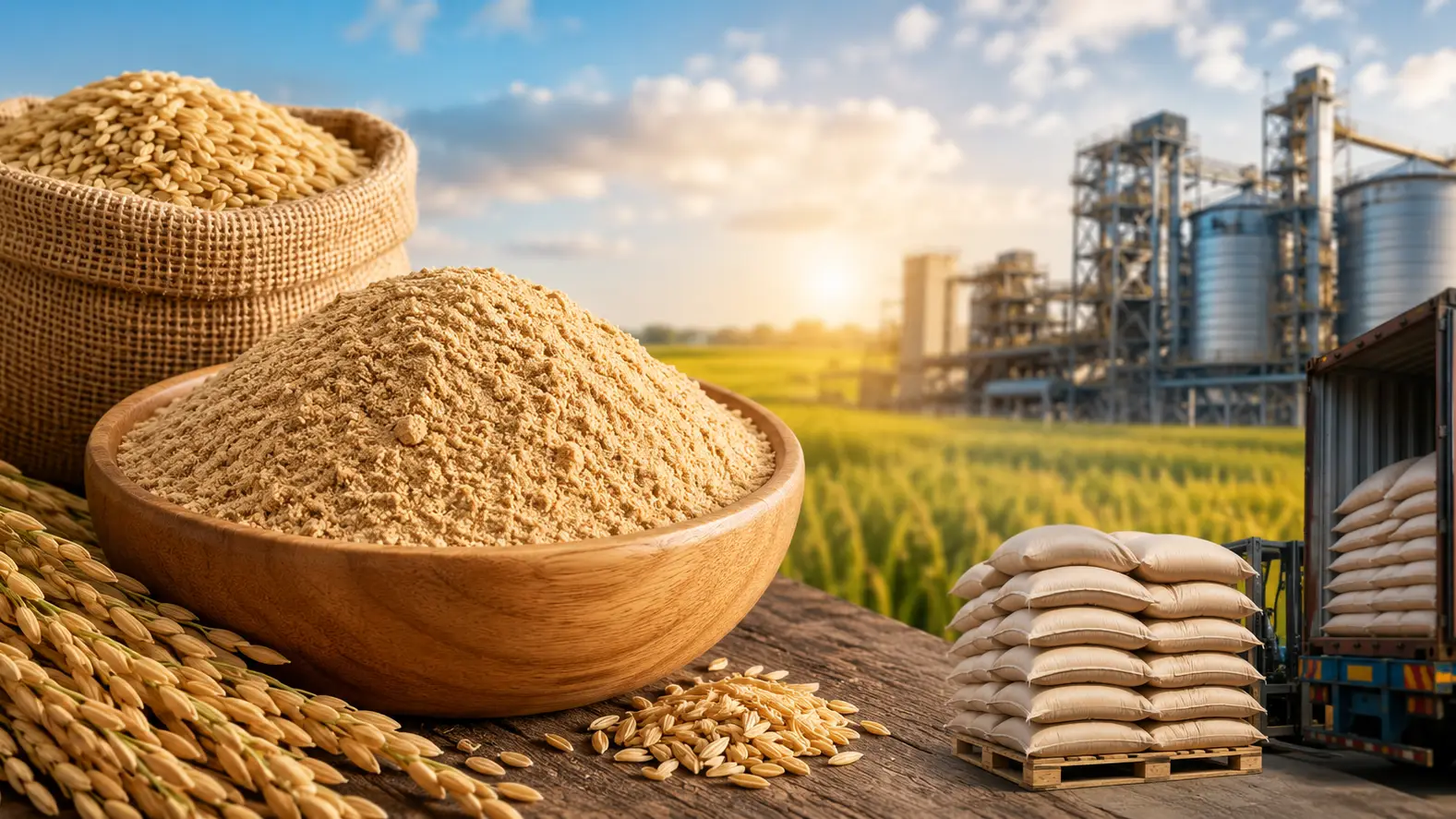
Deoiled Rice Bran, commonly abbreviated as DORB, is a rice-processing by-product produced after oil is extracted from rice bran. The product page identifies it as a solid, light-brown powder with a characteristic grain odor and describes its origin as India. It is also listed under the synonyms “deoiled rice bran” and “solvent-extracted rice bran,” reflecting the processing route used to reduce the oil content of conventional rice bran.
The commercial importance of DORB comes from its positioning as a feed-grade agricultural by-product rather than simply a residual material. The listed specification includes 13–15% minimum crude protein, maximum 1% crude fat, maximum 12% crude fiber and maximum 13% ash, with moisture below 12%. These parameters make specification control particularly relevant when feed manufacturers are assessing DORB as one component of a formulated ration.
Why Oil Extraction Matters
Oil extraction changes the physical and storage characteristics of rice bran. FAO technical material explains that untreated rice bran has a comparatively high oil content and can be susceptible to oxidation and rancidity, while extracted rice bran can be preferred by feed millers because of improved keeping quality. This distinction helps explain why Deoiled Rice Bran has a distinct commercial role within the wider rice-bran ingredient category.
Recent scientific research also supports the broader valorisation of de-oiled rice-bran meals. A 2023 study published in Food Chemistry Advances reported that de-oiled rice-bran meal contains nutritional constituents including protein, carbohydrates, dietary fibre and minerals, while also investigating antioxidant and prebiotic characteristics. For B2B buyers, this reinforces the importance of viewing DORB as a functional feed-material input whose commercial value depends on consistent specifications, application suitability and reliable supply.
Deoiled Rice Bran Applications Across Feed Industries
Cattle and Livestock Feed
The principal application identified for the product is animal feed, with cattle feed specifically highlighted on the product page. DORB can form part of formulated livestock rations where nutritionists balance protein, fibre, energy and other ingredients according to animal species and production stage. Its role is therefore best understood as a formulation ingredient rather than a universal substitute for every other feed material.
Research has demonstrated the practical relevance of DORB in ruminant diets. One study on adult ewes investigated replacement of maize with de-oiled rice bran and found that DORB could replace maize at substantial levels within the tested concentrate formulation without adverse effects on several measured performance parameters. Such findings indicate why livestock-feed manufacturers may evaluate DORB when designing cost-conscious formulations around locally available agricultural by-products.
Poultry and Aquaculture Feed
Poultry is another important application identified by the product information. FAO technical guidance likewise identifies rice bran and solvent-extracted rice by-products among materials used in poultry feed manufacturing. For poultry-feed producers, the commercial question is not simply whether DORB can be used, but how its nutritional profile fits into a complete formulation alongside grains, protein meals, minerals, vitamins and additives.
Aquaculture represents another significant application. Scientific research on Labeo rohita has examined DORB-based diets and found that dietary protein and lipid levels interact with DORB inclusion to affect growth and feed utilisation. Importantly, this research also demonstrates that inclusion rates need to be formulation-specific rather than treated as universally applicable recommendations.
Market Demand and Emerging Application Trends
Growth in Animal-Source Food Production
The market outlook for feed ingredients is closely linked to livestock, poultry and aquaculture production. The OECD-FAO Agricultural Outlook 2025–2034 projects increasing production and consumption of animal-source foods as incomes rise in middle-income economies. The same outlook identifies emerging economies as important contributors to future agricultural demand, creating a broader structural requirement for efficient feed production.
For DORB suppliers, this does not necessarily mean that demand for the individual ingredient will rise at a fixed rate. Instead, it indicates a broader market environment in which feed manufacturers will continue evaluating agricultural by-products and alternative feed materials. FAO documentation has long recognised rice bran as an agro-industrial by-product used in livestock and poultry feeding, illustrating the established role of rice-derived materials within feed-resource systems.
Feed Efficiency and By-product Utilisation
Another relevant trend is the greater commercial attention given to agricultural by-product utilisation. The 2023 Food Chemistry Advances study describes de-oiled rice-bran meal as a material with nutritional constituents that can be valorised for animal and fish feeding. This supports a wider circular-economy direction in which food and oil-processing streams can generate additional value through controlled use in feed applications.
At the same time, feed manufacturers are increasingly required to balance ingredient economics against technical consistency. The OECD-FAO outlook notes that feed use is expected to remain an important component of global cereal utilisation, while growth in animal-source food consumption creates additional pressure on agricultural productivity and supply chains. Consequently, DORB's commercial opportunity depends not only on availability, but also on predictable quality, documentation and logistics.
Who Buys Deoiled Rice Bran and What They Evaluate
Key B2B Buyer Groups
Typical buyers include compound-feed manufacturers, cattle-feed producers, poultry-feed manufacturers, aquaculture-feed companies, livestock nutrition businesses, ingredient distributors and agricultural commodity traders. These buyers generally purchase DORB as an input for formulated feed rather than as a finished consumer product. The product's stated applications in cattle, poultry and fish feed make these groups particularly relevant to a B2B sourcing strategy.
Procurement teams may also include importers, regional distributors and feed-ingredient wholesalers that require bulk quantities for onward distribution. For these buyers, supply continuity can be as important as the nominal product specification because formulation operations depend on predictable ingredient availability. FAO's work on feed resources also highlights the role of agricultural by-products in supporting feed supply systems and reducing dependence on limited conventional resources.
Procurement Specifications and Supplier Comparison
Before buying, procurement teams are likely to evaluate parameters such as crude protein, crude fat, crude fibre, ash, moisture and microbiological quality. The current product specification lists moisture below 12%, crude protein at 13–15%, crude fat at no more than 1%, crude fibre at no more than 12%, and ash at no more than 13%. It also lists total plate count, yeast and mould, E. coli, Salmonella, aflatoxin B1 and heavy-metal compliance parameters.
Supplier comparison can therefore extend beyond price per tonne. Buyers may assess packaging, shelf life, storage conditions, available certifications, technical documentation, country of origin, shipment scale and consistency between batches. The listed product is available in 50 kg or bulk formats, has a stated six-month shelf life, and is described as requiring cool, dry and pest-free storage, all of which are commercially relevant when planning international procurement.
Sourcing and Supplier Considerations for B2B Buyers
Evaluating Product Quality
A sound Deoiled Rice Bran sourcing process begins with matching the specification to the intended feed formulation. Protein, fat, fibre, ash and moisture should be reviewed alongside microbiological and contaminant parameters because the ingredient's contribution to a finished feed depends on the characteristics of the specific batch. The product listing provides a useful starting specification, including feed-grade status and stated compliance for heavy metals and dioxins/PCBs.
Buyers should also distinguish between technical specifications and application claims. Research on DORB in aquaculture shows that inclusion levels and nutritional outcomes depend on the overall dietary formulation, while higher inclusion levels can produce different physiological responses in fish. This makes technical consultation and formulation-specific assessment more appropriate than assuming one inclusion rate applies to all species or feed products.
Logistics, Documentation and Supply Reliability
For international buyers, commercial sourcing also requires attention to packaging, shipping configuration, shelf life and storage. The product listing specifies PP woven bags or bulk packaging and recommends cool, dry and pest-free storage. It also states that ISO/HACCP credentials are available and that Halal and Kosher certification can be provided on request, which may be relevant for buyers operating under specific customer or market requirements.
Buyers evaluating a Deoiled Rice Bran sourcing page can use the product information as an initial commercial screening point before requesting pricing, technical documents, customisation details and shipping information. This type of product-level information helps procurement teams move from general market research toward a qualified supplier discussion, particularly when bulk purchasing and recurring supply are involved.
Commercial Opportunities for Deoiled Rice Bran Suppliers
Demand Across Multiple Feed Segments
DORB has commercial relevance because one product can serve multiple feed-market segments, including cattle, poultry and aquaculture. This creates opportunities for manufacturers, traders and distributors to address different buyer groups rather than depending on a single end-use market. FAO sources similarly document rice-derived by-products as established feed resources across livestock and aquaculture applications.
For suppliers, application diversity can also influence market positioning. A supplier serving cattle-feed manufacturers may emphasise consistency and nutritional parameters, while an aquaculture buyer may place greater emphasis on formulation performance and species-specific suitability. The strongest B2B positioning therefore connects the product specification with the buyer's actual technical and procurement requirements rather than relying on generic claims about feed value.
Marketplace Positioning and Buyer Conversion
A B2B marketplace can shorten the distance between product discovery and commercial enquiry by presenting product specifications, packaging information, origin, certifications and technical documentation in one location. For DORB, this is particularly relevant because procurement decisions involve both nutritional suitability and supply-chain considerations. A structured product page can help buyers determine whether the material merits further qualification before requesting commercial terms.
For Tradeasia, Chemtradeasia and Tradechem Marketplace, the commercial opportunity lies in positioning DORB as a clearly specified feed ingredient for professional buyers rather than as an undifferentiated agricultural by-product. A marketplace approach can support manufacturers, distributors and procurement teams by connecting application requirements with supplier information, while transparent specifications help reduce uncertainty during supplier comparison. This supports a more qualified B2B lead-generation process without overstating product performance.
Conclusion: Building a Reliable Deoiled Rice Bran Supply Strategy
What Buyers Should Take Away
Deoiled Rice Bran occupies a practical position within the feed-ingredient market because it combines an established rice-processing origin with applications across livestock, poultry and aquaculture. The product specifications available for the listed Indian-origin material show a feed-grade ingredient with defined nutritional, microbiological and contaminant parameters, giving procurement teams a concrete basis for initial supplier evaluation.
Market conditions also support continued attention to efficient feed-ingredient sourcing. OECD-FAO projections indicate that growth in animal-source food consumption and production will continue to shape agricultural and feed markets, particularly in emerging economies. Within that broader environment, agricultural by-products such as DORB can remain commercially relevant when their quality, economics and application suitability align with feed-manufacturing requirements.
From Market Research to Procurement
The next step for a potential buyer is to compare the DORB specification against the requirements of the intended feed formulation, then assess documentation, packaging, logistics, certification requirements and commercial supply capability. Scientific studies demonstrate that DORB performance can vary with formulation and species, making technical evaluation an important part of responsible procurement.
For manufacturers, distributors and procurement teams seeking bulk Deoiled Rice Bran for industrial applications, the Deoiled Rice Bran supplier information provides a direct starting point for reviewing specifications and initiating a commercial enquiry. In a B2B marketplace environment, combining verified product information with application knowledge and supplier communication can help buyers make more informed sourcing decisions and build a dependable feed-ingredient supply strategy.
Sources
- OECD-FAO Agricultural Outlook 2025–2034 — authoritative market outlook covering agricultural, cereal and animal-source food trends. OECD-FAO Agricultural Outlook 2025–2034
- Food Chemistry Advances (2023): Discerning the proximate composition, anti-oxidative and prebiotic properties of de-oiled meals: Mustard and Rice-bran — peer-reviewed research supporting nutritional and valorisation context for de-oiled rice bran. Food Chemistry Advances — De-oiled Rice Bran Study
- Aquaculture: Feeding de-oiled rice bran (DORB) to Rohu, Labeo rohita — peer-reviewed research examining DORB inclusion, dietary formulation and feed utilisation in aquaculture. Aquaculture — DORB Feeding Study
Leave a Comment