What Is Deoiled Rice Bran and Why Does It Matter Commercially?
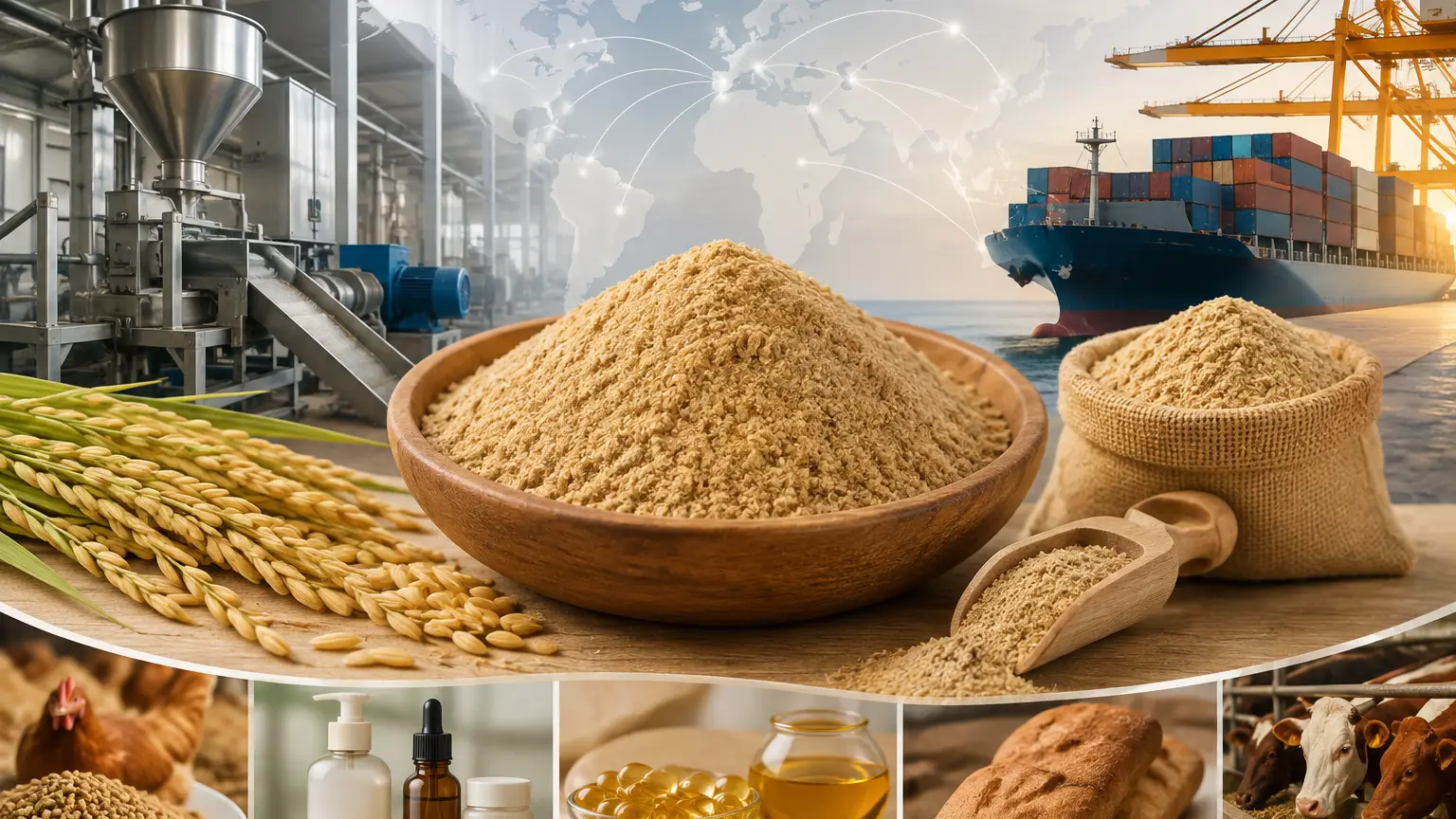
Deoiled Rice Bran is the rice-bran fraction remaining after oil extraction. It is therefore a secondary product of rice-bran oil processing rather than simply untreated rice bran. Scientific literature identifies defatted rice bran as a material containing useful nutritional components including protein, starch, non-starch polysaccharides, dietary fibre, γ-oryzanol and polyphenols. This composition gives the material relevance beyond the original oil-extraction process and creates opportunities for downstream utilization.
From rice milling to an industrial feed ingredient
Rice bran originates from rice milling, while Deoiled Rice Bran is produced after the oil-bearing fraction has been extracted. The distinction is commercially important because removing much of the oil changes the material's composition, storage characteristics and potential role in formulations. FAO technical information notes that oil-extracted rice bran is almost devoid of oil and has been favored by feed mills partly because of its longer shelf life than fresh rice bran.
Why deoiling creates additional value
The commercial significance of Deoiled Rice Bran is linked to the broader principle of agricultural by-product valorization. Rather than treating rice-bran residues as a low-value waste stream, processors can direct the defatted material toward feed and other applications. A 2025 scientific review describes rice bran as an underutilized agro-industrial resource and identifies defatted rice bran as a principal by-product after oil extraction, with animal feed remaining one of its major uses.
For B2B procurement teams, this makes Deoiled Rice Bran more than a commodity description. Buyers are typically evaluating a feed or industrial raw material whose usefulness depends on its composition, processing history, consistency, logistics and suitability for a particular formulation. Understanding the distinction between conventional rice bran and Deoiled Rice Bran is therefore the first step toward effective Deoiled Rice Bran sourcing and supplier comparison.
Key Industrial Applications of Deoiled Rice Bran
The strongest established application for Deoiled Rice Bran is animal nutrition. Its post-extraction composition makes it relevant to feed manufacturers seeking plant-derived raw materials for formulated diets, while its fibre characteristics also influence how it should be incorporated into specific feed systems. FAO material identifies oil-extracted rice bran as a feed-mill ingredient and notes its use in compound fish feeds.
Animal feed and livestock nutrition
Deoiled Rice Bran can serve as a component of formulated animal feed where its nutritional profile fits the target species and overall ration. The material can contribute protein, fibre and other nutritional components, although formulation decisions must account for its lower energy contribution compared with oil-containing rice bran. For commercial buyers, the relevant question is therefore not simply whether Deoiled Rice Bran can be used in feed, but whether its specification fits the nutritional and processing requirements of the intended formulation.
Aquaculture and fish feed
Aquaculture represents another important application area. FAO feed information documents the use of rice-bran materials in compound fish feeds and provides composition data for deoiled rice bran, illustrating its relevance to aquaculture feed formulation. At the same time, FAO notes that the fibre and water-absorption characteristics of deoiled rice bran can affect feed performance, making formulation and processing considerations particularly important for aquatic diets.
Beyond established feed uses, research is also investigating higher-value routes for defatted rice bran. Scientific literature has examined the material as a feedstock for anaerobic digestion and other bio-based processes, while reviews discuss potential pathways involving biofuels and integrated valorization. These emerging uses are commercially relevant as potential future demand channels, although they should be distinguished from established feed applications when assessing current purchasing requirements.
Market Demand and Emerging Application Trends
Demand for Deoiled Rice Bran is closely connected to two industrial systems: rice processing and rice-bran oil extraction. As rice bran moves through oil extraction, the resulting defatted material becomes available for downstream applications. This creates a supply relationship in which demand for rice-bran oil can also influence the availability of Deoiled Rice Bran. Research on rice-bran oil highlights the continuing development of extraction, stabilization and industrial applications, reinforcing the importance of the wider rice-bran value chain.
Valorization is shaping application development
One of the most relevant trends is the movement from simple by-product disposal toward systematic valorization. Recent scientific literature describes rice bran as a source of proteins, carbohydrates, oil, dietary fibre and bioactive compounds, while defatted rice bran is being studied for broader utilization. This trend supports commercial interest in finding dependable outlets for the material and in developing supply relationships between processors and downstream industries.
Feed remains the core commercial opportunity
Despite research into new applications, animal feed remains a central commercial route for Deoiled Rice Bran. This is important for buyers because established demand is generally easier to translate into recurring procurement than experimental applications. Feed mills, aquaculture producers and livestock nutrition businesses can evaluate the material according to formulation economics, nutritional specifications, physical characteristics and supply reliability.
At the same time, emerging bio-based applications may create additional opportunities for manufacturers and traders capable of supplying consistent material at suitable specifications. Research has investigated de-oiled rice bran for renewable biomethane and other biofuel pathways, demonstrating that the material can have value beyond conventional feed markets. For B2B suppliers, this creates a broader commercial positioning opportunity without requiring speculative claims about future demand.
Who Buys Deoiled Rice Bran?
The most relevant Deoiled Rice Bran buyers are businesses that formulate, manufacture, distribute or trade feed and related raw materials. Feed mills are a primary buyer group because they can incorporate rice-derived ingredients into formulated diets. Aquaculture feed manufacturers are also relevant, particularly where rice-bran ingredients are compatible with the nutritional and physical requirements of the target species. FAO technical material supports the role of oil-extracted rice bran in feed manufacturing and compound fish feeds.
Feed manufacturers and aquaculture producers
Feed manufacturers typically assess an ingredient as part of a broader formulation rather than purchasing it in isolation. Their requirements can therefore include nutritional composition, fibre levels, moisture, physical form, consistency and compatibility with milling, pelleting or extrusion processes. Aquaculture buyers may apply additional scrutiny because ingredient characteristics can affect pellet stability and water interactions.
Traders, distributors and procurement teams
Traders and distributors represent another important buyer group because they connect rice-processing supply with regional feed and industrial demand. Their purchasing decisions often place greater emphasis on dependable volume, documentation, packaging, logistics and supplier responsiveness. Procurement teams may compare several Deoiled Rice Bran suppliers because apparently similar materials can differ in processing method, composition, physical characteristics and commercial terms.
For businesses evaluating potential suppliers, a dedicated Deoiled Rice Bran supplier information page can function as an initial sourcing reference. The value of a product page is not limited to product discovery; it can help buyers identify the material, understand its intended application category and determine whether further technical and commercial discussions are warranted.
What B2B Buyers Should Evaluate When Sourcing Deoiled Rice Bran
Effective Deoiled Rice Bran procurement starts with specification alignment. Buyers should establish what the material needs to achieve within their formulation or process before comparing suppliers. Key considerations can include protein, fibre, residual fat, moisture, ash, particle characteristics and other parameters relevant to the intended application. The appropriate specification will vary by end use, so buyers should avoid treating a single composition profile as universally suitable.
Quality and specification consistency
Consistency is particularly important for repeat industrial purchasing. A feed manufacturer may be able to formulate around a known ingredient profile, but significant variation between shipments can affect formulation economics and production performance. Buyers should therefore clarify the supplier's specification, testing practices, batch consistency, packaging options and available technical documentation before committing to recurring procurement.
Supplier reliability and logistics
Commercial sourcing also requires evaluation of supply continuity and logistics. A competitive unit price may not represent the best procurement outcome if lead times are unpredictable, documentation is incomplete or shipment specifications vary. This is especially relevant for international buyers that need predictable delivery schedules, appropriate packaging and clear communication between supplier, trader and receiving facility.
Buyers should also distinguish product suitability from marketing language. Deoiled Rice Bran has recognized feed applications and documented potential for other industrial uses, but its suitability remains application-specific. Technical literature from FAO and scientific publishers demonstrates both its nutritional relevance and the importance of its physical characteristics. A disciplined procurement process therefore compares technical fit, supplier consistency, logistics and commercial terms together.
Supply Opportunities for Deoiled Rice Bran Traders and Manufacturers
For manufacturers and traders, Deoiled Rice Bran presents an opportunity to participate in the value chain created by rice milling and rice-bran oil extraction. The material connects upstream agricultural processing with downstream feed manufacturing and potentially with emerging bio-based industries. This makes it relevant to suppliers seeking products with identifiable industrial applications rather than purely speculative end markets.
Building supply around established applications
The most practical supply strategy is to prioritize established applications such as animal feed and aquaculture. Suppliers that can clearly communicate product specifications, available quantities, packaging, origin and logistics can make it easier for procurement teams to evaluate their offer. Application-specific positioning is particularly useful because a feed mill may have different requirements from an industrial buyer investigating biomass utilization.
Expanding into emerging value chains
Emerging applications provide a secondary opportunity for suppliers able to support technical evaluation. Scientific research has investigated de-oiled rice bran as a substrate for anaerobic digestion and other bio-based processes, showing that the material can participate in broader resource-valorization strategies. However, suppliers should present these applications as developing opportunities rather than representing them as equivalent to established feed demand.
The broader rice-bran industry also illustrates why supply relationships matter. Research on rice-bran oil shows continuing interest in extraction technology, stabilization and industrial utilization, while recent work on rice-bran valorization emphasizes the need to extract greater value from processing by-products. For traders and distributors, this creates an opportunity to connect verified supply with buyers searching for dependable rice-derived feed ingredients.
How Deoiled Rice Bran Fits B2B Marketplace Procurement
A B2B marketplace can reduce the friction between product discovery and commercial sourcing by presenting an industrial ingredient in a context that buyers can understand. For Deoiled Rice Bran, that context includes its relationship to rice-bran oil extraction, its feed applications, relevant buyer groups and the technical factors that influence procurement. This is particularly useful for international buyers entering a new supply market or comparing alternative suppliers.
From product discovery to qualified sourcing
A buyer searching for “Deoiled Rice Bran supplier,” “Deoiled Rice Bran for animal feed,” or “Deoiled Rice Bran sourcing” is generally demonstrating stronger commercial intent than someone searching only for a definition. Marketplace content can address that intent by explaining applications and procurement considerations before directing the buyer toward a relevant product listing. The Deoiled Rice Bran sourcing page can therefore serve as a natural next step for buyers evaluating availability and supplier information.
Supporting procurement decisions
Marketplace positioning is most effective when it complements, rather than replaces, technical due diligence. Buyers still need to confirm specifications, certifications where applicable, shipment terms, packaging, quantity, testing documentation and other commercial requirements directly with suppliers. The marketplace's role is to make the initial supplier-discovery process more structured and application-focused.
For Tradeasia, Chemtradeasia or Tradechem Marketplace positioning, Deoiled Rice Bran can therefore be presented as a commercially relevant feed ingredient within the broader rice-processing value chain. The combination of application information, buyer-focused SEO and a dedicated product page can help connect search traffic with procurement activity while maintaining a professional, evidence-based approach. This positioning is supported by technical literature showing established feed use alongside continued research into broader rice-bran valorization.
Conclusion: Turning Deoiled Rice Bran Demand Into Sourcing Opportunities
Deoiled Rice Bran occupies an important position between rice-bran oil extraction and downstream industrial utilization. Its strongest established opportunity is in animal nutrition, including formulated livestock and aquaculture feeds, while research continues to investigate higher-value applications for defatted rice-bran biomass. This combination of established use and emerging research gives the material commercial relevance across multiple stages of the B2B supply chain.
Why buyers should approach sourcing strategically
For procurement teams, the most important considerations are application suitability, consistent specifications, supplier reliability and logistics. Buyers should compare suppliers based on the requirements of their own formulation or process rather than relying solely on price. This approach is especially important for repeat procurement, where consistency and dependable delivery can have a direct effect on production planning.
Why supplier visibility matters
For manufacturers, traders and distributors, strong product visibility can help capture demand from buyers already researching rice-derived feed ingredients. Positioning Deoiled Rice Bran around documented applications, clear sourcing information and practical procurement criteria gives suppliers a more credible commercial proposition. Scientific literature's emphasis on rice-bran valorization further supports the broader business case for connecting processing by-products with suitable industrial markets.
Businesses looking to evaluate supply options can use the Deoiled Rice Bran product page as a starting point for commercial sourcing research. By combining application knowledge with specification checks and supplier due diligence, B2B buyers can make more informed purchasing decisions while suppliers can better connect available Deoiled Rice Bran with relevant feed and industrial demand.
Sources
- Food and Agriculture Organization of the United Nations (FAO) — Technical information on rice bran as a feed ingredient, including oil-extracted/deoiled rice bran, feed-mill use and aquaculture applications.
FAO — Feed Ingredient Survey
- ScienceDirect / Elsevier — Sustainable Management of Agro-Food Waste (2025) — Scientific review covering rice-bran valorization and the utilization of defatted rice bran after oil extraction.
ScienceDirect — Rice Bran Valorization
- ScienceDirect / Elsevier — Biomass and Bioenergy — Research examining de-oiled rice bran as a feedstock for renewable biomethane and broader bio-based utilization.
ScienceDirect — Utilization of De-oiled Rice Bran for Renewable Biomethane
Leave a Comment