Distillers Dried Grains with Solubles (DDGS) Global Market and Supply Chain Insights
Global Overview of DDGS Market and Feed Industry Role
Market Positioning of DDGS in Global Feed Systems
The global animal nutrition sector increasingly relies on cost-efficient protein and energy sources, and distillers dried grains with solubles (DDGS) has emerged as a key co-product of ethanol production. According to the United States Department of Agriculture (USDA), DDGS plays a critical role in balancing feed formulation costs while maintaining nutritional density in livestock diets.
From a commercial perspective, DDGS is positioned as a mid-protein feed ingredient widely used in cattle, swine, and poultry industries. Its competitive pricing compared to traditional feed grains makes it attractive for large-scale feed manufacturers. The product’s availability is closely tied to ethanol production capacity, particularly in North America.
Role in Global Feed Ingredient Substitution
DDGS is often used as a partial substitute for corn and soybean meal in feed rations, improving cost efficiency for feed producers. The Food and Agriculture Organization (FAO) highlights its importance in diversifying feed ingredient sourcing globally, especially in regions facing grain price volatility.
Its nutrient profile, including fiber, protein, and residual fat content, makes it suitable for ruminant nutrition systems. This substitution effect has strengthened DDGS demand across emerging livestock markets in Asia and Latin America.
The increasing global meat consumption trend further reinforces DDGS as a strategic feed ingredient in integrated supply chains.
Production Process and Global Supply Chain of DDGS
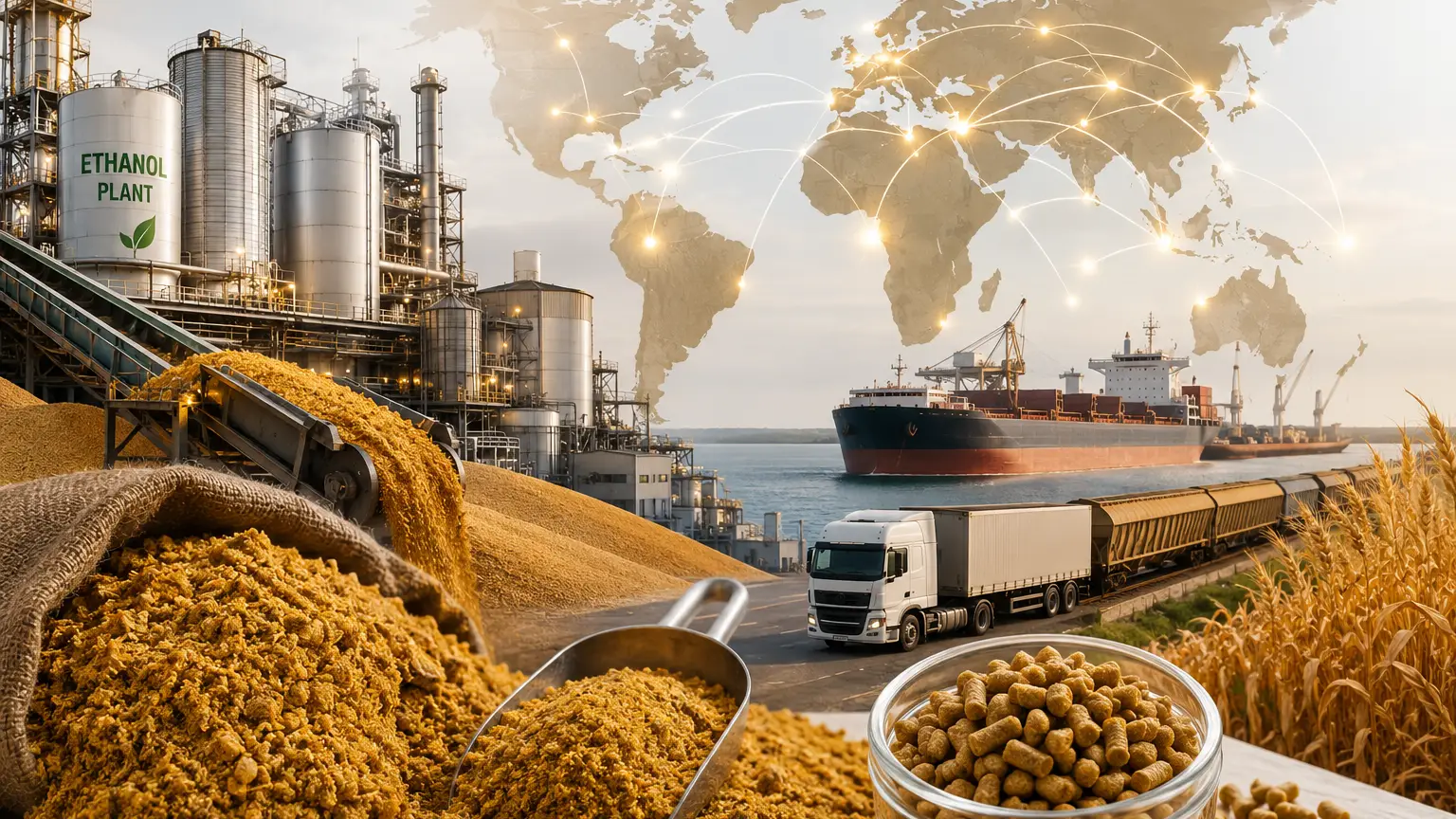
Distillers dried grains with solubles are produced during the dry-grind ethanol production process, where corn starch is fermented into ethanol and the remaining nutrients are concentrated. According to the Renewable Fuels Association (RFA), DDGS is one of the most significant co-products of corn-based ethanol industries.
The process involves drying and blending residual grains with solubles to create a stable, transportable feed ingredient. This integration between fuel and feed industries creates a dual-value commodity stream that supports agricultural economies.
Global Trade Flow and Export Channels
DDGS supply chains are highly export-oriented, particularly from the United States, which dominates global production. Industry data from the U.S. Grains Council indicates that Asia and the Middle East are key import regions due to strong livestock and poultry demand.
Logistics efficiency plays a critical role in DDGS distribution, as bulk shipping and containerized trade dominate international movement. Storage stability and moisture control are essential to maintaining product quality during long-distance transport.
The supply chain is heavily influenced by ethanol plant capacity utilization and corn harvest cycles.
Industrial Applications of Distillers Dried Grains with Solubles
DDGS is primarily used in ruminant diets such as cattle and dairy feed formulations, where fiber content supports digestive efficiency. Research published in animal nutrition journals indicates that DDGS can replace a significant portion of traditional feed grains without reducing performance outcomes.
In poultry and swine production, DDGS is incorporated at controlled inclusion rates due to its fiber and amino acid composition. Feed formulators adjust ratios to optimize energy and protein balance in commercial feed systems.
Aquaculture and Emerging Applications
Beyond traditional livestock feed, DDGS is increasingly evaluated for aquaculture applications, particularly in fish feed blends. According to Aquaculture Nutrition research publications, its protein content supports partial replacement of fishmeal in formulated diets.
The ingredient is also being explored in bio-based industrial applications, including fermentation substrates and organic fertilizer blends. These emerging uses contribute to broader market diversification.
Such application expansion enhances DDGS value within integrated agricultural and bioeconomy systems.
Market Demand Trends and Pricing Dynamics
The global demand for DDGS is closely linked to livestock production growth and ethanol output expansion. Market analysis from OECD-FAO agricultural outlook reports shows steady growth in feed grain alternatives due to rising protein consumption worldwide.
Emerging economies in Asia-Pacific are key demand drivers, supported by expanding poultry and pork production sectors. This demand is also influenced by feed cost volatility in conventional grain markets.
Pricing Structure and Commodity Sensitivity
DDGS pricing is highly correlated with corn and ethanol market dynamics, making it a sensitive commodity within agricultural trading systems. Industry reports from CME Group indicate that feed co-products often follow energy and grain price fluctuations.
Transport costs and export demand also influence regional price differentials. Buyers often evaluate DDGS pricing relative to soybean meal and corn futures to determine feed formulation economics.
This pricing volatility creates both risk and opportunity for global traders and procurement teams.
Buyer Intent and Procurement Considerations
Primary buyers include animal feed manufacturers, livestock integrators, commodity traders, and agricultural distributors. These stakeholders source DDGS in bulk quantities for feed formulation and resale distribution networks.
Large-scale poultry and cattle operations also procure DDGS directly to reduce feed cost structures. Procurement decisions are often centralized within feed mill operations or integrated agribusiness groups.
Procurement Evaluation Factors
Buyers typically evaluate protein content, moisture level, fiber composition, and contamination risk before purchase. According to feed industry procurement standards published by IFIF (International Feed Industry Federation), consistency and traceability are key sourcing requirements.
Supply reliability and shipment consistency are equally important due to the dependency on ethanol production cycles. Buyers also assess supplier certifications and logistics capabilities.
These factors directly influence long-term supplier contracts and trade relationships.
Sourcing Strategy for B2B Buyers and Distributors
B2B buyers prioritize suppliers with stable production capacity and strong export logistics networks. According to agricultural trade analysis from USDA Foreign Agricultural Service, the United States remains the most consistent DDGS exporter globally.
Buyers also consider supplier diversification strategies to mitigate supply disruptions caused by seasonal production changes or trade restrictions.
Trade Platforms and Contracting Models
DDGS sourcing often occurs through long-term contracts, spot trading, or marketplace procurement platforms. Distributors and feed companies rely on bulk procurement agreements to stabilize pricing and supply flow.
Quality assurance agreements and inspection protocols are standard in international DDGS trade. This ensures consistency across shipments and aligns with feed safety regulations in importing countries.
Digital B2B marketplaces increasingly facilitate cross-border DDGS transactions.
Sustainability and Future Outlook of DDGS Industry
DDGS contributes to circular economy principles by utilizing ethanol production residues for animal feed. According to environmental assessments published by the U.S. Environmental Protection Agency (EPA), ethanol co-products reduce overall waste and improve resource efficiency.
This dual-output system enhances sustainability within both fuel and feed sectors, reducing pressure on land and water resources used for dedicated feed crop production.
Future Market Growth and Innovation Trends
The DDGS market is expected to grow alongside global ethanol production and livestock expansion. Industry forecasts from OECD and FAO indicate continued demand for alternative protein sources in feed systems.
Technological improvements in ethanol processing may further enhance nutrient consistency and broaden DDGS applications. Innovation in feed formulation is also expanding its use in aquaculture and specialty feed products.
The long-term outlook positions DDGS as a stable and strategic feed commodity.
Conclusion and Strategic Insights
Distillers dried grains with solubles represent a critical intersection between biofuel production and global feed supply chains. Its role as a cost-effective protein ingredient continues to expand across livestock and aquaculture sectors.
For B2B buyers, DDGS sourcing requires careful evaluation of supply stability, nutritional consistency, and pricing volatility. Strategic procurement decisions are increasingly influenced by global grain markets and ethanol production trends.
As demand for efficient feed solutions grows, DDGS will remain a key commodity in international agricultural trade networks.
Sources
https://www.ers.usda.gov
https://www.fao.org

Leave a Comment