Corn Steep Liquor and Its Industrial Role
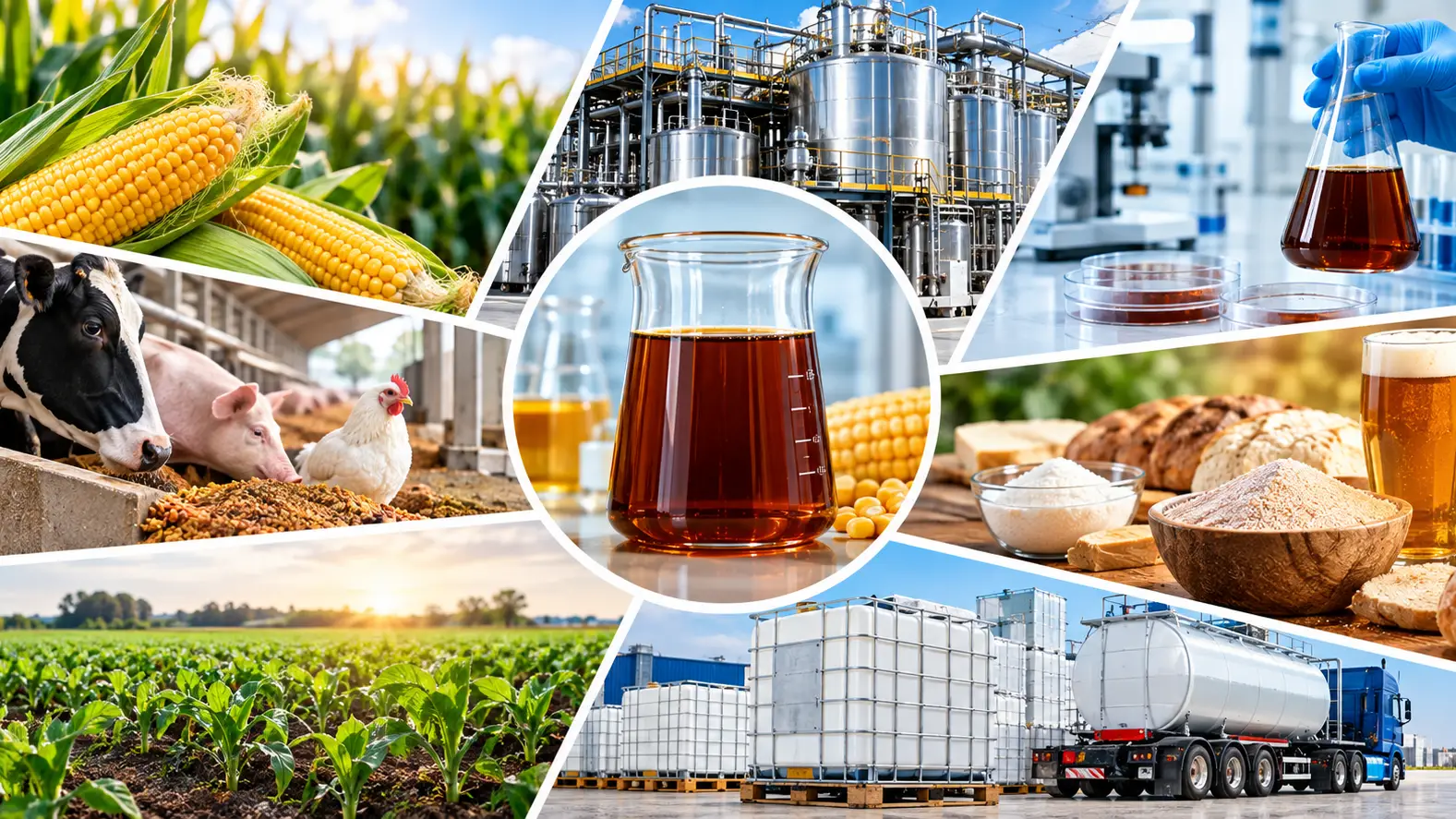
Corn Steep Liquor is a concentrated liquid by-product generated during the wet milling of corn. During steeping, soluble materials are extracted from corn kernels, and the resulting steepwater is concentrated to produce steep liquor. The material contains a mixture of soluble nutrients, including proteins, amino acids, carbohydrates, minerals, vitamins, and organic compounds. This composition is what gives Corn Steep Liquor value beyond its origin as a processing stream. The U.S. Environmental Protection Agency describes concentrated steepwater as a stream that can be incorporated into animal-feed products or sold for use as a fermentation nutrient.
Composition and Functional Value
From a commercial perspective, the important characteristic of Corn Steep Liquor is its nutrient density rather than a single active chemical component. Research published through PubMed describes CSL as containing crude proteins, amino acids, minerals, vitamins, reducing sugars, organic acids, enzymes, and other nutrients. This combination can provide carbon, nitrogen, vitamins, and micronutrients needed by microorganisms, making Corn Steep Liquor relevant to industrial fermentation and microbial cultivation.
By-Product to Industrial Resource
The transformation of Corn Steep Liquor from a wet-milling by-product into a commercial input also fits broader industrial resource-efficiency strategies. Instead of treating nutrient-rich organic streams solely as waste, manufacturers can recover value through feed, fermentation, and bioprocessing applications. A 2025 review indexed by PubMed identifies applications involving industrial organic acids, polysaccharides, lipids, enzymes, natural pigments, and other functional components, demonstrating the expanding research interest in CSL valorization.
Why the Product Matters to B2B Buyers
For procurement teams, this multifunctionality creates a different buying proposition from conventional commodity chemicals. Buyers are often interested in whether the material can deliver a reliable nutrient contribution to a defined process, rather than simply purchasing Corn Steep Liquor based on its name. Origin, concentration, consistency, handling properties, specifications, documentation, and intended application can therefore influence purchasing decisions. This makes the product particularly relevant to specialized B2B sourcing platforms serving technical and industrial buyers.
Key Industrial Applications of Corn Steep Liquor
The principal commercial applications of Corn Steep Liquor are concentrated around animal nutrition and industrial biotechnology. Its soluble nutrients make it useful as an ingredient in feed products and as a nutrient source for microbial fermentation. Reviews of maize wet-milling by-products identify steep solubles as ingredients in livestock, aquaculture, and poultry feed, while also documenting their use in fermentation processes.
Fermentation and Microbial Culture
Corn Steep Liquor has a long-established role as an economical nutrient source for industrial fermentation. It can supply nitrogen, amino acids, vitamins, minerals, and other nutrients that support microbial growth. Research published in Biotechnology Progress in 2023 examined CSL as an alternative nutrient source for industrial fermentation and found that differences between CSL batches can influence microbial performance, reinforcing the importance of characterization and process-specific qualification when sourcing the material.
Animal Feed Applications
Animal nutrition represents another important application pathway. Condensed steep liquor can be incorporated into feed streams because it contains soluble components originating from the corn kernel. The National Academies' Nutrient Requirements of Dairy Cattle explains that condensed steep corn liquor can be sold as a feed ingredient or used as a nutrient source for subsequent fermentation, while also describing how steep liquor can be combined with other wet-milling fractions to produce corn gluten feed.
Emerging Bioprocessing Uses
Research is increasingly investigating Corn Steep Liquor as a feedstock for higher-value biological production. Recent literature examines its use in biotransformation processes involving organic acids, enzymes, lipids, pigments, polysaccharides, and other products. These applications are commercially significant because they potentially allow manufacturers to substitute or supplement more expensive complex nutrient sources with an agricultural processing side stream, although each process requires technical validation rather than assuming universal interchangeability.
Market Demand and Application Trends
Demand for Corn Steep Liquor is closely connected to the economics and scale of corn wet milling. Because CSL is generated from corn processing, changes in corn availability, wet-milling capacity, feed demand, and industrial biotechnology influence its potential supply and end-use markets. The latest FAO cereal outlook shows that global maize production remains at historically high levels even after a downward revision for 2026, while coarse-grain utilization is expected to continue growing in 2026/27, supported in part by sustained feed demand.
Expanding Corn Processing Ecosystems
The wet-milling sector produces several commercially important outputs, including starch, sweeteners, oils, proteins, and co-products. Corn Steep Liquor sits within this integrated processing ecosystem, meaning its availability is linked to the operating economics of corn wet mills rather than to an independent primary agricultural supply chain. The USDA notes that wet mills process corn into starch, high-fructose corn syrup, glucose and dextrose, corn oil, alcohol products, and fuel ethanol, illustrating the breadth of downstream demand connected to corn processing.
Circular-Bioeconomy Development
A significant recent trend is the move toward valorizing agricultural processing side streams. Scientific reviews increasingly position CSL as a potentially useful resource for circular production because its organic and nutrient content can be redirected into microbial cultivation and biotransformation. The 2025 review literature specifically discusses CSL as a resource for producing value-added biological and chemical products, indicating that future demand may increasingly extend beyond conventional feed and fermentation applications.
Regional Demand Signals
Regional demand should nevertheless be interpreted carefully because Corn Steep Liquor is an intermediate whose economics depend on local corn-processing infrastructure and downstream industries. FAO's September 2026 outlook reports global maize output of approximately 1.309 billion tonnes and notes continued strong coarse-grain utilization and robust maize trade prospects. For B2B suppliers, this broader environment supports attention to markets with established feed manufacturing, starch processing, fermentation, biotechnology, and agricultural-processing capabilities rather than assuming uniform demand across all regions.
Key Buyers and Procurement Requirements
Corn Steep Liquor buyers generally fall into several industrial categories, with their purchasing criteria determined by the intended application. Feed manufacturers may evaluate nutritional specifications and compatibility with feed formulations, while biotechnology and fermentation companies are more likely to focus on nutrient composition, microbial performance, consistency, and process compatibility. Distributors and chemical traders may additionally prioritize packaging, shelf life, logistics, documentation, and supply continuity.
Fermentation and Biotechnology Buyers
Industrial biotechnology companies represent an important buyer group because CSL can function as a complex nutrient source in microbial cultivation. However, scientific research emphasizes a major procurement consideration: CSL is a side-stream material and can show batch-to-batch compositional variation. Consequently, fermentation buyers may need specifications covering solids content, nitrogen-related parameters, pH, ash or mineral content, microbiological characteristics, and other application-specific properties before approving a supplier.
Feed Manufacturers and Nutrition Buyers
Feed manufacturers approach Corn Steep Liquor from a nutritional and formulation perspective. Its soluble protein-related components and other nutrients can complement other feed materials, and steep liquor is also associated with the production of corn gluten feed. For these buyers, procurement decisions can depend on nutritional consistency, applicable feed regulations, handling characteristics, inclusion requirements, and compatibility with existing manufacturing systems. The National Academies identifies condensed steep corn liquor as a feed ingredient and fermentation nutrient within the broader corn wet-milling value chain.
What Procurement Teams Compare
Supplier comparison is important because two CSL products may originate from different corn-processing operations and therefore exhibit different specifications. Buyers may compare concentration, consistency, technical documentation, production origin, testing procedures, packaging or bulk-delivery options, lead time, minimum order quantities, and commercial terms. The 2023 Biotechnology Progress study specifically highlights differences between CSL batches and links them to origin and production processes, supporting the practical importance of supplier qualification.
B2B Sourcing Considerations for Corn Steep Liquor
Sourcing Corn Steep Liquor requires buyers to connect product specifications with the intended application. A fermentation manufacturer, for example, may require a very different specification and quality-control framework from an animal-feed producer. A successful B2B sourcing process therefore begins with defining the application, required concentration or solids range, quality parameters, regulatory requirements, delivery format, and expected purchasing volume before comparing suppliers.
Specification and Quality Assessment
Technical documentation is central to supplier evaluation. Buyers should request a current product specification and, where appropriate, certificates of analysis that establish the key parameters relevant to their process. Particular attention should be paid to solids concentration, nutrient composition, pH, physical characteristics, microbiological quality, contaminants, and consistency between batches. Because Corn Steep Liquor is derived from biological processing rather than manufactured as a narrowly defined pure compound, application-specific qualification is especially important.
Logistics and Supply Continuity
Corn Steep Liquor can also present logistical considerations that differ from dry chemical commodities. Its liquid form, concentration, viscosity, storage requirements, packaging configuration, and transport conditions should be considered during procurement planning. For buyers importing into markets such as the UAE, logistics planning should also account for supplier location, transit time, customs documentation, storage infrastructure, and the practical economics of moving a concentrated liquid over international distances.
Supplier Qualification and Risk Management
A reliable sourcing strategy should evaluate more than the quoted price. Buyers can assess production capability, quality systems, traceability, technical support, documentation, consistency of supply, responsiveness, and the supplier's ability to meet agreed specifications over repeated orders. This is particularly relevant when CSL becomes an input into a fermentation process, where changes in nutrient composition can potentially affect downstream microbial performance.
Commercial Opportunities Across the Supply Chain
Corn Steep Liquor creates commercial opportunities across an interconnected network of wet mills, manufacturers, traders, distributors, feed producers, fermentation companies, and biotechnology businesses. Its value proposition comes from the ability to convert a corn-processing side stream into a commercially useful nutrient resource. As industrial users place greater emphasis on resource efficiency and alternative feedstocks, suppliers that can provide consistent, well-documented material may address a wider range of procurement requirements.
Opportunities for Manufacturers and Processors
For corn wet mills and processors, CSL represents an opportunity to monetize an additional output from the wet-milling process. Rather than viewing steep liquor exclusively as a processing residue, manufacturers can position it for established feed and fermentation markets while investigating additional applications. Scientific literature increasingly examines CSL valorization as a route toward higher-value products, supporting continued technical development around the material.
Opportunities for Traders and Distributors
Traders and distributors can add value by connecting regional buyers with qualified producers and helping bridge differences in availability, logistics, and purchasing volumes. This can be particularly relevant where end users require imported raw materials or where a local market does not have sufficient production capacity. Effective distribution, however, depends on accurately matching product specifications with application requirements rather than treating all Corn Steep Liquor grades as interchangeable.
Marketplace-Based Procurement
A B2B chemical marketplace such as Tradeasia, Chemtradeasia, or Tradechem Marketplace can support this process by creating a structured entry point between buyers and suppliers. A product page can help buyers understand the material's industrial applications, identify relevant use cases, communicate purchasing requirements, and begin supplier inquiries. For procurement teams, the value of such a marketplace is strongest when product information is paired with transparent specifications, supplier responsiveness, commercial terms, and application-oriented sourcing support.
Conclusion: Positioning Corn Steep Liquor for Industrial Buyers
Corn Steep Liquor occupies an unusual position in industrial commerce because it is both a by-product of corn wet milling and a useful industrial input. Its nutrient-rich composition supports established applications in animal feed and microbial fermentation, while current research is expanding the discussion toward biotransformation, bio-based chemicals, enzymes, organic acids, and other value-added products.
From Commodity Stream to Functional Input
The commercial importance of CSL therefore depends on how effectively its characteristics can be matched with end-user requirements. Feed producers may value its nutritional contribution, while fermentation and biotechnology manufacturers may value its combination of nitrogen, amino acids, vitamins, minerals, and other nutrients. The practical question for buyers is not simply whether Corn Steep Liquor is available, but whether a particular grade consistently meets the needs of a defined production process.
A Procurement-Led Market Opportunity
For manufacturers, traders, distributors, and procurement teams, supplier qualification remains central to capturing this opportunity. Quality consistency, technical specifications, logistics, regulatory suitability, and continuity of supply should be considered alongside price. Broader maize-market conditions also matter: FAO's latest 2026 assessment points to historically high cereal production while continuing to identify strong feed demand and substantial maize trade flows, factors that influence the wider ecosystem from which CSL originates.
B2B Sourcing Through Tradeasia
For buyers evaluating Corn Steep Liquor, Tradeasia / Chemtradeasia / Tradechem Marketplace can serve as a commercial discovery and sourcing channel connecting industrial demand with relevant suppliers. The strongest purchasing approach is application-led: define the required technical parameters, identify qualified sources, compare supply conditions, and validate material performance before moving toward recurring procurement. This positions Corn Steep Liquor not merely as a corn-processing by-product, but as a potentially valuable B2B resource across feed, fermentation, biotechnology, and emerging circular-bioeconomy applications.
Leave a Comment